

Locknuts, serrated washers, and shrouds belong in a cable-gland assembly when each has a defined job and position. I would choose them from the entry drawing rather than add all three automatically. A locknut retains the gland through a clearance hole. A serrated washer may provide mechanical bite or electrical contact in a specified arrangement. A shroud covers exposed parts outside the enclosure. Added parts can consume usable thread, disturb the seal, conceal corrosion, or create an untested assembly.
This guide concentrates on those three accessories and the decisions that put them in the right order. The broader cable-gland accessories overview covers entry seals, earth tags, adaptors and reducers as well.
Key takeaways
- A clearance-hole entry usually needs a retaining nut; a tapped entry may not.
- Thread match, bearing face, usable engagement and tool clearance decide locknut fit.
- Serrations can bite a surface, but bonding performance still depends on the complete electrical path.
- A shroud is an external cover, not a substitute for the gland’s sealing or certification.
- The finished stack must preserve the intended seal, bond, thread engagement, cable route and inspection access.
Give gland accessories one job each
A locknut is a threaded retaining part on the far side of a clearance-hole entry. It clamps the gland shoulder and enclosure wall together.
A serrated washer is a toothed ring. Depending on the design and instructions, its teeth may resist rotation, penetrate a coating, or provide electrical contact.
A shroud is a shaped cover over the exposed gland body and cable transition. Its purpose may be environmental protection, touch protection, or keeping the outside clean.
I keep these three interfaces separate. The locknut forms part of the threaded clamp assembly. Washer teeth act only on the specified surface. The shroud covers the exterior rather than clamping the entry. Confusing their jobs can put teeth beneath a seal, assign ingress-protection (IP) performance to a cover, or treat a thin nut as proof of vibration resistance.
| Accessory | Primary decision | Information needed before selection | Common mismatch |
|---|---|---|---|
| Locknut | Can it retain this gland through this wall? | Exact thread, bearing face, wall/accessory stack, usable engagement, material and tool size | Nominal thread matches but engagement or seating does not |
| Serrated washer | Which surface should its teeth engage, and for what function? | Tooth form, orientation, mating finishes, bonding design, material and replacement rule | Teeth sit against a seal or unapproved coating |
| Shroud | What exposed area needs covering without trapping moisture or blocking service? | Gland profile, cable diameter, environment, drainage, material and removal access | Cover is too tight, too loose or hides the inspection point |
I start with the gland and enclosure-entry drawing. IEC 62444:2010 addresses requirements and tests for complete glands supplied by the responsible manufacturer or supplier. Do not choose an accessory that changes the assembly from its permitted arrangement. Matching thread size alone is not enough.
Fit the locknut to the entry and stack
A locknut is usually required when a gland passes through an unthreaded clearance hole and needs retention from the opposite side. A gland screwed into a tapped metal wall uses a different load path and may not use a locknut. A threaded adaptor, removable gland plate or thin plastic wall changes the bearing conditions again.
The thread designation must match fully: nominal size, pitch or threads per unit, thread form and fit all matter. Similar diameters do not establish compatibility. IEC 60423:2007 specifies dimensional requirements for conduits and associated fitting threads within its scope. For gland products outside that scope, the exact product drawings and applicable thread standard remain necessary.
A serrated contact washer is a separately specified accessory; the smooth B ring in this six-part example cannot stand in for it.
Usable thread engagement is what remains after the panel and permitted accessories take up part of the male entry thread. I would exclude the lead-in, chamfer, and incomplete crests from full-form engagement. The nut also needs to start squarely and reach its bearing face—the surface that carries clamp load—without stopping on an unthreaded shoulder.
I use this calculation to screen the geometry. The instructions still define required engagement, permissible protrusion, and the assembly endpoint. A universal “five threads” rule cannot cover different thread forms, materials, nut heights, panel stiffnesses, and loads.
I would check the nut’s bearing face as carefully as its thread. A narrow nut can concentrate load on a soft or thin wall. A flange can spread the load only on a flat, permitted surface with the seal undisturbed. Then check tool access on the finished panel. Terminal rails, earth studs, and cable bundles may block the socket or wrench after wiring.
Locknut torque is also configuration-specific. The value for a brass nut against a steel panel does not automatically transfer to nylon, stainless steel, a coated wall or a stack containing a serrated washer. The cable-gland torque guide explains why each joint needs its own value or assembly endpoint.
Decide whether a serrated washer belongs in the joint
A serrated washer belongs only where its teeth are intended to engage the named surfaces. Some designs use external or internal teeth to resist rotation. Some conductive arrangements use tooth contact to break through a specified finish and help form an electrical path. Other assemblies prohibit that contact because the teeth would damage a sealing land, protective coating or soft enclosure wall.
“Serrated washer” is too broad for ordering. I would specify inside-tooth, outside-tooth, conical, or double-sided geometry first. Then record material and finish, bore and outer diameter, thickness, tooth direction, and placement. A washer that clears the thread may still strike the shoulder, overlap the hole, or leave too little bearing area for the nut.
Electrical bonding needs a defined current path. If the washer participates, show the route from the gland body through the intended contacts to the enclosure or bonding conductor. I would check paint, powder coat, oxide, passivation, and plating as surface conditions. Moisture and mixed metals also affect the joint. IEEE P3003.2 covers grounding and bonding at the power-system level; the gland interface remains one local part of that route.
A washer does not replace a required earth tag or bonding jumper, the conductor linking the bonding points. It also does not prove high-frequency screen performance. Direct-current continuity checks the conductive path under its stated condition. Electromagnetic compatibility (EMC) transfer impedance describes frequency-dependent coupling through the screened path. I would assess these separately using the cable-gland earthing and bonding guide.
IEC 61557-4:2019 covers equipment for measuring the resistance of earth conductors, protective-earth conductors and equipotential-bonding conductors, including connections and terminals. It does not supply one pass value for every serrated-washer joint. The applicable electrical design or verification procedure defines the test points and acceptance criterion.
Mechanical bite should not be generalized into a vibration rating either. IEC 60068-2-6:2007 gives a sinusoidal vibration test method for specimens at stated severities. Suitable vibration performance needs data for the relevant gland, accessory, cable, panel and mounting. A tooth pattern alone cannot establish that result.
Place the three accessories in their physical zones
I use the drawing to check accessory order. Include every part that consumes entry-thread length in the thickness calculation. A part touching the sealing land, the surface under the seal, must be permitted by that design. A part making electrical contact must connect to the intended path. Fit the exterior shroud after the underlying interfaces are complete and available for inspection.
For a clearance-hole metal enclosure, one plausible order may be gland shoulder, specified entry seal, enclosure wall, serrated washer or earth tag when required, and locknut. Another certified or product-specific arrangement may differ. A tapped wall may omit the locknut entirely. The actual drawing remains decisive because moving a serrated washer to the opposite side can change both the seal and the contact path.
Specify a shroud without assigning it the gland’s duties
A shroud can cover the exposed gland body, compression area and cable transition, but it does not create the gland’s cable seal or enclosure-entry seal. It may reduce direct contact with dirt, splash, sunlight or incidental touch when its material and geometry suit the exposure. Its own product data should state the intended environment, temperature range, material compatibility and permitted gland profiles.
IEC 60529 classifies degrees of protection provided by enclosures. The IP code belongs to the declared enclosure arrangement and test conditions. Adding an untested shroud does not raise that code, and omitting a cosmetic cover does not necessarily reduce it. The gland, entry seal and enclosure wall still form the relevant ingress interfaces.
I would check how the shroud behaves after fitting. A loose cover may move, chafe, or leave surfaces exposed. A tight one may load the cable or obstruct inspection. An upward-facing pocket can retain water or debris. Hiding the nut can also delay discovery of corrosion, movement, or seal damage.
Material selection belongs to the actual exposure. Elastomer and polymer shrouds vary in resistance to ultraviolet light, oils, solvents, cleaning agents, temperature and flame. Color and softness do not establish those properties. Compatibility should cover the gland material, cable jacket, cleaning process and any fluid likely to collect at the entry.
I would plan shroud removal before ordering. Inspection may require it to slide along the cable or be replaced. Its length and bore must allow that movement without cutting the jacket or disturbing the gland. If it remains in place, keep the required wrench surfaces and inspection points accessible.
Check how the accessories work together
Each accessory has a particular job and contact interface. A locknut secures the body, a washer can affect seating or electrical contact, and a shroud changes the exposed environment. Use the intended combination rather than assume one accessory can compensate for another.
- gland part number, material, cable range and entry thread;
- enclosure material, finish, wall thickness, hole or tapped-thread detail;
- locknut thread, height, bearing face, material and tool size;
- serrated-washer type, material, tooth orientation, contact surfaces and electrical role;
- shroud model, gland range, cable bore, material, exposure and drainage orientation;
- stack order, usable thread, required engagement and assembly endpoint; and
- inspection and test points for the mechanical, sealing and electrical functions.
If moisture can reach the joint, I would check the material pairings. A conductive serrated interface may also form a corrosion cell when unsuitable metals, damaged coatings, and an electrolyte—a conductive liquid or damp deposit—are present. The gland-to-enclosure corrosion guide explains how exposed area, moisture, and finish affect that risk.
At receipt, I would compare all three accessories with their drawings. A nut that spins onto the thread still needs the correct face and height. Check the washer’s tooth form and finish. Fit the shroud to the named gland profile and cable without stretching it over sharp edges.
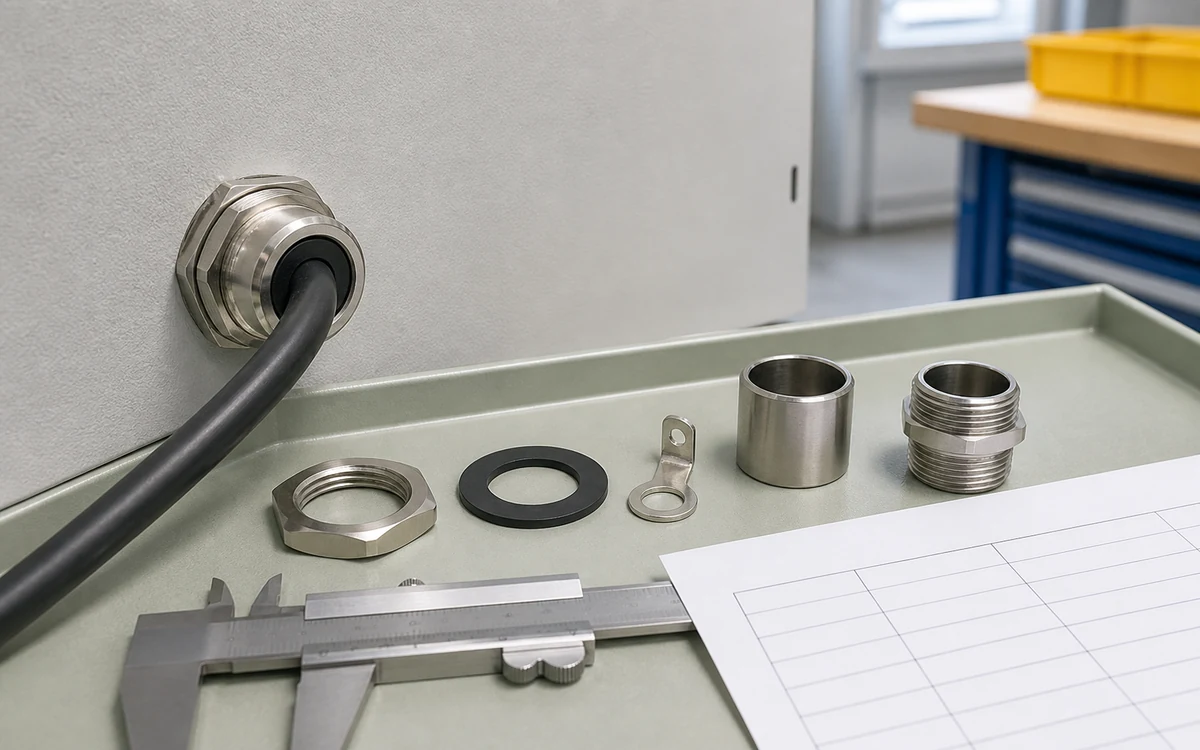
The loose parts in the bench photo illustrate a receiving check. Their proximity cannot establish that they form a compatible combination.
After assembly, I would check each accessory against its assigned job. Confirm locknut seating, engagement, and retained gland position. Assess the serrated washer using its specified mechanical or electrical method. Check shroud coverage, drainage, cable clearance, and access. High bond resistance, a loose body, and a trapped-water pocket point to different faults.
Conclusion
Locknuts, serrated washers and shrouds solve different problems at different places. The locknut retains a gland through a clearance hole. The serrated washer acts at a specified contact face. The shroud covers the completed exterior. A part that fits physically is not necessarily suitable for the seal, bond, material pair or declared construction.
I make the final choice from the complete assembly. Confirm thread engagement and bearing surfaces, then tooth orientation and coating treatment. Check drainage and maintenance access too. Giving each accessory a stated job keeps the gland and enclosure arrangement understandable and serviceable.
FAQs about locknuts, serrated washers, and shrouds
Does every cable gland need a locknut?
No. A gland through a clearance hole commonly needs a locknut on the opposite side. A gland or adaptor engaged in a suitable tapped wall may use the wall thread instead. The product and enclosure drawings determine the retention method and sealing arrangement.
Does a serrated washer automatically provide protective bonding?
No. Serrations may create mechanical bite or electrical contact at specified surfaces, but protective bonding depends on the complete designed path, materials, finishes, accessory order and verification method. A washer does not replace a required earth tag, jumper or protective conductor.
Can a serrated washer sit beneath an entry sealing washer?
Only when the product arrangement explicitly permits that order. Teeth can damage or tilt a sealing element and can interrupt a flat sealing land. The drawing should identify which side of the panel receives each washer and which surfaces must remain smooth.
Does a shroud increase the IP rating of a cable gland?
Not by itself. The IP code applies to the declared and tested enclosure arrangement. A shroud may cover exposed surfaces for a stated purpose, but it does not replace the cable seal or enclosure-entry seal and should not be used to infer a higher rating.
Can locknuts, serrated washers, and shrouds be mixed between brands?
Only after compatibility is established for the exact threads, dimensions, materials, stack order, sealing faces and declared construction. Visual similarity is insufficient. Approved or certified assemblies may require the accessories named in their documentation.
Sources and technical references
- IEC 62444:2010, Cable glands for electrical installations, accessed 2026-09-12.
- IEC 60423:2007, Outside diameters and threads for conduits and fittings, accessed 2026-09-12.
- IEEE P3003.2, Recommended Practice for Equipment Grounding and Bonding in Industrial and Commercial Power Systems, accessed 2026-09-12.
- IEC 61557-4:2019, Equipment for measuring resistance of earth and equipotential-bonding conductors, accessed 2026-09-12.
- IEC 60068-2-6:2007, Environmental testing - Test Fc: Vibration, accessed 2026-09-12.
- IEC 60529 consolidated version, Degrees of protection provided by enclosures, accessed 2026-09-12.