

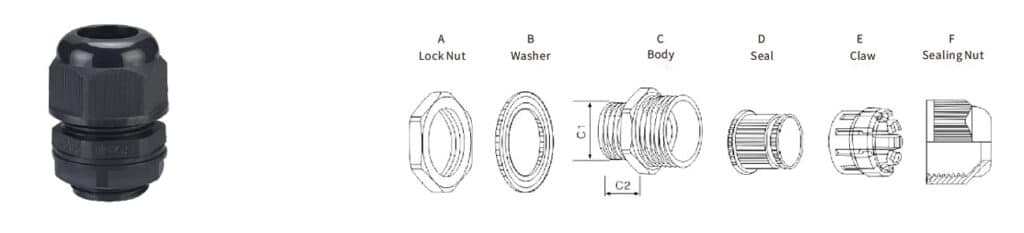
Last week, Marcus, a senior electrical engineer from a major automotive plant in Detroit, called me in frustration. “Samuel, our cable gland installations keep failing vibration tests, and I can’t figure out why. We’re using quality glands, but something’s not right.” After a quick discussion, I realized the issue wasn’t with the glands themselves—it was the missing accessories.
Cable gland accessories including locknuts, serrated washers, and shrouds are essential components that ensure proper installation, vibration resistance, and long-term reliability of cable gland systems in industrial applications. These seemingly small components play critical roles in maintaining electrical continuity, preventing loosening, and protecting against environmental hazards.
As someone who’s been in the cable gland business for over a decade, I’ve seen countless installations fail simply because engineers overlooked these crucial accessories. The difference between a successful installation and a costly failure often comes down to understanding when and how to use the right accessories 😉
Table of Contents
- What Are Cable Gland Accessories and Why Do They Matter?
- How Do Locknuts Prevent Installation Failures?
- When Should You Use Serrated Washers?
- What Protection Do Shrouds Provide?
- How Do You Select the Right Accessories for Your Application?
- FAQs About Cable Gland Accessories
What Are Cable Gland Accessories and Why Do They Matter?
Every experienced engineer knows that the devil is in the details, and cable gland accessories are those critical details that separate amateur installations from professional ones.
Cable gland accessories are supplementary components including locknuts, serrated washers, shrouds, and sealing rings that enhance the performance, reliability, and safety of cable gland installations by providing additional mechanical stability, electrical continuity, and environmental protection.
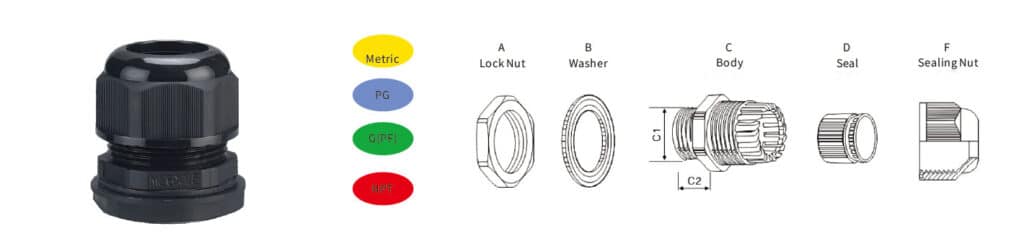
The Hidden Cost of Skipping Accessories
Many engineers focus solely on the cable gland itself, treating accessories as optional add-ons. This mindset leads to several problems:
- Mechanical Failure: Without proper locking mechanisms, vibration can loosen connections
- Electrical Issues: Poor continuity can cause voltage drops and heating
- Environmental Damage: Lack of protection exposes connections to harsh conditions
- Compliance Problems: Many standards require specific accessory configurations
Essential Accessory Categories
| Accessory Type | Primary Function | Typical Applications |
|---|---|---|
| Locknuts | Mechanical securing | High-vibration environments |
| Serrated Washers | Electrical continuity | EMC/grounding applications |
| Shrouds | Environmental protection | Outdoor/harsh conditions |
| Sealing Rings | Additional sealing | High IP rating requirements |
Take Hassan, who manages a petrochemical facility in Dubai. When his team initially installed cable glands without proper accessories, they experienced multiple failures during the first sandstorm season. “The cost of retrofitting with proper accessories was nothing compared to the downtime we avoided,” he told me later.
How Do Locknuts Prevent Installation Failures?
Understanding locknuts is crucial for any engineer dealing with industrial installations where vibration is a concern.
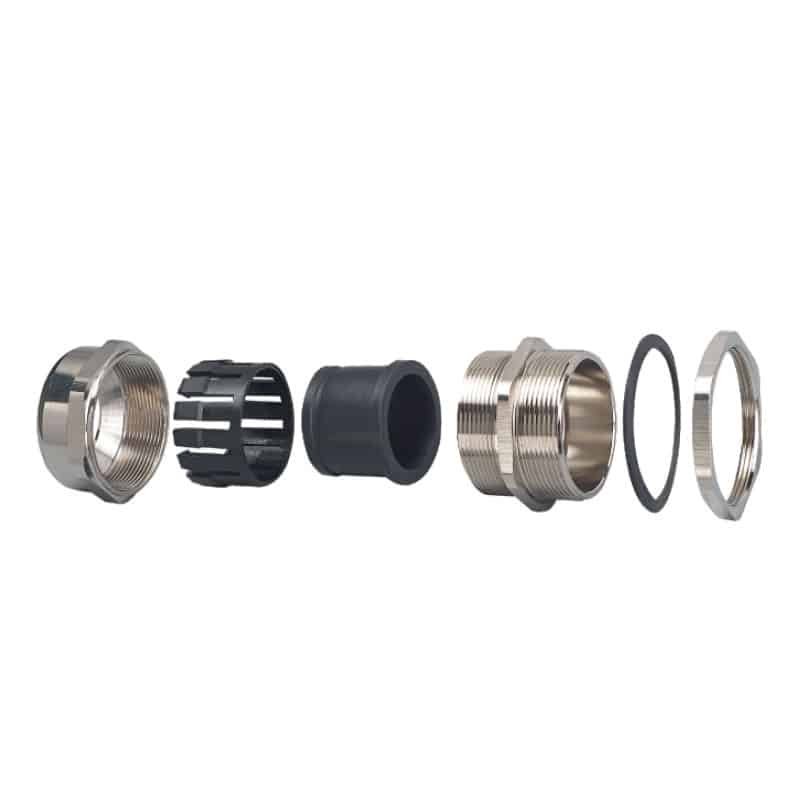
Locknuts are threaded accessories that secure cable glands to enclosures by creating a mechanical lock that prevents loosening due to vibration, thermal cycling, or other dynamic forces commonly found in industrial environments.
Types of Locknuts and Their Applications
Standard Locknuts: Made from brass, stainless steel, or nylon, these provide basic locking functionality for general applications.
Serrated Locknuts: Feature built-in serrations that bite into the enclosure surface, providing both mechanical locking and electrical continuity.
Flanged Locknuts: Include an integrated flange that distributes load over a larger area, ideal for thin-wall enclosures.
Installation Best Practices
Proper locknut installation requires attention to several key factors:
Thread Engagement: Ensure minimum 5 full threads of engagement between the gland and locknut for optimal holding strength.
Torque Specifications: Follow manufacturer recommendations—typically 15-25 Nm for M20 brass locknuts, but this varies by material and size.
Surface Preparation: Clean all surfaces to ensure proper contact and prevent galvanic corrosion between dissimilar metals.
Real-World Performance Data
Our testing at Bepto shows that properly installed locknuts can withstand:
- Vibration frequencies up to 2000 Hz1
- Temperature cycling from -40°C to +120°C
- Pull-out forces exceeding 500N for standard M20 installations
Remember Marcus from Detroit? After implementing proper locknut procedures, his vibration test failures dropped to zero. “It’s amazing how such a simple component can make such a big difference,” he said.
When Should You Use Serrated Washers?
Serrated washers are often misunderstood components that play a vital role in electrical installations.
Serrated washers should be used whenever electrical continuity between the cable gland and enclosure is critical, particularly in EMC applications2, grounding systems, and installations requiring reliable electrical bonding under dynamic conditions.

Understanding Serrated Washer Design
The serrated design serves multiple purposes:
Electrical Contact: Sharp teeth penetrate surface coatings and oxidation to establish reliable electrical contact.
Mechanical Grip: Teeth bite into both the gland and enclosure surfaces, preventing rotation and loosening.
Gas-Tight Sealing: Multiple contact points create effective barriers against moisture and contaminants.
Material Selection Considerations
| Material | Advantages | Typical Applications |
|---|---|---|
| Stainless Steel | Corrosion resistance, high strength | Marine, chemical environments |
| Brass | Good conductivity, moderate cost | General industrial use |
| Spring Steel | High elasticity, maintains tension | High-vibration applications |
EMC Performance Benefits
In electromagnetic compatibility applications, serrated washers provide:
- Contact resistance below 0.01 ohms3
- Effective shielding continuity across connection points
- Resistance to loosening under electromagnetic forces
- Compliance with EMC standards like EN 50081 and EN 50082
Installation Guidelines
Proper installation requires:
- Clean surfaces to remove paint, oxidation, or debris
- Position washer with serrations facing the enclosure
- Apply specified torque to ensure teeth penetrate properly
- Verify electrical continuity with multimeter testing
What Protection Do Shrouds Provide?
Shrouds are often the most visible accessories, but their protective functions go far beyond aesthetics.
Shrouds provide comprehensive environmental protection for cable gland installations by shielding connections from UV radiation, physical damage, chemical exposure, and extreme weather conditions while maintaining accessibility for maintenance.
Types of Protective Shrouds
Standard Shrouds: Basic protection against dust, moisture, and minor impacts. Suitable for indoor applications or mild outdoor environments.
Heavy-Duty Shrouds: Reinforced designs for harsh industrial environments, featuring impact-resistant materials and enhanced sealing.
Explosion-Proof Shrouds: Specialized designs for hazardous areas, meeting ATEX or IECEx requirements4 for explosive atmospheres.
Material Performance Characteristics
Different shroud materials offer varying levels of protection:
Nylon Shrouds: UV-stabilized PA66 provides excellent chemical resistance and temperature stability from -40°C to +100°C5.
Stainless Steel Shrouds: Maximum durability for extreme environments, resistant to acids, alkalis, and high temperatures up to 200°C.
Aluminum Shrouds: Lightweight option with good corrosion resistance and electromagnetic shielding properties.
Environmental Protection Benefits
Properly selected shrouds provide:
- IP65-IP68 ingress protection ratings
- UV resistance for 10+ year outdoor service life
- Chemical compatibility with industrial solvents and cleaners
- Impact resistance meeting IK08-IK10 standards
Cost-Benefit Analysis
While shrouds add 10-15% to initial installation costs, they typically provide:
- 3-5x longer service life in harsh environments
- Reduced maintenance requirements
- Lower total cost of ownership
- Improved system reliability and uptime
How Do You Select the Right Accessories for Your Application?
Choosing the correct accessories requires systematic evaluation of your specific requirements and operating conditions.
Selecting the right cable gland accessories requires analyzing environmental conditions, electrical requirements, mechanical stresses, and regulatory compliance needs to ensure optimal performance and long-term reliability of your installation.
Environmental Assessment Matrix
| Condition | Locknut Type | Washer Type | Shroud Level |
|---|---|---|---|
| Indoor/Mild | Standard brass | Standard flat | Basic nylon |
| High vibration | Serrated steel | Serrated steel | Standard |
| Marine/Coastal | SS316 | SS316 serrated | Heavy-duty SS |
| Chemical/Corrosive | Hastelloy | PTFE coated | Chemical resistant |
| Explosive atmosphere | ATEX certified | Conductive | Ex-rated shroud |
Electrical Requirements Checklist
Consider these electrical factors:
- Grounding needs: Serrated washers for reliable earth continuity
- EMC requirements: Conductive accessories for shielding effectiveness
- Current carrying: Adequate conductor cross-section through accessories
- Voltage rating: Insulation coordination with system voltage levels
Mechanical Stress Analysis
Evaluate these mechanical factors:
- Vibration frequency and amplitude: Determines locking mechanism requirements
- Temperature cycling: Affects material selection and thermal expansion
- Pull-out forces: Influences thread engagement and locknut design
- Impact resistance: Determines shroud material and thickness
Regulatory Compliance Considerations
Ensure accessories meet relevant standards:
- UL/CSA: North American safety requirements
- CE/ATEX: European conformity and explosion protection
- IECEx: International explosive atmosphere certification
- IP ratings: Ingress protection for specific environments
Bepto’s Accessory Selection Service
At Bepto, we provide comprehensive accessory selection support:
- Application-specific recommendations based on your requirements
- Complete compatibility verification with our cable gland products
- Technical documentation and installation guidelines
- Post-installation support and troubleshooting assistance
Our engineering team has developed selection software that considers over 50 variables to recommend optimal accessory combinations for any application.
FAQs About Cable Gland Accessories
Q: Do I really need locknuts if my cable glands thread tightly into the enclosure?
A: Yes, locknuts are essential for preventing loosening due to vibration, thermal cycling, and dynamic loads. Even hand-tight installations can loosen over time without proper locking mechanisms, leading to seal failure and potential safety hazards.
Q: What’s the difference between regular washers and serrated washers for cable glands?
A: Serrated washers have sharp teeth that penetrate surface coatings to establish reliable electrical continuity and prevent rotation. Regular flat washers only distribute load and don’t provide electrical bonding or anti-rotation features needed in many applications.
Q: How do I know what size shroud I need for my cable gland installation?
A: Shroud sizing depends on your cable gland thread size and the level of protection required. Measure your gland’s outer diameter, add clearance for cables, and select based on environmental conditions. Our technical team can provide specific recommendations for your application.
Q: Can I mix different materials for cable gland accessories?
A: Material compatibility is crucial to prevent galvanic corrosion. Generally, use accessories made from the same material as your cable gland, or ensure materials are galvanically compatible. Stainless steel with brass is acceptable, but avoid aluminum with stainless steel in wet environments.
Q: Are expensive accessories really worth it for indoor applications?
A: Quality accessories provide value even in mild environments through improved reliability, easier installation, and longer service life. While basic accessories may work initially, premium options often provide better long-term performance and lower total cost of ownership.
-
“IEC 60068-2-6 Environmental testing – Vibration”,
https://webstore.iec.ch/publication/424. Outlines standard procedures for testing industrial equipment under high-frequency vibration. Evidence role: standard; Source type: standard. Supports: Vibration frequencies up to 2000 Hz. ↩ -
“Electromagnetic Compatibility”,
https://en.wikipedia.org/wiki/Electromagnetic_compatibility. Details the principles of managing electromagnetic interference in electrical systems. Evidence role: mechanism; Source type: research. Supports: EMC applications. ↩ -
“ASTM B539 Standard Test Methods for Measuring Resistance of Electrical Connections”,
https://www.astm.org/b0539-02r13.html. Provides the methodology for verifying low-level contact resistance in electrical bonds. Evidence role: standard; Source type: standard. Supports: Contact resistance below 0.01 ohms. ↩ -
“IECEx Official System”,
https://www.iecex.com/. Provides international certification parameters for equipment operating in explosive environments. Evidence role: standard; Source type: government/official. Supports: ATEX or IECEx requirements. ↩ -
“Polyamide”,
https://en.wikipedia.org/wiki/Polyamide. Describes the thermal tolerances and material properties of industrial nylon polymers. Evidence role: material property; Source type: research. Supports: temperature stability from -40°C to +100°C. ↩
