

A marine cable-entry failure becomes a project risk when water passes the entry, reaches vulnerable equipment and creates repair work or delay. I use a hypothetical exposed deck box to show how the water path changes the response. The example follows inspection, local entry repair and equipment damage as separate outcomes, then puts an illustrative cost against each.
For each outcome, I identify the finding that triggers it, the work needed to restore service and the cost of carrying out that work within the project schedule. The marine and offshore cable-gland guide covers material, IP, electromagnetic compatibility and hazardous-area selection. Here I focus on what could follow an entry failure and how to plan a response that fits the finding.
Key takeaways
- Start with a plausible water path and the equipment it could reach.
- Keep “no ingress,” “local repair,” and “equipment outage” as separate outcomes.
- Add investigation, repair, access, and delay costs only when each is incremental.
- Choose checks that distinguish an entry defect from damage to the connected equipment.
- Set a contingency trigger before the deck-box access window closes.
Start with a credible marine cable-entry failure path
The scenario uses an exposed deck junction box with one fixed cable entry, a coated steel wall and periodic washdown. The cable can pull sideways at the entry, salt can remain at the wall, and access becomes limited after commissioning. I start a project review by checking those conditions against the actual box: cable support, water exposure, seating surface and the next available access window.
Failure path is the sequence from wetting, through a breached entry boundary, to any internal damage and project delay. I trace each step separately. Exterior deposits identify exposed surfaces; the interior condition and circuit checks establish how far the event progressed.
After a reported wetting episode, I preserve the condition before adjustment and inspect the cable seal and enclosure joint. A displaced washer, damaged seating surface or side-loaded cable directs the next check. If the interior remains dry and the required function checks pass, the work may be limited to investigation and a justified local correction. If water has entered, locate the affected surfaces and equipment before choosing a repair.
| Stage | Scenario question | Evidence that changes the branch |
|---|---|---|
| Water reaches the entry | Did washdown or trapped water wet the wall joint or cable seal? | Location, orientation, deposits, drainage, and the actual wetting record. |
| A boundary opens | Is the path at the wall seating face, cable seal, or another opening? | As-found photographs, seal position, cable movement, coating edge, and controlled examination. |
| Internal moisture appears | Is moisture confined near the entry or present at terminals? | Internal condition after authorized isolation and opening, plus the equipment’s approved checks. |
| Function is affected | Does the circuit still pass its required checks? | Electrical and functional test results under the asset’s procedure. |
| Work is delayed | Does the repair consume the schedule’s available float or stop a dependent task? | The current schedule, critical path, access plan, and contract terms. |
IEC 60529 classifies enclosure protection under defined conditions. Use the stated IP test conditions when assessing the installed entry, then use the inspection and circuit results to choose the project response. The entry-thread seal guide is useful when the suspected route is the wall joint.
Find the failed boundary before pricing a fix
A wet jacket outside the box, a cable-seal leak and an enclosure-face leak lead to different work scopes. I use the section view to locate those interfaces and the nearby support. Compare the drawing with the actual cable, gland, accessories and wall before following a suspected path.
IEC 62444:2010 addresses construction and performance tests for complete cable glands as supplied by the responsible manufacturer or supplier. For the installed entry, I check that the cable, accessories and enclosure match the intended configuration.
I examine the wall seating face, washer, jacket, seal and support in their as-found state: the condition before adjustment or repair. Match a local defect to a local correction. For example, a sound gland on a damaged seating face needs the face restored as well as the correct sealing accessory. If water reached terminals, assess the affected equipment and test the restored circuit under its approved procedure. The cable-gland leak troubleshooting guide provides a fuller symptom-to-cause check.
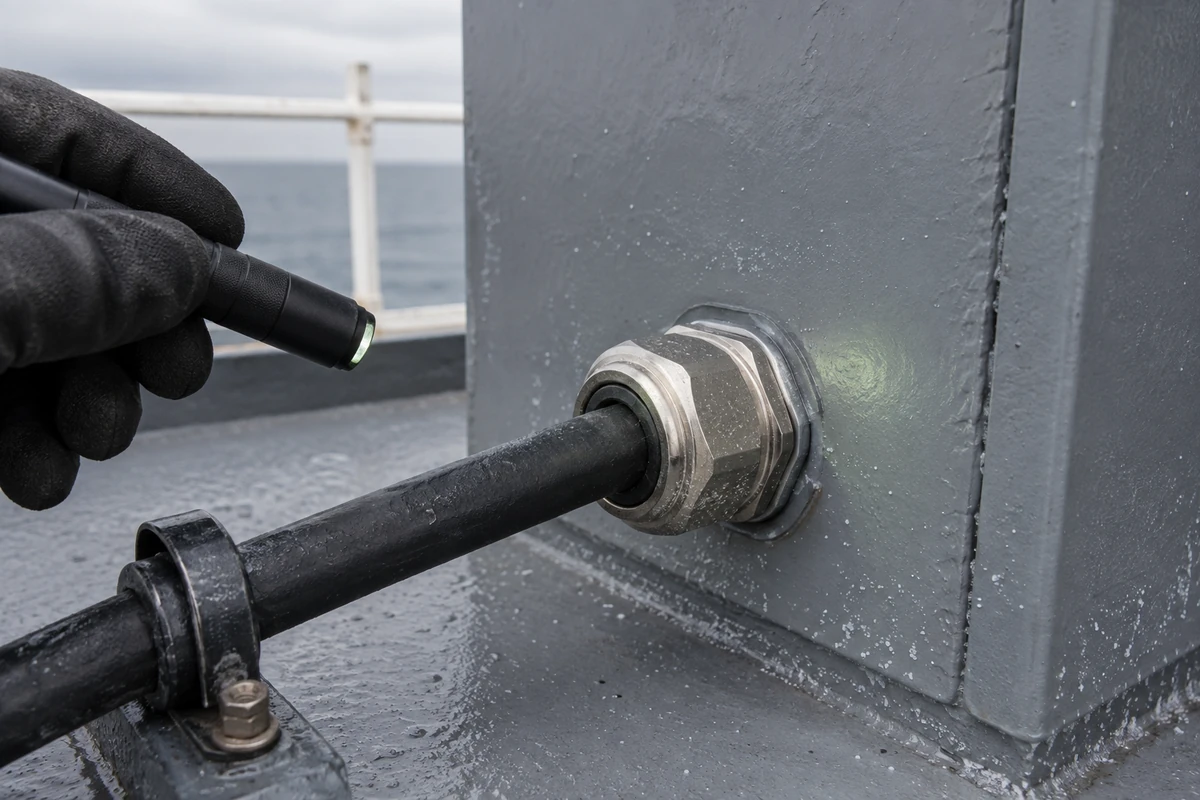
Illustrative deck-box entry showing salt deposits near the cable perimeter, gland body and coated wall joint, the first surfaces to examine when tracing a water path.
Keep the possible outcomes separate
An outcome branch is one possible ending to the suspected event after inspection. I choose the branch supported by the investigation and include the work required for that outcome. Keep the branches mutually exclusive: each describes one final state. This prevents an estimate from charging for a complete local repair and then adding another complete estimate for the same repair within an equipment-damage scenario.
| Outcome after investigation | What must be established | Cost boundary |
|---|---|---|
| A. Entry wet outside, interior dry | No internal moisture or impaired function is found under the approved checks. | Inspection and any justified entry correction; no presumed equipment replacement or outage. |
| B. Local ingress, equipment functional | Water crossed an entry boundary, but affected equipment passes the required checks after cleaning, repair, or replacement of the entry. | Investigation, entry repair, approved access and retest; add schedule impact only if this work actually delays a dependent task. |
| C. Equipment damaged or function unavailable | Moisture or electrical findings require equipment repair, replacement, or a longer isolation. | Branch B’s necessary investigation plus incremental equipment work, testing, access and attributable delay; do not add the full Branch B total again. |
For a safety function or classified hazardous area, I also check the governing asset procedure and approval conditions. IEC 60079-14:2024 covers selection, installation and initial inspection of electrical Ex equipment in or associated with explosive atmospheres. Use that review for an Ex installation alongside the asset’s applicable repair and return-to-service procedures.
Build one branch’s cost ledger
Incremental cost is a charge or loss caused by the selected branch that was absent from the planned work. I start with actual labor rates, equipment quotes and access costs. I then check test requirements, the current schedule and contract terms. For a missing quote or access rate, I name the owner and the date needed; this keeps the open input visible before the work is authorised.
| Ledger line | Input from the project | Add it when | Common double count |
|---|---|---|---|
| Investigation and containment | Authorized labor, isolation, examination and temporary protection. | The work is actually required in that branch. | Charging the same crew time again within a fixed repair quote. |
| Entry restoration | One approved repair method, replacement entry parts, installation and retest. | The entry needs correction. | Adding both full repair and full replacement for the same entry. |
| Equipment restoration | Inspection, parts, repair or replacement, and functional verification. | The affected equipment fails its required checks. | Counting a packaged equipment service twice as parts and labor. |
| Access and logistics | Platform, permit, lift, vessel call or other incremental access. | The branch creates a cost beyond planned access. | Adding a vessel day rate and a mobilization package that already includes that day. |
| Schedule impact | Only a demonstrated critical-path delay and its contract-specific rate or consequence. | The work consumes available float and shifts a dependent milestone. | Adding gross production loss and a contractual delay charge for the same exposure without checking overlap. |
| Recoveries | Warranty, insurance or other documented reimbursement. | Eligibility and amount are established. | Treating a possible recovery as certain or subtracting it twice. |
For one outcome, I add the eligible costs to find the gross impact. Then I subtract confirmed recoveries once to estimate net project exposure. Keep the cost of each branch separate until the investigation selects the response.
Worked example: inspection, local repair or a return visit
The following amounts are hypothetical planning inputs in USD, used to illustrate the ledger. Branch A needs inspection only. Branch B fits the existing deck-access window. Branch C includes equipment damage, a return visit and a distinct schedule cost. The assumed repair prices exclude the separately listed testing and access charges.
| Incremental cost, USD | A: dry interior, function passes | B: local ingress, equipment passes | C: equipment repair and return visit |
|---|---|---|---|
| Investigation | 400 | 400 | 400 |
| Entry parts and installation | 0 | 800 | 800 |
| Equipment restoration | 0 | 0 | 2,500 |
| Additional access and logistics | 0 | 0 | 1,200 |
| Retesting after repair | 0 | 200 | 400 |
| Attributable schedule cost | 0 | 0 | 1,500 |
| Gross branch cost | 400 | 1,400 | 6,800 |
Branch B totals 400 + 800 + 200 = USD 1,400. Branch C totals 400 + 800 + 2,500 + 1,200 + 400 + 1,500 = USD 6,800. The USD 5,400 difference comes from the added equipment, access, test and schedule work. Replace every input with the project’s own quote or rate before using the table for an approval.
For this comparison, I check the access and schedule lines together. A return visit can cost money even if it fits within the completion date. Conversely, a repair can delay a dependent task while the crew is already on site. The estimate needs to show which condition applies. Suppose a repair quote already includes travel and crew time: enter that package once, then add only charges outside its scope. If the repair uses an existing access slot, the extra vessel or platform charge may be zero. If the task has enough schedule float, a later local finish may still leave the project milestone unchanged. This distinction keeps the repair method, access plan and schedule consequence visible without charging the same activity twice.
Use these branch totals to size the response and decide which quote or inspection is needed next. Expected-cost calculations also need probabilities for the mutually exclusive outcomes. Where the project has no supported probabilities, the separate branch costs still give the planner useful contingency amounts and clear triggers.
Let inspection and testing change the decision
Before energization, I compare the installed entry with the product instructions and enclosure design. Each check should lead to a defined action. I check cable size and condition, wall seating, washer position and cable support. Then I check drainage and any assigned electrical contact.
If the configuration is wrong, correct it before relying on an enclosure rating. Keep photographs and exact part identities as the installed baseline for later comparisons.
After suspected wetting, follow the asset’s isolation and authorization procedure before opening the box or performing electrical tests. I record exterior deposits, cable movement and seal position before any change. Then I examine the interior and apply the equipment maker’s prescribed checks.
A dry interior with a passing function check supports Branch A; a wet terminal or failed circuit expands the work scope. Select any ingress test through the approved procedure, with the equipment state and test boundary defined before water is applied.
For example, a displaced external seal with a dry interior directs attention to the entry installation. Moisture at a terminal directs attention to the circuit and connected equipment as well. I record that distinction on the work order so the installer and electrical test team receive the right scope.
The IP-rating guide explains the enclosure test code. For the project check, record the cable, mounting arrangement, test method and acceptance criterion. Keep the result with the corrected configuration so the next inspection has a clear baseline.
Choose the contingency while access is available
I prepare the response while access is available. For the deck-box scenario, that means an approved replacement entry, the correct sealing accessories, a competent installer, an isolation slot and suitable test equipment. Put the planned preparation cost in the project budget and identify the finding that authorises each repair.
| Trigger at the deck box | Immediate decision | Condition for resuming use |
|---|---|---|
| Seal displaced, cable unsupported or wall seating damaged before energization | Correct the identified interface and reassess nearby entries installed the same way. | Installation and required commissioning checks pass for the corrected configuration. |
| Wet exterior after washdown, with no internal finding yet | Isolate as required, document the as-found state and inspect the boundary. | The water path is resolved and required checks support the selected branch. |
| Internal moisture or failed electrical function | Keep the affected circuit out of service under the site’s procedure; assess connected equipment. | Repair, test and authorization cover the equipment and entry, not only the gland. |
If access is expensive, I compare the planned correction cost with the work and access needed for a later return. A known installation defect is easiest to resolve when the right people and equipment are already present. Preserve the as-found record, repair details, test result and invoice so the completed job replaces the planning allowance with actual quantities and costs.
Conclusion
I plan a marine cable-entry response around the water path and the equipment it reaches. Exterior wetting, local ingress and equipment damage lead to different work scopes. Inspect the interfaces first, select the supported outcome, then price the repair, access and schedule impact within that branch.
Before the deck-access window closes, confirm the spare parts, isolation arrangement and required tests. The worked example shows why this matters: an entry repair inside existing access and a later equipment-restoration visit can have very different costs even when they involve the same gland.
FAQs about marine cable-entry failure risk
How should I estimate the cost of a marine cable-entry failure?
Select the outcome supported by inspection, then add the incremental investigation, entry repair, equipment restoration, access, testing and schedule costs for that outcome. Use actual project quotes and rates, remove overlaps and subtract confirmed recoveries once. The worked example illustrates this method with hypothetical costs of USD 400, USD 1,400 and USD 6,800 for three different outcomes.
Which findings separate a local entry repair from equipment damage?
The as-found water path, internal moisture location, and required electrical and functional checks separate the branches. Exterior salt staining alone cannot establish a damaged circuit. If terminals or connected equipment are affected, the response must include their assessment and restoration. The entry repair by itself closes only the entry’s physical defect.
Which cable-entry costs may be added together?
Add incremental investigation, the chosen entry correction, necessary equipment work, access, retesting, and attributable schedule effects within one outcome. Do not add full repair and replacement for the same entry, duplicate a bundled access charge, or add mutually exclusive outcome totals. Subtract documented recoveries once when estimating net exposure.
Does an IP rating predict the financial consequence of a leak?
No. IEC 60529 classifies enclosure protection under defined test conditions. The rating does not reveal whether this installed entry leaked, which equipment got wet, or whether the work delayed a critical task. Those answers come from the installed configuration, inspection and tests, and the project’s schedule and cost records.
What changes when the affected entry is in a hazardous area?
Follow the asset’s hazardous-area procedure and the exact equipment and entry approval conditions. IEC 60079-14 addresses electrical installation design, selection, installation and initial inspection of Ex equipment. Confirm that the repair method, replacement parts and required tests meet the applicable Ex requirements before authorising return to service.
Sources and technical references
- International Electrotechnical Commission - IEC 62444:2010, Cable glands for electrical installations, accessed 2026-10-28.
- International Electrotechnical Commission - IEC 60529 consolidated edition, Degrees of protection provided by enclosures, accessed 2026-10-28.
- International Electrotechnical Commission - IEC 60079-14:2024, Explosive atmosphere electrical installation design and selection, accessed 2026-10-28.