

Proper assembly and disassembly of reusable cable glands starts with documented reuse permission. I check whether the exact instructions permit reuse of the complete gland or specific parts. Every retained part must meet its stated limits. Unscrewing a gland establishes only that it can be dismantled. It does not establish reuse of the seal, clamp, compound, washer, locknut, earth accessory, or body.
Start with the model, instructions, parts list, and certificate schedule. Decide which parts to retain or replace before reassembly. Preserve the documented sequence, surface condition, and closure method. Model-specific torque, lubricant, thread treatment, seal orientation, preparation dimensions, and reuse limits must come from those documents.
Key takeaways
- Reusable is a documented permission, not a property inferred from appearance or metal construction.
- Treat the cable seal, retention or armour termination, enclosure entry, electrical contact, and Ex barrier as separate interfaces.
- Preserve part identity, order, and orientation without assuming that disassembly is universally the reverse of assembly.
- Replace every part that is single-use, damaged, contaminated, incomplete, out of tolerance, or otherwise outside the exact instruction.
- Reassembly does not automatically restore a previous IP, Ex, bonding, EMC, or retention result.
Reusable is a documented property, not an appearance
Reuse permission explicitly allows an identified gland or component to be installed again under defined conditions. I look for it in the installation and service instructions, parts list, certificate schedule, and accessory documents. A thread, metal body, spanner flat, or intact removal does not provide that permission.
IEC 62444:2010 covers complete cable glands as supplied by the responsible manufacturer or supplier. It does not make every removable component a reusable spare. The IEC 62444 cable-gland guide explains that complete-product scope.
Reuse permission can apply unevenly within one assembly. A manufacturer may permit a metal body to be recovered while requiring a new seal. A compression nut may remain serviceable, while a deformed gripping ring, washer, compound barrier, or screen-contact element must be replaced. Conversely, an undamaged hard part can still be restricted to one installation. Follow the reuse conditions for each exact part; a similar family, size or material can have different limits.
Map the interfaces before loosening the gland
An interface map identifies every function that disassembly can disturb. A simple gland may have fewer interfaces than an armoured, EMC, or barrier gland, so use the product drawing rather than a generic exploded view.
| Interface | What disassembly may disturb | Question to answer before reuse |
|---|---|---|
| Cable-facing seal | Seal surface, cable jacket, insert, compression state, and cable range relationship | Does the instruction permit this seal and cable surface to be reused, and under which inspection limits? |
| Cable retention or armour termination | Gripping element, armour cone or ring, bedding, sheath preparation, and axial support | Which parts and cable preparation dimensions must be renewed or remade? |
| Entry thread and panel seal | Threads, seating face, washer, locknut, adaptor, wall, and hole or tapped entry | Does the same entry stack remain permitted and undamaged? |
| Protective bonding or EMC contact | Earth tag, metallic contact path, screen termination, spring, clamping surface, and enclosure connection | Which contact surfaces and electrical checks are required after disturbance? |
| Ex compound or barrier | Compound, resin chamber, cable core preparation, barrier seal, and certified configuration | Does the certificate and instruction allow any part of this barrier arrangement to be reused? |
One action can disturb several interfaces. Turning the cap may release the cable seal while the entry body stays mounted. Pulling the cable can then disturb its screen contact or armour preparation. Removing the body may disturb the panel washer, locknut, earth tag, or thread treatment. I map those effects before opening the gland. An interface left in place still needs any applicable checks.
Use the exact product drawing, parts list, instructions, and certificate schedule to determine the permitted component order, torque, replacement parts, and reuse checks.
Isolate the equipment and remove external load
Control hazardous energy and cable loads before service. In the United States, the OSHA control-of-hazardous-energy standard applies within its servicing and maintenance scope. Follow the rules and procedure governing the actual site and jurisdiction.
Once the equipment is safe, I support the cable so its weight, bend, armour, conduit, or external restraint does not load the gland during release. Remove accessories only in the permitted order. If movement would stress internal terminations, resolve that constraint first. Keep turning force and axial load out of conductors, screens, armour, enclosure walls, and adjacent entries.
A separate cable support carries the external run while the gland and enclosure entry are serviced. This keeps cable weight and bending load away from the joint being released.

Preserve identity, order, and orientation during disassembly
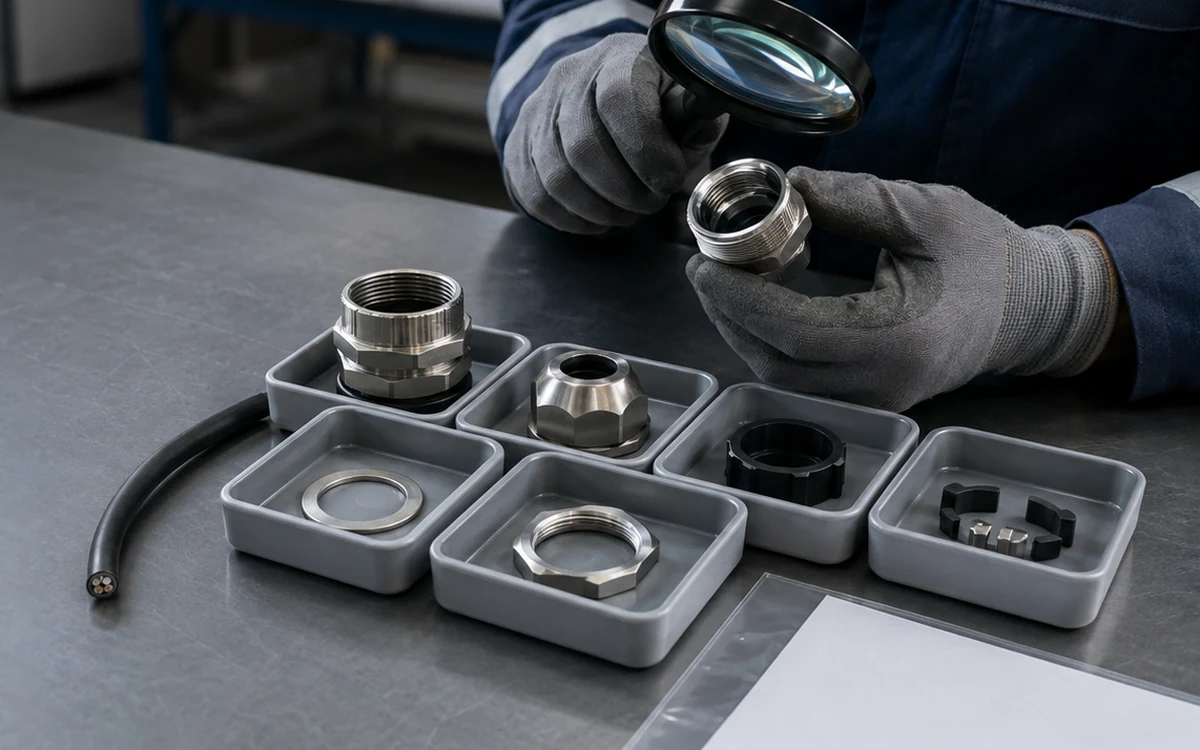
Part identity control keeps every component linked to its original gland and documented position. Photograph or sketch the installation where site rules allow. Mark orientation only by an approved, non-damaging method. I use a separate clean tray for each gland and keep similar seals, washers, rings, and locknuts from different sizes or revisions apart.
Follow the stated release sequence. Disassembly is not necessarily installation in reverse. Some designs retain internal parts, depend on specified cable preparation, or require one joint to be held steady while another is released. Ex glands, used in explosive atmospheres, may have barriers or cured compound that cannot be recovered by ordinary dismantling. EMC contact parts serve electromagnetic compatibility and also need their own disturbance checks.
I use the intended spanner flats and specified tools. Avoid serrated pliers on sealing surfaces, uncontrolled impact, heat, and improvised levers. Protect exposed threads, gasket faces, cones, insert bores, and electrical contacts. If parts seize, turn together unexpectedly, distort, or cannot be identified, stop and resolve the cause. Forcing the joint can damage threads, sealing faces or contact parts that might otherwise remain serviceable.
Clean only by a permitted material method
Cleaning can change a working interface. Solvent may swell a seal, attack a polymer, remove factory treatment, or leave residue on a bonding face. Abrasion may alter threads, sealing faces, finish, or plating. Compressed air can spread debris into a barrier chamber. I use only the permitted cleaner, method, drying conditions, and contamination limits for the exact parts.
For lubrication, identify whether each joint is dry, factory-treated, manufacturer-specified, or explicitly allowed field lubrication. Do not add grease just to ease reassembly. The cable-gland lubricant guide explains why a product and amount allowed at one interface may not suit another. Adding lubricant does not resolve an unknown original condition.
Inspect every part against its documented reuse limit
A reuse limit is a condition the exact part must meet before returning to service. It may concern dimensions, appearance, material, procedure, or service cycles. I apply the stated limit rather than inventing a percentage threshold, cycle count, or interval. In the table, galling means adhesive surface damage that can make threads seize; fretting is wear caused by small repeated movements.
| Part or area | Inspect for | Disposition boundary |
|---|---|---|
| Body, cap, threads, and seating faces | Cross-threading, galling, cracks, burrs, distortion, corrosion, damaged finish, worn flats, or an altered seal land | Reuse only when the exact instruction permits it and every stated criterion is met |
| Cable-facing seal or insert | Cuts, tears, hardening, swelling, permanent deformation, embedded debris, chemical attack, wrong size, or lost identity | Replace when single-use, unidentified, damaged, contaminated, or outside the documented condition |
| Gripping, armour, or screen-contact parts | Distortion, fretting, missing teeth or springs, damaged cone or ring, contamination, corrosion, and changed cable preparation | Restore only the named compatible parts and preparation permitted for that exact configuration |
| Washer, locknut, adaptor, earth accessory, or shroud | Damage, flattening, corrosion, missing part, wrong material or size, and changed panel interface | Do not substitute a visually similar accessory; follow its own reuse or replacement rule |
| Compound or barrier parts | Cured or disturbed compound, voids, contamination, damaged chamber, wrong seal, and altered core preparation | Treat as a certificate- and instruction-controlled case; do not assume compound or barrier material is recoverable |
| Cable and enclosure entry | Jacket cuts, deformation, contamination, changed OD or preparation, damaged hole or thread, warped wall, or poor seating face | Repair or replacement must follow the cable, enclosure, and gland instructions that cover the actual damage |
A seal can look smooth yet be prohibited for reuse. A metal body can look robust yet have thread or contact damage outside the manufacturer’s limits. If a part number, material, orientation, history, or condition cannot be established, do not solve the uncertainty by tightening harder or combining parts from another gland.
For example, instructions may allow an undamaged body and cap to be reused while requiring a new insert. I keep the retained parts tied to their model and size, install the specified replacement, and repeat checks affected by opening the joint. A similar-looking insert from another gland does not establish compatibility.
Reassemble only the exact allowed configuration
After inspection, I assemble the retained parts and required replacements into the exact allowed configuration. Match model, size, cable preparation, seals, grips, accessories, entry thread, panel interface, and instruction revision. The current instructions govern dry or treated surfaces, counterholding, part order, closure criteria, and any retightening.
Use the stated torque, turns, or compression dimensions for that joint. The cable-gland torque guide explains the dependence on lubrication, tools, and product instructions. NIST’s torque-realization overview describes traceability to SI, the International System of Units. It does not provide the gland maker’s value. Use controlled tools where required and hold only the specified surfaces.
Before closure, lay out the retained components and specified replacements against the parts list. Keeping the body, cap, insert and washer separated makes missing or mixed components easier to spot before assembly.

After closure, I complete the model-specific checks. These may cover cable position, seal engagement, panel seating, accessory orientation, armour or screen termination, conductor condition, and support. Perform the authorized electrical or ingress checks as required. The cable-gland installation do’s and don’ts covers installation controls. Each disturbed part must also meet its stated reuse conditions.
Treat Ex and barrier glands as a separate reuse case
For explosive-atmosphere equipment, keep the protection concept, certificate, schedule, marking, special conditions, cable, accessories, and instructions aligned. IEC 60079-14:2024 covers design, selection, installation, and initial inspection. It does not approve a generic dismantling method for every certified gland. IEC 60079-17:2023 covers hazardous-area inspection and maintenance; its scope excludes repair and overhaul of explosion-protected equipment.
I use the current certificate schedule and instructions after disturbance to decide the status of the gland, metal hardware, seals, barrier parts, compound, and cable preparation. Inspection or successful dismantling is not permission to reclaim them. If the documents give no reuse route for the actual condition, use the specified replacement route.
A previous IP or electrical result does not carry over automatically
An earlier ingress result covers the assembly and conditions that were tested. IEC 60529 classifies enclosure protection. It does not guarantee the former result after a gland is removed and reassembled. A new seal, reused body, changed jacket, different washer, disturbed thread, or new assembly method can change the configuration.
I check retention, protective bonding, EMC contact, and armour termination separately too. A cable seal does not prove the wall seal; a sound washer does not prove retention; a metal body does not prove continuity through disturbed contacts. Follow the checks required by the product, enclosure, equipment, certificate, and site procedure. The IP68 installation guide explains both sealing interfaces.
Conclusion
I confirm the current gland instructions and certificate set before deciding which parts can be reused. Then I map the interfaces, isolate the equipment, support the cable, and preserve part identity and orientation. Clean by permitted methods and inspect every part against its own stated limits before reassembly.
Reassemble the exact allowed configuration with the required new parts, sequence, surface condition, and closure method. Repeat the applicable sealing, retention, entry, bonding, EMC, armour, and Ex barrier checks. Previous installation or test results do not automatically cover the new assembly.
Frequently asked questions
Can a cable gland sealing element be reused?
Only when the exact manufacturer instructions permit that sealing element to be reused and it meets every stated condition. Replace a seal that is single-use, unidentified, cut, hardened, swollen, permanently deformed, contaminated, chemically attacked, the wrong size, or otherwise outside the documented limit.
Can I simply retighten a cable gland after removing it?
No universal retightening rule exists. First confirm reuse permission for the gland and each disturbed part. Then follow the exact sequence, dry or treated interface condition, closure endpoint, cable preparation, and post-installation checks stated for that model and configuration.
When must a reusable cable gland be replaced?
Replace it when the documentation does not authorize reuse, a required part is single-use or missing, identity is uncertain, damage or contamination falls outside the stated limits, the configuration has changed, or the required reassembly and revalidation steps cannot be completed.
May I add lubricant when reassembling a cable gland?
Only if the exact instructions permit the named lubricant, amount, location, and application method for that interface. A joint specified as dry, factory-treated, or otherwise controlled should not receive an improvised lubricant. Lubrication can change friction, closure, material compatibility, and contamination risk.
How should an Ex or barrier cable gland be handled after disassembly?
Use the current certificate schedule, special conditions, and manufacturer instructions for the exact gland and cable configuration. Do not assume that a disturbed barrier, compound, cable preparation, seal, or metal component may be reused. If the documents do not authorize the proposed reuse route, replace the controlled parts or complete gland as specified.
Sources and technical references
- IEC 62444:2010, Cable glands for electrical installations - IEC, edition 1.0, accessed 2026-09-08.
- 29 CFR 1910.147, The control of hazardous energy (lockout/tagout) - OSHA, accessed 2026-09-08.
- Torque Realization - National Institute of Standards and Technology, accessed 2026-09-08.
- IEC 60079-14:2024, Explosive atmospheres - Part 14: Electrical installations design, selection and installation - IEC, edition 6.0, accessed 2026-09-08.
- IEC 60079-17:2023, Explosive atmospheres - Part 17: Electrical installations inspection and maintenance - IEC, edition 6.0, accessed 2026-09-08.
- IEC 60529:1989+A1:1999+A2:2013, Degrees of protection provided by enclosures (IP Code) - IEC, consolidated edition 2.2, accessed 2026-09-08.