

The best potting and sealing compounds for cable glands match the job: a specified barrier compound for a barrier chamber, a joint sealant for an approved joint, or a potting resin where the design calls for a filled space. I start with that location and duty, then compare the named formulations. Adhesion, flexibility, chemical exposure, cure and cable-jacket compatibility decide which product suits the entry. For a certified barrier gland, use the compound and process listed in its instructions. For a conventional gland, first check whether the design needs any added compound: many seal through a supplied insert and a wall gasket. If the gland is the wrong size, the cable is damaged or the entry lacks support, correct that fault before choosing a sealant.
Key takeaways
- Select by exact location and duty before comparing polymer chemistry.
- Treat barrier compound, cable seal, wall gasket, thread sealant, and external encapsulation as different systems.
- Compare named formulations using evidence that matches the real substrates, chemicals, temperatures, movement, and cure conditions.
- Do not infer an IP or hazardous-area result from the compound alone.
- Follow the gland and compound instructions for preparation, mixing, filling, cure, and inspection; generic times and ratios are unsafe substitutes.
First decide whether a compound belongs in the cable entry
A potting compound is a flowable or mouldable material placed around components or conductors and cured to fill a defined volume. A sealant is a material that limits fluid or contaminant passage at a joint under its specified conditions. These names describe functions, rather than fixed chemical families. Products from one polymer family can have different stiffness, adhesion, cure chemistry, fillers, flame behaviour, electrical properties and service limits. I check those properties on the named product.
Several cable-entry boundaries can look alike from outside. Barrier compound may fill a chamber around individual conductors inside a certified gland. A flexible, rubber-like sealing insert may seal against the cable jacket without any compound applied on site. A gasket may seal the gland body to the enclosure wall, while thread sealant acts at an entry thread. An external overmould or heat-shrink accessory protects a separate transition. I keep these jobs separate: none of the materials automatically replaces the others. The heat-shrinkable gland sealing kit guide covers that last accessory category.
A barrier compound is a specified material installed around prepared conductors inside the barrier chamber of a particular gland system. The gland’s certification and instructions define its purpose, preparation and permitted configuration. Use the exact compound assigned to that gland system and follow its chamber-filling procedure.
Map the material to one exact interface
The location tells me what the material is allowed to do and which evidence to check. I use this table before choosing a chemistry. That avoids choosing a familiar material and then looking for somewhere to put it.
| Location and duty | What must be established | Separate interface to check |
|---|---|---|
| Barrier chamber inside a specified barrier gland | Exact gland, compound, cable preparation, conductor separation, fill, cure, and certification conditions | Outer cable seal, armour termination, and enclosure-wall sealing |
| Cable-facing seal supplied as part of the gland | Cable type and actual diameter, jacket condition, sealing range, compression geometry, temperature, movement, and product instructions | External encapsulation, cable support, and wall gasket |
| Gland-to-enclosure wall interface | Entry type, seating surface, wall thickness, gasket or washer, thread arrangement, torque method, and enclosure configuration | Cable-jacket seal, retention, and armour or screen termination |
| Thread sealant or approved accessory | Exact thread form, material pair, engagement, electrical duties, chemical exposure, cure, and manufacturer permission | Locknut engagement, protective bonding, electromagnetic compatibility (EMC) contact, and entry condition |
| External overmould, repair, or cable-joint encapsulation | Defined joint design, adhesion, strain transfer, water path, rework needs, and its own qualification | Certified gland internals and complete-gland performance |
The microscopic sealing-mechanism guide explains contact pressure and surface pathways at a cable seal. I distinguish that contact seal from filling an internal chamber or coating the outside of the gland.
Compare potting and sealing compounds for cable glands
I use the polymer family to build a shortlist, then compare the properties that affect the joint. A change in filler, curing agent or softener can change how the material bonds, flexes or resists a liquid. Two products from the same family may also shrink or heat up by different amounts during cure. I compare these properties on the exact data sheets before testing the joint.
A formulation-level claim applies to a named material, preparation, test method, specimens, conditioning and result. It does not apply to every member of that polymer family. For example, a flexible epoxy may tolerate movement that cracks a rigid epoxy. Different additives may change its chemical response or adhesion. I therefore compare the candidate products under the conditions that matter for this entry.
| Family label | Behaviour that may be available in some formulations | Questions that remain open until the exact product is known |
|---|---|---|
| Epoxy | Rigid or toughened cure, low or high viscosity, electrically insulating or filled variants | Adhesion, cure shrinkage and heat, crack response, thermal cycling, cable compatibility, chemical exposure, rework |
| Silicone | Soft or firm elastomers, condensation or addition cure, neutral or other cure systems | By-products, adhesion, contamination sensitivity, tear behaviour, fluid resistance, movement range, cure depth |
| Polyurethane | Flexible through rigid grades, castable or sealant forms, varied abrasion and water response | Hydrolysis, moisture during cure, isocyanate hazards, adhesion, chemical exposure, long-term modulus |
| Polysulfide | Flexible sealant formulations and fuel-resistant grades may exist | Exact fluid, adhesion, cure, electrical needs, temperature, movement, and compatibility with adjacent materials |
| Butyl or non-curing compounds | Tack and low-permeability behaviour may suit certain approved interfaces | Creep, squeeze-out, temperature response, contamination, mechanical retention, and whether the design permits it |
For chemical duty, compare the named product with the actual liquid and exposure conditions. ASTM D543 covers evaluating plastics against chemical reagents. Its interpretation depends on the reagent, concentration, duration, temperature, stress and similarity to end use. ASTM D471 covers the effect of liquids on rubber materials. Its laboratory data are comparative; they do not automatically prove an installed part.
For example, a coupon may show little change during a short liquid exposure, while the jacket bond still needs a thermal-cycle check. I use the material test to shortlist a formulation, then assess adhesion and retained sealing in the actual joint. This follows the two failure paths: changes within the compound and separation at its contact surfaces.
Match service exposure and substrates
First, I list the actual surfaces: the cable jacket, conductor insulation, gland insert and body, enclosure coating, gasket, thread and any primer. For each surface, I record whether the material must bond to it, contact it or remain separate. Compatibility goes beyond visible swelling. The compound may soften or embrittle a material, stain it, extract additives, inhibit cure or lose adhesion. It may also corrode metal or change electrical contact. I check cable layers separately because the jacket, bedding, conductor insulation and screen can use different materials and serve different functions.
Next, I describe the exposure. “Chemical resistant” needs a named chemical, concentration and any mixture. It also needs temperature, contact time, splash or immersion, cleaning cycles and mechanical stress. “Outdoor” needs the same care: water, condensation, sunlight, salt, pollutants, thermal cycles and freezing and thawing are separate conditions.
If the cable moves, I decide whether the compound must flex, carry load or stay isolated from strain. A rigid fill may protect a component but concentrate strain at its edge. A soft material may accommodate motion but provide little structural support.
Application temperature and service temperature are different checks. I separate storage, substrate and mixing temperatures from cure temperature and peak cure heat, also called exotherm. I also check the time before handling and the minimum cure before energization. Steady service temperature and short temperature peaks need their own limits. I take each limit from the named product’s datasheet and instructions. The operating-temperature guide explains why the complete entry must be checked at its actual interfaces; the broadest component rating cannot stand for the whole assembly.
Check cure and application limits before accepting a material
A material that works when cured may still be unsuitable if it cannot be applied reliably in the available space. Before accepting it, I check the required surface preparation and primer. Then I check mixing ratio and method, working time, dispensing and fill sequence. The instructions must also cover maximum pour or cure depth, venting, orientation, cure conditions and acceptance checks. Use the cleaner, primer, mixing ratio, cure time and minimum thickness stated for that exact product.
In a filled chamber, I pay particular attention to voids and surfaces the compound may not reach. Trapped air, packed conductors, contamination, short working time or poor access can prevent complete wetting. Too much compound creates another problem: it can enter contacts, threads, sealing surfaces or electrical paths where it should not cure. Shrinkage and cure heat may affect sensitive cable materials too. Review these effects against the chamber geometry and the named formulation’s application limits.
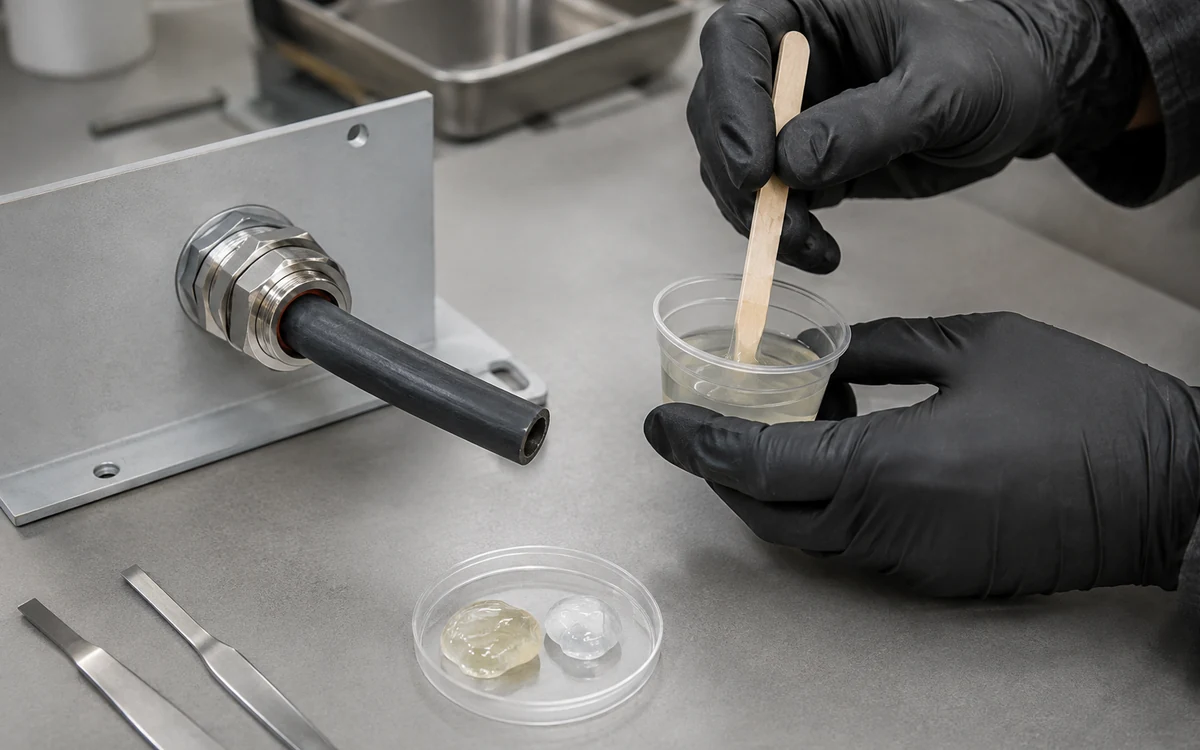
A gloved operator stirs an unlabelled material beside a panel-mounted cable gland, illustrating why product-specific mixing and cure instructions matter.
Uncured components need chemical handling controls. The UK Health and Safety Executive’s safety-data-sheet guidance explains how a safety data sheet (SDS) provides hazard and safe-use information for workplace risk assessment. I use the current SDS and workplace controls for the actual components. Apply the handling controls while measuring, mixing and dispensing the uncured components.
Keep compound evidence inside the complete-product boundary
IEC 62444:2010 specifies requirements and tests for the construction and performance of complete cable glands supplied by the manufacturer or responsible supplier. I keep that complete-product boundary in view. A resin coupon, sealant datasheet or adhesion test can describe a material property. It cannot alone prove cable retention, cable sealing, armour continuity, electrical characteristics or assembled-gland performance.
A complete-gland test does not authorize a different internal compound or application method either. I check the cable type and size, accessories, mounting, conditioning and acceptance criteria covered by the evidence. Changing compound may change cure geometry or its contact with other parts. Similar-looking materials do not establish an equivalent assembly.
Ingress classification applies to the enclosure boundary. IEC 60529 classifies degrees of protection provided by enclosures under defined conditions. Sealant on the outside of a gland does not automatically create an IP68 entry. I check the gland and cable together with the enclosure entry and wall. The gasket or thread arrangement, mounting, exposure and test conditions also remain relevant. The IEC 60529 cable-gland selection guide covers this separate enclosure-level decision.
For a hazardous area, I stay within the certified gland design. IEC 60079-14:2024 addresses the design, selection, installation and initial inspection of Ex equipment installations within its scope. Ex identifies equipment for explosive atmospheres. A certified barrier gland requires the compound, preparation, conductor arrangement, cure process and installation conditions allowed by its certificate and instructions.
For a barrier gland, check the permitted compound by its exact product identity. Similar colour or hardness can conceal a different cure or bond behavior. Inspect conductor spacing, chamber fill and cure at the stages named in the instructions, while those features can still be checked. The hazardous-area gland selection guide gives the broader equipment and installation context.
Find the leak path before adding compound
I locate the leak path before choosing a repair. Replace a wrong-size gland, restore the specified gasket or locknut, and correct insufficient thread engagement. Damaged cable and cracked enclosures need an approved repair or replacement. Restore cable support separately. Keep sealant away from electrical contact faces unless the design expressly calls for it there.
Permanent encapsulation can also prevent inspection or dismantling. If later access matters, I compare the approved repair and replacement options first. The reusable cable-gland assembly guide explains why part condition and product instructions control reuse.
When moisture appears, I trace its route before sealing the nearest visible gap. Water may travel along the cable, enter another enclosure opening, form as condensation or pass beneath a coating. Compound over the gland body may trap liquid and hide corrosion without stopping that route. Correct the cable, gland, entry, support, drainage or enclosure fault at its source. Then use compound only where the repaired design specifies it.
Conclusion
I choose potting and sealing compounds by location and duty. That may be the barrier chamber, cable seal, wall interface, thread or accessory, or a separate external encapsulation. Then I compare named formulations against the actual surfaces, exposure and movement. Application, cure, safety controls and future rework also have to suit the job.
Use material tests to shortlist the formulation and assembly tests to check the finished cable entry. Keep a certified barrier gland within its permitted compound and process. For a leaking conventional entry, correct the actual seal, cable or mounting fault before adding material that could hide it.
FAQs about potting and sealing compounds for cable glands
Is epoxy always the best compound for chemical exposure?
No. Epoxy formulations differ in cure, toughness, adhesion, shrinkage and response to particular chemicals. I compare the named product on the actual surfaces, with the chemical species, concentration, temperature, duration and stress that represent service. A material coupon cannot prove the complete cable entry.
Can silicone be used in every outdoor cable gland?
No. “Silicone” covers different formulations, and “outdoor” covers different exposures. I check compatibility with the cable, gland, enclosure and adjacent materials. Then I check movement, liquids, sunlight, temperatures and cure conditions, along with any certification limits. Many glands seal without silicone applied on site.
Can I add potting compound to make a gland IP68?
No. An IP classification applies to a defined enclosure configuration and test conditions. Added compound may change the assembly without stopping the real water path. I select the gland, cable, wall seal and mounting method as one enclosure-entry arrangement for the required protection.
May I substitute another compound in a hazardous-area barrier gland?
Only when the exact certification and manufacturer instructions explicitly allow that compound and process. Similar chemistry, hardness, colour, or cure appearance is not evidence of equivalence. The barrier chamber, conductor preparation, fill, cure, and complete gland must remain within the permitted configuration.
What evidence should I compare before choosing a compound?
I start with the compound’s location and duty, then its named formulation and the surfaces it must contact. I check cable compatibility, exposure and movement before reviewing application, cure limits, safety data and rework needs. Separately, I check the complete gland, enclosure entry, IP requirement and any hazardous-area conditions. Each claim applies only to the configuration and method behind it.
Sources and technical references
- IEC 62444:2010, Cable glands for electrical installations, accessed 2026-10-28.
- IEC 60529:1989+A1:1999+A2:2013, Degrees of protection provided by enclosures, accessed 2026-10-28.
- IEC 60079-14:2024, Explosive atmospheres - Part 14: Electrical installation design, selection and installation of equipment, including initial inspection, accessed 2026-10-28.
- ASTM D543, Standard Practices for Evaluating the Resistance of Plastics to Chemical Reagents, accessed 2026-10-28.
- ASTM D471, Standard Test Method for Rubber Property - Effect of Liquids, accessed 2026-10-28.
- Safety data sheets - UK Health and Safety Executive, accessed 2026-10-28.