

Reliable cable glands cannot guarantee that a facility will avoid USD 100,000 per hour of downtime. That rate belongs to a facility’s defined production scenario. It is neither a gland property nor an industry constant. I would credit a gland only for the specific entry failures it can help prevent when the product, cable, enclosure, installation, environment and maintenance match its supporting evidence.
I would ask four questions before calculating a saving. Which entry failure could start an interruption? What could stop it spreading? How would it be detected? Which site data define the consequence? The following method traces those connections without assigning a universal failure rate, avoided loss or financial return to a gland.
Key takeaways
- Treat USD 100,000 per hour as a site-approved scenario input, never as a cable-gland performance claim.
- Separate the hazard, initiating event, local failure effect, system effect, and production consequence.
- Credit a gland only for functions demonstrated for the exact product and installed configuration.
- Model preventive, diagnostic, containment, and restoration barriers separately, including shared causes that can defeat several at once.
- Use observed failure and downtime data before calculating expected loss or comparing alternatives.
The title is a scenario input, not a promised saving
The USD 100,000 hourly figure belongs in the facility’s consequence model. It may represent lost contribution, reduced throughput, contractual exposure or another approved measure. Before multiplying it by time, I would establish its definition, time basis, affected production boundary and exclusions. A large hourly figure does not prove that a gland failure can cause that loss.
Cable gland downtime risk links an entry failure conditionally to a defined production effect. A hazard is a condition with the potential for harm or loss. An initiating event is the first defined loss of an assigned function. Diagnostic coverage is the portion of relevant failures that a diagnostic can reveal within its stated scope and response time.
I use the following distinctions to keep each risk term specific:
| Term | Meaning in this cable-entry analysis | What it is not |
|---|---|---|
| Hazard | An energy, material, environment, or process condition with the potential to cause harm or loss | The gland defect itself |
| Initiating event | The first defined loss of an entry function, such as sealing, retention, or assigned continuity | Automatic proof of a shutdown |
| Barrier | A preventive or mitigative measure that can interrupt the scenario under stated conditions | A vague claim that a component is reliable |
| Diagnostic coverage | The defined portion of relevant failure conditions that a diagnostic can reveal within its stated test and time boundary | The mere presence of an alarm or sensor |
| Common cause | One condition that can impair more than one nominally separate barrier or channel | Two unrelated failures counted separately |
| Repair time | Time to restore or replace the failed item | Necessarily the same as process restoration time |
| Production consequence | The site-specific operational and financial effect after the failure has propagated through the system | A universal cost attached to a cable gland |
IEC 31010:2019 describes risk-assessment techniques as tools for decisions under uncertainty. I would use the model to reveal missing evidence, rather than turn assumptions into precise-looking savings.
Build the cable-entry failure model before assigning money
Start with an entry function and a credible loss of that function. Then trace what must happen before production is affected. IEC 60812:2018 describes failure modes and effects analysis (FMEA) as a systematic method for identifying failure modes, local and wider effects, and possible causes. I would use those distinctions to replace an undefined “gland failed” event with a specific failure that can be investigated and treated.
I would separate five stages in that model:
- Stress or exposure. Water, dust, chemicals, heat, cold, vibration, pull, impact, cable movement, or electromagnetic disturbance reaches the installed entry.
- Initiating event. One assigned entry function falls outside its accepted condition. Examples include a seal path opening, cable retention being lost, an entry joint loosening, or an assigned bond becoming discontinuous.
- Local effect. Liquid enters a compartment, a cable moves, a conductor or screen is stressed, or an electrical interface changes.
- System effect. A circuit trips, a signal becomes unavailable, a control channel is isolated, or redundancy carries the function. This step depends on the equipment architecture.
- Production consequence. Throughput is reduced or stopped, material is lost, recovery work begins, or no production effect occurs.
The gland affects only part of this sequence. IEC 62444:2010 covers requirements and tests for complete cable glands as supplied. It does not specify the surrounding enclosure, circuit architecture, diagnostics, recovery strategy or hourly production loss. I would check that the installation preserves each demonstrated gland function before crediting it in the model.
Before assigning probabilities or money, I would define the barriers, dependencies and diagnostics for the actual installation. Record each conditional branch and its consequence.
The UK Health and Safety Executive’s Major Hazard Regulatory Model places preventive and mitigation barriers around a loss-of-control event. I would use that logical structure where appropriate without treating every entry as a major-hazard scenario. The analysis still needs a clear path, and the controls must fit the context.
Map gland functions to failure modes and detection evidence
“Reliable” needs a named function, an installed arrangement and evidence. A gland may provide several functions, while the project uses only some. I would describe how one assigned function is lost. A material label, price tier or “bad product” label does not define that failure.
For example, the cable can remain retained after the wall seal opens. Sealing can remain sound while a screen contact deteriorates. These initiating events need different evidence and have different effects. A liquid alarm can detect moisture without identifying its route. Record the function, physical boundary, symptom and detection method before choosing a treatment.
| Assigned cable-entry function | Credible initiating event | Local evidence or diagnostic question | Boundary on the claim |
|---|---|---|---|
| Cable-to-gland sealing | Seal no longer controls the jacket interface | Is liquid or dust present at the actual seal path, under a defined exposure? | Cable construction, diameter, surface, seal material, assembly, and test condition matter |
| Gland-to-enclosure sealing | Entry joint permits a path | Does evidence separate the wall joint from the cable seal and other openings? | Wall, hole or thread, washer, coating, adaptor, orientation, and enclosure matter |
| Cable retention | Cable movement exceeds the accepted condition | Is displacement, conductor strain, or loss of support detected before function is lost? | Cable, clamp geometry, closure, routing load, and support matter |
| Assigned bonding or screen contact | Intended conductive interface becomes ineffective | Does a defined continuity or signal diagnostic detect the relevant loss? | Frequency, current path, surfaces, accessories, and measurement method matter |
| Environmental compatibility | A material or seal condition degrades the assigned function | Can inspection or testing connect the observed change to functional loss? | Chemical, concentration, temperature, time, stress, and complete construction matter |
An ingress-protection (IP) classification describes a tested enclosure arrangement under stated conditions. It does not predict downtime. If water is found inside, I would use the cable-gland leak investigation method to distinguish cable sealing, the wall joint and other openings. Check water travelling along the cable and condensation too. The IEC 62444 scope guide explains the separate complete-gland evidence.
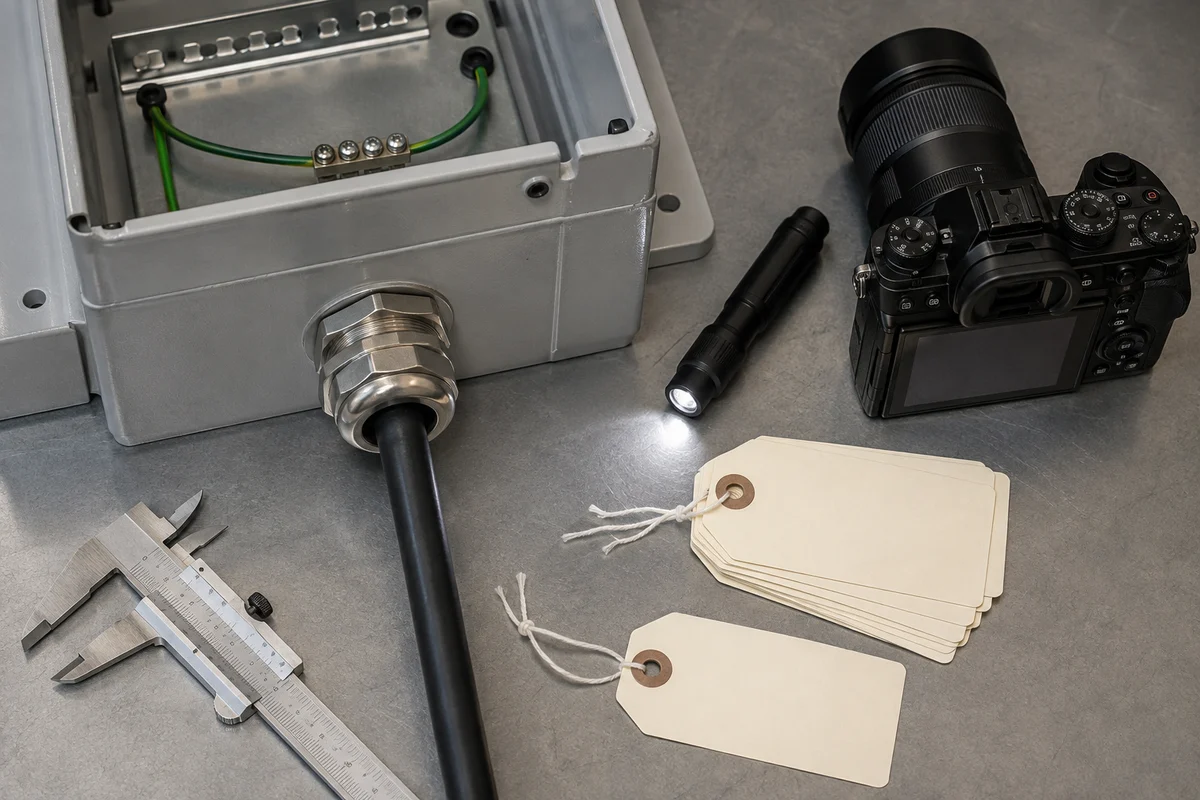
Follow the site’s approved isolation and investigation procedure. I would then record the hardware, conditions, measurements and observation time.
Separate preventive, diagnostic, and restoration barriers
A control is not automatically independent or always available. Preventive barriers aim to stop the initiating event or keep it from crossing the entry. Diagnostics reveal conditions within a stated coverage and response time. Mitigation limits the wider effect. Restoration returns equipment and the process to an accepted operating state. I would model these jobs separately.
Preventive barriers
Selection and installation provide prevention within defined limits. Cable range, jacket, opening, accessories, exposure, tightening method and support must match the evidence. Routing or shielding can reduce direct exposure. A separate enclosure feature may keep liquid away from the entry. I would count the physical protection once; several documents describing the same seal do not make several barriers.
The outdoor liquid-tight gland selection guide separates the cable seal, wall connection, water route, exposure and enclosure. For tightening, I would use the product, cable, size and assembly method covered by the torque article. There is no universal value for all those arrangements.
Diagnostics and mitigation
A moisture switch, insulation monitor, control diagnostic or continuity test may detect some failures. I would establish its threshold, location, test interval and response time, then which failures it can reveal. Diagnostic coverage concerns failures detected in time. The presence of a sensor does not make that coverage one hundred percent.
Mitigation acts after the initiating failure has progressed. Isolation may confine a circuit; redundancy may preserve its function. Compartments may limit spread, and a controlled safe response may stop further damage. I would check the architecture and procedures supporting each outcome. They sit outside the gland. The functional-safety cable-entry guide explains why a passive gland does not inherit the system’s integrity level.
Common causes and restoration
One common cause can defeat apparently separate barriers. A washdown may expose adjacent entries and a shared seam. An incorrect cable record can repeat the same sizing error across several glands. A shared plate can give liquid a path to redundant channels. I would also check whether one maintenance method disturbs both the primary entry and backup routing.
Repair ends when the failed item is corrected or replaced. Restoration ends when equipment, utilities, process conditions and materials return to the site’s defined state. Quality checks and operating permissions may be part of that state too. I would record the two times separately; either can differ substantially from the other.
The US government’s Ready.gov emergency-planning guidance distinguishes emergency response, continuity and technology recovery. It does not assign a cable-gland recovery time. The facility must define and validate that duration.
Calculate the site-specific production consequence
Calculate a production consequence only when the scenario reaches production. I would keep each input linked to the facility’s approved definition. Separate lost production flow from scrap, recovery resources, contractual effects and other included costs. Use the actual interruption interval, which may differ from item repair time.
For a defined scenario, apply the approved production-loss rate to the time that its production boundary is actually affected. Add scrap, recovery or contractual effects only when supported separately and included in the site’s method. I would check for overlap before adding any term.
Consider an arithmetic example, not a field case. Suppose a facility has approved USD 100,000 per hour for one production boundary. A defined event interrupts production for 18 minutes, although item repair and later checks take longer. The direct flow consequence is USD 100,000 multiplied by 18/60, which equals USD 30,000.
This calculation does not show that a gland caused, prevented or saved USD 30,000. It applies the approved hourly input to the scenario’s production interruption. Scrap, recovery and contractual terms remain zero until evidence supports them. I would also consider whether redundancy maintained production throughout repair. That boundary’s interruption time could then be zero despite the maintenance work.
Expected annual consequence needs further evidence. For each scenario, multiply its supported initiating-event frequency by its conditional escalation probability and event consequence, then sum the results. The escalation probability must account for credited barriers and dependencies. Without defensible frequency and escalation inputs, I would keep the ranking qualitative. Do not publish an expected annual loss, avoided-loss total or product financial return until the evidence supports it.
Use observed data without inventing failure probability
No observed failures does not establish a very low failure rate. A product name does not supply operational data either. NIST explains that reliability-estimate precision depends strongly on observed failures and that highly reliable items can leave too few failures to assess. Accelerated-test extrapolation also needs a valid link from test to service conditions. I would consider these limits using NIST’s discussion of reliability data with few or no failures.
Use field data and test data for the same defined scenario when estimating reliability. reliability data collection distinguishes operational observations from planned tests and includes conditions and stresses in the assessment. Consistent observations help you compare events, but they cannot supply missing failure frequencies, escalation probabilities or financial inputs.
To understand what an entry-related event actually costs, separate these factors:
- Assembly and duty: the exact gland, cable, accessories and entry, plus the function and operating state affected.
- Detection and loss: the symptom, detection method, alarm time and first lost function.
- Failure path: the supported cause, local effect and consequence for the system.
- Other controls: whether barriers were available, bypassed, failed or successful.
- Shared causes: exposure or maintenance that could affect other entries or channels.
- Restoration: repair time, production interruption, staged restart and full return to service.
- Financial consequence: separately supported production, scrap, recovery and contractual costs.
Use consistent event definitions. Calling every wet enclosure a “gland failure” can inflate that category while hiding door, plug, condensation, cable-route or maintenance causes. Ending the record at repair completion can omit restoration work. I would also separate scheduled maintenance from unplanned downtime so it does not distort the consequence in the opposite direction.
Compare reliable cable glands without marketing grades
Compare alternatives by the part of the scenario they can change. A different gland may reduce a specific initiating-event probability when its demonstrated functions and limits better fit the application. It does not automatically alter the hourly consequence, diagnostic coverage, redundancy, repair access or restoration plan.
For example, relevant sealing and retention evidence may strengthen prevention for the stated cable and opening. It does not prove that another opening stays sealed, that monitoring detects ingress, that redundancy carries the load or that restart meets a target time. I would attach each claimed improvement to the physical or operational step it affects.
I would compare the options using these explicit questions:
| Decision question | Evidence needed | Invalid shortcut |
|---|---|---|
| Does the option reduce a defined initiating event? | Exact function, model, cable, entry, assembly, environment, and applicable test or assessment | Material name, price, appearance, or broad quality label |
| Does it add an independent barrier? | Different physical mechanism and a review of shared causes | Counting two claims for the same seal as two barriers |
| Will the condition be detected sooner? | Defined detectable failure set, threshold, location, interval, response, and proof | “Monitored” without coverage or timing |
| Will production continue? | System architecture, isolation, redundancy, capacity, and operating response | Assuming a local defect means full shutdown |
| Will restoration be faster? | Access, safe isolation, spares, repair method, restart sequence, and validated recovery steps | Using component replacement time as plant restoration time |
| Is the risk treatment worth adopting? | Site-approved consequence model and defensible frequency or qualitative risk criteria | Generic financial return or avoided-loss percentage |
The analysis may support a better-fitting gland, routing changes, a sheltered enclosure, diagnostics, isolated circuits or a spare strategy. Several measures may need to work together. I would target the main uncertainty or failure path. Replacing the gland while leaving the wrong cable, damaged entry, shared exposure or ineffective detection largely preserves that problem.
Conclusion: keep the gland inside the risk model
A suitable cable gland can reduce specific entry-failure opportunities when its demonstrated functions fit the cable, opening, enclosure, exposure and installation. It cannot guarantee avoidance of a fixed hourly loss. I would keep its contribution within the stages it can influence.
Trace one credible scenario from exposure through initiating failure, barrier conditions, system effect and restoration. Apply the approved hourly rate only to the production interval actually affected. If frequency or escalation probability is uncertain, I would compare options qualitatively and improve the evidence before calculating expected loss.
Cable Gland Downtime Risk FAQs
Can a cable gland alone prevent a USD 100,000-per-hour loss?
No. A gland can reduce defined entry failures only within its supported configuration. Whether any local failure reaches a USD 100,000-per-hour production consequence depends on the enclosure, circuit architecture, diagnostics, isolation, redundancy, response, repair, and restoration. The hourly amount must come from a site-approved scenario model.
Is an IP rating a downtime-reduction claim?
No. An IP classification addresses enclosure protection under defined test conditions. It is not a failure rate, avoided-loss percentage, restoration promise, or guarantee for every installed entry. The cable, gland, enclosure interface, accessories, assembly, exposure, and complete tested configuration still control how the evidence applies.
How is a hazard different from an initiating event?
A hazard is a condition with the potential to cause harm or loss, such as water exposure, chemical attack, or mechanical energy. An initiating event is the first defined loss in the scenario, such as an entry seal no longer controlling its interface. The hazard can exist without that failure occurring.
How should common cause affect barrier credit?
Treat barriers as dependent when one exposure, design choice, installation error, utility, location, or maintenance action can impair more than one of them. Do not multiply independent-success assumptions until the shared cause has been examined. A common gland plate or shared washdown path can matter even when individual circuits are redundant.
Should a consequence model use repair time or restoration time?
Use the time that matches each consequence term. Component repair time may differ from the production interruption and from full process restoration. If production continues through redundancy, its interruption time may be zero. If restart, cleaning, or quality checks follow repair, restoration may end later. Keep these intervals separate.
Sources and technical references
- IEC 31010:2019, Risk management - Risk assessment techniques, accessed 2026-09-07.
- IEC 60812:2018, Failure modes and effects analysis, accessed 2026-09-07.
- IEC 62444:2010, Cable glands for electrical installations, accessed 2026-09-07.
- UK Health and Safety Executive, Major Hazard Regulatory Model, accessed 2026-09-07.
- Ready.gov, Business Emergency Plans, accessed 2026-09-07.
- NIST Engineering Statistics Handbook, Lack of failures, accessed 2026-09-07.
- NIST Engineering Statistics Handbook, Reliability data collection, accessed 2026-09-07.