


When David, a procurement manager from a major automotive manufacturer in Detroit, called me last month, he was frustrated. “Samuel, I keep getting confused between strain relief and cable glands. My engineers are asking for both, but I don’t know which one we actually need for our production line!”
The key difference is simple: electrical strain relief prevents cable damage from bending and pulling forces, while cable glands provide environmental sealing and secure cable entry into enclosures. Both serve critical but distinct functions in electrical installations, and understanding when to use each can save you time, money, and potential safety issues.
As someone who’s spent over 10 years in the cable connection industry, I’ve seen countless projects delayed because teams chose the wrong component. Let me clear up this confusion once and for all, so you can make confident decisions for your next project.
Table of Contents
- What is Electrical Strain Relief?
- What are Cable Glands?
- Key Differences Between Strain Relief and Cable Glands
- When Should You Use Each Component?
- Can You Use Both Together?
- FAQ
What is Electrical Strain Relief?
Electrical strain relief is a protective device that prevents mechanical stress on cable connections by distributing pulling and bending forces away from sensitive termination points.

Think of strain relief as a protective sleeve or boot that wraps around the point where a cable enters a connector or device. Its primary job is mechanical protection – nothing more, nothing less.
How Strain Relief Works
The magic happens through force distribution. When you pull on a cable, the strain relief redirects that force along the cable’s length instead of concentrating it at the connection point. This prevents:
- Wire breakage at termination points1
- Connector damage from excessive pulling
- Intermittent connections caused by loose wires
- Premature cable failure
Common Types of Strain Relief
At Bepto, we manufacture several strain relief solutions:
| Type | Material | Best For |
|---|---|---|
| Rubber Boots | Flexible rubber/silicone | General purpose, vibration resistance |
| Plastic Grips | Nylon, PVC | Cost-effective, indoor applications |
| Metal Strain Relief | Stainless steel, brass | Heavy-duty, industrial environments |
| Heat Shrink | Polyolefin2 | Permanent installations, weather sealing |
I remember working with Hassan, an electrical contractor in Dubai, who was installing control panels in a petrochemical facility. The constant vibration from nearby machinery was causing cable failures every few months. After switching to our heavy-duty metal strain relief connectors, he hasn’t had a single failure in over two years! 😊
What are Cable Glands?
Cable glands are mechanical devices that secure cables entering electrical enclosures while providing environmental sealing, strain relief, and sometimes electromagnetic shielding.
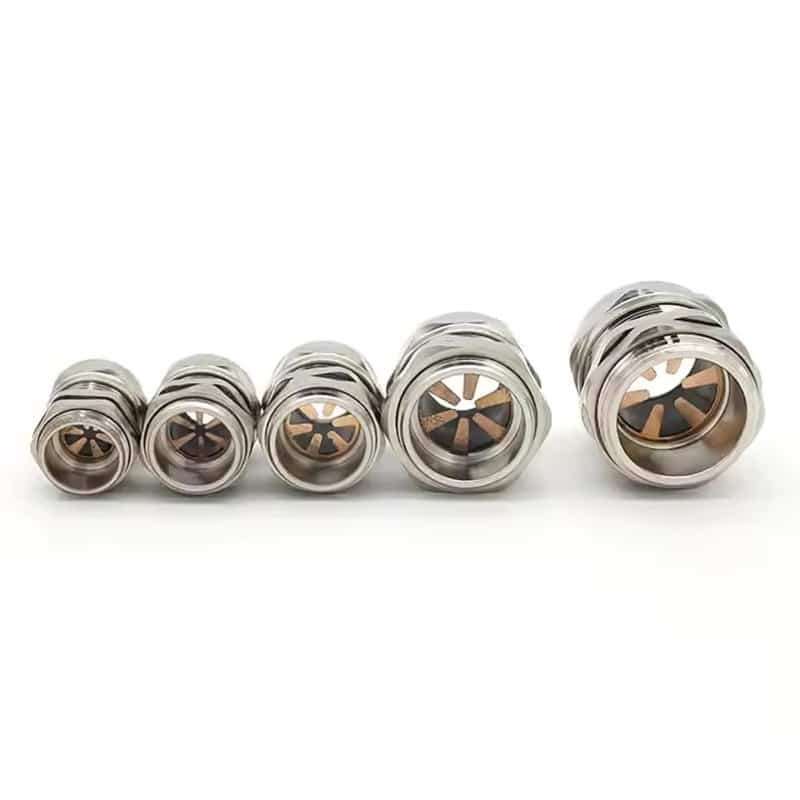
Unlike simple strain relief, cable glands are complete entry systems. They’re like the “front door” for cables entering electrical boxes, control panels, or junction boxes.
Key Functions of Cable Glands
Cable glands serve multiple critical functions:
- Environmental Sealing: Prevents water, dust, and chemicals from entering enclosures
- Strain Relief: Protects cables from mechanical stress (yes, they do this too!)
- Cable Retention: Securely holds cables in place
- EMC Shielding: Some models provide electromagnetic compatibility3 protection
- Fire Safety: Certain types maintain fire barriers
Cable Gland Construction
A typical cable gland consists of:
- Body: Threaded component that screws into the enclosure
- Sealing Elements: O-rings or gaskets for environmental protection
- Compression Ring: Grips the cable outer sheath
- Lock Nut: Secures the assembly
Our Cable Gland Product Range
At Bepto, we offer comprehensive cable gland solutions:
- Nylon Cable Glands: Cost-effective, IP68 rated, perfect for general industrial use
- Brass Cable Glands: Superior durability, excellent for marine and harsh environments
- Stainless Steel Cable Glands: Ultimate corrosion resistance for chemical processing
- Explosion-Proof Cable Glands: ATEX4 certified for hazardous area applications
- EMC Cable Glands: 360-degree shielding for sensitive electronic equipment
Key Differences Between Strain Relief and Cable Glands
Let me break down the fundamental differences that often confuse buyers:
Primary Function Comparison
| Aspect | Strain Relief | Cable Glands |
|---|---|---|
| Main Purpose | Mechanical protection only | Multi-function: sealing + protection + retention |
| Installation | Usually attached to cables/connectors | Mounted in enclosure walls |
| Environmental Protection | Minimal to none | IP65, IP66, IP67, IP ratings5 available |
| Cost | Lower cost | Higher cost due to complexity |
| Maintenance | Replace when damaged | Long-term solution, minimal maintenance |
Application Scenarios
Choose Strain Relief When:
- You need simple mechanical protection
- Budget is a primary concern
- Environmental sealing isn’t required
- Working with temporary installations
- Protecting individual cable connections
Choose Cable Glands When:
- Cables enter electrical enclosures
- Environmental protection is critical
- You need secure cable retention
- Working in harsh industrial environments
- Compliance with IP ratings is required
When Should You Use Each Component?
Based on my decade of experience helping customers worldwide, here’s my practical guidance:
Strain Relief Applications
Perfect for:
- Appliance power cords
- Temporary electrical connections
- Indoor control panels with minimal environmental exposure
- Cost-sensitive projects
- Retrofit applications where enclosure modification isn’t possible
Real Example: David’s automotive production line needed protection for robot arm cables that experienced constant flexing. Simple strain relief boots solved the problem at 30% of the cost of cable glands, since environmental sealing wasn’t needed in the controlled factory environment.
Cable Gland Applications
Essential for:
- Outdoor electrical installations
- Marine and offshore applications
- Chemical processing facilities
- Food and beverage industry (washdown environments)
- Hazardous area installations
- Any application requiring IP65+ protection
Real Example: A food processing plant in Germany needed cable entries for their control panels that would withstand daily high-pressure washdowns. Our IP68-rated nylon cable glands provided the perfect solution, maintaining seal integrity even under extreme cleaning conditions.
Can You Use Both Together?
Absolutely! In fact, this combination often provides the best protection for critical applications.
When to Use Both
Recommended for:
- High-vibration environments with environmental exposure
- Critical safety systems
- Long cable runs with multiple stress points
- Applications where cable replacement is extremely costly
Installation Best Practices
When using both components:
- Install cable gland first at the enclosure entry point
- Add strain relief at equipment connection points
- Ensure proper cable routing between components
- Verify environmental ratings match application requirements
- Test installation under expected operating conditions
The key is understanding that they complement each other – cable glands handle the enclosure interface and environmental protection, while strain relief manages mechanical stress at connection points.
Conclusion
The choice between electrical strain relief and cable glands doesn’t have to be complicated. Remember: strain relief is for mechanical protection, cable glands are for complete cable entry solutions with environmental sealing.
At Bepto, we’ve helped thousands of customers make the right choice for their specific applications. Whether you need simple strain relief boots for indoor applications or heavy-duty stainless steel cable glands for offshore platforms, we have the expertise and products to ensure your project succeeds.
The bottom line? Don’t let component confusion delay your project. When in doubt, reach out to our technical team – we’re here to help you choose the right solution for your specific needs.
FAQ
Q: Can I use strain relief instead of cable glands to save money?
A: Only if environmental sealing isn’t required. Strain relief provides mechanical protection but won’t prevent water, dust, or chemical ingress into electrical enclosures, which could cause dangerous failures.
Q: What IP rating do I need for outdoor cable gland installations?
A: For outdoor applications, choose IP65 minimum for dust and water jet protection. For areas with heavy rain or washdown requirements, IP67 or IP68 ratings provide submersion protection.
Q: How do I determine the right cable gland size?
A: Measure your cable’s outer diameter and match it to the gland’s cable range. Always verify thread size compatibility with your enclosure. Our technical team can help with sizing if you’re unsure.
Q: Are metal cable glands always better than plastic ones?
A: Not necessarily. Nylon cable glands offer excellent chemical resistance and are lighter weight. Metal glands provide superior mechanical strength and EMC shielding. Choose based on your specific environmental requirements.
Q: Can cable glands be reused if I need to change cables?
A: Quality cable glands can typically be reused several times, but sealing elements (O-rings, gaskets) should be replaced to maintain environmental protection. Always inspect components before reuse.
-
Learn about the specific electrical junctions where a wire or cable ends and connects to a device, which are most vulnerable to mechanical stress. ↩
-
Understand the properties of this polymer material commonly used in heat shrink tubing for its excellent insulating and chemical resistance capabilities. ↩
-
Read about the ability of electrical equipment to function properly in its electromagnetic environment without introducing intolerable electromagnetic disturbances. ↩
-
Review the European Union directives describing what equipment and work space is allowed in an environment with an explosive atmosphere. ↩
-
Explore the Ingress Protection (IP) rating system which classifies the degrees of protection provided against the intrusion of solid objects, dust, and water. ↩
