


Solar installers face devastating equipment failures, fire hazards, and insurance claim rejections when overcurrent conditions damage expensive inverters, combiner boxes, and solar panels due to inadequate circuit protection, leading to catastrophic system failures that can destroy entire installations worth hundreds of thousands of dollars. Without proper fuse protection, reverse current flow, ground faults, and short circuits create dangerous conditions that trigger arc faults, equipment burnout, and potential fire hazards that violate electrical codes and void equipment warranties, exposing installers to massive liability claims and regulatory penalties.
In-line fuses1 for MC4 connectors are essential safety devices that protect solar installations from overcurrent conditions by interrupting dangerous current flow before it can damage equipment or create fire hazards. These specialized fuses integrate directly into MC4 connector assemblies, providing string-level protection that prevents reverse current flow, limits fault current during ground faults, and ensures compliance with NEC requirements2 for photovoltaic system protection while maintaining the weatherproof integrity of outdoor installations.
Last month, I received an emergency call from Marcus Thompson, operations manager at a major solar EPC company in Phoenix, Arizona, who discovered that lightning-induced surges had destroyed 15 string inverters worth $180,000 because their installation lacked proper in-line fuse protection on individual strings. The insurance company initially denied the claim, citing inadequate overcurrent protection as a code violation, forcing Marcus to implement comprehensive fuse protection across their entire 2MW installation to prevent future losses and ensure code compliance! ⚡
Table of Contents
- What Are In-line Fuses for MC4 Connectors?
- When Do You Need In-line Fuses in Solar Installations?
- What Types of In-line MC4 Fuses Are Available?
- How Do You Select the Right Fuse Rating and Type?
- What Are the Installation Best Practices for MC4 In-line Fuses?
- FAQs About In-line Fuses for MC4 Connectors
What Are In-line Fuses for MC4 Connectors?
Understanding in-line MC4 fuses helps solar professionals implement proper overcurrent protection at the string level.
In-line fuses for MC4 connectors are specialized overcurrent protection devices that integrate directly into MC4 connector assemblies, providing individual string protection without requiring separate combiner boxes or fuse holders. These compact devices feature weatherproof housings rated for outdoor use, replaceable fuse elements rated for DC applications, and MC4-compatible connections that maintain system integrity while providing critical safety protection. Professional solar installations use in–line MC4 fuses to meet NEC requirements, protect expensive equipment from damage, and ensure safe operation under all operating conditions.
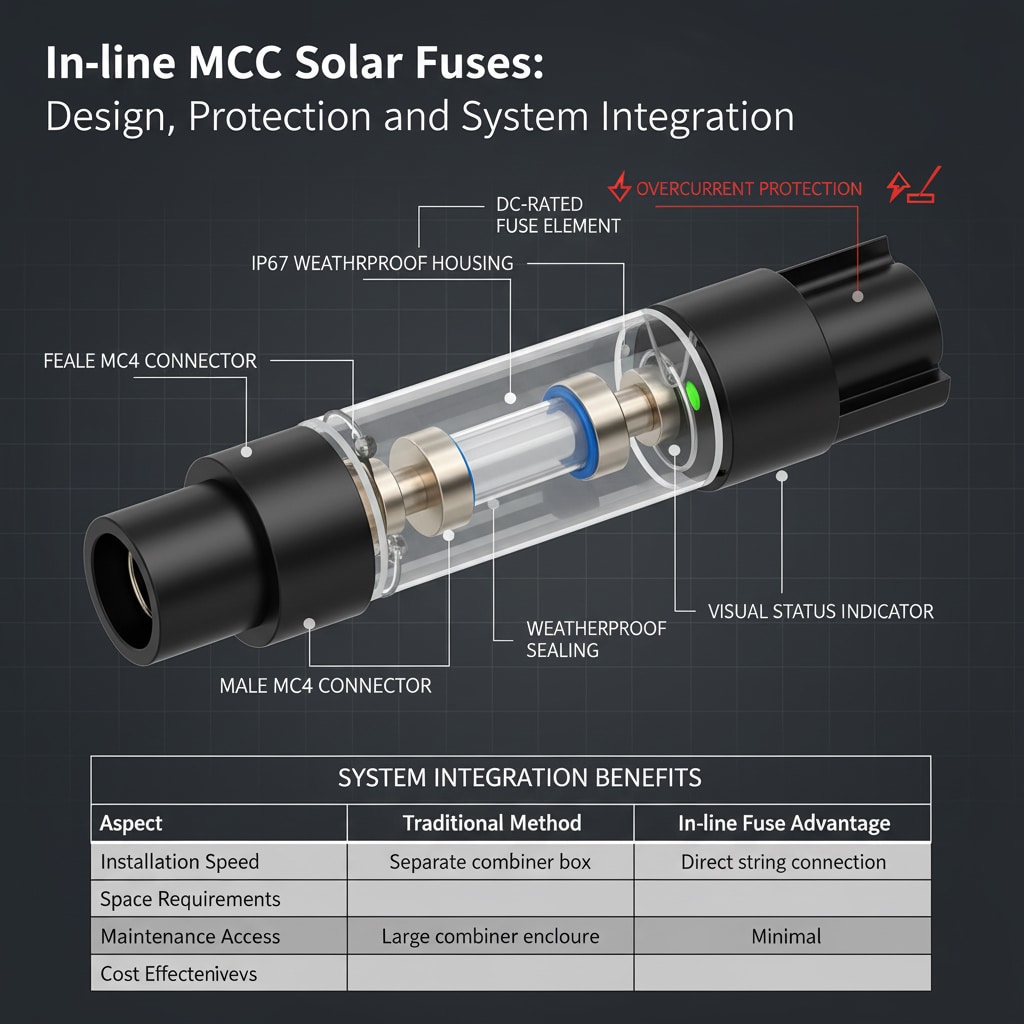
Design and Construction
Weatherproof Housing: In-line MC4 fuses feature IP67-rated housings that protect internal components from moisture, dust, and environmental contamination.
DC-Rated Elements: Specialized fuse elements designed for DC applications provide reliable interruption of fault currents without the arc extinction challenges of AC fuses.
Connector Integration: Standard MC4 connections on both ends allow seamless integration into existing solar installations without modification.
Visual Indicators: Many models include visual fuse status indicators that allow quick identification of blown fuses during maintenance inspections.
Protection Functions
Overcurrent Protection: Primary function involves interrupting excessive current flow that could damage downstream equipment or create fire hazards.
Reverse Current Prevention: Prevents reverse current flow from parallel strings that could damage solar panels during shading or failure conditions.
Ground Fault Limitation: Limits fault current during ground fault conditions to prevent equipment damage and reduce fire risk.
Arc Fault Mitigation: Reduces arc fault potential by quickly interrupting fault conditions before dangerous arcing can occur.
System Integration Benefits
| Integration Aspect | Benefit | Traditional Method | In-line Fuse Advantage |
|---|---|---|---|
| Installation Speed | 50% faster | Separate combiner box | Direct string connection |
| Space Requirements | Minimal | Large combiner enclosure | No additional space |
| Maintenance Access | String level | Centralized location | Distributed access |
| Cost Effectiveness | Lower total cost | High material/labor | Reduced components |
Technical Specifications
Current Ratings: Available in ratings from 10A to 30A to match various solar panel and string configurations.
Voltage Ratings: DC voltage ratings up to 1500V to accommodate high-voltage solar installations and future system expansions.
Interrupting Capacity3: High interrupting ratings ensure reliable fault current interruption under maximum fault conditions.
Temperature Performance: Operating temperature ranges from -40°C to +85°C for reliable performance in extreme environmental conditions.
Regulatory Compliance
NEC Requirements: In-line fuses help meet National Electrical Code requirements for overcurrent protection in photovoltaic systems.
UL Certification: UL-listed devices ensure compliance with safety standards and acceptance by authorities having jurisdiction.
International Standards: Many models meet IEC standards for international installations and export market requirements.
Insurance Acceptance: Proper fuse protection often reduces insurance premiums and ensures claim acceptance after equipment failures.
Working with Sarah Mitchell, chief electrical engineer at a leading solar manufacturer in Munich, Germany, I learned that implementing in-line MC4 fuses reduced their warranty claims by 35% while improving installation efficiency by eliminating the need for separate combiner boxes on smaller residential installations. Sarah’s team now specifies in-line fuses as standard practice for all string-level applications! 🔧
When Do You Need In-line Fuses in Solar Installations?
Determining when in-line fuses are required ensures code compliance and optimal system protection.
In-line fuses for MC4 connectors are required when NEC 690.9 mandates overcurrent protection for solar installations, typically in systems with three or more parallel strings, installations using combiner boxes without individual string fuses, residential systems requiring distributed protection, and commercial installations where centralized protection is impractical. Code requirements vary by system size, configuration, and local amendments, but in-line fuses provide the most flexible and cost-effective solution for meeting overcurrent protection requirements while maintaining system reliability and safety.
NEC Code Requirements
690.9 Overcurrent Protection: National Electrical Code requires overcurrent protection for photovoltaic systems under specific conditions and configurations.
Three-String Rule: Systems with three or more parallel strings typically require individual string overcurrent protection to prevent reverse current damage.
Maximum Series Fuse Rating: Fuse ratings must not exceed the maximum series fuse rating specified by solar panel manufacturers.
Equipment Protection: Overcurrent devices must protect both conductors and connected equipment from damage during fault conditions.
System Configuration Factors
Parallel String Count: More parallel strings increase the potential for reverse current flow and require individual string protection.
String Current Levels: Higher string currents increase the potential for damage and may require lower fuse ratings for adequate protection.
Panel Specifications: Solar panel maximum series fuse ratings determine the maximum allowable fuse size for string protection.
System Voltage: Higher system voltages may require specialized fuses with appropriate DC voltage ratings and interrupting capacity.
Installation Type Considerations
| Installation Type | Fuse Requirement | Typical Application | Protection Strategy |
|---|---|---|---|
| Residential (≤3 strings) | Often optional | Small rooftop systems | Panel-level or string-level |
| Residential (>3 strings) | Required | Large residential | In-line or combiner |
| Commercial | Required | Most installations | Distributed protection |
| Utility-Scale | Required | All installations | Centralized + distributed |
Environmental Factors
Lightning Exposure: Areas with high lightning activity benefit from enhanced overcurrent protection to limit surge damage.
Temperature Extremes: Extreme temperatures can affect fuse performance and may require temperature-compensated ratings.
Moisture Exposure: High-moisture environments require enhanced sealing and corrosion protection for reliable long-term operation.
Maintenance Access: Remote installations benefit from distributed protection that allows localized troubleshooting and repair.
Economic Considerations
Equipment Protection Value: High-value equipment installations justify additional protection costs to prevent expensive replacement.
Insurance Requirements: Some insurance policies require specific overcurrent protection levels to maintain coverage.
Maintenance Costs: Distributed protection can reduce maintenance costs by allowing targeted troubleshooting and component replacement.
System Downtime: In-line fuses can reduce system downtime by isolating faulted strings while allowing continued operation of healthy strings.
Special Applications
Rapid Shutdown Systems4: In-line fuses can integrate with rapid shutdown devices to provide combined protection and safety functions.
Monitoring Integration: Some in-line fuses include monitoring capabilities that provide real-time status information to system operators.
Retrofit Applications: Existing installations can be upgraded with in-line fuses to improve protection without major system modifications.
Mobile Installations: Portable and mobile solar systems benefit from integrated protection that travels with the equipment.
Working with Ahmed Al-Rashid, senior project manager for a major solar developer in Riyadh, Saudi Arabia, I discovered that implementing in-line fuses on their 100MW utility-scale project reduced commissioning time by 30% and eliminated the need for 50 separate combiner boxes, saving over $200,000 in material and installation costs while improving system reliability! 🌞
What Types of In-line MC4 Fuses Are Available?
Understanding available in-line MC4 fuse types helps select the optimal protection solution for specific applications.
In-line MC4 fuses are available in several types including standard overcurrent fuses with replaceable elements, combination fuse/disconnect devices with manual switching capability, smart fuses with monitoring and communication features, and specialized high-voltage fuses for utility-scale installations. Each type offers specific advantages for different applications, with standard fuses providing basic overcurrent protection, combination devices offering maintenance convenience, smart fuses enabling remote monitoring, and high-voltage models supporting large-scale commercial installations with enhanced safety and performance features.
Standard In-line Fuses
Basic Protection: Standard in-line fuses provide essential overcurrent protection with replaceable fuse elements and weatherproof housings.
Cost-Effective: Most economical option for basic overcurrent protection requirements in residential and small commercial installations.
Simple Operation: No complex features or controls – purely passive protection that operates automatically during overcurrent conditions.
Wide Availability: Standard fuses are readily available from multiple manufacturers with consistent specifications and performance.
Combination Fuse/Disconnect Devices
Dual Function: Combine overcurrent protection with manual disconnect capability for maintenance and troubleshooting convenience.
Safety Enhancement: Manual disconnect feature allows safe isolation of individual strings during maintenance without affecting other system components.
Visual Status: Clear visual indication of fuse status and switch position for quick assessment during inspections.
Maintenance Friendly: Simplified maintenance procedures with integrated disconnect eliminate need for separate isolation devices.
Smart In-line Fuses
| Feature Category | Standard Fuse | Smart Fuse | Advanced Smart Fuse |
|---|---|---|---|
| Overcurrent Protection | Yes | Yes | Yes |
| Status Monitoring | Visual only | Remote monitoring | Real-time analytics |
| Communication | None | Basic reporting | Full integration |
| Diagnostics | None | Fault detection | Predictive analysis |
High-Voltage Specialized Fuses
1500V Ratings: Designed for high-voltage installations with enhanced insulation and arc extinction capabilities.
Enhanced Safety: Additional safety features including arc fault detection and enhanced personnel protection during maintenance.
Commercial Grade: Heavy-duty construction for demanding commercial and utility-scale applications with extended service life.
Regulatory Compliance: Meet stringent safety and performance standards for high-voltage DC applications and utility interconnection.
Application-Specific Variants
Marine Grade: Corrosion-resistant materials and enhanced sealing for marine and coastal installations with salt spray exposure.
High-Temperature: Specialized materials and designs for extreme temperature environments including desert and industrial applications.
Rapid Shutdown Integration: Built-in rapid shutdown functionality to meet NEC 690.12 requirements for module-level shutdown.
Monitoring Compatible: Integration capabilities with popular solar monitoring systems for centralized status reporting and analysis.
Selection Criteria
Current Rating: Match fuse current rating to string characteristics and panel maximum series fuse specifications.
Voltage Rating: Ensure fuse voltage rating exceeds maximum system voltage including temperature and irradiance variations.
Environmental Rating: Select appropriate IP rating and temperature range for installation environment and climate conditions.
Feature Requirements: Determine need for monitoring, disconnect, or other advanced features based on system requirements and budget.
Performance Characteristics
Response Time: Fast-acting fuses provide quick response to overcurrent conditions while time-delay types prevent nuisance tripping.
I²t Rating5: Energy let-through characteristics determine downstream equipment protection during fault conditions.
Aging Characteristics: Long-term stability and performance degradation rates affect maintenance requirements and replacement intervals.
Temperature Compensation: Some fuses include temperature compensation to maintain consistent protection levels across operating temperature ranges.
Cost-Benefit Analysis
Initial Cost: Standard fuses offer lowest initial cost while smart fuses provide enhanced functionality at higher price points.
Installation Cost: In-line fuses reduce installation costs compared to separate combiner boxes and centralized protection schemes.
Maintenance Cost: Smart fuses can reduce maintenance costs through remote monitoring and predictive maintenance capabilities.
Total Cost of Ownership: Consider all costs including initial purchase, installation, maintenance, and replacement over system lifetime.
How Do You Select the Right Fuse Rating and Type?
Proper fuse selection ensures optimal protection while preventing nuisance tripping and maintaining system performance.
Selecting the right in-line MC4 fuse requires calculating the string short-circuit current, applying appropriate safety factors, verifying compatibility with solar panel maximum series fuse ratings, considering environmental conditions and temperature derating, and ensuring the fuse voltage rating exceeds maximum system voltage under all operating conditions. The fuse current rating should typically be 125-156% of the string maximum power current while not exceeding the panel manufacturer’s maximum series fuse rating, with proper consideration for temperature effects, aging factors, and coordination with other protective devices in the system.
Current Rating Calculations
String Maximum Current: Calculate based on solar panel specifications and number of panels in series configuration.
Short-Circuit Current: Use panel short-circuit current (Isc) multiplied by appropriate safety factors for system design conditions.
Temperature Factors: Account for temperature effects on both panel current output and fuse rating characteristics.
Safety Margins: Apply NEC-required safety factors including 125% continuous current rating and additional design margins.
Panel Compatibility Requirements
Maximum Series Fuse: Never exceed the solar panel manufacturer’s specified maximum series fuse rating under any conditions.
Warranty Compliance: Ensure fuse selection maintains panel warranty coverage and doesn’t void manufacturer guarantees.
Performance Impact: Select fuse ratings that don’t limit normal system performance or cause unnecessary power losses.
Coordination Requirements: Coordinate with other protective devices to ensure proper selectivity and system protection.
Environmental Considerations
| Environmental Factor | Impact on Selection | Mitigation Strategy | Rating Adjustment |
|---|---|---|---|
| High Temperature | Reduces fuse capacity | Temperature derating | 10-20% reduction |
| Low Temperature | Affects response time | Cold weather rating | Verify specifications |
| Humidity/Moisture | Corrosion potential | Enhanced sealing | IP67+ rating |
| UV Exposure | Material degradation | UV-resistant materials | Extended life rating |
Voltage Rating Selection
System Maximum Voltage: Calculate maximum system voltage including temperature coefficients and irradiance effects.
Safety Margins: Apply appropriate safety margins to account for voltage variations and transient conditions.
Future Expansion: Consider potential system expansions that might increase operating voltage levels.
Standard Ratings: Select from standard voltage ratings that provide adequate margin above maximum system voltage.
Application-Specific Requirements
Residential Systems: Typically require 15-20A fuses for standard residential panel configurations and string sizes.
Commercial Systems: May require 20-30A fuses depending on panel specifications and string configuration optimization.
Utility-Scale Systems: Often use specialized high-current fuses with enhanced interrupting capacity and monitoring features.
Special Applications: Marine, mobile, or industrial applications may require specialized fuse types with enhanced environmental protection.
Performance Optimization
I²t Coordination: Ensure fuse I²t characteristics provide adequate protection for downstream equipment during fault conditions.
Selectivity Analysis: Verify proper coordination with upstream and downstream protective devices to prevent unnecessary outages.
Aging Factors: Account for fuse aging characteristics that may affect long-term performance and protection levels.
Replacement Planning: Develop replacement schedules based on manufacturer recommendations and field experience data.
Quality and Certification
UL Listing: Ensure fuses carry appropriate UL listings for photovoltaic applications and meet safety standards.
Manufacturer Reputation: Select fuses from established manufacturers with proven track records in solar applications.
Technical Support: Choose suppliers that provide comprehensive technical support and application assistance.
Warranty Coverage: Evaluate warranty terms and conditions to ensure adequate protection for your investment.
At Bepto, we work closely with solar installers to ensure proper fuse selection for their specific applications. Our technical team provides detailed application guides and selection tools that help customers choose the optimal in–line MC4 fuses for their installations, ensuring code compliance, equipment protection, and long-term reliability! 🔧
What Are the Installation Best Practices for MC4 In-line Fuses?
Following proper installation procedures ensures reliable performance and long-term protection from in-line MC4 fuses.
Installation best practices for MC4 in-line fuses include proper placement at the positive conductor of each string near the solar panels, ensuring adequate clearance for maintenance access, using proper torque specifications for connector assembly, implementing appropriate strain relief to prevent mechanical stress, and following manufacturer guidelines for environmental protection and mounting orientation. Professional installations require proper documentation, testing procedures, and compliance with local electrical codes while maintaining the weatherproof integrity of all connections and ensuring easy access for future maintenance and fuse replacement operations.
Placement and Location
String Positioning: Install in-line fuses on the positive conductor of each string as close to the solar panels as practical.
Accessibility Requirements: Ensure adequate clearance around fuses for safe maintenance access and fuse replacement procedures.
Environmental Protection: Position fuses to minimize exposure to direct sunlight, moisture accumulation, and mechanical damage.
Code Compliance: Follow NEC requirements for fuse placement and accessibility while maintaining proper working clearances.
Mechanical Installation
Connector Assembly: Use proper assembly techniques and torque specifications to ensure reliable electrical connections.
Strain Relief: Implement appropriate strain relief methods to prevent mechanical stress on fuse housings and connections.
Support Systems: Provide adequate mechanical support to prevent damage from wind loading and thermal cycling.
Orientation: Follow manufacturer recommendations for mounting orientation to ensure proper operation and drainage.
Installation Procedures
| Installation Step | Requirement | Tools Needed | Quality Check |
|---|---|---|---|
| Pre-installation | System de-energized | Voltage tester | Zero energy verified |
| Connector prep | Clean connections | Contact cleaner | Visual inspection |
| Fuse installation | Proper orientation | Torque wrench | Connection integrity |
| Final testing | Continuity check | Multimeter | Performance verification |
Safety Procedures
Lockout/Tagout: Implement proper LOTO procedures to ensure system is de-energized during installation.
Personal Protection: Use appropriate PPE including electrical gloves and arc flash protection during installation.
Team Communication: Establish clear communication protocols between installation team members during safety-critical operations.
Emergency Procedures: Ensure emergency response procedures are in place and all team members understand emergency protocols.
Testing and Commissioning
Continuity Testing: Verify electrical continuity through fuse assemblies before system energization.
Insulation Testing: Perform insulation resistance testing to verify proper installation and prevent ground faults.
Load Testing: Conduct initial load testing to verify proper fuse operation under normal operating conditions.
Documentation: Complete comprehensive documentation including fuse locations, ratings, and installation details.
Quality Assurance
Visual Inspection: Conduct thorough visual inspections of all connections and mechanical installations.
Torque Verification: Verify all connections meet specified torque requirements using calibrated torque tools.
Environmental Sealing: Ensure all connections maintain proper environmental sealing and weather protection.
Code Compliance: Verify installation meets all applicable electrical codes and manufacturer requirements.
Maintenance Considerations
Access Planning: Design installations to provide easy access for future maintenance and fuse replacement operations.
Spare Parts: Maintain adequate inventory of replacement fuses and components for quick repair operations.
Maintenance Schedules: Establish regular inspection and maintenance schedules based on manufacturer recommendations.
Documentation Systems: Implement systems for tracking fuse installations, replacements, and maintenance activities.
Common Installation Errors
Improper Placement: Installing fuses in locations that don’t provide adequate protection or violate code requirements.
Poor Connections: Inadequate connection torque or contaminated connections that create high resistance and potential failures.
Environmental Exposure: Failing to provide adequate environmental protection leading to premature failure and safety hazards.
Access Limitations: Installing fuses in locations that prevent safe maintenance access and fuse replacement procedures.
Conclusion
In-line fuses for MC4 connectors provide essential overcurrent protection that ensures safe, reliable operation of solar installations while meeting National Electrical Code requirements and protecting valuable equipment investments. Proper selection based on string characteristics, environmental conditions, and system requirements ensures optimal performance while preventing equipment damage and safety hazards. Professional installation following established best practices maximizes the effectiveness of in-line fuse protection while maintaining long-term reliability and compliance with safety standards. The relatively small investment in quality in-line MC4 fuses provides significant protection value that far exceeds the cost, making them an essential component of any professional solar installation that prioritizes safety, reliability, and code compliance.
FAQs About In-line Fuses for MC4 Connectors
Q: Do I need in-line fuses if my solar system has a combiner box with fuses?
A: You may still need in-line fuses depending on your system configuration and local code requirements. Systems with three or more parallel strings often require individual string protection even with combiner box fuses to prevent reverse current damage and ensure proper overcurrent coordination.
Q: What size fuse should I use for my solar string?
A: Select a fuse rated at 125-156% of your string’s maximum power current, but never exceed the solar panel manufacturer’s maximum series fuse rating. For example, if your string produces 8A maximum, use a 10-12A fuse, provided your panels are rated for that fuse size.
Q: Can I replace a blown in-line MC4 fuse myself?
A: Yes, but only after properly de-energizing the system and following lockout/tagout procedures. Always use the exact same fuse type and rating as specified in your system design, and investigate the cause of fuse failure before re-energizing the system.
Q: How often should I inspect my in-line MC4 fuses?
A: Inspect in-line fuses during regular system maintenance, typically annually or as recommended by the manufacturer. Look for signs of overheating, corrosion, or physical damage, and verify that visual indicators show proper fuse status.
Q: Are in-line MC4 fuses required by electrical code?
A: Requirements vary by system size and configuration, but NEC 690.9 typically requires overcurrent protection for systems with three or more parallel strings. Check with your local authority having jurisdiction for specific requirements in your area, as local amendments may impose additional requirements.
-
Learn the basics of in-line fuses, which are protective devices housed in a compact holder that can be inserted directly into a circuit’s wiring. ↩
-
Learn about the National Electrical Code (NEC), the benchmark for safe electrical design, installation, and inspection to protect people and property from electrical hazards. ↩
-
Understand the Interrupting Capacity (or Breaking Capacity) of a fuse, which is the maximum current that the fuse can safely interrupt without rupturing. ↩
-
Explore the requirements of NEC 690.12 for Rapid Shutdown Systems, a safety function designed to de-energize solar arrays quickly for firefighter safety. ↩
-
Discover what the I²t (Ampere Squared Seconds) rating of a fuse signifies, a measure of the thermal energy that a fuse can withstand during a short-circuit event. ↩