

Introduction
Have you ever faced a project delay because a cable gland failed to maintain its seal, letting water or dust compromise your equipment? Choosing the wrong O-ring material for your brass glands can lead to leaks, corrosion, or even catastrophic failures in harsh environments.
The right O-ring material for brass glands depends on your application’s temperature range, chemical exposure, and sealing requirements—NBR excels in oil resistance, while Silicone handles extreme temperatures better.
As Samuel, Sales Director at Zhejiang Bepto Import and Export Co., Ltd., I’ve guided countless clients through this decision. We often see confusion about which material offers the best performance for specific conditions. Let’s dive into the properties of NBR and Silicone O-rings to help you make an informed choice and avoid costly mistakes.
Table of Contents
- What Are O-Rings in Brass Cable Glands?
- Why Does O-Ring Material Matter for Performance?
- How Do NBR and Silicone Compare for Your Application?
- How to Install and Maintain O-Rings Properly?
- Conclusion
What Are O-Rings in Brass Cable Glands?
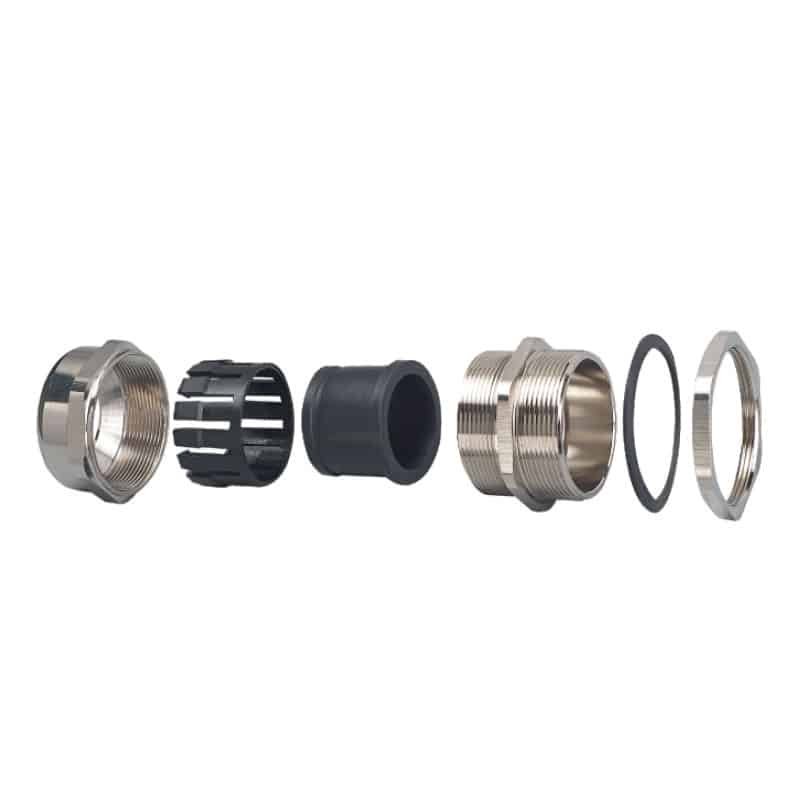
Let’s start with the basics. An O-ring in a brass cable gland is a small but critical component—a circular rubber seal that sits between the gland body and the enclosure surface. Its primary role is to prevent the ingress of water, dust, or gases, ensuring the gland maintains its IP681 rating.
Key Characteristics
At Bepto, our brass glands—made from high-quality CuZn39Pb3 nickel-plated brass—are designed to work seamlessly with O-rings for optimal sealing. Here’s what defines their importance:
Material Compatibility: The O-ring must resist deformation and chemical breakdown when paired with brass.
Compression Set2: It needs to maintain elasticity under constant pressure to avoid leaks over time.
Size Standards: Typically follows metric or ISO standards to match gland dimensions (e.g., M20 glands use specific inner diameters).
Why Brass Glands Need Quality O-Rings
Brass, while corrosion-resistant due to nickel plating, can still face galvanic corrosion3 if moisture penetrates. A subpar O-ring material can degrade, allowing environmental factors to breach the seal. This is why we rigorously test our glands under TUV and ATEX standards to ensure reliability.

Why Does O-Ring Material Matter for Performance?
The O-ring material directly impacts the longevity and reliability of your brass cable gland. Two of the most common materials we use at Bepto are NBR (Nitrile Butadiene Rubber4) and Silicone. Each has unique chemical and physical properties that make them suitable for different environments.
NBR vs. Silicone: A Detailed Comparison
Let’s break down the core differences between these materials with data derived from our internal testing and industry standards:
| Property | NBR (Nitrile Rubber) | Silicone Rubber |
|---|---|---|
| Temperature Range | -30°C to +100°C | -60°C to +200°C |
| Oil Resistance | Excellent (resists petroleum, fuels) | Poor (swells with hydrocarbons) |
| Chemical Resistance | Good (acids, alkalis, solvents) | Moderate (limited solvent resistance) |
| Weathering/Ozone | Poor (cracks under UV exposure5) | Excellent (UV and ozone resistant) |
| Cost | More cost-effective | Higher cost due to performance |
| Typical Use | Industrial, automotive | Food-grade, extreme climates |
Real-World Impact: A Client’s Lesson
I recall working with David, a procurement manager for an industrial automation firm. David needed brass glands for a factory setup with frequent exposure to hydraulic oils. Initially, he considered Silicone O-rings due to their broader temperature tolerance.
After reviewing his specs, I recommended NBR O-rings. “David, your primary concern is oil exposure, not extreme heat. NBR will hold up better and save you 15% on costs,” I explained. He agreed, and after installation, his team reported zero leaks even after six months of heavy use. This choice directly addressed his pain point of balancing quality with budget.
How Do NBR and Silicone Compare for Your Application?
Choosing between NBR and Silicone isn’t just about lab data; it’s about matching the material to your project’s environment. Let’s explore how these materials perform in specific scenarios.
Understanding Application Needs
1. Temperature Extremes
- Silicone Wins: If your brass glands are installed in environments below -30°C (think Arctic oil rigs) or above +100°C (like near industrial furnaces), Silicone is non-negotiable. Its thermal stability prevents cracking or softening.
- NBR Limits: NBR becomes brittle in extreme cold and loses elasticity in high heat, risking seal failure.
2. Chemical Exposure
- NBR Excels: For applications involving oils, fuels, or mild acids—common in automotive or manufacturing—NBR’s resistance to swelling ensures a tight seal.
- Silicone Struggles: Silicone can degrade with prolonged hydrocarbon exposure, making it unsuitable for oily environments.
3. Outdoor vs. Indoor Use
- Silicone for Outdoors: UV and ozone resistance make Silicone ideal for Marine or Solar installations exposed to weather.
- NBR for Indoors: NBR suffices for controlled indoor settings like factory floors but degrades faster outside.
Industry-Specific Recommendations
At Bepto, we’ve supplied glands for diverse sectors:
- Industrial Automation: NBR is often preferred for its durability against lubricants.
- Marine Applications: Silicone O-rings are critical due to saltwater and temperature swings.
- Explosion-Proof Zones: Both can work if paired with ATEX-certified glands, but material choice hinges on chemical hazards.
A Quality-First Perspective
Hassan, a business owner in the petrochemical sector, approached us after a project failure due to inferior O-rings. “Samuel, I can’t risk another leak in an explosion-proof zone,” he stressed. Safety was his priority.
We recommended NBR O-rings for his brass glands, given the oil-rich environment and moderate temperatures. Our glands, tested for IP68 sealing under extreme pressure, paired with NBR, passed his rigorous on-site evaluations. Hassan’s trust in TUV-certified components was validated, preventing costly rework.
How to Install and Maintain O-Rings Properly?
Even the best O-ring material fails if installed incorrectly. Here’s how to ensure your brass glands perform as intended.
Installation Steps
- Inspect the O-Ring: Check for cuts or deformities before installation. A damaged O-ring compromises the seal.
- Clean the Surface: Ensure the gland and enclosure are free of debris or oil that could interfere with sealing.
- Lubricate Sparingly: Use a compatible lubricant (avoid petroleum-based for Silicone) to ease placement without over-stretching.
- Torque Correctly: Tighten the gland to the manufacturer’s spec (e.g., Bepto’s M20 glands require 5-7 Nm) to avoid over-compressing the O-ring.
Common Mistakes to Avoid
- Over-Tightening: Excessive torque flattens the O-ring, causing permanent deformation and leaks.
- Wrong Material Match: Installing Silicone in an oil-heavy environment will lead to swelling and failure.
- Ignoring Replacement Cycles: O-rings degrade over time. Replace them during routine maintenance, especially in harsh conditions.
Bepto’s Quality Assurance
Our brass glands undergo ISO9001 and IATF16949 quality checks, ensuring O-rings fit perfectly. We also offer replacement kits for both NBR and Silicone, tailored to your gland size, so maintenance is hassle-free.
Conclusion
Selecting the right O-ring material for your brass cable glands boils down to understanding your environment. NBR is your go-to for oil resistance and cost-efficiency, while Silicone shines in extreme temperatures and outdoor durability. At Bepto, we’re committed to guiding you with precision-engineered solutions.
Struggling to decide? Reach out to our team for personalized recommendations and ensure your next project is sealed for success.
FAQs
Q: Is NBR or Silicone better for brass cable glands in oily environments?
A: NBR is better for oily environments. It resists swelling from petroleum and fuels, ensuring a reliable seal, while Silicone can degrade under similar conditions.
Q: Can Silicone O-rings handle freezing temperatures for brass glands?
A: Yes, Silicone O-rings perform well in freezing temperatures down to -60°C, making them ideal for cold environments where NBR would become brittle.
Q: Are NBR O-rings suitable for outdoor brass gland installations?
A: No, NBR isn’t ideal for outdoor use. It cracks under UV and ozone exposure. Silicone is a better choice for weathering in outdoor settings.
Q: Do Bepto brass glands come with NBR or Silicone O-rings by default?
A: At Bepto, most brass glands come with NBR O-rings as standard due to cost and common industrial use. Silicone is available upon request.
Q: How often should I replace O-rings in brass cable glands?
A: Replace O-rings every 1-2 years or during maintenance, especially in harsh conditions. Inspect regularly for cracks or deformation to prevent seal failure.
Learn about the specific protection levels against dust and water submersion defined by the IP68 rating. ↩
Discover how compression set measurements determine an O-ring’s ability to maintain a seal over time. ↩
Explore the chemical process of galvanic corrosion and how proper sealing prevents metal degradation. ↩
Understand the chemical structure and versatile performance characteristics of nitrile butadiene rubber. ↩
Read about how UV radiation causes photo-degradation and cracking in standard rubber materials. ↩
