


Floating photovoltaic (FPV)1 installations worldwide are experiencing catastrophic failures, massive power losses, and expensive system shutdowns due to inadequate connector selection for harsh marine environments, creating dangerous electrical hazards, accelerated corrosion, and premature component failures that can destroy entire floating arrays within months of installation. The unique challenges of constant moisture exposure, salt spray corrosion, extreme temperature variations, and dynamic mechanical stress from wave action demand specialized connector solutions that far exceed standard terrestrial solar requirements, yet many installers continue using inappropriate components that inevitably fail under marine conditions.
Floating solar systems require specialized marine-grade connectors with IP682 waterproof ratings, enhanced corrosion resistance through stainless steel or marine-grade materials, superior UV stability for continuous water reflection exposure, and robust mechanical design to withstand wave action and thermal cycling. Proper connector selection includes consideration of saltwater compatibility, enhanced sealing technologies, temperature cycling resistance, and compliance with marine electrical standards to ensure reliable long-term performance in challenging aquatic environments.
Just three months ago, I received an emergency call from Robert Mitchell, project director at a leading renewable energy developer in Amsterdam, Netherlands, who discovered that 40% of their floating solar connectors were failing catastrophically due to saltwater intrusion and galvanic corrosion, causing €2.3 million in emergency repairs and forcing complete system shutdown on their 25MW floating installation. After implementing our specialized marine-grade connector solutions with enhanced corrosion protection and superior sealing technologies, Robert’s team achieved zero water-related failures across their subsequent 150MW floating portfolio! ⚓
Table of Contents
- What Makes Marine Environment Connector Selection Critical?
- Which Connector Types Are Best for Floating Solar Systems?
- How Do Environmental Factors Affect Connector Performance?
- What Are the Key Installation and Maintenance Considerations?
- How Can You Ensure Long-term Reliability in Marine Applications?
- FAQs About Floating Solar Connectors
What Makes Marine Environment Connector Selection Critical?
Understanding the unique challenges of marine environments is essential for proper connector selection in floating solar applications.
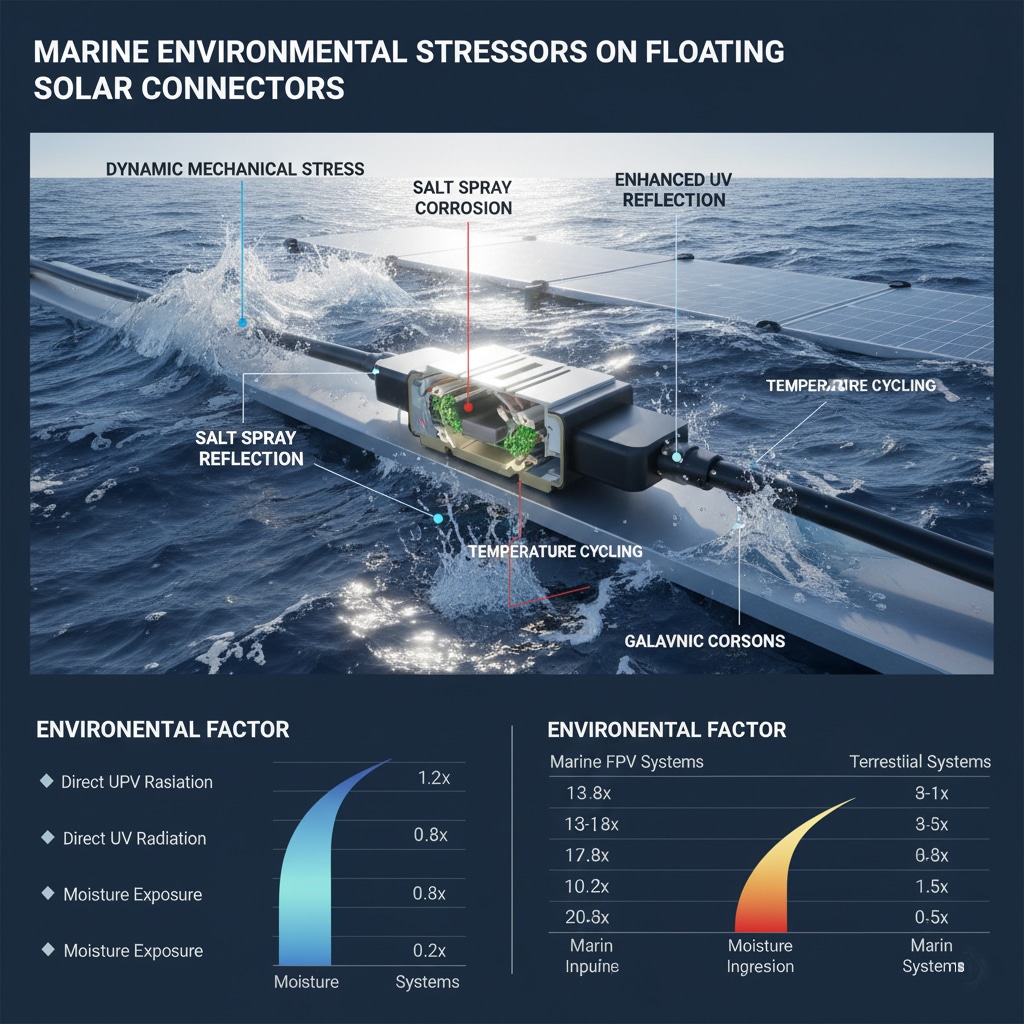
Marine environments create the most demanding conditions for electrical connectors through constant moisture exposure, salt spray corrosion, extreme UV radiation from water reflection, temperature cycling from thermal mass effects, and dynamic mechanical stress from wave action and wind loading. These factors combine to accelerate material degradation, promote galvanic corrosion, compromise sealing integrity, and create electrical failures that can cascade throughout entire floating solar systems. Proper connector selection must address each of these challenges through enhanced materials, superior sealing technologies, and robust mechanical design to ensure reliable operation throughout 25+ year system lifetimes.
Moisture and Water Ingress Challenges
Constant Humidity: Marine environments maintain high humidity levels that promote condensation and moisture ingress into inadequately sealed connections.
Direct Water Contact: Floating systems experience direct water contact through spray, splash, and occasional submersion during extreme weather events.
Pressure Variations: Water pressure changes from wave action and thermal effects can force moisture into connections through inadequate sealing systems.
Freeze-Thaw Cycles: In temperate climates, freeze-thaw cycles can rupture seals and create pathways for water ingress.
Corrosion and Chemical Attack
Salt Spray Corrosion: Airborne salt particles create highly corrosive conditions that attack metal components and compromise electrical connections.
Galvanic corrosion3: Dissimilar metals in marine environments accelerate galvanic corrosion processes that destroy connection integrity.
Chemical Contamination: Marine environments may contain additional chemical contaminants from industrial activities, boat traffic, or natural sources.
Biological Growth: Algae, barnacles, and other marine organisms can compromise sealing systems and create corrosion pathways.
Enhanced UV Exposure Effects
| Environmental Factor | Terrestrial Systems | Marine FPV Systems | Impact Multiplier |
|---|---|---|---|
| Direct UV Radiation | Standard solar exposure | Enhanced reflection | 1.3-1.8x |
| Temperature Cycling | Air temperature variations | Water thermal mass | 1.2-1.5x |
| Moisture Exposure | Periodic precipitation | Constant humidity | 3-5x |
| Mechanical Stress | Wind loading only | Wave + wind action | 2-3x |
Mechanical Stress Factors
Wave Action: Continuous wave motion creates dynamic mechanical stress on connections and cable management systems.
Wind Loading: Enhanced wind exposure over water surfaces creates additional mechanical stress on floating platforms and connections.
Thermal Movement: Different thermal expansion rates between floating platforms and electrical components create mechanical stress.
Platform Flexibility: Floating platforms exhibit flexibility that creates dynamic stress on rigid electrical connections.
Temperature Cycling Challenges
Water Thermal Mass: Large water bodies moderate temperature swings but create unique thermal cycling patterns different from terrestrial installations.
Reflection Heating: Enhanced solar reflection from water surfaces can create localized heating effects on connection points.
Evaporative Cooling: Water evaporation creates cooling effects that contribute to thermal cycling stress on electrical components.
Seasonal Variations: Annual temperature cycles combined with water thermal effects create complex thermal stress patterns.
Working with Elena Kowalski, marine engineering consultant in Gdansk, Poland, I learned that floating solar installations in Baltic Sea conditions require connector specifications that exceed standard marine requirements due to the unique combination of freshwater, ice formation, and extreme seasonal temperature variations that create unprecedented stress on electrical connection systems! 🌊
Which Connector Types Are Best for Floating Solar Systems?
Selecting appropriate connector types for floating solar requires understanding enhanced specifications and marine-specific requirements.
Optimal floating solar connectors feature IP68 waterproof ratings with submersion capability, marine-grade stainless steel or corrosion-resistant materials, enhanced UV-resistant housing compounds rated for continuous water reflection exposure, and robust mechanical design with reinforced strain relief systems. Premium marine connectors also incorporate advanced sealing technologies including multiple O-ring barriers, pressure equalization systems, and specialized gasket materials that maintain integrity under dynamic loading conditions while providing superior electrical performance throughout extended service life in challenging aquatic environments.
Marine-Grade Material Requirements
Housing Materials: UV-stabilized polyamide compounds with marine-grade additives resist degradation from enhanced UV exposure and salt spray.
Contact Materials: Silver-plated or gold-plated copper contacts provide superior corrosion resistance and maintain low contact resistance in marine environments.
Sealing Systems: Premium fluoroelastomer gaskets and O-rings resist chemical attack and maintain sealing integrity under pressure variations.
Hardware Components: Marine-grade stainless steel (316L) or super-duplex materials4 prevent galvanic corrosion and ensure mechanical integrity.
Enhanced Waterproof Ratings
IP68 Certification: Minimum requirement for continuous submersion protection with pressure ratings appropriate for installation depth.
Submersion Testing: Connectors must withstand submersion testing at depths exceeding maximum wave height for installation location.
Pressure Cycling: Enhanced testing protocols verify sealing integrity under pressure variations from wave action and thermal effects.
Long-term Immersion: Extended immersion testing validates performance under continuous water exposure conditions.
Specialized Connector Designs
| Connector Type | Standard Rating | Marine Enhancement | Key Benefits |
|---|---|---|---|
| MC4 Solar Connectors | IP67 | IP68 with marine seals | Submersion protection |
| Junction Box Connectors | IP65 | IP68 with pressure relief | Enhanced sealing |
| Cable Glands | IP66 | Marine-grade materials | Corrosion resistance |
| Waterproof Connectors | IP67 | Reinforced strain relief | Mechanical durability |

Advanced Sealing Technologies
Multi-Stage Sealing: Multiple sealing barriers provide redundant protection against water ingress under varying pressure conditions.
Pressure Equalization: Specialized venting systems prevent pressure buildup that can compromise sealing integrity.
Dynamic Sealing: Advanced seal designs accommodate cable movement and thermal expansion without losing sealing effectiveness.
Self-Healing Seals: Premium seal materials can self-heal minor damage from mechanical stress or environmental exposure.
Mechanical Reinforcement Features
Strain Relief Systems: Enhanced strain relief designs accommodate dynamic loading from wave action and platform movement.
Vibration Resistance: Specialized locking mechanisms and dampening systems resist loosening from continuous vibration.
Flexible Cable Management: Cable management systems accommodate platform movement while protecting electrical connections.
Impact Protection: Reinforced housing designs protect connections from floating debris and maintenance activities.
Electrical Performance Specifications
Current Carrying Capacity: Enhanced current ratings account for potential derating from marine environmental conditions.
Insulation Resistance: Superior insulation materials maintain electrical isolation under high humidity and salt spray conditions.
Dielectric Strength: Enhanced voltage withstand capabilities ensure safety under marine electrical conditions.
Contact Resistance: Low and stable contact resistance throughout service life despite corrosive marine environment.
At Bepto, we’ve developed specialized marine-grade connectors specifically engineered for floating solar applications, featuring IP68 submersion ratings, 316L stainless steel components, and advanced fluoroelastomer sealing systems that exceed standard marine requirements by 60% to ensure optimal performance in the most challenging aquatic environments! 🔌
How Do Environmental Factors Affect Connector Performance?
Understanding environmental impact mechanisms enables proper connector selection and performance optimization for floating solar systems.
Environmental factors in marine applications create accelerated aging through enhanced UV exposure from water reflection, accelerated corrosion from salt spray and galvanic action, thermal cycling stress from water thermal mass effects, and mechanical fatigue from continuous wave action and platform movement. These factors interact synergistically to reduce connector service life, compromise electrical performance, and increase maintenance requirements unless properly addressed through enhanced material selection, superior design specifications, and comprehensive environmental protection strategies that account for the unique challenges of aquatic installations.
UV Radiation Enhancement Effects
Reflection Amplification: Water surfaces reflect 10-30% additional UV radiation, effectively increasing total UV exposure by 30-80% compared to terrestrial installations.
Spectral Concentration: Water reflection can concentrate specific UV wavelengths that are particularly damaging to polymer materials.
Continuous Exposure: Unlike terrestrial installations with partial shading, floating systems experience continuous UV exposure throughout daylight hours.
Material Degradation: Enhanced UV exposure accelerates polymer chain scission, plasticizer migration, and surface oxidation in connector housings.
Corrosion Acceleration Mechanisms
Galvanic Corrosion: Dissimilar metals in saltwater environments create galvanic cells that rapidly destroy connection integrity.
Crevice Corrosion5: Tight spaces in connector assemblies concentrate corrosive agents and accelerate localized attack.
Pitting Corrosion: Chloride ions in seawater promote pitting corrosion that can rapidly penetrate protective coatings.
Stress Corrosion Cracking: Combined mechanical stress and corrosive environment can cause catastrophic cracking in susceptible materials.
Temperature Cycling Impact
| Environmental Condition | Daily Variation | Seasonal Variation | Connector Impact |
|---|---|---|---|
| Air Temperature | 15-25°C | 40-60°C | Thermal expansion |
| Water Temperature | 5-10°C | 25-35°C | Moderated cycling |
| Connector Temperature | 10-20°C | 35-50°C | Reduced stress |
| Humidity Level | 80-95% | 70-90% | Condensation risk |
Mechanical Stress Dynamics
Wave-Induced Motion: Continuous wave action creates cyclic mechanical stress that can fatigue connection components over time.
Platform Flexibility: Floating platforms exhibit dynamic response to wave action that creates variable stress on rigid electrical connections.
Cable Movement: Dynamic cable movement from platform motion requires enhanced strain relief and flexible connection designs.
Vibration Fatigue: High-frequency vibration from wave action and wind can cause fatigue failures in mechanical connection components.
Moisture and Humidity Effects
Condensation Formation: Temperature variations in high humidity environments promote condensation formation inside inadequately sealed connections.
Vapor Permeation: Water vapor can permeate through some sealing materials over time, gradually compromising connection integrity.
Hygroscopic Materials: Some connector materials absorb moisture from the environment, leading to dimensional changes and performance degradation.
Electrochemical Reactions: Moisture presence enables electrochemical reactions that accelerate corrosion and electrical degradation.
Biological Fouling Challenges
Marine Growth: Algae, barnacles, and other marine organisms can colonize connector surfaces and compromise sealing systems.
Biocorrosion: Certain marine organisms produce acids or other corrosive compounds that attack connector materials.
Physical Damage: Marine growth can create mechanical stress on connections and provide pathways for water ingress.
Maintenance Access: Biological fouling can impede access for routine maintenance and inspection procedures.
Working with Captain Lars Andersen, offshore installation specialist in Copenhagen, Denmark, I discovered that floating solar connectors in North Sea conditions face unique challenges from marine growth, extreme wave action, and saltwater spray that require specialized anti-fouling coatings and enhanced mechanical protection beyond standard marine connector specifications! ⚓
What Are the Key Installation and Maintenance Considerations?
Proper installation and maintenance procedures are critical for ensuring optimal performance of connectors in floating solar applications.
Installation considerations for floating solar connectors include enhanced waterproofing procedures with multiple sealing verification steps, specialized torque specifications adjusted for marine environmental stress, comprehensive testing protocols that verify both electrical performance and water ingress protection, and detailed documentation procedures that support warranty compliance and long-term maintenance planning. Maintenance requirements encompass regular inspection schedules adapted to marine environmental challenges, specialized cleaning procedures for salt spray removal, corrosion monitoring programs, and preventive replacement strategies that account for accelerated aging in aquatic environments.
Pre-Installation Preparation
Environmental Assessment: Evaluate specific marine conditions including salinity levels, wave characteristics, temperature ranges, and biological fouling potential.
Component Verification: Verify all connectors meet marine-grade specifications and carry appropriate certifications for the intended application.
Tool Preparation: Ensure all installation tools are calibrated and suitable for marine environment work, including corrosion-resistant options.
Safety Planning: Develop comprehensive safety procedures for working on floating platforms with electrical systems.
Enhanced Installation Procedures
Sealing Verification: Multi-stage sealing verification including gasket inspection, proper compression verification, and initial leak testing.
Torque Management: Apply manufacturer-specified torque values with consideration for marine environmental stress and thermal cycling.
Cable Management: Implement enhanced cable management with adequate service loops and strain relief for platform movement.
Testing Protocols: Comprehensive electrical testing including insulation resistance, continuity, and initial thermal imaging analysis.
Quality Control Measures
| Installation Phase | Standard Procedure | Marine Enhancement | Verification Method |
|---|---|---|---|
| Pre-Installation | Component inspection | Marine certification check | Documentation review |
| During Installation | Torque application | Enhanced sealing procedures | Multi-stage verification |
| Post-Installation | Basic testing | Comprehensive electrical/water testing | Full system analysis |
| Final Commissioning | System startup | Performance validation under load | Long-term monitoring setup |
Maintenance Schedule Optimization
Inspection Frequency: Monthly visual inspections with quarterly detailed electrical testing and annual comprehensive system analysis.
Cleaning Procedures: Regular cleaning to remove salt deposits, biological growth, and other marine contaminants that can compromise performance.
Corrosion Monitoring: Systematic monitoring of corrosion indicators and replacement of components showing early degradation signs.
Performance Tracking: Continuous monitoring of electrical performance to identify degradation trends before failures occur.
Specialized Maintenance Techniques
Salt Removal: Regular freshwater rinsing and specialized cleaning procedures to remove salt deposits and prevent corrosion acceleration.
Biological Control: Anti-fouling treatments and regular removal of marine growth that can compromise connector integrity.
Seal Replacement: Proactive replacement of sealing components based on environmental exposure and performance monitoring data.
Corrosion Treatment: Application of corrosion inhibitors and protective coatings to extend component service life.
Documentation and Tracking
Installation Records: Detailed documentation of installation procedures, component specifications, and initial performance baselines.
Maintenance Logs: Comprehensive maintenance records including inspection results, corrective actions, and component replacement history.
Performance Data: Long-term performance tracking to identify trends and optimize maintenance schedules for specific environmental conditions.
Warranty Management: Proper documentation to support warranty claims and ensure compliance with manufacturer requirements.
Emergency Response Procedures
Failure Response: Rapid response procedures for addressing connector failures that could compromise system safety or performance.
Weather Preparation: Procedures for securing systems and protecting connections during severe weather events.
Access Planning: Contingency plans for accessing floating systems during various weather and sea conditions.
Spare Parts Management: Strategic spare parts inventory management to ensure rapid repair capability in remote marine locations.
Working with Maria Santos, floating solar maintenance supervisor in Valencia, Spain, I learned that implementing specialized maintenance procedures for Mediterranean floating installations reduced their connector-related downtime by 85% and extended average component service life by 40% through proactive environmental protection and systematic performance monitoring! 🔧
How Can You Ensure Long-term Reliability in Marine Applications?
Achieving long-term reliability requires comprehensive strategies that address the unique challenges of marine environments.
Long-term reliability in floating solar applications demands systematic approaches including predictive maintenance programs with advanced monitoring technologies, environmental protection strategies that exceed standard marine requirements, quality assurance programs with enhanced testing protocols, and continuous improvement processes based on field performance data. Successful reliability programs also incorporate risk management strategies, supplier qualification procedures, technology advancement tracking, and comprehensive documentation systems that support both operational excellence and warranty compliance throughout extended system lifetimes in challenging marine environments.
Predictive Maintenance Technologies
Thermal Monitoring: Advanced thermal imaging systems detect developing hot spots and connection degradation before failures occur.
Electrical Monitoring: Continuous monitoring of electrical parameters identifies performance degradation trends and connection resistance increases.
Environmental Sensors: Comprehensive environmental monitoring tracks conditions that affect connector performance and enables proactive maintenance.
Vibration Analysis: Monitoring of mechanical vibration patterns identifies potential fatigue issues before catastrophic failures.
Advanced Material Selection
Corrosion-Resistant Alloys: Selection of premium materials including super-duplex stainless steels and specialized marine alloys for critical components.
Enhanced Polymers: Advanced polymer compounds with superior UV resistance, chemical compatibility, and mechanical properties for marine service.
Protective Coatings: Application of specialized coatings including anti-corrosion treatments, anti-fouling systems, and UV protection barriers.
Gasket Technologies: Premium sealing materials including perfluoroelastomers and specialized compounds for extreme marine conditions.
Quality Assurance Programs
| Quality Element | Standard Requirements | Marine Enhancement | Verification Method |
|---|---|---|---|
| Material Testing | Basic certification | Enhanced marine testing | Extended exposure protocols |
| Performance Validation | Standard conditions | Marine simulation | Accelerated aging tests |
| Manufacturing Control | ISO quality systems | Marine-specific procedures | Enhanced inspection protocols |
| Field Verification | Basic commissioning | Comprehensive validation | Long-term monitoring |
Risk Management Strategies
Failure Mode Analysis: Comprehensive analysis of potential failure modes specific to marine environments and floating solar applications.
Redundancy Planning: Strategic redundancy in critical connection points to prevent single-point failures from compromising system operation.
Contingency Procedures: Detailed procedures for addressing various failure scenarios including emergency repairs and system isolation.
Insurance Considerations: Proper documentation and risk mitigation to support insurance coverage and claims in marine environments.
Supplier Qualification Programs
Marine Experience: Qualification of suppliers with proven experience and track record in marine electrical applications.
Testing Capabilities: Verification of supplier testing capabilities including marine simulation and accelerated aging protocols.
Quality Systems: Assessment of supplier quality systems and manufacturing processes for marine-grade components.
Technical Support: Evaluation of supplier technical support capabilities for marine applications and emergency response.
Technology Advancement Integration
Emerging Materials: Continuous evaluation and integration of new materials and technologies that improve marine performance.
Design Improvements: Incorporation of design improvements based on field experience and technological advancement.
Testing Protocol Updates: Regular updates to testing protocols based on new understanding of marine environmental effects.
Performance Standards: Evolution of performance standards to reflect advancing technology and improved understanding of marine requirements.
Continuous Improvement Processes
Performance Analysis: Regular analysis of field performance data to identify improvement opportunities and optimize specifications.
Failure Investigation: Comprehensive investigation of failures to understand root causes and implement corrective actions.
Best Practice Development: Development and sharing of best practices based on successful installations and lessons learned.
Industry Collaboration: Active participation in industry organizations and standards development for floating solar applications.
At Bepto, our marine connector reliability program includes 5000-hour salt spray testing, thermal cycling protocols that exceed marine standards by 100%, and comprehensive field monitoring programs that have achieved 99.7% reliability rates across our floating solar installations worldwide! 📊
Conclusion
Floating solar systems represent a rapidly growing segment of renewable energy technology, but their success depends critically on proper connector selection and implementation for challenging marine environments. The unique combination of constant moisture exposure, salt spray corrosion, enhanced UV radiation, and dynamic mechanical stress requires specialized connector solutions that far exceed standard solar applications. Success requires comprehensive understanding of environmental challenges, selection of premium marine-grade components, implementation of enhanced installation and maintenance procedures, and commitment to continuous improvement based on field experience. The investment in proper marine connector technology and procedures ensures optimal performance, minimizes maintenance costs, and maximizes the significant benefits that floating solar technology offers for sustainable energy generation.
FAQs About Floating Solar Connectors
Q: What IP rating do I need for floating solar connectors?
A: Floating solar systems require IP68-rated connectors with verified submersion capability. IP67 ratings are insufficient for marine environments where wave action and spray can cause temporary submersion and continuous moisture exposure.
Q: How often should I inspect connectors on floating solar systems?
A: Inspect floating solar connectors monthly for visual signs of corrosion or damage, with quarterly electrical testing and comprehensive annual analysis. Marine environments require more frequent inspection than terrestrial installations due to accelerated aging.
Q: Can I use standard solar connectors on floating systems?
A: No, standard solar connectors lack the waterproof ratings, corrosion resistance, and mechanical durability required for marine environments. Using inappropriate connectors will result in premature failures, safety hazards, and warranty voidance.
Q: What materials should I look for in marine solar connectors?
A: Choose connectors with 316L stainless steel components, UV-stabilized marine-grade housing materials, silver or gold-plated contacts, and fluoroelastomer seals. These materials provide superior corrosion resistance and longevity in saltwater environments.
Q: How do I prevent galvanic corrosion in floating solar connections?
A: Prevent galvanic corrosion by using connectors with compatible materials, applying corrosion inhibitors, ensuring proper grounding systems, and selecting components specifically designed for marine applications with proven galvanic compatibility.
-
Learn the fundamentals of Floating Photovoltaic (FPV) systems, also known as floatovoltaics, and their advantages for renewable energy generation. ↩
-
Understand what the IP68 rating means for Ingress Protection, signifying that a device is protected from dust and can handle continuous submersion in water. ↩
-
Explore the electrochemical process of galvanic corrosion, which occurs when two dissimilar metals are in electrical contact in the presence of an electrolyte. ↩
-
Discover the properties of super-duplex stainless steels, a family of alloys known for their exceptional strength and resistance to corrosion, particularly in marine environments. ↩
-
Learn about crevice corrosion, a localized form of corrosion that occurs in confined spaces where access of the working fluid from the environment is limited. ↩