# 摩擦係數如何影響電纜密封接頭組裝與密封壓力

> Source: https://chinacableglands.com/zh-hant/blog/the-coefficient-of-friction-how-it-impacts-gland-assembly-and-sealing-pressure/
> Language: zh-Hant
> Publisher: 倍拓電纜接頭
> Author: Victor Huang
> Published: 2026-02-27
> Updated: 2026-10-29

了解摩擦係數如何改變電纜密封接頭鎖緊、軸向位移與密封件接觸，並透過有明確範圍的夾持力範例及實用故障檢查加以說明。

<p><strong>摩擦係數會影響推動電纜密封接頭壓縮機構所需的轉動施力大小。</strong>螺紋與旋轉承靠面的變化，即使在相同扭矩設定下，也可能改變產生的軸向負荷或行程。我會追蹤這項移動如何傳至密封件：密封件的形狀、剛度及與電纜的接觸，會決定密封壓力的分布。</p>
<p>平順且可重複的閉合，始於規定的表面狀態。將電纜密封接頭的乾燥或潤滑狀態、電纜尺寸及組裝方式視為一組條件一併管理。扭矩反應改變時，應先檢查移動情形與介面，再調整設定。</p>
<blockquote>
<p><strong>重點摘要</strong></p>
<ul>
<li>摩擦取決於接觸表面及其狀態，包括表面處理、潤滑劑、污染與磨耗。</li>
<li>確認工具轉動的是壓縮蓋帽、引入口本體、鎖緊螺帽，還是鎧裝機構。</li>
<li>沿著扭矩作用，追蹤軸向位移與密封件變形，以了解其對電纜接觸的影響。</li>
<li>螺帽係數描述完整緊固件的扭矩－負荷關係，與表面摩擦係數不同。</li>
<li>異常阻力出現時應停止操作；排除原因後，分別檢查電纜密封與壁面介面。</li>
</ul>
</blockquote>
<h2 id="what-the-coefficient-of-friction-describes">摩擦係數所描述的內容</h2>
<p><strong>摩擦係數</strong>是在所述接觸條件與運動狀態下，切向摩擦力與法向接觸力的比值。<strong>摩擦系統</strong>由相互作用的表面及其運動條件構成。因此，即使兩種材料名稱相同，只要表面處理、潤滑或負載改變，摩擦表現也可能不同。</p>
<p><a href="https://store.astm.org/standards/g115">ASTM G115-24</a> 指引摩擦量測方法的選擇，以及應記錄足夠的測試資訊以判斷結果是否適用。針對電纜密封接頭，我會檢視實際螺紋牙側、旋轉承靠面及表面處理。拋光試樣在實驗室滑動時的接觸狀態，與鍍層螺紋在負載下前進時不同。</p>
<p>實際要問的是該接觸處發生了什麼變化。新塗層可能改變滑動阻力。污垢可能妨礙移動。重複使用可能因磨耗或損傷而改變表面。溫度可能影響潤滑劑與聚合物部件。請將接觸狀態連同摩擦量測一併記錄，讓結果能對應到正在組裝的接合處。</p>
<p>我也會區分起始移動與持續移動。開始運動所需的阻力，可能不同於滑動時的阻力。閉合粗糙或出現頓挫感時，應檢查部件與對準狀態。反覆強行鎖緊可能損傷表面，並進一步改變其反應。</p>
<h2 id="identify-the-gland-joint-that-carries-the-load">找出承受負荷的電纜密封接頭接合處</h2>
<p><strong>扭矩</strong>是施加於工具的轉動力矩。<strong>軸向負荷</strong>沿螺紋或壓縮機構的方向作用。哪些部件會承受該負荷，取決於正在轉動的接合處；因此，我會先確認接合處，再解讀讀值或所產生的移動。</p>
<table>
<thead>
<tr>
<th>接合處或接觸部位</th>
<th>預期作用</th>
<th>對摩擦敏感的表面</th>
<th>組裝時的觀察項目</th>
</tr>
</thead>
<tbody>
<tr>
<td>壓縮蓋帽／本體</td>
<td>帶動電纜密封機構</td>
<td>螺紋與旋轉承靠面</td>
<td>蓋帽行程、密封件位置及規定的閉合判準</td>
</tr>
<tr>
<td>本體／攻牙引入口</td>
<td>使電纜密封接頭在外殼處就位</td>
<td>引入口螺紋、承靠面及允許使用的密封劑</td>
<td>螺紋咬合、就位狀態及壁面密封</td>
</tr>
<tr>
<td>無螺紋通孔處的本體／鎖緊螺帽</td>
<td>夾緊安裝堆疊</td>
<td>螺紋、鎖緊螺帽端面、壁面及墊圈</td>
<td>本體位置、面板接觸及密封件壓縮量</td>
</tr>
<tr>
<td>鎧裝機構（如有配置）</td>
<td>夾持指定的鎧裝層</td>
<td>錐體、環件、螺紋及鎧裝接觸面</td>
<td>正確夾持鎧裝層，並形成必要的機械／電氣連接</td>
</tr>
<tr>
<td>密封件／電纜護套</td>
<td>封閉電纜路徑，並可能增加夾持力</td>
<td>柔性密封件與電纜表面</td>
<td>電纜外徑、表面狀態及密封件配合</td>
</tr>
</tbody>
</table>
<p>例如，蓋帽與本體一同轉動時，兩者之間的移動可能很小，卻會擾動壁面密封。我檢查此故障時會分別觀察這兩個部件。若說明要求，請用反力工具固定指定的本體扳手平面，再依正確的閉合方式操作。</p>
<p>該方式可能採用扭矩、位置、尺寸或明確的止擋。請將其與所控制的接合處對應。<a href="/zh-hant/blog/whats-the-perfect-torque-value-for-cable-glands-and-how-tight-is-too-tight/">電纜密封接頭扭矩指南</a>說明如何選擇適當的組裝指示。</p>
<h2 id="follow-movement-from-the-thread-into-the-seal">沿著螺紋追蹤移動至密封件</h2>
<p><strong>密封件位移</strong>是施加於密封元件的移動或變形。<strong>密封接觸壓力</strong>是該元件接觸電纜或電纜密封接頭本體處的局部壓縮應力。密封件貼合電纜並填滿可用空間時，接觸壓力會隨位置而變化。</p>
<p>蓋帽轉動時，其螺紋會帶動機構沿軸向前進。螺紋牙側與旋轉承靠面會阻礙該移動。接著，電纜密封接頭的錐度、腔體、嵌件與止擋會引導密封件變形。將彈性體向內擠壓的機構，與採用獨立夾持元件或明確機械止擋的機構，反應方式不同。</p>
<p>檢視閉合狀態改變時，我會追蹤三種結果：</p>
<ul>
<li>滑動表面的阻力增加時，可能在預期移動尚未發生前就達到目標扭矩。</li>
<li>阻力降低時，依機構及其行程位置而定，相同扭矩可能產生更大的軸向作用。</li>
<li>到達設計止擋後，額外轉動施力會讓抵住止擋的整個組件承受額外負荷，但不一定會帶來有用的額外密封件位移。</li>
</ul>
<p>電纜也是這個幾何系統的一部分。其直徑、橢圓度、表面輪廓及護套剛度，會影響接觸開始的位置與壓力分布。允許範圍內較小的電纜，可能需要不同於較大電纜的變形量。即使其他區域已緊密壓縮，受損或有凸紋的表面仍可能留下局部通道。</p>
<figure class="blog-chart" style="container-type: inline-size;">
<svg xmlns="http&#58;//www.w3.org/2000/svg" viewBox="0 0 480 1560" role="img" aria-labelledby="cg-friction-chain-title cg-friction-chain-desc" style="font-family:var(--font-body); width: 100% !important; max-width: 100% !important; height: auto !important;" id="cg-typography-2a9237b0c80c43e9">
<style>
#cg-typography-2a9237b0c80c43e9 { --svg-body-screen: 17px; }
@media (max-width: 760px) { #cg-typography-2a9237b0c80c43e9 { --svg-body-screen: 16px; } }
</style>
<title id="cg-friction-chain-title">從施加的扭矩到電纜密封接頭組裝中的電纜接觸</title>
<desc id="cg-friction-chain-desc">五階段流程將接合處與接觸表面連結到扭矩反應、密封件移動，以及已組裝電纜引入口的檢查。</desc>
<defs>
<marker id="cg-friction-arrow" markerWidth="10" markerHeight="10" refX="8" refY="5" orient="auto" markerUnits="strokeWidth">
<path d="M0 0L10 5L0 10Z" fill="var(--color-primary)"/>
</marker>
</defs>
<text x="240" y="42" text-anchor="middle" fill="var(--color-carbon)" font-size="26" font-weight="700" style="font-size: calc(22px * 480px / 100cqw) !important;">從施加的扭矩</text>
<text x="240" y="74" text-anchor="middle" fill="var(--color-carbon)" font-size="26" font-weight="700" style="font-size: calc(22px * 480px / 100cqw) !important;">到電纜接觸</text>
<text x="240" y="108" text-anchor="middle" fill="var(--color-graphite)" font-size="18" style="font-size: calc(var(--svg-body-screen) * 480px / 100cqw) !important;">沿著接合處追蹤機構的作用。</text>
<rect x="26" y="130" width="428" height="200" rx="18" fill="var(--surface-card)" stroke="var(--color-primary)" stroke-width="3"/>
<circle cx="66" cy="176" r="24" fill="var(--color-primary)"/>
<text x="66" y="183" text-anchor="middle" fill="var(--color-white)" font-size="20" font-weight="700" style="font-size: calc(16px * 480px / 100cqw) !important;">1</text>
<text x="106" y="174" fill="var(--color-carbon)" font-size="20" font-weight="700" style="font-size: calc(18px * 480px / 100cqw) !important;">辨識接合處</text>
<text x="42" y="222" fill="var(--color-graphite)" font-size="18" style="font-size: calc(var(--svg-body-screen) * 480px / 100cqw) !important;">壓縮蓋帽、螺紋引入口、</text>
<text x="42" y="254" fill="var(--color-graphite)" font-size="18" style="font-size: calc(var(--svg-body-screen) * 480px / 100cqw) !important;">鎖緊螺帽或鎧裝機構各自</text>
<text x="42" y="286" fill="var(--color-graphite)" font-size="18" style="font-size: calc(var(--svg-body-screen) * 480px / 100cqw) !important;">沿著不同的負荷路徑作用。</text>
<path d="M240 330V364" fill="none" stroke="var(--color-primary)" stroke-width="4" marker-end="url(#cg-friction-arrow)"/>
<rect x="26" y="380" width="428" height="220" rx="18" fill="var(--surface-card)" stroke="var(--color-primary)" stroke-width="3"/>
<circle cx="66" cy="426" r="24" fill="var(--color-primary)"/>
<text x="66" y="433" text-anchor="middle" fill="var(--color-white)" font-size="20" font-weight="700" style="font-size: calc(16px * 480px / 100cqw) !important;">2</text>
<text x="106" y="424" fill="var(--color-carbon)" font-size="20" font-weight="700" style="font-size: calc(18px * 480px / 100cqw) !important;">檢查接觸表面</text>
<text x="42" y="470" fill="var(--color-graphite)" font-size="18" style="font-size: calc(var(--svg-body-screen) * 480px / 100cqw) !important;">材料、表面處理與塗層，</text>
<text x="42" y="502" fill="var(--color-graphite)" font-size="18" style="font-size: calc(var(--svg-body-screen) * 480px / 100cqw) !important;">允許使用的潤滑劑或密封劑、</text>
<text x="42" y="534" fill="var(--color-graphite)" font-size="18" style="font-size: calc(var(--svg-body-screen) * 480px / 100cqw) !important;">潔淨度、溫度、損傷狀況，</text>
<text x="42" y="566" fill="var(--color-graphite)" font-size="18" style="font-size: calc(var(--svg-body-screen) * 480px / 100cqw) !important;">以及重複使用狀態。</text>
<path d="M240 600V634" fill="none" stroke="var(--color-primary)" stroke-width="4" marker-end="url(#cg-friction-arrow)"/>
<rect x="26" y="650" width="428" height="210" rx="18" fill="var(--surface-card)" stroke="var(--color-primary)" stroke-width="3"/>
<circle cx="66" cy="696" r="24" fill="var(--color-primary)"/>
<text x="66" y="703" text-anchor="middle" fill="var(--color-white)" font-size="20" font-weight="700" style="font-size: calc(16px * 480px / 100cqw) !important;">3</text>
<text x="106" y="694" fill="var(--color-carbon)" font-size="20" font-weight="700" style="font-size: calc(18px * 480px / 100cqw) !important;">追蹤扭矩反應</text>
<text x="42" y="740" fill="var(--color-graphite)" font-size="18" style="font-size: calc(var(--svg-body-screen) * 480px / 100cqw) !important;">螺紋與旋轉承靠面的摩擦</text>
<text x="42" y="772" fill="var(--color-graphite)" font-size="18" style="font-size: calc(var(--svg-body-screen) * 480px / 100cqw) !important;">會耗去轉動施力，同時</text>
<text x="42" y="804" fill="var(--color-graphite)" font-size="18" style="font-size: calc(var(--svg-body-screen) * 480px / 100cqw) !important;">機構則產生軸向作用</text>
<text x="42" y="836" fill="var(--color-graphite)" font-size="18" style="font-size: calc(var(--svg-body-screen) * 480px / 100cqw) !important;">與變形。</text>
<path d="M240 860V894" fill="none" stroke="var(--color-primary)" stroke-width="4" marker-end="url(#cg-friction-arrow)"/>
<rect x="26" y="910" width="428" height="210" rx="18" fill="var(--surface-card)" stroke="var(--color-primary)" stroke-width="3"/>
<circle cx="66" cy="956" r="24" fill="var(--color-primary)"/>
<text x="66" y="963" text-anchor="middle" fill="var(--color-white)" font-size="20" font-weight="700" style="font-size: calc(16px * 480px / 100cqw) !important;">4</text>
<text x="106" y="954" fill="var(--color-carbon)" font-size="20" font-weight="700" style="font-size: calc(18px * 480px / 100cqw) !important;">追蹤密封件移動</text>
<text x="42" y="1000" fill="var(--color-graphite)" font-size="18" style="font-size: calc(var(--svg-body-screen) * 480px / 100cqw) !important;">錐度、腔體、止擋、密封件剛度、</text>
<text x="42" y="1032" fill="var(--color-graphite)" font-size="18" style="font-size: calc(var(--svg-body-screen) * 480px / 100cqw) !important;">電纜外徑與表面輪廓會形塑</text>
<text x="42" y="1064" fill="var(--color-graphite)" font-size="18" style="font-size: calc(var(--svg-body-screen) * 480px / 100cqw) !important;">分布式接觸區域。</text>
<path d="M240 1120V1154" fill="none" stroke="var(--color-primary)" stroke-width="4" marker-end="url(#cg-friction-arrow)"/>
<rect x="26" y="1170" width="428" height="220" rx="18" fill="var(--surface-card)" stroke="var(--color-primary)" stroke-width="3"/>
<circle cx="66" cy="1216" r="24" fill="var(--color-primary)"/>
<text x="66" y="1223" text-anchor="middle" fill="var(--color-white)" font-size="20" font-weight="700" style="font-size: calc(16px * 480px / 100cqw) !important;">5</text>
<text x="106" y="1214" fill="var(--color-carbon)" font-size="20" font-weight="700" style="font-size: calc(18px * 480px / 100cqw) !important;">檢查已組裝的引入口</text>
<text x="42" y="1260" fill="var(--color-graphite)" font-size="18" style="font-size: calc(var(--svg-body-screen) * 480px / 100cqw) !important;">評估電纜密封、保持能力、</text>
<text x="42" y="1292" fill="var(--color-graphite)" font-size="18" style="font-size: calc(var(--svg-body-screen) * 480px / 100cqw) !important;">引入口壁面密封，以及整套零件組合的組裝</text>
<text x="42" y="1324" fill="var(--color-graphite)" font-size="18" style="font-size: calc(var(--svg-body-screen) * 480px / 100cqw) !important;">完整性</text>
<text x="42" y="1356" fill="var(--color-graphite)" font-size="18" style="font-size: calc(var(--svg-body-screen) * 480px / 100cqw) !important;">須在規定條件下評估。</text>
<path d="M240 1390V1424" fill="none" stroke="var(--color-primary)" stroke-width="4" marker-end="url(#cg-friction-arrow)"/>
<rect x="26" y="1440" width="428" height="95" rx="16" fill="var(--surface-card)" stroke="var(--color-carbon)" stroke-width="3"/>
<text x="240" y="1479" text-anchor="middle" fill="var(--color-carbon)" font-size="20" font-weight="700" style="font-size: calc(18px * 480px / 100cqw) !important;">採用接合處專用的設定值</text>
<text x="240" y="1511" text-anchor="middle" fill="var(--color-carbon)" font-size="20" font-weight="700" style="font-size: calc(var(--svg-body-screen) * 480px / 100cqw) !important;">並維持規定的表面狀態。</text>
</svg>
<figcaption>沿著所選接合處，從滑動阻力追蹤至密封件移動，再檢查電纜密封、保持能力及安裝介面。</figcaption>
</figure>
<p><a href="/zh-hant/blog/how-do-cable-gland-sealing-mechanisms-work-at-the-microscopic-level/">微觀密封接觸指南</a>說明密封件如何貼合電纜表面。我會運用這種接觸示意，將觀察到的蓋帽位置與預定功能連結起來。目標是在組件限值內，取得可靠密封與適當的保持能力，而不是追求最高的扳手讀值。</p>
<h2 id="use-a-clamp-force-example-to-understand-sensitivity">用夾持力範例理解敏感度</h2>
<p><strong>螺帽係數</strong>結合緊固件幾何形狀與摩擦的影響，以簡化的扭矩－負荷關係表示。它是系統係數，不是單一表面的摩擦係數。<a href="https://ntrs.nasa.gov/api/citations/19900009424/downloads/19900009424.pdf">NASA《緊固件設計手冊》印刷版第 17 頁</a>提供簡式螺栓扭矩關係；以下將其移項以估算軸向力：</p>
<div class="article-math article-math-display" data-latex="F_{\mathrm{est}}=\frac{T}{Kd}"><span class="katex"><math xmlns="http://www.w3.org/1998/Math/MathML" display="block"><semantics><mrow><msub><mi>F</mi><mrow><mi mathvariant="normal">e</mi><mi mathvariant="normal">s</mi><mi mathvariant="normal">t</mi></mrow></msub><mo>=</mo><mfrac><mi>T</mi><mrow><mi>K</mi><mi>d</mi></mrow></mfrac></mrow><annotation encoding="application/x-tex">F_{\mathrm{est}}=\frac{T}{Kd}</annotation></semantics></math></span></div>
<p>其中，T 是以 N·m 表示的施加扭矩，K 是無因次螺帽係數，d 是以公尺表示的緊固件公稱直徑。計算結果為力，單位是牛頓。NASA 的完整公式會分開表示螺紋摩擦與旋轉承靠面摩擦；這兩個接觸處的摩擦係數不必相同。</p>
<p>在此<strong>示意性的緊固件計算</strong>中，假設扭矩為 5 N·m，緊固件公稱直徑為 10 mm，或 0.010 m。保持這些輸入不變，比較兩個假設的螺帽係數：</p>
<table>
<thead>
<tr>
<th>示意輸入案例</th>
<th>假設螺帽係數</th>
<th>估算軸向力</th>
</tr>
</thead>
<tbody>
<tr>
<td>A</td>
<td>0.20</td>
<td>2,500 N</td>
</tr>
<tr>
<td>B</td>
<td>0.16</td>
<td>3,125 N</td>
</tr>
</tbody>
</table>
<p>假設係數從 0.20 降至 0.16 時，估算值增加 625 N，即 25%。這些數值是計算輸入，不是乾燥或潤滑型電纜密封接頭的建議係數。此比較說明，接觸條件改變時，即使扭矩相同，負荷也可能改變。</p>
<p><a class="article-tool-card article-tool-card-link" href="/zh-hant/resource-center/tools/torque-to-clamp-force-calculator/" aria-label="扭矩轉夾持力計算器"><span class="article-tool-card-index">工具</span><span class="article-tool-card-kicker">機械載荷</span><strong class="article-tool-card-title">扭矩轉夾持力計算器</strong><span class="article-tool-card-copy">用此緊固件範例試算：輸入扭矩（N·m）、公稱直徑（mm）及明確選定的螺帽係數。結果為估算的軸向夾持力；密封接觸則須依電纜密封接頭機構與電纜幾何形狀另外評估。</span><span class="article-tool-card-formula">F = τ / (Kd)</span><span class="article-tool-card-inputs" aria-label="計算器輸入項目"><em>施加扭矩</em><em>輸入的螺帽係數</em><em>公稱直徑</em></span><span class="article-tool-card-action">開啟計算器 <span aria-hidden="true">-&gt;</span></span></a></p><p>我會用這個模型說明敏感度，接著回到電纜密封接頭的實際機構。要將軸向力轉化為電纜接觸狀態，還須考量錐度或腔體、密封材料反應、行程及電纜尺寸。若電纜密封接頭具有多個移動接點，將同一手冊係數套用於整個閉合過程，可能會掩蓋發生變化的介面。</p>
<h2 id="diagnose-the-changed-surface-condition">診斷表面狀態的變化</h2>
<p><strong>咬合磨損</strong>是與金屬間滑動接觸相關的黏著性表面損傷。允許使用的潤滑劑可能有助於控制咬合磨損，但移動不順也可能有其他原因。我會先檢查對準狀態、污染、螺紋損傷及部件堆疊，再判斷潤滑是否為適當的處理方式。</p>
<table>
<thead>
<tr>
<th>改變的條件</th>
<th>閉合狀態可能如何改變</th>
<th>可採取的後續措施</th>
</tr>
</thead>
<tbody>
<tr>
<td>鍍層、塗層或表面處理不同</td>
<td>滑動阻力或磨耗表現改變</td>
<td>比對規定的表面狀態，並檢查配合面</td>
</tr>
<tr>
<td>加入潤滑劑或螺紋密封劑</td>
<td>扭矩、行程與負荷可能一併改變</td>
<td>使用規定允許的確切產品、位置與相關設定</td>
</tr>
<tr>
<td>污垢、腐蝕產物或碎屑</td>
<td>正確就位前的阻力可能升高</td>
<td>依說明清潔或更換，然後檢查對準狀態及移動是否順暢</td>
</tr>
<tr>
<td>螺紋錯扣、受損或不匹配</td>
<td>牙側接觸異常</td>
<td>停止操作，找出錯誤配合或損傷並更換受影響部件</td>
</tr>
<tr>
<td>重複使用的零件</td>
<td>磨耗、殘留物或先前變形改變接觸狀態</td>
<td>確認是否允許重複使用，並檢查螺紋與密封件的實際狀態</td>
</tr>
<tr>
<td>組裝溫度不同</td>
<td>潤滑劑反應、尺寸及聚合物剛度可能改變</td>
<td>讓組件維持在規定條件內，並另行評估使用影響</td>
</tr>
</tbody>
</table>
<p>在一個乾式螺紋組裝的示意案例中，螺紋受損後，蓋帽尚未到達預期位置，就已達到規定扭矩。再增加扭矩會提高受損接觸處的負荷。我會停止操作，檢查配合的兩側螺紋，修正受損組件後再重做規定程序。</p>
<p>再看另一種情況：有人對規定須保持乾燥的閉合部位加了潤滑劑。滑動狀態改變後，蓋帽在原設定下的移動可能不同。請依產品允許的清潔或更換方式恢復規定狀態。若要改用潤滑組裝程序，須為該配置建立設定值；概括降低某個百分比，可能無法反映實際反應。</p>
<p><a href="/zh-hant/blog/when-should-you-use-cable-gland-lubricants-and-what-are-the-best-options/">潤滑劑選用指南</a>涵蓋配方相容性與施用位置。讓潤滑劑避開會干擾必要密封、夾持或電氣接觸的介面。若懷疑螺紋有黏著性損傷，可參考<a href="/zh-hant/blog/preventing-thread-galling-in-brass-cable-gland-installation/">黃銅電纜密封接頭螺紋咬合磨損指南</a>，並與其他卡滯情況區分。</p>
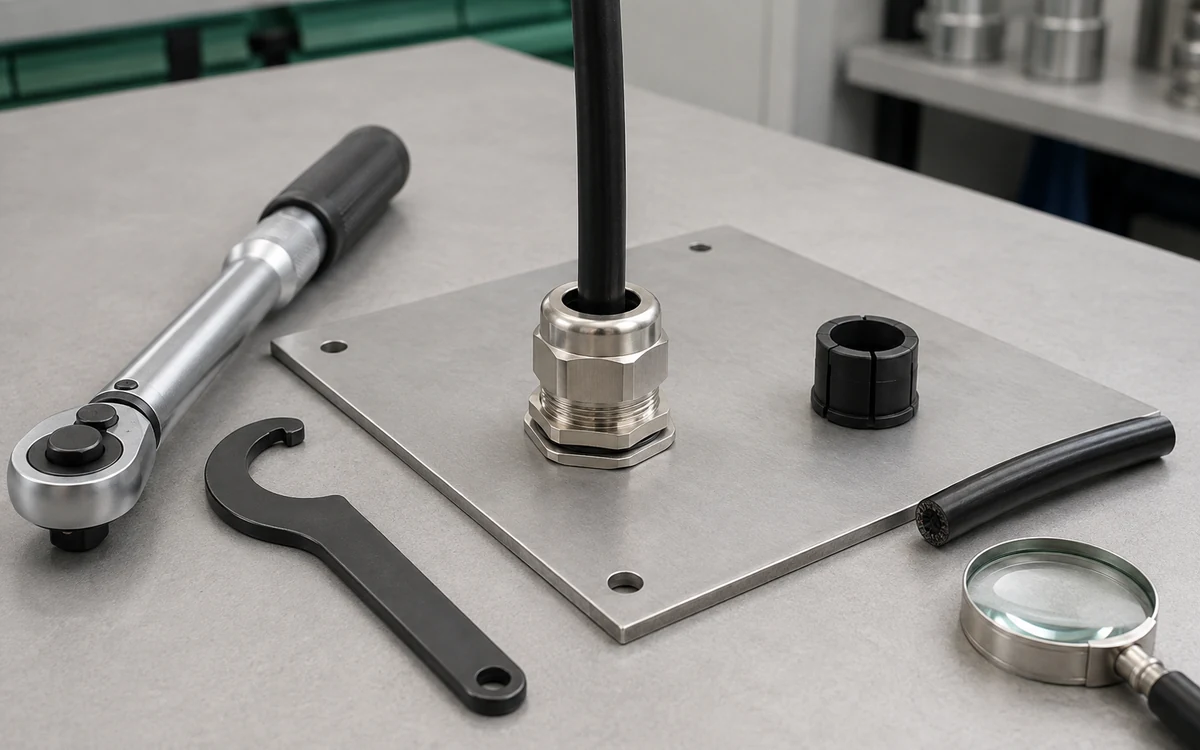
<img alt="電纜密封接頭安裝在實驗室測試面板上，旁邊有扭矩工具、反力扳手、密封嵌件及電纜試樣" src="/images/blog/the-coefficient-of-friction-how-it-impacts-gland-assembly-and-sealing-pressure/gland-friction-assembly-setup.webp" srcset="/images/blog/the-coefficient-of-friction-how-it-impacts-gland-assembly-and-sealing-pressure/gland-friction-assembly-setup-600.webp 600w, /images/blog/the-coefficient-of-friction-how-it-impacts-gland-assembly-and-sealing-pressure/gland-friction-assembly-setup.webp 1200w" sizes="(max-width: 760px) 100vw, 760px" width="1200" height="750" loading="lazy" decoding="async">
<p><em>組裝參考圖：接頭接合處位於扭矩工具與反力扳手之間，密封嵌件及電纜試樣則置於測試面板旁。</em></p>
<h2 id="control-torque-travel-and-the-resulting-contact-together">一併控制扭矩、行程與接觸結果</h2>
<p><strong>校準過的扭矩工具</strong>會受控地指示施加的轉動力矩。<a href="https://www.nist.gov/noac/technology/mass-force-and-acceleration/torque-realization">NIST 的扭矩實現研究</a>說明扭矩工具校準背後的可追溯量測。我會搭配預定的接合條件使用該工具，並觀察組件移動，因為校準與機械反應各自對應製程的不同部分。</p>
<p>NASA 的<a href="https://ntrs.nasa.gov/citations/20120002826">限扭矩方法論</a>研究扭矩控制下預緊力的變化，並採用緊固件扭矩－張力測試。表面處理或允許使用的潤滑劑改變時，該研究支持對重複組裝的組件進行測試。評估電纜密封接頭時，我會將密封件、電纜與機構一併納入比較，因為每一項都會影響最終反應。</p>
<p>比較表面處理或潤滑劑時，我會保持電纜密封接頭、電纜、安裝堆疊、工具、方法及溫度相同，只改變正在研究的一項表面狀態。記錄扭矩及行程或最終位置，並檢查損傷。重複組裝以了解結果變異程度，再比較這些樣品的密封與保持結果。</p>
<p>已安裝的電纜引入口另有彼此獨立的密封路徑。電纜密封壓縮良好，仍可能同時存在未妥善就位的壁面墊圈。組裝蓋帽後，我會檢查本體安裝狀態，並遵循不同的壁面密封指示。<a href="/zh-hant/blog/why-is-entry-thread-sealing-critical-and-should-you-choose-o-rings-or-washers/">引入口 O 形環與墊圈指南</a>說明該介面；<a href="/zh-hant/blog/how-do-cable-glands-balance-strain-relief-and-sealing-for-maximum-protection/">應力釋放指南</a>則說明電纜的機械支撐。</p>
<p><a href="https://webstore.iec.ch/en/publication/7034">IEC 62444:2010</a> 涵蓋完整電纜密封接頭的結構與性能要求。<a href="https://webstore.iec.ch/en/publication/2452">IEC 60529</a> 將外殼的侵入防護分類。請使用相關完整組件及侵入防護測試，將受控的安裝程序與其必要功能連結。記錄電纜、密封件、安裝方式及表面狀態，以便重現相同組裝配置。</p>
<h2 id="conclusion">結論</h2>
<p>我將摩擦視為電纜密封接頭機構的一部分。螺紋與旋轉承靠面會形塑扭矩反應；產生的移動使密封件變形；密封件與電纜幾何形狀則建立局部接觸。任一階段改變，都可能在相同扭矩設定下改變結果。</p>
<p>使用接合處專用的閉合指示，並維持規定的表面狀態。阻力或行程出現非預期變化時，請停止操作並檢查原因。設備恢復使用前，請比較修正後組件的位置、電纜密封、保持能力及壁面介面。</p>
<h2 id="frequently-asked-questions">常見問題</h2>
<h3 id="is-the-coefficient-of-friction-fixed-for-brass-stainless-steel-or-nylon-glands">黃銅、不鏽鋼或尼龍電纜密封接頭的摩擦係數是固定值嗎？</h3>
<p>這取決於實際表面與接觸條件。表面處理、塗層、潤滑劑、負荷、運動、溫度、污染及磨耗都可能改變量測值。使用結果分析組件前，我會先確認摩擦測試符合所研究的介面。</p>
<h3 id="does-lower-friction-improve-cable-gland-sealing">較低的摩擦能改善電纜密封接頭的密封效果嗎？</h3>
<p>較低的滑動阻力可能改變相同扭矩下的軸向作用或行程。電纜密封接頭的幾何形狀、止擋、密封件及電纜，會決定這項變化是有利還是過度。請遵循規定的表面狀態與閉合方式，再檢查密封效果與保持能力。</p>
<h3 id="how-is-a-nut-factor-different-from-a-coefficient-of-friction">螺帽係數與摩擦係數有何不同？</h3>
<p>摩擦係數描述一個明確指定的接觸。螺帽係數則以簡化的緊固件扭矩－軸向負荷關係，合併表示幾何形狀與摩擦的影響。因此，將螺帽係數代入夾持力計算時，不能直接把它當作密封壓力輸入，也不能用來取代電纜密封接頭的組裝說明。</p>
<h3 id="what-does-a-calibrated-wrench-tell-me-about-sealing-pressure">校準過的扳手能提供哪些與密封壓力相關的資訊？</h3>
<p>它表示在該工具的校準條件下施加的扭矩。若要將這項輸入連結到密封壓力，還須考量接合處的摩擦、機構移動、密封件反應及電纜幾何形狀。我會將行程與完整組件的功能結果，連同扭矩讀值一併比較。</p>
<h3 id="what-should-i-do-when-the-gland-reaches-torque-before-its-expected-position">電纜密封接頭尚未到達預期位置就已達到規定扭矩時，該怎麼辦？</h3>
<p>停止操作，檢查對準狀態、螺紋狀況、污染、部件堆疊及任何設計止擋。遵循所選電纜密封接頭的閉合判準與允許的修正方式。強行鎖緊或加入未核准的潤滑劑，可能改變負荷，卻仍未解決根本問題。</p>
<h3 id="sources-and-technical-references">資料來源與技術參考</h3>
<ul>
<li><a href="https://store.astm.org/standards/g115">ASTM G115-24 — 摩擦係數量測與報告標準指南</a>，查閱日期：2026-10-29。</li>
<li><a href="https://ntrs.nasa.gov/api/citations/19900009424/downloads/19900009424.pdf">NASA — 緊固件設計手冊，RP1228，1990</a>，查閱日期：2026-10-29。</li>
<li><a href="https://ntrs.nasa.gov/citations/20120002826">NASA — 螺紋緊固件限扭矩判定方法論，2011</a>，查閱日期：2026-10-29。</li>
<li><a href="https://www.nist.gov/noac/technology/mass-force-and-acceleration/torque-realization">NIST — 扭矩實現</a>，查閱日期：2026-10-29。</li>
<li><a href="https://webstore.iec.ch/en/publication/7034">IEC 62444:2010 — 電氣裝置用電纜密封接頭</a>，查閱日期：2026-10-29。</li>
<li><a href="https://webstore.iec.ch/en/publication/2452">IEC 60529:1989+A1:1999+A2:2013 — 外殼提供的防護等級</a>，查閱日期：2026-10-29。</li>
</ul>