# PG16 金屬電纜密封接頭：技術尺寸選型指南

> Source: https://chinacableglands.com/zh-hant/blog/pg16-metal-cable-glands-a-technical-sizing-guide/
> Language: zh-Hant
> Publisher: 倍拓電纜接頭
> Author: Henry Xu
> Published: 2026-07-07
> Updated: 2026-10-29

依 PG16 的 22.5 mm 引入螺紋、電纜外徑限值、橢圓度、面板堆疊與可用螺紋長度，並搭配選型範例，為金屬電纜密封接頭進行尺寸選擇。

<p><strong>PG16 金屬電纜密封接頭採用 PG16 外殼引入螺紋，其公稱大徑為 22.5 mm，螺距約 1.41 mm。</strong>電纜適用範圍則取決於接頭的密封件與嵌件。我會先確認引入口，再比較電纜完整的直徑範圍，以及面板與密封件安裝後剩餘的螺紋長度。</p>
<p>這三項檢查可縮小範圍，找出能實際安裝的零件。接著，金屬材質、密封件配方、電氣功能與使用條件會決定哪種完整接頭適用於該用途。</p>
<blockquote>
<p><strong>重點摘要</strong></p>
<ul>
<li>PG16 是螺紋標示；它不同於 M16，也不同於直徑 16 mm 的電纜。</li>
<li>檢查密封範圍時，同時使用電纜允許的最小與最大外徑。</li>
<li>橢圓電纜應保留長軸與短軸讀值；只取平均值可能掩蓋配合不良。</li>
<li>檢查鎖緊螺帽旋合長度前，先從可用螺紋中扣除已安裝的面板與配件堆疊。</li>
<li>完整接頭、引入口密封件與安裝方式都應符合所需的使用條件。</li>
</ul>
</blockquote>
<h2 id="what-does-pg16-mean-on-a-metal-cable-gland">金屬電纜密封接頭上的 PG16 代表什麼？</h2>
<p><strong>PG16</strong> 是 Panzergewinde 螺紋系列中的一種尺寸，用於電纜密封接頭與外殼之間的連接。<a href="https://www.dinmedia.de/en/standard/din-40430/647985">DIN 40430:1971-02</a> 是鋼導管螺紋的尺寸標準。螺紋工具製造商 <a href="https://www.gewindebohrer.de/en/service/technische-daten/thread-type-steel-conduit-thread">BAER 的技術表</a>中，PG16 列值為大徑 22.5 mm、圓整後約 1.41 mm 的螺距，以及每英吋 18 牙。這些尺寸可用於識別；成品螺紋能否驗收，仍取決於規定的牙型與公差。</p>
<p>在外殼連接處，與公制螺紋的差異很重要。M16 × 1.5 螺紋的公稱大徑為 16 mm，螺距為 1.5 mm，與 PG16 的尺寸不同。尺寸相近的公制螺紋或管螺紋開口，也必須先另行確認，再選擇接頭。</p>
<p>我依照以下順序，將 PG16 標示轉化為完整的選型：</p>
<table>
<thead>
<tr>
<th>檢查項目</th>
<th>比較的數值或特徵</th>
<th>所需結果</th>
</tr>
</thead>
<tbody>
<tr>
<td>引入口</td>
<td>PG16 外螺紋，以及配合的內螺紋或間隙孔配置</td>
<td>相容的安裝介面</td>
</tr>
<tr>
<td>電纜</td>
<td>完整外徑範圍、表面與電纜構造</td>
<td>正確的密封件、嵌件與穿線孔徑</td>
</tr>
<tr>
<td>安裝</td>
<td>可用螺紋長度、面板、已安裝密封件、鎖緊螺帽與操作空間</td>
<td>足夠的旋合長度與組裝空間</td>
</tr>
<tr>
<td>使用條件</td>
<td>金屬、表面處理、密封件配方、溫度與暴露情況</td>
<td>適用於該用途的完整接頭</td>
</tr>
<tr>
<td>電氣功能</td>
<td>必要時的等電位連結、鎧裝或屏蔽連接</td>
<td>規定的導電通路與接觸點</td>
</tr>
</tbody>
</table>
<p>若引入口身分不明，<a href="/zh-hant/blog/pg-vs-metric-vs-npt-threads-which-cable-gland-threading-system-should-you-choose/">PG、公制與 NPT 螺紋比較</a>有助於區分螺紋系列。確認為 PG16 後，其餘檢查便可針對所選接頭與電纜進行。</p>
<figure>
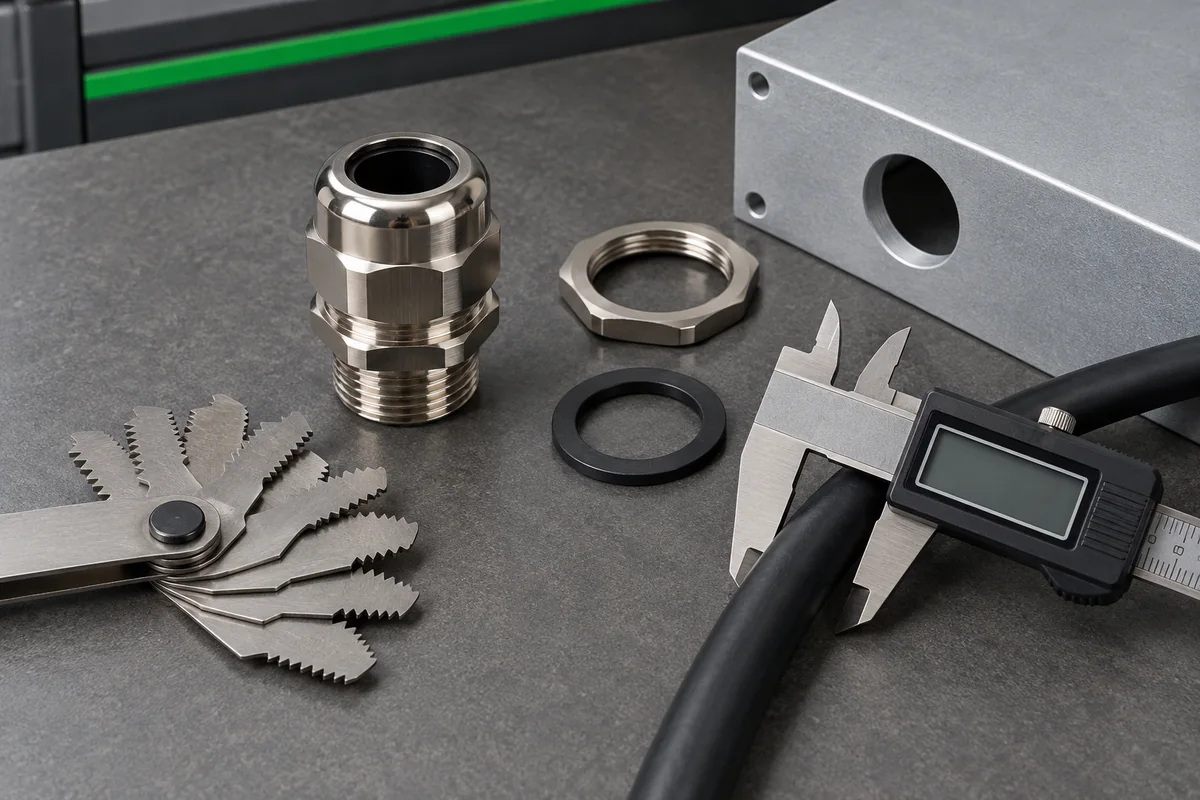
<img alt="工作檯上有金屬電纜密封接頭、電纜樣品、卡尺、螺距規、鎖緊螺帽、黑色環圈及帶圓孔的外殼板。" src="/images/blog/pg16-metal-cable-glands-a-technical-sizing-guide/pg16-selection-bench.webp" srcset="/images/blog/pg16-metal-cable-glands-a-technical-sizing-guide/pg16-selection-bench-600.webp 600w, /images/blog/pg16-metal-cable-glands-a-technical-sizing-guide/pg16-selection-bench.webp 1200w" sizes="(max-width: 640px) calc(100vw - 2rem), 1200px" width="1200" height="800" loading="lazy" decoding="async">
<figcaption>接頭、引入口板及螺紋量規用於比較引入口端；電纜與卡尺則用於比較電纜端。</figcaption>
</figure>
<h2 id="match-the-cable-range-to-the-actual-seal">讓電纜範圍符合實際密封件</h2>
<p><strong>密封範圍</strong>是針對特定接頭、密封件與嵌件組合所規定的電纜直徑區間。兩種 PG16 接頭可能因接觸電纜的零件不同而具有不同範圍。即使外殼螺紋相同，縮徑嵌件也可能再次改變適用範圍。</p>
<p>先取得電纜製造商列出的成品最小及最大外徑（OD）。導體截面積與芯數說明的是電纜內部構造，不能據此得知護套直徑。電纜外形也要納入檢查。圓形壓縮密封件需要沿整個周邊都有適當的接觸表面。扁平、波紋或帶有明顯肋紋的電纜，可能需要不同的嵌件或接頭設計。</p>
<p>以假設選型為例，取外徑範圍為 <strong>11.8–12.4 mm</strong> 的電纜，再比較兩種 PG16 款式，其標示範圍分別為 10–14 mm 與 12–16 mm。假設這兩種範圍均適用於同一種電纜，以及各自選定的密封件款式。</p>
<table>
<thead>
<tr>
<th>假設的 PG16 款式</th>
<th>低端範圍餘裕</th>
<th>高端範圍餘裕</th>
<th>尺寸判斷</th>
</tr>
</thead>
<tbody>
<tr>
<td>A：10–14 mm</td>
<td>11.8 − 10 = 1.8 mm</td>
<td>14 − 12.4 = 1.6 mm</td>
<td>涵蓋電纜完整範圍</td>
</tr>
<tr>
<td>B：12–16 mm</td>
<td>11.8 − 12 = −0.2 mm</td>
<td>16 − 12.4 = 3.6 mm</td>
<td>電纜直徑可能低於密封件下限</td>
</tr>
</tbody>
</table>
<p>我會將款式 A 納入安裝與材料檢查。款式 B 則需改用其他允許的嵌件或更換電纜；加大鎖緊力並不能擴大其標示範圍。這些是範例尺寸，不是型錄數值。</p>
<p>本比較採用電纜完整尺寸範圍，因此若在標稱外徑上增加百分比餘裕，反而會模糊實際限值。若電纜具有鎧裝層、墊層或屏蔽接觸，也應檢查這些介面。<a href="/zh-hant/blog/the-ultimate-guide-to-cable-gland-sizing-how-to-match-glands-to-cable-diameters/">完整電纜密封接頭尺寸選型方法</a>會說明其他所需量測。</p>
<h2 id="measure-ovality-at-the-sealing-zone">在密封區域量測橢圓度</h2>
<p><strong>橢圓度</strong>表示電纜同一橫截面上的大徑與小徑差異。選擇密封件時，我會保留兩個讀值。平均值有助描述外形，但範圍檢查仍須以最大與最小尺寸為準。</p>
<p>使用乾淨、未受外力變形的電纜樣品，以及適用且經校正的量測儀器。在預定密封區域的多個角度與位置讀取數值。讓量爪輕觸柔軟護套，但不要將護套壓扁。檢查凸起標記、接縫、扁平處、損傷，以及密封位置的直徑變化。</p>
<p><a href="https://www.nist.gov/metrology/metrological-traceability">NIST 計量溯源指南</a>說明，量測結果透過具有明示不確定度的校正鏈，連結至參考標準。不確定度也必須足夠小，能支持所進行的比較。若讀值接近接頭範圍限值，應採用適用的量測與驗收規則，而不是將讀值四捨五入後納入範圍。</p>
<figure>
<picture>
<source srcset="/images/blog/pg16-metal-cable-glands-a-technical-sizing-guide/pg16-cable-sealing-zone-inspection-600.webp 600w" media="(max-width: 640px)" type="image/webp">
<img alt="卡尺量爪夾在電纜護套周圍，護套上可見縱向接縫與凸起標記。" src="/images/blog/pg16-metal-cable-glands-a-technical-sizing-guide/pg16-cable-sealing-zone-inspection.webp" width="1200" height="800" loading="lazy" decoding="async">
</picture>
<figcaption>卡尺量爪間可見縱向接縫與凸起標記。請在密封區沿多個角度及位置檢查輪廓。</figcaption>
</figure>
<p>延續假設電纜的範例，<strong>同一橫截面上互相垂直的 12.4 mm 與 11.8 mm 讀值</strong>相差 0.6 mm，平均值為 12.1 mm。以直徑差除以平均值，橢圓度為：</p>
<div class="article-math article-math-display" data-latex="O = \frac{D_{\max}-D_{\min}}{(D_{\max}+D_{\min})/2}\times100\%"><span class="katex"><math xmlns="http://www.w3.org/1998/Math/MathML" display="block"><semantics><mrow><mi>O</mi><mo>=</mo><mfrac><mrow><msub><mi>D</mi><mi>max</mi><mo>⁡</mo></msub><mo>−</mo><msub><mi>D</mi><mi>min</mi><mo>⁡</mo></msub></mrow><mrow><mo stretchy="false">(</mo><msub><mi>D</mi><mi>max</mi><mo>⁡</mo></msub><mo>+</mo><msub><mi>D</mi><mi>min</mi><mo>⁡</mo></msub><mo stretchy="false">)</mo><mi mathvariant="normal">/</mi><mn>2</mn></mrow></mfrac><mo>×</mo><mn>100</mn><mi mathvariant="normal">%</mi></mrow><annotation encoding="application/x-tex">O = \frac{D_{\max}-D_{\min}}{(D_{\max}+D_{\min})/2}\times100\%</annotation></semantics></math></span></div>
<p>其中，<span class="article-math article-math-inline" data-latex="D_{\max}"><span class="katex"><math xmlns="http://www.w3.org/1998/Math/MathML"><semantics><mrow><msub><mi>D</mi><mi>max</mi><mo>⁡</mo></msub></mrow><annotation encoding="application/x-tex">D_{\max}</annotation></semantics></math></span></span> 與 <span class="article-math article-math-inline" data-latex="D_{\min}"><span class="katex"><math xmlns="http://www.w3.org/1998/Math/MathML"><semantics><mrow><msub><mi>D</mi><mi>min</mi><mo>⁡</mo></msub></mrow><annotation encoding="application/x-tex">D_{\min}</annotation></semantics></math></span></span> 分別是大徑與小徑的毫米讀值。四捨五入後結果為 <strong>4.96%</strong>。若電纜圖面或專案規格要求其他定義，請採用該定義；此範例未提供通用的允許橢圓度。</p>
<p>12.1 mm 的平均值落在兩種範例接頭的標示範圍內。然而，款式 B 的 11.8 mm 小徑讀值低於 12 mm 下限。因此，取平均值會掩蓋完整電纜範圍所揭示的同一項配合問題。款式 A 涵蓋兩個讀值，但仍須確認允許的電纜外形與密封性能適用於該用途。</p>
<p><a class="article-tool-card article-tool-card-link" href="/zh-hant/resource-center/tools/oval-cable-diameter-calculator/" aria-label="橢圓形電纜直徑計算器"><span class="article-tool-card-index">工具</span><span class="article-tool-card-kicker">電纜尺寸</span><strong class="article-tool-card-title">橢圓形電纜直徑計算器</strong><span class="article-tool-card-copy">輸入同一電纜橫截面上的長軸與短軸讀值。本例的 12.4 mm 與 11.8 mm 讀值會得出 0.6 mm 的直徑差與 4.96% 橢圓度。檢查接頭密封範圍時，應保留兩個讀值；橢圓度定義與限值則採用電纜規格所列資料。</span><span class="article-tool-card-formula">Dmean = (Dmajor + Dminor) / 2; Deq = √(Dmajor × Dminor)</span><span class="article-tool-card-inputs" aria-label="計算器輸入項目"><em>長軸直徑</em><em>短軸直徑</em></span><span class="article-tool-card-action">開啟計算器 <span aria-hidden="true">-&gt;</span></span></a></p><p>樣品只能確認該段電纜的狀況。選用替換電纜或後續批次時，仍須保留製造商列出的完整外徑限值。若護套、電纜供應商或密封嵌件改變，就應重新進行配合檢查。</p>
<figure class="blog-chart" style="container-type: inline-size;">
<svg xmlns="http&#58;//www.w3.org/2000/svg" viewBox="0 0 480 1320" role="img" aria-labelledby="pg16-map-title pg16-map-desc" style="font-family:var(--font-body); width: 100% !important; max-width: 100% !important; height: auto !important;" id="cg-typography-b534496d24d44a71">
<style>
#cg-typography-b534496d24d44a71 { --svg-body-screen: 17px; }
@media (max-width: 760px) { #cg-typography-b534496d24d44a71 { --svg-body-screen: 16px; } }
</style>
<title id="pg16-map-title">選擇 PG16 金屬電纜密封接頭的四項配合條件</title>
<desc id="pg16-map-desc">此垂直選型流程依序核對 PG16 引入口、電纜外徑、安裝後的面板堆疊及使用工況，四者相符後才接受一個確切料號。</desc>
<defs><marker id="pg16-arrow" markerWidth="8" markerHeight="8" refX="7" refY="4" orient="auto"><path d="M0 0L8 4L0 8Z" fill="var(--color-primary)"/></marker></defs>
<text x="240" y="40" text-anchor="middle" fill="var(--color-carbon)" font-size="24" font-weight="700" style="font-size: calc(22px * 480px / 100cqw) !important;">四項 PG16 選型檢查</text>
<rect x="28" y="72" width="424" height="216" rx="16" fill="var(--surface-card)" stroke="var(--color-primary)" stroke-width="3"/>
<text x="52" y="112" fill="var(--color-carbon)" font-size="20" font-weight="700" style="font-size: calc(18px * 480px / 100cqw) !important;">1. 外殼引入口</text>
<text x="52" y="151" fill="var(--color-carbon)" font-size="20" font-weight="700" style="font-size: calc(16px * 480px / 100cqw) !important;">PG16 識別</text>
<text x="52" y="184" fill="var(--color-graphite)" font-size="20" style="font-size: calc(16px * 480px / 100cqw) !important;">牙頂名義直徑 22.5 mm</text>
<text x="52" y="217" fill="var(--color-graphite)" font-size="20" style="font-size: calc(var(--svg-body-screen) * 480px / 100cqw) !important;">螺距 1.41 mm · 正確 PG 牙型</text>
<text x="52" y="250" fill="var(--color-graphite)" font-size="20" style="font-size: calc(var(--svg-body-screen) * 480px / 100cqw) !important;">攻牙引入口或無螺紋通孔</text>
<path d="M240 288V334" stroke="var(--color-primary)" stroke-width="4" marker-end="url(#pg16-arrow)"/>
<rect x="28" y="346" width="424" height="216" rx="16" fill="var(--color-ash)" stroke="var(--color-cloud)" stroke-width="2"/>
<text x="52" y="386" fill="var(--color-carbon)" font-size="20" font-weight="700" style="font-size: calc(18px * 480px / 100cqw) !important;">2. 密封處的電纜</text>
<text x="52" y="425" fill="var(--color-carbon)" font-size="20" font-weight="700" style="font-size: calc(18px * 480px / 100cqw) !important;">完整 OD 區間及輪廓</text>
<text x="52" y="458" fill="var(--color-graphite)" font-size="20" style="font-size: calc(var(--svg-body-screen) * 480px / 100cqw) !important;">完整允許電纜外徑範圍</text>
<text x="52" y="491" fill="var(--color-graphite)" font-size="20" style="font-size: calc(var(--svg-body-screen) * 480px / 100cqw) !important;">若為橢圓形，記錄長、短軸讀值</text>
<text x="52" y="524" fill="var(--color-graphite)" font-size="20" style="font-size: calc(var(--svg-body-screen) * 480px / 100cqw) !important;">確切密封件及嵌件</text>
<path d="M240 562V608" stroke="var(--color-primary)" stroke-width="4" marker-end="url(#pg16-arrow)"/>
<rect x="28" y="620" width="424" height="232" rx="16" fill="var(--surface-card)" stroke="var(--color-primary)" stroke-width="3"/>
<text x="52" y="660" fill="var(--color-carbon)" font-size="20" font-weight="700" style="font-size: calc(18px * 480px / 100cqw) !important;">3. 安裝後的面板堆疊</text>
<text x="52" y="699" fill="var(--color-carbon)" font-size="20" font-weight="700" style="font-size: calc(var(--svg-body-screen) * 480px / 100cqw) !important;">計入每一層後的可用螺紋</text>
<text x="52" y="732" fill="var(--color-graphite)" font-size="20" style="font-size: calc(var(--svg-body-screen) * 480px / 100cqw) !important;">壁面 · 密封墊片 · 墊圈 · 鎖緊螺帽</text>
<text x="52" y="765" fill="var(--color-graphite)" font-size="20" style="font-size: calc(var(--svg-body-screen) * 480px / 100cqw) !important;">密封件承靠 · 內部間隙</text>
<text x="52" y="798" fill="var(--color-graphite)" font-size="20" style="font-size: calc(var(--svg-body-screen) * 480px / 100cqw) !important;">工具迴轉空間 · 電纜彎曲空間</text>
<path d="M240 852V898" stroke="var(--color-primary)" stroke-width="4" marker-end="url(#pg16-arrow)"/>
<rect x="28" y="910" width="424" height="232" rx="16" fill="var(--color-ash)" stroke="var(--color-cloud)" stroke-width="2"/>
<text x="52" y="950" fill="var(--color-carbon)" font-size="20" font-weight="700" style="font-size: calc(18px * 480px / 100cqw) !important;">4. 使用工況</text>
<text x="52" y="989" fill="var(--color-carbon)" font-size="20" font-weight="700" style="font-size: calc(18px * 480px / 100cqw) !important;">完整接頭組件</text>
<text x="52" y="1022" fill="var(--color-graphite)" font-size="20" style="font-size: calc(var(--svg-body-screen) * 480px / 100cqw) !important;">本體 · 表面處理 · 密封件 · 護套</text>
<text x="52" y="1055" fill="var(--color-graphite)" font-size="20" style="font-size: calc(var(--svg-body-screen) * 480px / 100cqw) !important;">曝露條件 · 電氣功能</text>
<text x="52" y="1088" fill="var(--color-graphite)" font-size="20" style="font-size: calc(var(--svg-body-screen) * 480px / 100cqw) !important;">額定條件 · 安裝說明</text>
<path d="M240 1142V1188" stroke="var(--color-primary)" stroke-width="4" marker-end="url(#pg16-arrow)"/>
<rect x="28" y="1200" width="424" height="84" rx="16" fill="var(--color-primary)"/>
<text x="240" y="1236" text-anchor="middle" fill="#ffffff" font-size="20" font-weight="700" style="font-size: calc(18px * 480px / 100cqw) !important;">選擇完整接頭</text>
<text x="240" y="1266" text-anchor="middle" fill="#ffffff" font-size="20" style="font-size: calc(var(--svg-body-screen) * 480px / 100cqw) !important;">配合全部四個介面</text>
</svg>
<figcaption>引入口、電纜、面板堆疊及使用工況，都必須符合同一套完整的 PG16 電纜密封接頭配置。</figcaption>
</figure>
<h2 id="check-the-existing-pg16-entry-and-usable-thread">檢查既有 PG16 引入口與可用螺紋長度</h2>
<p>嘗試更換零件前，我會先依圖面或標示確認設備進線口的形式與規格。若要拆下既有接頭才能操作，應依現場安全作業程序隔離設備。以允許的方法清潔引入口，再檢查螺紋與密封面是否受損。</p>
<p>卡尺或測微器可協助檢查外螺紋牙頂直徑，螺距規可協助辨識螺距。讀值接近 22.5 mm 並且螺距符合 PG16，可用於識別，但不足以完整評估螺紋配合。</p>
<p>正式量規檢驗應採用指定的 PG 量規與驗收程序。<a href="https://www.dinmedia.de/en/standard/din-40431-1/648064">DIN 40431-1</a> 涵蓋通止螺紋環規；<a href="https://www.dinmedia.de/de/norm/din-40431-2/649165">DIN 40431-2</a> 涵蓋螺紋塞規。環規檢查外螺紋，塞規則檢查內螺紋。將量產接頭當作試塞使用，無法提供這些量規限值。</p>
<p>對外殼的攻牙孔引入口，請檢查完整且可用的螺紋深度。導入倒角、不完整牙段、受損牙紋與塗層堆積都可能縮短有效深度。確認接頭在端部抵底前能到達指定的貼合位置。內部也必須為本體、導體與電纜彎曲預留空間。</p>
<p>先以手旋入已確認相容的螺紋。若提早卡住，請停止並檢查對準、螺距與損傷。接頭本體尚未抵達密封面前，強行施力可能切削或變形螺紋牙側。</p>
<p>M20、M25、NPT 或 G 引入口需要使用適當轉接件，或採取允許的引入口變更。檢查轉接件兩端的旋合長度、密封件、材料與必要核准。<a href="/zh-hant/blog/how-to-master-cable-gland-thread-conversion-between-npt-pg-and-metric-systems/">螺紋轉接方法</a>將兩端視為不同的接合處。</p>
<h2 id="size-the-clearance-hole-and-mounting-stack">估算間隙孔與安裝堆疊</h2>
<p><strong>可用螺紋長度</strong>是指由產品圖面定義的基準位置起算，可供安裝堆疊與旋合使用的完整外螺紋長度。若總長尺寸包含不完整的導入牙段或收尾段，實際可用長度可能較短。</p>
<p>若接頭穿過面板安裝，孔徑與公差應依所選產品的安裝圖確認。孔洞必須容許外螺紋通過，同時保留規定的肩部、密封件與鎖緊螺帽支撐。螺紋的公稱直徑並不能決定通用的成品間隙孔或沉頭尺寸。</p>
<p>從兩側檢查成品孔洞。沖孔可能產生錐度或翻邊；鑽孔可能留下毛邊或偏心開口。依允許的方法去除銳邊，但不要切除密封承壓面。檢查孔距、與面板邊緣的距離，以及在本體與鎖緊螺帽周圍操作扳手的空間。</p>
<p>軸向堆疊需要另外計算。依已安裝順序，納入成品面板厚度及每個允許使用的密封件、墊圈、接地片或防轉零件。圖面有要求時，應採用壓縮後的密封件厚度。所有尺寸都必須使用一致的基準，避免同一層重複計算。</p>
<h3 id="worked-example-a-required-washer-changes-the-thread-choice">計算示例：必要墊圈會改變螺紋選擇</h3>
<p>假設圖面列出 <strong>6.5 mm 的可用完整牙型外螺紋長度</strong>。2.0 mm 的面板與 1.0 mm 已安裝密封件共占 3.0 mm，因此留給鎖緊螺帽的長度為 <strong>3.5 mm</strong>。再假設這項安裝說明要求至少有 <strong>3.0 mm 的有效鎖緊螺帽旋合長度</strong>。</p>
<table>
<thead>
<tr>
<th>假設安裝配置</th>
<th>鎖緊螺帽前占用長度</th>
<th>可用完整牙型螺紋長度</th>
<th>高於假設 3.0 mm 要求的餘裕</th>
</tr>
</thead>
<tbody>
<tr>
<td>6.5 mm 螺紋；只含面板與密封件</td>
<td>3.0 mm</td>
<td>3.5 mm</td>
<td>+0.5 mm</td>
</tr>
<tr>
<td>相同螺紋；另加必要的 1.0 mm 墊圈</td>
<td>4.0 mm</td>
<td>2.5 mm</td>
<td>−0.5 mm</td>
</tr>
<tr>
<td>8.5 mm 螺紋款式；保留墊圈</td>
<td>4.0 mm</td>
<td>4.5 mm</td>
<td>+1.5 mm</td>
</tr>
</tbody>
</table>
<p>第一種配置有足夠長度符合所述要求。加上必要墊圈後，短螺紋版本便不適用。我會檢查保留墊圈的長螺紋版本，包括其內部突出量與扳手操作空間。這樣既能保留配件功能，也能增加旋合長度。</p>
<p>這些數值假設鎖緊螺帽有足夠的內部可用螺紋，且能到達所述位置。3.0 mm 要求是示例輸入值，不是 PG16 的通用規則。較長的外螺紋也須與內部零件保持間隙；僅因長度較多，並不足以構成選用理由。</p>
<p>再假設兩種範例密封件款式都有兩種螺紋長度，且必要的 1.0 mm 墊圈必須使用。在此假設比較中，我找到尺寸相符的組合：<strong>10–14 mm 密封件搭配 8.5 mm 可用螺紋長度</strong>。該密封件涵蓋 11.8–12.4 mm 電纜範圍，且螺紋長度比假設的鎖緊螺帽要求多出 1.5 mm 餘裕。同一密封件若搭配較短本體，安裝檢查便不合格。12–16 mm 密封件即使搭配較長本體，也無法通過電纜尺寸檢查。因此，我會先比較電纜與面板尺寸，再選擇料號；一處介面改善無法補救另一處不匹配。接下來的選型則須考慮完整組件的材料、電氣功能、內部間隙與密封條件。</p>
<figure class="blog-chart" style="container-type: inline-size;">
<svg id="pg16-thread-stack-svg" xmlns="http://www.w3.org/2000/svg" viewBox="0 0 480 1450" role="img" aria-labelledby="pg16-thread-stack-title pg16-thread-stack-desc" style="width:100%;height:auto;font-family:var(--font-body); width: 100% !important; max-width: 100% !important; height: auto !important;">
<style>
#pg16-thread-stack-svg { --svg-body-screen: 17px; }
@media (max-width: 760px) { #pg16-thread-stack-svg { --svg-body-screen: 16px; } }
</style>
<title id="pg16-thread-stack-title">PG16 可用螺紋堆疊計算示例</title><desc id="pg16-thread-stack-desc">此限定情境的計算示例從 6.5 mm 可用完整牙型螺紋開始，扣除 3.0 mm 的完成面板及密封堆疊後，剩下 3.5 mm，供指定鎖緊螺帽及安裝說明判定。導入段及螺紋收尾段不列入計算。</desc>
<style>#pg16-thread-stack-svg{--bg:#f4f7f5;--card:#fff;--ink:#142820;--muted:#455a52;--line:#536861;--soft:#d8dfdc;--part:#c7d0cc;--accent:#16805d;--accent-dark:#0e6045;--accent-soft:#dceee7;--metal:#d6b86a;--metal-line:#8b743e;--warm:#f7f1df}:root[data-theme="dark"] #pg16-thread-stack-svg{--bg:#101714;--card:#19231f;--ink:#f0f6f3;--muted:#c1cec8;--line:#93a69e;--soft:#34433d;--part:#52635c;--accent:#42c999;--accent-dark:#a4f2d5;--accent-soft:#1d3b31;--metal:#806d3f;--metal-line:#d7ba70;--warm:#332d1e}#pg16-thread-stack-svg .bg{fill:var(--bg)}#pg16-thread-stack-svg .card{fill:var(--card);stroke:var(--line);stroke-width:2}#pg16-thread-stack-svg .ink{fill:var(--ink)}#pg16-thread-stack-svg .muted{fill:var(--muted)}#pg16-thread-stack-svg .part{fill:var(--part);stroke:var(--line)}#pg16-thread-stack-svg .soft{fill:var(--soft);stroke:var(--line)}#pg16-thread-stack-svg .seal{fill:var(--accent);stroke:var(--accent-dark)}#pg16-thread-stack-svg .callout{fill:var(--accent-soft);stroke:var(--accent)}#pg16-thread-stack-svg .metal{fill:var(--metal);stroke:var(--metal-line)}</style>
<rect class="bg" width="480" height="1450"/><text class="ink" x="24" y="42" font-size="24" font-weight="700" style="font-size: calc(22px * 480px / 100cqw) !important;">PG16 螺紋堆疊計算示例</text><text class="muted" x="24" y="72" font-size="18" style="font-size: calc(var(--svg-body-screen) * 480px / 100cqw) !important;">僅計算可用的完整牙型螺紋。</text>
<g transform="translate(20 98)"><rect class="card" width="440" height="640" rx="18"/><rect x="24" y="24" width="392" height="106" rx="14" fill="var(--bg)" stroke="var(--line)" stroke-width="2"/><text class="ink" x="220" y="59" text-anchor="middle" font-size="19" font-weight="700" style="font-size: calc(18px * 480px / 100cqw) !important;">導入段＋螺紋收尾段</text><text class="muted" x="220" y="91" text-anchor="middle" font-size="18" style="font-size: calc(var(--svg-body-screen) * 480px / 100cqw) !important;">不納入計算</text><path class="part" d="M34 224H250L286 248V304L250 328H34Z" stroke-width="3"/><path d="M194 232l34 18-34 18m0 10 34 18-34 18" fill="none" stroke="var(--metal-line)" stroke-width="7"/><rect class="part" x="24" y="244" width="66" height="64" rx="13" stroke-width="3"/><rect class="soft" x="286" y="176" width="88" height="190" rx="7" stroke-width="3"/><rect x="286" y="236" width="88" height="84" fill="var(--bg)" stroke="var(--line)" stroke-width="3"/><rect class="seal" x="264" y="224" width="22" height="108" rx="7" stroke-width="2"/><path class="metal" d="M374 232l48 16v60l-48 16Z" stroke-width="3"/><text class="ink" x="330" y="202" text-anchor="middle" font-size="18" font-weight="700" style="font-size: calc(16px * 480px / 100cqw) !important;">完成後</text><text class="ink" x="330" y="224" text-anchor="middle" font-size="18" font-weight="700" style="font-size: calc(16px * 480px / 100cqw) !important;">面板</text><text x="252" y="394" text-anchor="end" fill="var(--accent-dark)" font-size="18" font-weight="700" style="font-size: calc(16px * 480px / 100cqw) !important;">密封堆疊</text><text x="396" y="394" text-anchor="middle" fill="var(--metal-line)" font-size="18" font-weight="700" style="font-size: calc(16px * 480px / 100cqw) !important;">螺帽</text><path d="M160 204V176H410V204" fill="none" stroke="var(--accent)" stroke-width="3"/><text x="285" y="160" text-anchor="middle" fill="var(--accent-dark)" font-size="18" font-weight="700" style="font-size: calc(16px * 480px / 100cqw) !important;">可用螺紋 · 6.5 mm</text><rect class="callout" x="24" y="442" width="392" height="164" rx="14" stroke-width="2"/><text x="220" y="480" text-anchor="middle" fill="var(--accent-dark)" font-size="19" font-weight="700" style="font-size: calc(18px * 480px / 100cqw) !important;">查看剖面圖</text><text class="ink" x="42" y="522" font-size="18" style="font-size: calc(var(--svg-body-screen) * 480px / 100cqw) !important;">• 可用的完整牙型長度</text><text class="ink" x="42" y="558" font-size="18" style="font-size: calc(var(--svg-body-screen) * 480px / 100cqw) !important;">• 不計入導入倒角與不完整牙段</text><text class="ink" x="42" y="594" font-size="18" style="font-size: calc(var(--svg-body-screen) * 480px / 100cqw) !important;">• 配件依指定順序安裝</text></g>
<g transform="translate(20 766)"><rect class="card" width="440" height="494" rx="18"/><text class="ink" x="24" y="42" font-size="20" font-weight="700" style="font-size: calc(18px * 480px / 100cqw) !important;">軸向尺寸分配</text><text x="220" y="82" text-anchor="middle" fill="var(--accent-dark)" font-size="19" font-weight="700" style="font-size: calc(16px * 480px / 100cqw) !important;">6.5 mm 可用完整牙型螺紋</text><rect class="soft" x="24" y="110" width="392" height="124" rx="14" stroke-width="2"/><text class="ink" x="220" y="150" text-anchor="middle" font-size="18" font-weight="700" style="font-size: calc(18px * 480px / 100cqw) !important;">面板 + 密封件堆疊</text><text class="muted" x="220" y="196" text-anchor="middle" font-size="28" font-weight="700" style="font-size: calc(16px * 480px / 100cqw) !important;">− 3.0 mm</text><rect x="24" y="254" width="392" height="124" rx="14" fill="var(--warm)" stroke="var(--metal-line)" stroke-width="2"/><text class="ink" x="220" y="294" text-anchor="middle" font-size="18" font-weight="700" style="font-size: calc(18px * 480px / 100cqw) !important;">剩餘旋合長度</text><text class="muted" x="220" y="340" text-anchor="middle" font-size="28" font-weight="700" style="font-size: calc(16px * 480px / 100cqw) !important;">＝ 3.5 mm</text><text class="ink" x="220" y="422" text-anchor="middle" font-size="18" style="font-size: calc(var(--svg-body-screen) * 480px / 100cqw) !important;">規定的鎖緊螺帽旋合長度</text><text class="ink" x="220" y="452" text-anchor="middle" font-size="18" style="font-size: calc(var(--svg-body-screen) * 480px / 100cqw) !important;">決定最小長度。</text></g>
<rect class="callout" x="20" y="1288" width="440" height="124" rx="18" stroke-width="2"/><text x="240" y="1326" text-anchor="middle" fill="var(--accent-dark)" font-size="19" font-weight="700" style="font-size: calc(18px * 480px / 100cqw) !important;">為完整螺紋長度預留空間</text><text class="ink" x="240" y="1362" text-anchor="middle" font-size="18" style="font-size: calc(var(--svg-body-screen) * 480px / 100cqw) !important;">計算旋合長度前，先排除</text><text class="ink" x="240" y="1390" text-anchor="middle" font-size="18" style="font-size: calc(var(--svg-body-screen) * 480px / 100cqw) !important;">螺紋收尾段及導入段。</text>
</svg>
<figcaption>示例分配 6.5 mm 的可用螺紋長度：面板與已安裝密封件占用 3.0 mm，留給鎖緊螺帽的長度為 3.5 mm。</figcaption>
</figure>
<p>面板圖面中的攻牙孔要求與間隙孔要求應分開處理。<a href="/zh-hant/blog/how-to-select-the-correct-entry-hole-size-for-your-cable-gland/">引入口孔徑尺寸方法</a>說明這兩種安裝方式。</p>
<h2 id="select-the-metal-seal-and-electrical-functions">選擇金屬、密封件與電氣功能</h2>
<p>尺寸相符後，我會比較實際暴露情況：水、鹽分、清潔劑、油品、溫度循環與振動。金屬等級與表面處理應和密封件配方、電纜護套一併檢查。鍍鎳黃銅或不鏽鋼本體，即使 PG16 尺寸相同，也可能搭配不同彈性體或配件組。</p>
<p>在潮濕安裝環境中，材料評估也要涵蓋接頭、鎖緊螺帽、墊圈與外殼之間的接觸。不同金屬透過濕氣相連時，可能形成腐蝕通路。清潔化學品的種類、濃度、接觸時間與溫度，也會影響暴露材料。<a href="/zh-hant/blog/nickel-plated-brass-vs-316-stainless-steel-cable-glands-the-ultimate-corrosion-resistance-guide/">鍍鎳黃銅與 316 不鏽鋼比較</a>會進一步說明這些材料選擇。</p>
<p>保護等電位連結與屏蔽端接需要各自的實體通路。若接頭承擔保護等電位連結功能，請檢查指定接觸點、外殼介面與導體配置是否符合故障電流要求。需要 EMC 連接時，應依電纜選擇適當的屏蔽接觸結構與適用範圍。標準電纜密封件應密封指定的護套表面；只有在為外露編織屏蔽層設計的配置中，才能將其用於該處。</p>
<p>即使 PG16 螺紋與電纜範圍相符，這項檢查仍可能改變所選接頭。標準護套密封款式與屏蔽端接款式，可能需要不同的電纜準備方式、嵌件與安裝空間。</p>
<h2 id="seal-the-cable-and-enclosure-interfaces">密封電纜與外殼介面</h2>
<p>電纜側密封件會密封電纜護套周圍；引入口密封件則封閉電纜密封接頭本體與外殼之間的連接。兩者都必須在組裝後的引入口中發揮作用。</p>
<p><a href="https://webstore.iec.ch/en/publication/7034">IEC 62444:2010</a> 涵蓋完整電纜密封接頭的構造與性能。其直接螺紋範圍是 IEC 60423 公制引入口；對其他引入螺紋，則可作為指引。選用 PG16 產品時，應檢查實際標示的配置與試驗。<a href="https://webstore.iec.ch/en/publication/2452">IEC 60529</a> 提供外殼 IP 分類架構。</p>
<p>我會將安裝情況與電纜密封接頭所述條件逐項比較：電纜類型與範圍、密封件配置、安裝表面、規定時的方向，以及鎖緊方法。浸沒用途也要納入所述深度或壓力及持續時間。請採用所選款式與組裝引入口的規定數值。</p>
<p>面板上的墊片或 O 形環，需要在指定貼合表面上以適當壓縮量安裝。毛邊、彎曲的承壓面、受損塗層或錯誤的配件順序，都可能留下洩漏通路。鎖緊電纜帽蓋不會改變這處面板接合。<a href="/zh-hant/blog/the-importance-of-entry-thread-seals-in-maintaining-enclosure-ip-ratings/">引入口螺紋密封檢查</a>說明應在何處查看。</p>
<h2 id="install-the-body-and-cable-seal-in-sequence">依序安裝本體與電纜密封件</h2>
<p>組裝前，我會先將接頭、嵌件、密封件、引入口墊片與安裝配件依序排好。任何必要的等電位連結或屏蔽接觸零件，都應與其所屬接頭放在一起。</p>
<ol>
<li>確認電纜範圍、構造與完好的密封區域，並預留彎曲空間及外部支撐。</li>
<li>檢查 PG16 螺紋或允許的間隙孔、密封承壓面、可用長度與工具操作空間。</li>
<li>依規定順序安裝本體與引入口密封件。先用手旋入螺紋，再用扳手在指定的扳手平面上反向固定以防轉動。</li>
<li>依指定方法讓壁面密封件貼合，避免扭轉、損傷或擠出。</li>
<li>將電纜護套安置於密封件內，依規定扭矩、尺寸、旋轉圈數或目視判準，完成電纜側接合。</li>
<li>檢查旋合長度、鎖緊螺帽固定狀況、電纜位置與密封表面。設備恢復使用前，完成必要的電氣與侵入防護檢查。</li>
</ol>
<p>若本體在密封件貼合前就已抵底，應重新檢查螺紋長度與安裝幾何尺寸。若電纜超出密封範圍，請選用正確的密封件或接頭。增加扭矩無法解決這兩種尺寸不匹配，反而可能損壞原本可用的零件。</p>
<h2 id="conclusion-match-pg16-to-the-cable-and-enclosure">結論：使 PG16 與電纜及外殼相符</h2>
<p>選擇 PG16 金屬電纜密封接頭時，我會綜合考量引入口身分、電纜配合、安裝長度與使用條件。PG16 標示只是起點；所選密封件、本體與配件才構成完整配置。比較時應保留電纜完整外徑（OD）範圍及長軸／短軸讀值，避免平均直徑掩蓋配合不良。</p>
<p>接著檢查已安裝的堆疊。必要墊圈可能占用組裝前原本可用的少量旋合餘裕。請選擇能容納完整堆疊，且仍與內部零件保持間隙的螺紋款式。最後，讓材料、電氣功能及兩處密封介面都符合實際安裝條件。這樣才能依 PG16 標示選出可用的接頭。</p>
<h2 id="faqs-about-pg16-metal-cable-glands">PG16 金屬電纜密封接頭常見問題</h2>
<h3 id="is-pg16-the-same-as-m16--15">PG16 跟 M16 × 1.5 相同嗎？</h3>
<p>PG16 與 M16 × 1.5 的尺寸不同。PG16 的公稱大徑為 22.5 mm，螺距約 1.41 mm；M16 × 1.5 則分別為 16 mm 與 1.5 mm。選擇接頭或適用轉接件前，應先確認完整的內螺紋標示。</p>
<h3 id="what-cable-diameter-fits-a-pg16-metal-cable-gland">PG16 金屬電纜密封接頭適用哪種電纜直徑？</h3>
<p>使用所選電纜密封接頭、密封件與嵌件的密封範圍。PG16 表示外殼螺紋，因此兩種 PG16 款式可適用於不同電纜。我會將電纜從最小至最大的完整外徑（OD）範圍及外形與密封範圍比較，再檢查電纜構造與所需的固定能力。</p>
<h3 id="what-hole-size-is-needed-for-a-pg16-cable-gland">PG16 電纜密封接頭需要多大的孔？</h3>
<p>應從所選產品的安裝圖取得成品孔徑及公差。間隙孔必須能讓外螺紋穿過，同時支撐指定的肩部、密封件與鎖緊螺帽。攻牙孔則需具有正確的 PG16 螺紋及可用深度。22.5 mm 的公稱螺紋直徑並非通用的間隙孔尺寸指示。</p>
<h3 id="how-much-thread-must-remain-for-the-locknut">鎖緊螺帽至少要保留多少螺紋？</h3>
<p>依實際鎖緊螺帽與安裝配置的旋合要求判斷。從可用完整牙型的外螺紋長度中，扣除已安裝的面板及配件堆疊，再檢查螺帽內部可用螺紋與其位置。範例中，6.5 mm 扣除 3.0 mm 堆疊後，在增加另一個墊圈前，尚有 3.5 mm。</p>
<h3 id="does-a-metal-pg16-gland-provide-the-required-ingress-protection">金屬 PG16 電纜密封接頭能提供所需的侵入防護嗎？</h3>
<p>請檢查所選完整電纜密封接頭的 IP 性能及安裝條件。電纜範圍、護套表面、電纜密封、引入口墊片及外殼接合處都會影響已組裝的引入口。我會依工作用途讓這些零件與所述防水條件相符，再遵循指定的組裝及確認方法。</p>
<h3 id="sources-and-technical-references">來源與技術參考資料</h3>
<ul>
<li><a href="https://www.dinmedia.de/en/standard/din-40430/647985">DIN 40430:1971-02 — 鋼導管螺紋尺寸</a>，取用日期：2026-10-29。</li>
<li><a href="https://www.gewindebohrer.de/en/service/technische-daten/thread-type-steel-conduit-thread">BAER Tools — PG 螺紋技術尺寸</a>，取用日期：2026-10-29。</li>
<li><a href="https://www.dinmedia.de/en/standard/din-40431-1/648064">DIN 40431-1:1970-11 — 通止螺紋環規</a>，取用日期：2026-10-29。</li>
<li><a href="https://www.dinmedia.de/de/norm/din-40431-2/649165">DIN 40431-2:1972-11 — 通止螺紋塞規</a>，取用日期：2026-10-29。</li>
<li><a href="https://www.nist.gov/metrology/metrological-traceability">NIST — 計量溯源</a>，取用日期：2026-10-29。</li>
<li><a href="https://webstore.iec.ch/en/publication/7034">IEC 62444:2010 — 電氣裝置用電纜密封接頭</a>，取用日期：2026-10-29。</li>
<li><a href="https://webstore.iec.ch/en/publication/2452">IEC 60529:1989+AMD1:1999+AMD2:2013 — 外殼提供的防護等級</a>，取用日期：2026-10-29。</li>
</ul>
