# 如何確保電纜密封接頭的運作溫度與電纜相符？

> Source: https://chinacableglands.com/zh-hant/blog/how-to-ensure-the-glands-operating-temperature-matches-the-cables/
> Language: zh-Hant
> Publisher: 倍拓電纜接頭
> Author: Edward Wang
> Published: 2026-04-21
> Updated: 2026-09-09

區分額定類型、找出共同溫度範圍、檢查熱點並驗證循環條件，確保電纜密封接頭的運作溫度與電纜相符。

<p><strong>比較位置、運作狀態、持續時間及已安裝組件均相同的額定值，確保電纜密封接頭的運作溫度與電纜相符。</strong>我會先找出電纜引入口處合理可預期的最低與最高溫度。這些溫度必須符合電纜護套、接頭密封件、本體、配件、外殼介面及認證條件的共同限值。</p>
<p>電纜的最高導體溫度不一定等於接頭處的電纜護套溫度。金屬本體的材料耐溫能力，也不等於密封件的額定值。增加通用的 20 °C 裕度，無法解決其中任何一種不匹配。</p>
<p>每項溫度限值都取決於溫度作用位置、持續時間及同時出現的負載。我會將佐證文件及版次、電纜結構、接頭料號與驗收規則一併保留在選型紀錄中。</p>
<blockquote>
<p><strong>重點摘要</strong></p>
<ul>
<li>界定外殼實際引入口處的溫度歷程，而不只是室內環境溫度。</li>
<li>區分電纜導體、外護套、安裝、反覆彎曲、緊急狀況及儲存的限值。</li>
<li>將接頭料號、密封件、配件、電纜及認證視為同一配置。</li>
<li>計算裕度前，先找出所有適用連續溫度範圍的交集。</li>
<li>一併檢視冷態啟動、高溫負載、溫度循環、移動、化學品、日照及侵入防護曝露；沒有明確依據的溫度範圍應予排除。</li>
</ul>
</blockquote>
<h2 id="start-with-the-temperature-at-the-enclosure-entry">先確認外殼引入口處的溫度</h2>
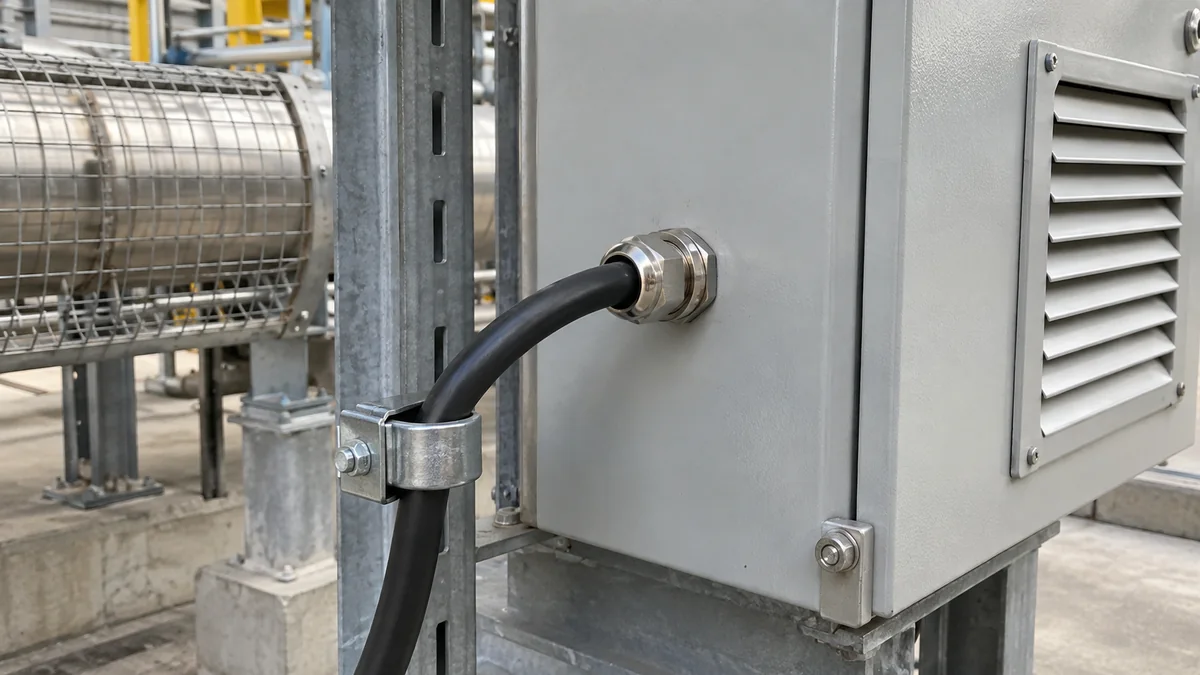
<p><strong>引入口溫度</strong>是電纜穿越外殼壁面處的電纜護套及接頭組件溫度。此處溫度可能不同於附近空氣溫度。電纜電流、外殼內部損耗、太陽輻射、高溫製程表面、通風及零件導熱，都會影響這個位置。我會為每種運轉狀態記錄合理可預期的最低<span class="article-math article-math-inline" data-latex="T_{e,\min}"><span class="katex"><math xmlns="http://www.w3.org/1998/Math/MathML"><semantics><mrow><msub><mi>T</mi><mrow><mi>e</mi><mo separator="true">,</mo><mi>min</mi><mo>⁡</mo></mrow></msub></mrow><annotation encoding="application/x-tex">T_{e,\min}</annotation></semantics></math></span></span>以及最高<span class="article-math article-math-inline" data-latex="T_{e,\max}"><span class="katex"><math xmlns="http://www.w3.org/1998/Math/MathML"><semantics><mrow><msub><mi>T</mi><mrow><mi>e</mi><mo separator="true">,</mo><mi>max</mi><mo>⁡</mo></mrow></msub></mrow><annotation encoding="application/x-tex">T_{e,\max}</annotation></semantics></math></span></span>溫度、每次極值的持續時間及溫度變化率。</p>
<figure>
<img alt="黑色電纜穿過金屬接頭進入工業外殼的引入口示意圖；另有獨立支撐夾，附近可見帶護罩的金屬管線及壁面百葉通風口" src="/images/blog/how-to-ensure-the-glands-operating-temperature-matches-the-cables/local-entry-heat-and-vent-context.webp" srcset="/images/blog/how-to-ensure-the-glands-operating-temperature-matches-the-cables/local-entry-heat-and-vent-context-600.webp 600w, /images/blog/how-to-ensure-the-glands-operating-temperature-matches-the-cables/local-entry-heat-and-vent-context.webp 1200w" sizes="(max-width: 640px) 100vw, 760px" width="1200" height="675" loading="lazy" decoding="async">
<figcaption>已安裝的接頭、獨立電纜支撐、帶防護的金屬管線及外殼百葉通風口，標示出界定引入口溫度歷程時應檢查的物理影響因素；這個示意場景並未提供任何溫度量測值。</figcaption>
</figure>
<p>建立引入口溫度歷程時，我會採用下列輸入資料，而不只套用單一環境溫度範圍：</p>
<table>
<thead>
<tr>
<th>輸入項目</th>
<th>應取得的資料</th>
<th>對選型的影響</th>
</tr>
</thead>
<tbody>
<tr>
<td>一般環境溫度</td>
<td>引入口附近空氣溫度的最低值與最高值</td>
<td>可建立周遭環境條件，但不一定代表組件溫度</td>
</tr>
<tr>
<td>電纜負載</td>
<td>負載情境、導體損耗計算、電纜結構及路徑</td>
<td>可能使電纜與局部引入口溫度高於環境溫度</td>
</tr>
<tr>
<td>外殼熱量</td>
<td>內部耗散、通風狀態、壁面溫度及附近熱源</td>
<td>熱量可能由安裝側傳至接頭</td>
</tr>
<tr>
<td>輻射</td>
<td>日照方向、遮蔽情況及高溫製程表面的視線曝露</td>
<td>可能形成局部表面熱點</td>
</tr>
<tr>
<td>低溫狀態</td>
<td>儲存、安裝、斷電狀態靜置及啟動順序</td>
<td>可能影響護套處理或密封件反應</td>
</tr>
<tr>
<td>暫態</td>
<td>峰值溫度、持續時間、頻率及恢復情況</td>
<td>區分連續工況與允許的短暫事件</td>
</tr>
<tr>
<td>溫度循環</td>
<td>高低溫平台、升降溫或轉換速率、停留時間及循環次數</td>
<td>與單次穩態溫度曝露有不同的要求</td>
</tr>
</tbody>
</table>
<figure class="blog-chart" style="container-type: inline-size;">
<svg id="entry-temperature-influence-map-inline" xmlns="http://www.w3.org/2000/svg" viewBox="0 0 480 1160" role="img" aria-labelledby="entry-temp-title entry-temp-desc" font-family="Arial, Helvetica, sans-serif" style="width: 100% !important; max-width: 100% !important; height: auto !important;">
<style>
#entry-temperature-influence-map-inline { --svg-body-screen: 17px; }
@media (max-width: 760px) { #entry-temperature-influence-map-inline { --svg-body-screen: 16px; } }
</style>
<title id="entry-temp-title">電纜密封接頭引入口處的溫度影響因素</title>
<desc id="entry-temp-desc">狹長的縱向圖示呈現電纜與接頭位於外殼壁面處，接著顯示六項局部及時間相關因素如何匯入該引入口的溫度紀錄。</desc>
<style>
#entry-temperature-influence-map-inline{--bg:#fff;--panel:#f7faf8;--panel-alt:#edf4f0;--border:#9ab9ac;--text:#17372b;--muted:#4a6158;--cable:#243f35;--core:#e7efeb;--core-stroke:#78958a;--metal:#d4a052;--metal-stroke:#6b481c;--wall:#cbd7d1;--warm:#9a3412;--cool:#075985;--time:#5b21b6;--accent:#087e54;--entry-fill:#9a3412;--white:#fff}
:root[data-theme="dark"] #entry-temperature-influence-map-inline{--bg:#101915;--panel:#17241e;--panel-alt:#203129;--border:#557568;--text:#f2f7f4;--muted:#c7d4ce;--cable:#080d0b;--core:#dce6e1;--core-stroke:#90a79d;--metal:#d4a052;--metal-stroke:#3d2910;--wall:#62756c;--warm:#fb923c;--cool:#38bdf8;--time:#c4b5fd;--accent:#4cdda5;--entry-fill:#9a3412;--white:#fff}
</style>
<defs>
<marker id="entry-arrow" markerWidth="8" markerHeight="8" refX="7" refY="4" orient="auto"><path d="M0 0L8 4L0 8Z" fill="var(--accent)"/></marker>
</defs>
<rect width="480" height="1160" fill="var(--bg)"/>
<text x="240" y="36" text-anchor="middle" fill="var(--text)" font-size="24" font-weight="700" style="font-size: calc(22px * 480px / 100cqw) !important;">建立電纜入口處</text>
<text x="240" y="69.6915" text-anchor="middle" fill="var(--text)" font-size="24" font-weight="700" style="font-size: calc(22px * 480px / 100cqw) !important;">的溫度歷程</text>
<text x="240" y="98" text-anchor="middle" fill="var(--muted)" font-size="18" style="font-size: calc(var(--svg-body-screen) * 480px / 100cqw) !important;">六項位置及時間相關輸入在此匯集</text>
<rect x="24" y="126" width="432" height="224" rx="18" fill="var(--panel)" stroke="var(--border)" stroke-width="3"/>
<text x="240" y="160" text-anchor="middle" fill="var(--text)" font-size="20" font-weight="700" style="font-size: calc(18px * 480px / 100cqw) !important;">電纜局部引入口</text>
<text x="240" y="190" text-anchor="middle" fill="var(--muted)" font-size="18" style="font-size: calc(var(--svg-body-screen) * 480px / 100cqw) !important;">量測電纜、接頭與外殼壁面的交會處</text>
<rect x="52" y="226" width="184" height="58" rx="29" fill="var(--cable)" stroke="var(--text)" stroke-width="3"/>
<rect x="52" y="243" width="230" height="24" rx="12" fill="var(--core)" stroke="var(--core-stroke)" stroke-width="3"/>
<path d="M188 208H328L366 234V276L328 302H188Z" fill="var(--metal)" stroke="var(--metal-stroke)" stroke-width="4"/>
<rect x="366" y="208" width="42" height="94" fill="var(--wall)" stroke="var(--core-stroke)" stroke-width="3"/>
<circle cx="250" cy="255" r="46" fill="var(--entry-fill)" stroke="var(--white)" stroke-width="6"/>
<text x="250" y="262" text-anchor="middle" fill="var(--white)" font-size="18" font-weight="700" style="font-size: calc(18px * 480px / 100cqw) !important;">引入口</text>
<text x="126" y="328" text-anchor="middle" fill="var(--text)" font-size="18" font-weight="700" style="font-size: calc(16px * 480px / 100cqw) !important;">電纜護套</text>
<text x="348" y="328" text-anchor="middle" fill="var(--text)" font-size="18" font-weight="700" style="font-size: calc(18px * 480px / 100cqw) !important;">接頭＋外殼壁面</text>
<path d="M240 350V362M240 408V944" fill="none" stroke="var(--accent)" stroke-width="3" stroke-dasharray="7 7"/>
<text x="240" y="390" text-anchor="middle" fill="var(--text)" font-size="20" font-weight="700" style="font-size: calc(18px * 480px / 100cqw) !important;">引入口溫度歷程的輸入項目</text>
<rect x="24" y="420" width="204" height="146" rx="15" fill="var(--panel)" stroke="var(--warm)" stroke-width="3"/>
<text x="42" y="456" fill="var(--text)" font-size="20" font-weight="700" style="font-size: calc(18px * 480px / 100cqw) !important;">電纜負載</text>
<text x="42" y="494" fill="var(--muted)" font-size="18" style="font-size: calc(var(--svg-body-screen) * 480px / 100cqw) !important;">導體損耗</text>
<text x="42" y="528" fill="var(--muted)" font-size="18" style="font-size: calc(var(--svg-body-screen) * 480px / 100cqw) !important;">路徑・負載狀態</text>
<path d="M228 493H238" stroke="var(--accent)" stroke-width="3" marker-end="url(#entry-arrow)"/>
<rect x="252" y="420" width="204" height="146" rx="15" fill="var(--panel)" stroke="var(--warm)" stroke-width="3"/>
<text x="270" y="456" fill="var(--text)" font-size="20" font-weight="700" style="font-size: calc(18px * 480px / 100cqw) !important;">外殼熱量</text>
<text x="270" y="494" fill="var(--muted)" font-size="18" style="font-size: calc(var(--svg-body-screen) * 480px / 100cqw) !important;">內部損耗</text>
<text x="270" y="528" fill="var(--muted)" font-size="18" style="font-size: calc(var(--svg-body-screen) * 480px / 100cqw) !important;">壁面導熱</text>
<path d="M252 493H242" stroke="var(--accent)" stroke-width="3" marker-end="url(#entry-arrow)"/>
<rect x="24" y="590" width="204" height="146" rx="15" fill="var(--panel)" stroke="var(--warm)" stroke-width="3"/>
<text x="42" y="626" fill="var(--text)" font-size="20" font-weight="700" style="font-size: calc(18px * 480px / 100cqw) !important;">輻射</text>
<text x="42" y="664" fill="var(--muted)" font-size="18" style="font-size: calc(var(--svg-body-screen) * 480px / 100cqw) !important;">日照曝露</text>
<text x="42" y="698" fill="var(--muted)" font-size="18" style="font-size: calc(var(--svg-body-screen) * 480px / 100cqw) !important;">高溫表面視線曝露</text>
<path d="M228 663H238" stroke="var(--accent)" stroke-width="3" marker-end="url(#entry-arrow)"/>
<rect x="252" y="590" width="204" height="146" rx="15" fill="var(--panel)" stroke="var(--cool)" stroke-width="3"/>
<text x="270" y="626" fill="var(--text)" font-size="20" font-weight="700" style="font-size: calc(18px * 480px / 100cqw) !important;">附近空氣</text>
<text x="270" y="664" fill="var(--muted)" font-size="18" style="font-size: calc(var(--svg-body-screen) * 480px / 100cqw) !important;">局部通風</text>
<text x="270" y="698" fill="var(--muted)" font-size="18" style="font-size: calc(var(--svg-body-screen) * 480px / 100cqw) !important;">環境溫度狀態</text>
<path d="M252 663H242" stroke="var(--accent)" stroke-width="3" marker-end="url(#entry-arrow)"/>
<rect x="24" y="760" width="204" height="146" rx="15" fill="var(--panel)" stroke="var(--cool)" stroke-width="3"/>
<text x="42" y="796" fill="var(--text)" font-size="20" font-weight="700" style="font-size: calc(18px * 480px / 100cqw) !important;">低溫靜置</text>
<text x="42" y="834" fill="var(--muted)" font-size="18" style="font-size: calc(var(--svg-body-screen) * 480px / 100cqw) !important;">儲存與閒置</text>
<text x="42" y="868" fill="var(--muted)" font-size="18" style="font-size: calc(var(--svg-body-screen) * 480px / 100cqw) !important;">啟動狀態</text>
<path d="M228 833H238" stroke="var(--accent)" stroke-width="3" marker-end="url(#entry-arrow)"/>
<rect x="252" y="760" width="204" height="146" rx="15" fill="var(--panel)" stroke="var(--time)" stroke-width="3"/>
<text x="270" y="796" fill="var(--text)" font-size="20" font-weight="700" style="font-size: calc(18px * 480px / 100cqw) !important;">溫度循環</text>
<text x="270" y="834" fill="var(--muted)" font-size="18" style="font-size: calc(var(--svg-body-screen) * 480px / 100cqw) !important;">峰值・停留時間・變化率</text>
<text x="270" y="868" fill="var(--muted)" font-size="18" style="font-size: calc(var(--svg-body-screen) * 480px / 100cqw) !important;">恢復・重複次數</text>
<path d="M252 833H242" stroke="var(--accent)" stroke-width="3" marker-end="url(#entry-arrow)"/>
<path d="M240 924V958" stroke="var(--accent)" stroke-width="4" marker-end="url(#entry-arrow)"/>
<rect x="24" y="970" width="432" height="164" rx="18" fill="var(--panel-alt)" stroke="var(--border)" stroke-width="3"/>
<text x="240" y="1006" text-anchor="middle" fill="var(--text)" font-size="20" font-weight="700" style="font-size: calc(18px * 480px / 100cqw) !important;">記錄引入口局部溫度歷程</text>
<rect x="48" y="1026" width="384" height="42" rx="10" fill="var(--panel)" stroke="var(--border)" stroke-width="2"/>
<text x="240" y="1054" text-anchor="middle" fill="var(--text)" font-size="18" style="font-size: calc(var(--svg-body-screen) * 480px / 100cqw) !important;">局部最低溫度＋最高溫度</text>
<rect x="48" y="1080" width="384" height="42" rx="10" fill="var(--panel)" stroke="var(--border)" stroke-width="2"/>
<text x="240" y="1108" text-anchor="middle" fill="var(--muted)" font-size="18" style="font-size: calc(var(--svg-body-screen) * 480px / 100cqw) !important;">狀態・持續時間・變化率・不確定度</text>
</svg>
<figcaption>圖示以電纜負載、外殼發熱、輻射、周圍空氣、冷浸及溫度循環為線索，標出引入口承受該溫度歷程時外護套與電纜密封接頭的位置。</figcaption>
</figure>
<p><a href="https://www.nist.gov/metrology/metrological-traceability">NIST 的計量追溯指南</a>將量測結果連結至有文件記錄的校正鏈。使用量測溫度建立引入口溫度歷程時，我會在資料檔中一併記錄感測器、校正狀態、位置及固定方式。也要記錄取樣間隔、負載狀態與不確定度。保留原始時間序列，並標示其中涵蓋的負載及事件。</p>
<p><a href="https://webstore.iec.ch/en/publication/68118">IEC 60287-1-1:2023</a>涵蓋電纜載流量與損耗計算。其計算依據包括指定的穩態周遭條件與最高導體溫度。導體與路徑條件應採用適用的電纜設計方法。接著取得或判定接頭處的電纜護套溫度。在詢價（RFQ）資料中，我會將導體限值與接頭溫度欄位分開。</p>
<h2 id="read-the-cable-ratings-by-condition-and-location">依條件與位置判讀電纜額定值</h2>
<p>電纜文件通常會列出適用於不同條件的多項溫度。我會先請製造商確認電纜結構、護套材料配方、文件版本及各項數值的意義，再進行比較。</p>
<table>
<thead>
<tr>
<th>電纜數值</th>
<th>位置</th>
<th>相符的使用情況</th>
</tr>
</thead>
<tbody>
<tr>
<td>連續導體最高溫度</td>
<td>指定負載與環境下的導體溫度</td>
<td>可用於電纜負載評估；不代表引入口處的護套溫度</td>
</tr>
<tr>
<td>外護套運作溫度範圍</td>
<td>指定已安裝條件下的護套</td>
<td>依相同負荷條件與電纜接觸部件比較</td>
</tr>
<tr>
<td>最低安裝溫度</td>
<td>拉放、彎曲、剝線或端接作業</td>
<td>僅在此處理條件內處理電纜</td>
</tr>
<tr>
<td>固定安裝溫度範圍</td>
<td>不需反覆彎曲的已安裝電纜</td>
<td>僅適用於靜態路徑與引入口</td>
</tr>
<tr>
<td>反覆彎曲溫度範圍</td>
<td>在指定彎曲與循環條件下移動的電纜</td>
<td>須搭配動態固定與彎曲控制要求</td>
</tr>
<tr>
<td>緊急或過載限值</td>
<td>明確指定的短時電氣事件</td>
<td>與連續使用條件分開評估</td>
</tr>
<tr>
<td>短路限值</td>
<td>指定故障持續時間內的導體溫度</td>
<td>不可作為連續使用的護套或接頭溫度值</td>
</tr>
<tr>
<td>儲存或運輸溫度範圍</td>
<td>尚未安裝、仍在包裝內的電纜</td>
<td>不可作為通電使用時的溫度值</td>
</tr>
</tbody>
</table>
<p><a href="https://webstore.iec.ch/en/publication/3554">IEC 60811-504:2012</a>涵蓋擠製電纜絕緣與護套的低溫彎曲試驗。<a href="https://webstore.iec.ch/en/publication/89762">IEC 60811-508:2012+A1:2017+A2:2023</a>涵蓋通常用於熱塑性電纜材料配方的高溫壓力試驗。這些材料試驗並未為聚氯乙烯（PVC）、交聯聚乙烯（XLPE）、橡膠或其他任何電纜系列訂出通用的使用溫度範圍。</p>
<p>低溫安裝前，我會確認展放、彎曲、剝線及鎖緊作業的處理溫度限值。通電使用時則應採用運作溫度限值。電纜可能允許維持在低溫狀態，但禁止在該溫度下彎曲。</p>
<h2 id="read-the-gland-rating-as-a-complete-configuration">將接頭額定值視為完整配置的條件</h2>
<p><strong>電纜密封接頭運作溫度</strong>是特定接頭組件在明確條件下文件記載的使用溫度範圍。限制因素可能是電纜密封件或引入口密封件、屏障密封材料配方、螺紋密封劑、鎧裝介面、配件或證書條件，不一定是可見的本體。<a href="https://webstore.iec.ch/en/publication/7034">IEC 62444:2010</a>涵蓋供應時的完整電纜密封接頭。</p>
<p>我會先確認完整料號及說明。通用材料溫度範圍不能取代這些資料。此原則適用於尼龍、黃銅及不鏽鋼，也適用於丁腈橡膠（NBR）、乙烯丙烯二烯單體橡膠（EPDM）、矽膠及氟橡膠（FKM）密封件。</p>
<p>對實際組件，我會索取：</p>
<ul>
<li>一般使用溫度的最低值與最高值，包括不同密封材料配方的影響；</li>
<li>任何短時間限值，包括持續時間、重複次數、恢復時間及驗收準則；</li>
<li>電纜是固定安裝（靜態）或需依指定方式移動（動態），以及試驗採用的電纜類型與直徑；</li>
<li>引入口密封件與壓縮密封件、O 形環、屏障材料、鎧裝零件、鎖緊螺帽、接地片、護套及核准的螺紋膏劑；</li>
<li>鎖緊說明及依溫度而定的安裝限制；</li>
<li>證書附表、圖面、資料表及說明書的版本；</li>
<li>高溫與化學品、紫外線（UV）曝露、振動、壓力或水同時作用時的限值。</li>
</ul>
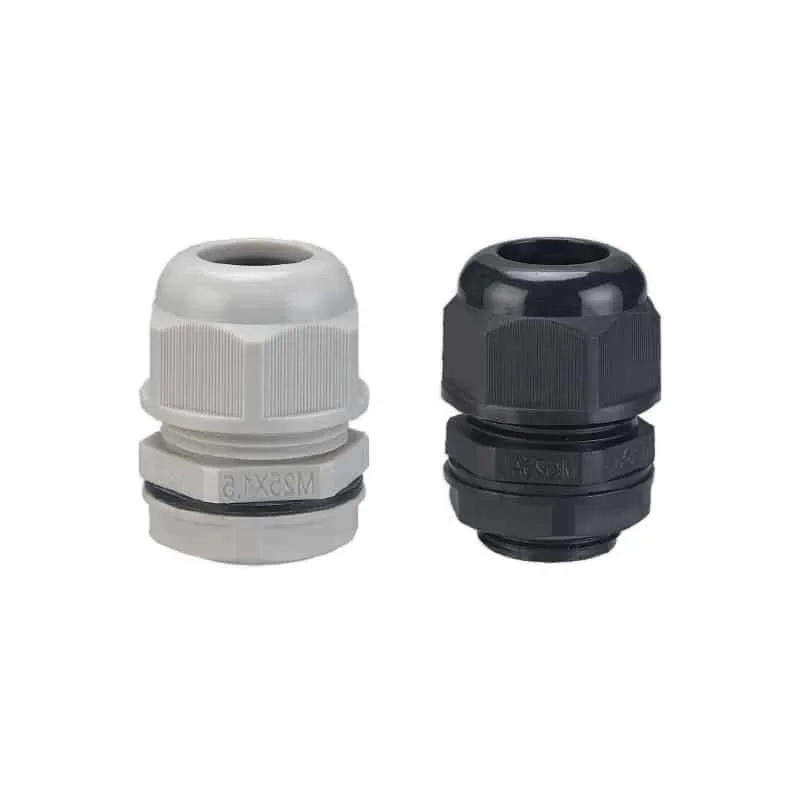
<img alt="白色與黑色聚合物電纜密封接頭，呈現完整本體、螺帽、密封位置及安裝螺紋" src="/images/blog/how-to-ensure-the-glands-operating-temperature-matches-the-cables/nylon-cable-gland-variants.webp" srcset="/images/blog/how-to-ensure-the-glands-operating-temperature-matches-the-cables/nylon-cable-gland-variants-600.webp 600w, /images/blog/how-to-ensure-the-glands-operating-temperature-matches-the-cables/nylon-cable-gland-variants.webp 800w" sizes="(max-width: 640px) 100vw, 800px" width="800" height="800" loading="lazy" decoding="async" />
<figcaption>完整料號及隨附密封組件，可識別其溫度文件所適用的配置。</figcaption>
<h2 id="calculate-the-shared-continuous-temperature-window">計算共同的連續使用溫度範圍</h2>
<p>在這項初步檢查中，我只納入可比較的連續使用溫度範圍。對每一項適用組件<span class="article-math article-math-inline" data-latex="i"><span class="katex"><math xmlns="http://www.w3.org/1998/Math/MathML"><semantics><mrow><mi>i</mi></mrow><annotation encoding="application/x-tex">i</annotation></semantics></math></span></span>，記錄<span class="article-math article-math-inline" data-latex="T_{i,\min}"><span class="katex"><math xmlns="http://www.w3.org/1998/Math/MathML"><semantics><mrow><msub><mi>T</mi><mrow><mi>i</mi><mo separator="true">,</mo><mi>min</mi><mo>⁡</mo></mrow></msub></mrow><annotation encoding="application/x-tex">T_{i,\min}</annotation></semantics></math></span></span>及<span class="article-math article-math-inline" data-latex="T_{i,\max}"><span class="katex"><math xmlns="http://www.w3.org/1998/Math/MathML"><semantics><mrow><msub><mi>T</mi><mrow><mi>i</mi><mo separator="true">,</mo><mi>max</mi><mo>⁡</mo></mrow></msub></mrow><annotation encoding="application/x-tex">T_{i,\max}</annotation></semantics></math></span></span>，並依各自所處的位置與條件記錄。共同界限如下：</p>
<div class="article-math article-math-display" data-latex="T_{c,\min}=\max_i(T_{i,\min}),\qquad T_{c,\max}=\min_i(T_{i,\max})"><span class="katex"><math xmlns="http://www.w3.org/1998/Math/MathML" display="block"><semantics><mrow><msub><mi>T</mi><mrow><mi>c</mi><mo separator="true">,</mo><mi>min</mi><mo>⁡</mo></mrow></msub><mo>=</mo><munder><mrow><mi>max</mi><mo>⁡</mo></mrow><mi>i</mi></munder><mo stretchy="false">(</mo><msub><mi>T</mi><mrow><mi>i</mi><mo separator="true">,</mo><mi>min</mi><mo>⁡</mo></mrow></msub><mo stretchy="false">)</mo><mo separator="true">,</mo><mspace width="2em"/><msub><mi>T</mi><mrow><mi>c</mi><mo separator="true">,</mo><mi>max</mi><mo>⁡</mo></mrow></msub><mo>=</mo><munder><mrow><mi>min</mi><mo>⁡</mo></mrow><mi>i</mi></munder><mo stretchy="false">(</mo><msub><mi>T</mi><mrow><mi>i</mi><mo separator="true">,</mo><mi>max</mi><mo>⁡</mo></mrow></msub><mo stretchy="false">)</mo></mrow><annotation encoding="application/x-tex">T_{c,\min}=\max_i(T_{i,\min}),\qquad T_{c,\max}=\min_i(T_{i,\max})</annotation></semantics></math></span></div>
<p>只有在<span class="article-math article-math-inline" data-latex="T_{c,\min}\le T_{c,\max}"><span class="katex"><math xmlns="http://www.w3.org/1998/Math/MathML"><semantics><mrow><msub><mi>T</mi><mrow><mi>c</mi><mo separator="true">,</mo><mi>min</mi><mo>⁡</mo></mrow></msub><mo>≤</mo><msub><mi>T</mi><mrow><mi>c</mi><mo separator="true">,</mo><mi>max</mi><mo>⁡</mo></mrow></msub></mrow><annotation encoding="application/x-tex">T_{c,\min}\le T_{c,\max}</annotation></semantics></math></span></span>成立時，才存在共同範圍。預期的引入口溫度範圍符合該共同範圍的條件是：</p>
<div class="article-math article-math-display" data-latex="T_{e,\min}\ge T_{c,\min}\quad\text{and}\quad T_{e,\max}\le T_{c,\max}"><span class="katex"><math xmlns="http://www.w3.org/1998/Math/MathML" display="block"><semantics><mrow><msub><mi>T</mi><mrow><mi>e</mi><mo separator="true">,</mo><mi>min</mi><mo>⁡</mo></mrow></msub><mo>≥</mo><msub><mi>T</mi><mrow><mi>c</mi><mo separator="true">,</mo><mi>min</mi><mo>⁡</mo></mrow></msub><mspace width="1em"/><mtext>and</mtext><mspace width="1em"/><msub><mi>T</mi><mrow><mi>e</mi><mo separator="true">,</mo><mi>max</mi><mo>⁡</mo></mrow></msub><mo>≤</mo><msub><mi>T</mi><mrow><mi>c</mi><mo separator="true">,</mo><mi>max</mi><mo>⁡</mo></mrow></msub></mrow><annotation encoding="application/x-tex">T_{e,\min}\ge T_{c,\min}\quad\text{and}\quad T_{e,\max}\le T_{c,\max}</annotation></semantics></math></span></div>
<p><strong>溫度裕度</strong>是預期引入口極值與適用共同界限之間的差值。冷端裕度為<span class="article-math article-math-inline" data-latex="M_{cold}=T_{e,\min}-T_{c,\min}"><span class="katex"><math xmlns="http://www.w3.org/1998/Math/MathML"><semantics><mrow><msub><mi>M</mi><mrow><mi>c</mi><mi>o</mi><mi>l</mi><mi>d</mi></mrow></msub><mo>=</mo><msub><mi>T</mi><mrow><mi>e</mi><mo separator="true">,</mo><mi>min</mi><mo>⁡</mo></mrow></msub><mo>−</mo><msub><mi>T</mi><mrow><mi>c</mi><mo separator="true">,</mo><mi>min</mi><mo>⁡</mo></mrow></msub></mrow><annotation encoding="application/x-tex">M_{cold}=T_{e,\min}-T_{c,\min}</annotation></semantics></math></span></span>，熱端裕度為<span class="article-math article-math-inline" data-latex="M_{hot}=T_{c,\max}-T_{e,\max}"><span class="katex"><math xmlns="http://www.w3.org/1998/Math/MathML"><semantics><mrow><msub><mi>M</mi><mrow><mi>h</mi><mi>o</mi><mi>t</mi></mrow></msub><mo>=</mo><msub><mi>T</mi><mrow><mi>c</mi><mo separator="true">,</mo><mi>max</mi><mo>⁡</mo></mrow></msub><mo>−</mo><msub><mi>T</mi><mrow><mi>e</mi><mo separator="true">,</mo><mi>max</mi><mo>⁡</mo></mrow></msub></mrow><annotation encoding="application/x-tex">M_{hot}=T_{c,\max}-T_{e,\max}</annotation></semantics></math></span></span>。納入量測與模型不確定度後，我會依專案核准的規則比較兩項裕度。電纜額定值之外不存在通用的 10 °C、20 °C 或百分比裕度。裕度必須適用於指定位置及使用條件，不能套用到無關的型錄數值。</p>
<p><a class="article-tool-card article-tool-card-link" href="/zh-hant/resource-center/tools/temperature-rating-margin-calculator/" aria-label="溫度額定值餘裕計算器"><span class="article-tool-card-index">工具</span><span class="article-tool-card-kicker">熱變化與材料變化</span><strong class="article-tool-card-title">溫度額定值餘裕計算器</strong><span class="article-tool-card-copy">將文件記載的單一元件限值，與同一實際位置、相同連續負荷條件下的運作溫度比較。冷端也要重複計算，並逐一檢查每個限制組件；之後再分別檢查溫度循環與同時發生的曝露。</span><span class="article-tool-card-formula">MT = Trating − Toperating</span><span class="article-tool-card-inputs" aria-label="計算器輸入項目"><em>文件記載的額定溫度</em><em>運轉溫度</em></span><span class="article-tool-card-action">開啟計算器 <span aria-hidden="true">-&gt;</span></span></a></p><p>假設引入口處核准的連續外護套溫度範圍為 −25 °C 至 90 °C，特定接頭配置為 −40 °C 至 80 °C，外殼介面為 −30 °C 至 85 °C。三者的共同範圍為 −25 °C 至 80 °C。若引入口模型給出的溫度範圍為 −20 °C 至 74 °C，算出的冷端裕度為 5 °C，熱端裕度為 6 °C。這些輸入僅用於示範計算；實際選型仍須取得指定文件、考量不確定度與溫度循環、確認電纜配合，並遵循專案驗收規則。</p>
<figure class="blog-chart" style="container-type: inline-size;">
<svg xmlns="http://www.w3.org/2000/svg" viewBox="0 0 480 1120" role="img" aria-labelledby="temp-title temp-desc" style="font-family:var(--font-body); width: 100% !important; max-width: 100% !important; height: auto !important;" id="cg-typography-69d6592a2bfb8c92">
<style>
#cg-typography-69d6592a2bfb8c92 { --svg-body-screen: 17px; }
@media (max-width: 760px) { #cg-typography-69d6592a2bfb8c92 { --svg-body-screen: 16px; } }
</style>
<title id="temp-title">電纜與接頭溫度基準檢查</title>
<desc id="temp-desc">縱向判斷流程先將外殼引入口的溫度，與電纜及完整接頭配置的限值對齊，再計算共同連續溫度範圍，並將溫度循環合格驗證與數值範圍重疊分開處理。</desc>
<text x="240" y="42" text-anchor="middle" fill="var(--color-carbon)" font-size="23" font-weight="700" style="font-size: calc(22px * 480px / 100cqw) !important;">採用相同的溫度基準</text>
<rect x="30" y="78" width="420" height="160" rx="18" fill="var(--surface-card)" stroke="var(--color-primary)" stroke-width="3"/>
<circle cx="70" cy="118" r="22" fill="var(--color-primary)"/>
<text x="70" y="125" text-anchor="middle" fill="#fff" font-size="18" font-weight="700" style="font-size: calc(16px * 480px / 100cqw) !important;">1</text>
<text x="108" y="116" fill="var(--color-primary)" font-size="18" font-weight="700" style="font-size: calc(18px * 480px / 100cqw) !important;">引入口條件</text>
<text x="54" y="156" fill="var(--color-carbon)" font-size="18" style="font-size: calc(var(--svg-body-screen) * 480px / 100cqw) !important;">局部最低溫度與最高溫度。</text>
<text x="54" y="184" fill="var(--color-graphite)" font-size="18" style="font-size: calc(var(--svg-body-screen) * 480px / 100cqw) !important;">狀態・持續時間・循環・不確定度。</text>
<text x="54" y="212" fill="var(--color-graphite)" font-size="18" style="font-size: calc(var(--svg-body-screen) * 480px / 100cqw) !important;">環境溫度＋電纜＋外殼＋輻射。</text>
<path d="M240 238v42" stroke="var(--color-primary)" stroke-width="4"/>
<path d="M230 270l10 12 10-12" fill="none" stroke="var(--color-primary)" stroke-width="4"/>
<rect x="30" y="282" width="420" height="154" rx="18" fill="var(--surface-card)" stroke="var(--color-carbon)" stroke-width="3"/>
<circle cx="70" cy="322" r="22" fill="var(--color-primary)"/>
<text x="70" y="329" text-anchor="middle" fill="#fff" font-size="18" font-weight="700" style="font-size: calc(16px * 480px / 100cqw) !important;">2</text>
<text x="108" y="320" fill="var(--color-carbon)" font-size="18" font-weight="700" style="font-size: calc(18px * 480px / 100cqw) !important;">電纜文件</text>
<text x="54" y="360" fill="var(--color-carbon)" font-size="18" style="font-size: calc(var(--svg-body-screen) * 480px / 100cqw) !important;">接頭處的外護套。</text>
<text x="54" y="388" fill="var(--color-graphite)" font-size="18" style="font-size: calc(var(--svg-body-screen) * 480px / 100cqw) !important;">運轉 ≠ 安裝 ≠ 短路。</text>
<text x="54" y="416" fill="var(--color-graphite)" font-size="18" style="font-size: calc(var(--svg-body-screen) * 480px / 100cqw) !important;">固定路徑 ≠ 反覆彎曲。</text>
<path d="M240 436v42" stroke="var(--color-primary)" stroke-width="4"/>
<path d="M230 468l10 12 10-12" fill="none" stroke="var(--color-primary)" stroke-width="4"/>
<rect x="30" y="480" width="420" height="154" rx="18" fill="var(--surface-card)" stroke="var(--color-carbon)" stroke-width="3"/>
<circle cx="70" cy="520" r="22" fill="var(--color-primary)"/>
<text x="70" y="527" text-anchor="middle" fill="#fff" font-size="18" font-weight="700" style="font-size: calc(16px * 480px / 100cqw) !important;">3</text>
<text x="108" y="518" fill="var(--color-carbon)" font-size="18" font-weight="700" style="font-size: calc(18px * 480px / 100cqw) !important;">接頭配置</text>
<text x="54" y="558" fill="var(--color-carbon)" font-size="18" style="font-size: calc(var(--svg-body-screen) * 480px / 100cqw) !important;">確切料號及電纜。</text>
<text x="54" y="586" fill="var(--color-graphite)" font-size="18" style="font-size: calc(var(--svg-body-screen) * 480px / 100cqw) !important;">本體・密封件・配件・材料配方。</text>
<text x="54" y="614" fill="var(--color-graphite)" font-size="18" style="font-size: calc(var(--svg-body-screen) * 480px / 100cqw) !important;">說明・證書條件。</text>
<path d="M240 634v42" stroke="var(--color-primary)" stroke-width="4"/>
<path d="M230 666l10 12 10-12" fill="none" stroke="var(--color-primary)" stroke-width="4"/>
<rect x="30" y="678" width="420" height="168" rx="18" fill="var(--color-primary)"/>
<text x="240" y="716" text-anchor="middle" fill="#fff" font-size="18" font-weight="700" style="font-size: calc(18px * 480px / 100cqw) !important;">共同連續溫度範圍</text>
<text x="240" y="760" text-anchor="middle" fill="#fff" font-size="18" style="font-size: calc(var(--svg-body-screen) * 480px / 100cqw) !important;">Tc,min = 所有最低值中的最大值。</text>
<text x="240" y="796" text-anchor="middle" fill="#fff" font-size="18" style="font-size: calc(var(--svg-body-screen) * 480px / 100cqw) !important;">Tc,max = 所有最高值中的最小值。</text>
<text x="240" y="828" text-anchor="middle" fill="#fff" font-size="18" style="font-size: calc(var(--svg-body-screen) * 480px / 100cqw) !important;">採用相同的位置與工況基準。</text>
<path d="M240 846v42" stroke="var(--color-primary)" stroke-width="4"/>
<path d="M230 878l10 12 10-12" fill="none" stroke="var(--color-primary)" stroke-width="4"/>
<path d="M240 892l170 78-170 78L70 970Z" fill="var(--surface-card)" stroke="var(--color-primary)" stroke-width="3"/>
<text x="240" y="957" text-anchor="middle" fill="var(--color-carbon)" font-size="18" font-weight="700" style="font-size: calc(18px * 480px / 100cqw) !important;">引入口溫度範圍是否落在</text>
<text x="240" y="984" text-anchor="middle" fill="var(--color-carbon)" font-size="18" font-weight="700" style="font-size: calc(18px * 480px / 100cqw) !important;">共同範圍的兩個界限內？</text>
<text x="61" y="1000" fill="#b45309" font-size="18" font-weight="700" style="font-size: calc(16px * 480px / 100cqw) !important;">否</text>
<text x="389" y="1000" fill="#009530" font-size="18" font-weight="700" style="font-size: calc(16px * 480px / 100cqw) !important;">是</text>
<text x="34" y="1042" fill="var(--color-carbon)" font-size="18" font-weight="700" style="font-size: calc(18px * 480px / 100cqw) !important;">拒收或重新設計。</text>
<text x="289" y="1042" fill="var(--color-carbon)" font-size="18" font-weight="700" style="font-size: calc(18px * 480px / 100cqw) !important;">檢查循環與配合。</text>
<text x="34" y="1070" fill="var(--color-graphite)" font-size="18" style="font-size: calc(var(--svg-body-screen) * 480px / 100cqw) !important;">套用專案裕度。</text>
<text x="289" y="1070" fill="var(--color-graphite)" font-size="18" style="font-size: calc(var(--svg-body-screen) * 480px / 100cqw) !important;">接著對組件進行合格驗證。</text>
</svg>
<figcaption>溫度比對須先採用相同的定義。數值範圍重疊僅能確認連續使用溫度範圍相容；溫度循環、電纜配合、同時曝露、安裝及認證仍須分別檢查。</figcaption>
</figure>
<h2 id="check-hot-spots-cold-starts-and-temperature-cycling">檢查熱點、冷態啟動及溫度循環</h2>
<p>穩態低溫、穩態高溫及反覆溫度變化是不同的要求。<a href="https://webstore.iec.ch/en/publication/82354">IEC 60068-2-1:2025</a>涵蓋散熱及不散熱試件的低溫試驗。<a href="https://webstore.iec.ch/en/publication/82355">IEC 60068-2-2:2025</a>涵蓋乾熱，並明確排除溫度變化的影響。<a href="https://webstore.iec.ch/en/publication/71503">IEC 60068-2-14:2023</a>提供採用指定環境溫度變化的試驗方法。只有在產品或專案規格指定嚴酷度、狀態調節、量測及驗收準則時，我才會採用這些方法。</p>
<p>至少檢查下列情況：</p>
<ol>
<li><strong>斷電低溫靜置及啟動：</strong>確認電纜處理、密封件狀態、螺紋操作，以及低溫狀態下是否允許鎖緊。</li>
<li><strong>最高合理可預期的電氣負載：</strong>系統到達定義的狀態後，判定護套與接頭溫度，而不只是查看室內溫度。</li>
<li><strong>外殼熱點：</strong>評估驅動器、匯流排、加熱器、引擎、製程管線或曝曬日照表面附近的外殼壁面與接頭。</li>
<li><strong>具代表性的溫度變化：</strong>界定高低溫、轉換速率、停留時間、循環次數、通電狀態、電纜移動及恢復後檢查。</li>
<li><strong>同時曝露：</strong>若合格驗證依據有所要求，應將溫度與使用時可能同時發生的化學品、振動、紫外線（UV）、沖洗、壓力或電纜移動組合評估。</li>
<li><strong>狀態調節後檢查：</strong>依規定等待恢復，然後檢查並測試驗收計畫中列出的相同功能。</li>
</ol>
<p>在每個引入口溫度極值下，檢查<a href="/zh-hant/blog/how-does-operating-temperature-impact-cable-gland-sealing-performance/">溫度對電纜密封接頭密封性能的影響</a>，並考量供應的密封件與組件。低溫主導的工況，請參考<a href="/zh-hant/blog/how-do-you-select-cable-glands-for-low-temperature-and-cryogenic-applications/">低溫電纜密封接頭選型檢查</a>。高溫工況則須核實<a href="/zh-hant/blog/which-high-temperature-cable-glands-can-survive-your-most-extreme-industrial-applications/">材料、密封元件、配件及證書限值</a>。只有電纜與完整接頭在共同介面上均具有可接受的溫度範圍時，我才會接受此組合。</p>
<h2 id="verify-cable-fit-across-the-declared-temperature-range">確認電纜在聲明的溫度範圍內配合良好</h2>
<p><strong>已安裝的電纜必須保持在接頭核准的密封與固定範圍內。</strong>我會記錄其外徑（OD）、橢圓度、護套結構、公差及表面狀況。接著檢查接頭的電纜範圍、嵌件選項、鎖緊說明及任何移動限制。溫度會改變尺寸與材料反應，但僅靠係數計算無法預測密封壓力或壽命。</p>
<p>對自由且均勻的組件而言，<span class="article-math article-math-inline" data-latex="\Delta L=\alpha L_0\Delta T"><span class="katex"><math xmlns="http://www.w3.org/1998/Math/MathML"><semantics><mrow><mi mathvariant="normal">Δ</mi><mi>L</mi><mo>=</mo><mi>α</mi><msub><mi>L</mi><mn>0</mn></msub><mi mathvariant="normal">Δ</mi><mi>T</mi></mrow><annotation encoding="application/x-tex">\Delta L=\alpha L_0\Delta T</annotation></semantics></math></span></span>可估算線性尺寸變化。此處<span class="article-math article-math-inline" data-latex="\alpha"><span class="katex"><math xmlns="http://www.w3.org/1998/Math/MathML"><semantics><mrow><mi>α</mi></mrow><annotation encoding="application/x-tex">\alpha</annotation></semantics></math></span></span>是該材料在此溫度區間的文件記載係數。接頭會限制多種材料並壓縮密封件，因此我也會評估<a href="/zh-hant/blog/how-do-thermal-expansion-coefficients-affect-cable-gland-seal-integrity-during-temperature-cycles/">接頭介面處的差異熱膨脹</a>、密封壓縮量及完整循環行為。設定試驗或公差前，應先完成上述評估，不能只採用自由膨脹估算值。樹脂或彈性體系列資料無法確定完整接頭的溫度範圍。</p>
<p>活動電纜除了外徑，也應在相關溫度下檢查彎曲、張力、扭轉及循環限值。扭轉是指纏扭。溫度範圍重疊，並不代表固定安裝用電纜適合持續彎曲。</p>
<h2 id="reject-shorthand-material-rankings-and-generic-margins">不要依簡化材料排名或通用裕度選型</h2>
<p>材料名稱有助縮小選項，但不能據此核准整個組件。尼龍牌號、穩定劑、含水狀態、金屬表面處理、彈性體材料配方、潤滑劑及屏障材料配方都可能影響結果。「不鏽鋼可耐至 200 °C」並未說明隨附密封件、護套、螺紋處理、認證或低溫限值。我只會以核准組件中列出的替代品更換 O 形環；單獨更換密封件可能使評估失效。</p>
<p>有下列任一情況仍未解決時，應拒絕該選型：</p>
<ul>
<li>電纜數值描述導體溫度，但接頭數值描述環境空氣溫度；</li>
<li>拿短期或故障額定值與連續使用條件相比；</li>
<li>接頭溫度範圍未包含密封材料配方、電纜範圍或配件組合；</li>
<li>低溫下限僅涵蓋儲存，未涵蓋安裝或移動；</li>
<li>以任意溫度裕度取代專案不確定度分析；</li>
<li>僅測試分開的材料試片，卻尚未驗證完整組件的宣稱；</li>
<li>以 IP 代碼、Ex 標示或材料名稱當作額定溫度。</li>
</ul>
<p><a href="https://webstore.iec.ch/en/publication/2452">IEC 60529:1989+A1:1999+A2:2013</a>分類外殼防護等級。侵入防護（IP）代碼並未說明溫度相容性。任何危險場所、火災相關性能、海事、鐵路、衛生或其他產業要求，也須遵循相應的證書及使用條件。防爆（Ex）標示是另一項限制，並非溫度額定值。</p>
<h2 id="qualify-the-installed-cable-and-gland-combination">對已安裝的電纜與接頭組合進行合格驗證</h2>
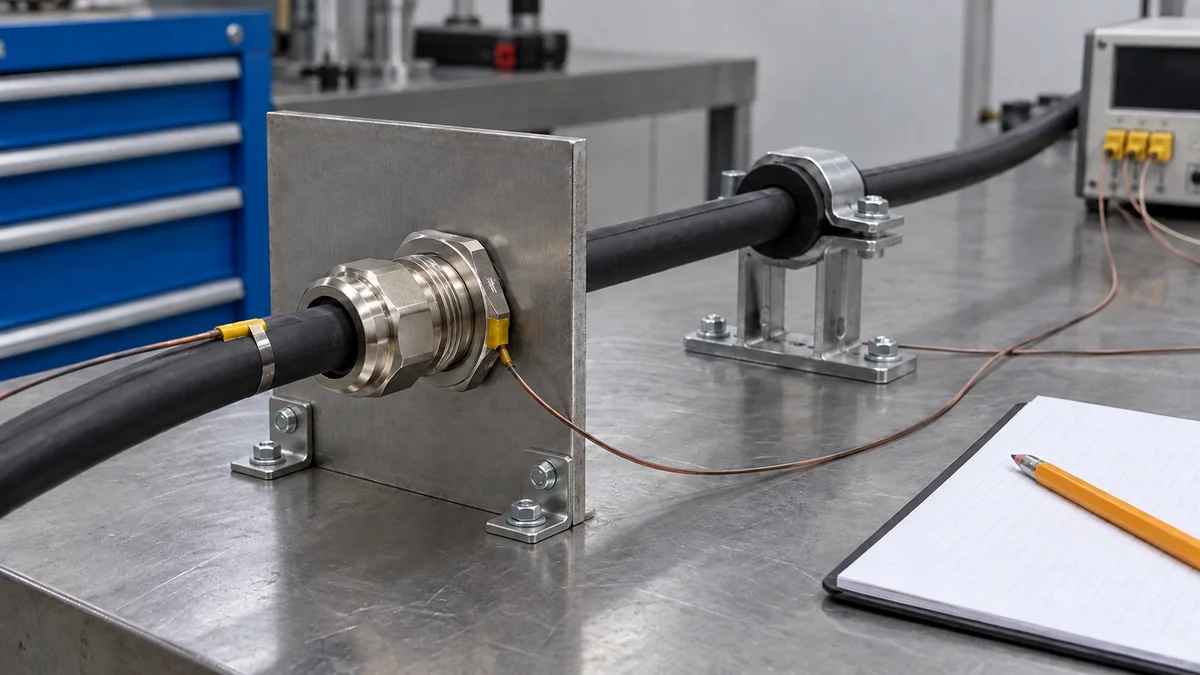
<p>只有在電纜、接頭、引入口及配件都符合預定安裝配置時，溫度檢查才有意義。鎖緊方式、感測器位置、電氣負載、曝露順序及恢復時間都會影響結果。依主導要求而定，檢查項目可能包括裂紋、位移、保持力、密封件位置、洩漏、侵入狀況、等電位連接或絕緣。尺寸變化、扭矩見證標記或受控拆解，也可能顯示曝露後的變化。這些檢查可呈現該組合對所述條件的反應；單次短時間的試驗箱曝露無法證明長期使用壽命。</p>
<figure>
<img alt="試驗台示意試件：電纜穿過金屬接頭與平面板，另有獨立支撐夾、細感測器導線及空白紀錄表" src="/images/blog/how-to-ensure-the-glands-operating-temperature-matches-the-cables/cable-gland-temperature-specimen-setup.webp" srcset="/images/blog/how-to-ensure-the-glands-operating-temperature-matches-the-cables/cable-gland-temperature-specimen-setup-600.webp 600w, /images/blog/how-to-ensure-the-glands-operating-temperature-matches-the-cables/cable-gland-temperature-specimen-setup.webp 1200w" sizes="(max-width: 640px) 100vw, 760px" width="1200" height="675" loading="lazy" decoding="async">
<figcaption>此示意試件配置中可見電纜、接頭、面板、支撐及兩個感測位置。僅憑此配置，無法得知任何溫度或合格驗證結果。</figcaption>
</figure>
<p>整體配置很重要，因為電纜、接頭本體、密封件及配件可能各有不同的溫度限值：</p>
<table>
<thead>
<tr>
<th>溫度比較中的部件</th>
<th>重要細節</th>
</tr>
</thead>
<tbody>
<tr>
<td>電纜識別資料</td>
<td>製造商、完整型號、結構、護套材料配方、外徑（OD）範圍、批次或版本</td>
</tr>
<tr>
<td>電纜溫度基準</td>
<td>導體、護套、安裝、固定、反覆彎曲、緊急及儲存限值，並列明位置與持續時間</td>
</tr>
<tr>
<td>接頭識別資料</td>
<td>完整料號、密封件選項、電纜範圍、引入口螺紋、配件及說明</td>
</tr>
<tr>
<td>引入口溫度歷程</td>
<td><span class="article-math article-math-inline" data-latex="T_{e,\min}"><span class="katex"><math xmlns="http://www.w3.org/1998/Math/MathML"><semantics><mrow><msub><mi>T</mi><mrow><mi>e</mi><mo separator="true">,</mo><mi>min</mi><mo>⁡</mo></mrow></msub></mrow><annotation encoding="application/x-tex">T_{e,\min}</annotation></semantics></math></span></span>，<span class="article-math article-math-inline" data-latex="T_{e,\max}"><span class="katex"><math xmlns="http://www.w3.org/1998/Math/MathML"><semantics><mrow><msub><mi>T</mi><mrow><mi>e</mi><mo separator="true">,</mo><mi>max</mi><mo>⁡</mo></mrow></msub></mrow><annotation encoding="application/x-tex">T_{e,\max}</annotation></semantics></math></span></span>，負載狀態、熱點、暫態、循環及不確定度</td>
</tr>
<tr>
<td>共同範圍</td>
<td>組件限值、<span class="article-math article-math-inline" data-latex="T_{c,\min}"><span class="katex"><math xmlns="http://www.w3.org/1998/Math/MathML"><semantics><mrow><msub><mi>T</mi><mrow><mi>c</mi><mo separator="true">,</mo><mi>min</mi><mo>⁡</mo></mrow></msub></mrow><annotation encoding="application/x-tex">T_{c,\min}</annotation></semantics></math></span></span>，<span class="article-math article-math-inline" data-latex="T_{c,\max}"><span class="katex"><math xmlns="http://www.w3.org/1998/Math/MathML"><semantics><mrow><msub><mi>T</mi><mrow><mi>c</mi><mo separator="true">,</mo><mi>max</mi><mo>⁡</mo></mrow></msub></mrow><annotation encoding="application/x-tex">T_{c,\max}</annotation></semantics></math></span></span>、冷端與熱端裕度、核准準則</td>
</tr>
<tr>
<td>同時作用條件</td>
<td>化學品、紫外線（UV）、水、壓力、振動、電纜移動及外殼發熱</td>
</tr>
<tr>
<td>驗證</td>
<td>方法、嚴酷度、試件數量、感測器、驗收準則及結果</td>
</tr>
<tr>
<td>變更管制</td>
<td>電纜、密封件、接頭、外殼或製程變更後須重新檢視的文件及檢查項目</td>
</tr>
</tbody>
</table>
<p>在試運轉時及相關熱事件後進行檢查。我會記錄<a href="/zh-hant/blog/how-do-you-perform-effective-visual-inspection-of-cable-gland-integrity/">可觀察到的電纜密封接頭狀況</a>；不僅憑外觀判定隱藏的螺紋嚙合或密封接觸。若高溫同時伴隨其他曝露，應依觀察到的狀況、已知使用工況及適用維護準則，安排<a href="/zh-hant/blog/how-does-environmental-aging-affect-cable-gland-seal-performance-over-time/">依條件執行的環境老化檢查</a>。</p>
<h2 id="conclusion">結論</h2>
<p>溫度配合須依據實際電纜護套及接頭介面溫度、可比較的額定值定義，以及已安裝組件中的每個零件。我會找出共同範圍，而不是比較兩個型錄最高值。最低合理可預期的引入口狀態必須高於所有適用下限中的最高值；最高合理可預期的狀態則必須低於所有適用上限中的最低值。</p>
<p>只有共同連續溫度範圍及專案裕度符合電纜配合、低溫安裝、高溫負載、溫度循環、同時曝露及證書條件時，我才會接受該接頭。若溫度範圍未說明位置、持續時間、電纜、密封件或組件，應取得相關資料，否則拒絕該選項。</p>
<h2 id="faqs-about-matching-cable-gland-and-cable-operating-temperatures">電纜密封接頭與電纜運作溫度配合常見問題</h2>
<h3 id="must-the-gland-temperature-rating-be-higher-than-the-cable-conductor-rating">接頭的額定溫度必須高於電纜導體額定溫度嗎？</h3>
<p>不一定。電纜導體與接頭通常位於不同位置，溫度也可能不同。應針對每種負載情境，判定電纜護套與接頭介面的溫度，再與適用於那些位置及工況的額定值比較。</p>
<h3 id="how-much-temperature-margin-should-i-add-to-a-cable-gland">電纜密封接頭應增加多少溫度裕度？</h3>
<p>應遵循專案對不確定度、後果、設計規則及適用文件的要求。不存在通用的 10 °C、20 °C 或百分比裕度。只有在位置及連續或短時間使用基準相符後，我才會計算冷端與熱端裕度。</p>
<h3 id="does-a-metal-gland-body-determine-the-whole-gland-temperature-range">金屬接頭本體會決定整個接頭的溫度範圍嗎？</h3>
<p>不會。電纜密封件、引入口密封件、O 形環、屏障材料配方、螺紋處理、配件、電纜及認證都可能造成更窄的限值。請確認完整且確切的料號與配置所適用的溫度範圍。</p>
<h3 id="can-i-use-a-cables-emergency-or-short-circuit-temperature-as-the-gland-operating-temperature">可以把電纜緊急或短路溫度當作接頭運作溫度嗎？</h3>
<p>不可以。限時導體事件不等同於連續護套或接頭額定值。應記錄事件持續時間與頻率、判定引入口處的實際溫度，並確認完整組件有相符的短時間使用基準。</p>
<h3 id="is-a-chamber-temperature-cycle-test-enough-to-approve-the-cable-entry">試驗箱溫度循環測試足以核准電纜引入嗎？</h3>
<p>只有在方法、嚴酷度、試件、通電狀態、電纜移動、同時曝露、量測及驗收準則均符合適用要求時，才足以作為依據。接受測試前，我會先確認這些細節。通用試驗箱循環不會自動證明侵入防護、固定能力、認證或使用壽命。</p>
<h3 id="sources-and-technical-references">來源與技術參考資料</h3>
<ul>
<li><a href="https://webstore.iec.ch/en/publication/7034">IEC 62444:2010，電氣裝置用電纜密封接頭</a>，查閱日期：2026-09-23。</li>
<li><a href="https://www.nist.gov/metrology/metrological-traceability">NIST，計量追溯</a>，查閱日期：2026-09-23。</li>
<li><a href="https://webstore.iec.ch/en/publication/68118">IEC 60287-1-1:2023，電纜—載流量計算—通則</a>，查閱日期：2026-09-23。</li>
<li><a href="https://webstore.iec.ch/en/publication/3554">IEC 60811-504:2012，電纜絕緣與護套的低溫彎曲試驗</a>，查閱日期：2026-09-23。</li>
<li><a href="https://webstore.iec.ch/en/publication/89762">IEC 60811-508:2012+A1:2017+A2:2023，電纜絕緣與護套的高溫壓力試驗</a>，查閱日期：2026-09-23。</li>
<li><a href="https://webstore.iec.ch/en/publication/82354">IEC 60068-2-1:2025，環境試驗—低溫</a>，查閱日期：2026-09-23。</li>
<li><a href="https://webstore.iec.ch/en/publication/82355">IEC 60068-2-2:2025，環境試驗—乾熱</a>，查閱日期：2026-09-23。</li>
<li><a href="https://webstore.iec.ch/en/publication/71503">IEC 60068-2-14:2023，環境試驗—溫度變化</a>，查閱日期：2026-09-23。</li>
<li><a href="https://webstore.iec.ch/en/publication/2452">IEC 60529 合併版本，外殼提供的防護等級</a>，查閱日期：2026-09-23。</li>
</ul>