# 電纜密封接頭材料密度如何影響移動應用中的重量與慣性

> Source: https://chinacableglands.com/zh-hant/blog/how-cable-gland-material-density-impacts-weight-and-inertia-in-moving-applications/
> Language: zh-Hant
> Publisher: 倍拓電纜接頭
> Author: Edward Wang
> Published: 2026-02-25
> Updated: 2026-07-25

電纜密封接頭材料的密度會影響完整已安裝組件的質量；了解幾何形狀、移動位置及與軸線的距離如何改變機械設備中的重量與慣性。

<p><strong>材料密度會透過已安裝電纜密封接頭的質量、幾何形狀及位置，影響移動系統。</strong> 我會先在機械設備上定位接頭，再使用其完整組件質量。只有比較的材料體積相當時，較低密度材料才會降低質量。平移效應取決於承載質量；旋轉效應還取決於與軸線的距離及質量分布。僅憑密度無法判定機械性能或電纜引入適用性。</p>
<blockquote>
<p><strong>重點整理</strong></p>
<ul>
<li>先確認接頭是固定不動，還是由移動組件承載。</li>
<li>在機械模型中使用完整已安裝接頭組件的質量，而非一般密度值。</li>
<li>將平移與旋轉分開處理；轉動效應很大程度取決於軸線距離及質量分布。</li>
<li>比較系統層級的動態變化，不要承諾固定的速度、能耗或精度效益。</li>
<li>將材料適用性、電纜固定能力、密封、引入口安裝及電氣功能分開檢查。</li>
</ul>
</blockquote>
<h2 id="cable-gland-material-density-changes-mass-through-material-volume">電纜密封接頭材料密度會透過材料體積改變質量</h2>
<p><strong>質量密度</strong> 是質量除以體積。<a href="https://www.nist.gov/pml/special-publication-811/nist-guide-si-chapter-8">NIST《國際單位制指南》第 8 章</a> 給出 <span class="article-math article-math-inline" data-latex="\rho = m/V"><span class="katex"><math xmlns="http://www.w3.org/1998/Math/MathML"><semantics><mrow><mi>ρ</mi><mo>=</mo><mi>m</mi><mi mathvariant="normal">/</mi><mi>V</mi></mrow><annotation encoding="application/x-tex">\rho = m/V</annotation></semantics></math></span></span>，並以公斤/立方公尺作為 SI 單位。對均質零件，初步估算為 <span class="article-math article-math-inline" data-latex="m_{\mathrm{est}} = \rho V_{\mathrm{net}}"><span class="katex"><math xmlns="http://www.w3.org/1998/Math/MathML"><semantics><mrow><msub><mi>m</mi><mrow><mi mathvariant="normal">e</mi><mi mathvariant="normal">s</mi><mi mathvariant="normal">t</mi></mrow></msub><mo>=</mo><mi>ρ</mi><msub><mi>V</mi><mrow><mi mathvariant="normal">n</mi><mi mathvariant="normal">e</mi><mi mathvariant="normal">t</mi></mrow></msub></mrow><annotation encoding="application/x-tex">m_{\mathrm{est}} = \rho V_{\mathrm{net}}</annotation></semantics></math></span></span>，其中 <span class="article-math article-math-inline" data-latex="V_{\mathrm{net}}"><span class="katex"><math xmlns="http://www.w3.org/1998/Math/MathML"><semantics><mrow><msub><mi>V</mi><mrow><mi mathvariant="normal">n</mi><mi mathvariant="normal">e</mi><mi mathvariant="normal">t</mi></mrow></msub></mrow><annotation encoding="application/x-tex">V_{\mathrm{net}}</annotation></semantics></math></span></span> 是該材料所佔的體積。這不是組裝完成電纜密封接頭的質量：本體、蓋帽、鎖緊螺帽、密封件、嵌件、接觸零件、塗層、空隙及配件都會改變總質量。</p>
<p>日常用語中的「重量」常被用來指質量，但兩者是不同的工程量。NIST 將重量定義為與當地重力加速度相關的力。移動系統計算通常需要以公斤表示的質量；靜態支撐也可能需要以力表示的重量。應明確標示質量、力、密度及體積的單位。</p>
<p><a class="article-tool-card article-tool-card-link" href="/zh-hant/resource-center/tools/mass-from-density-volume-calculator/" aria-label="依密度與體積計算質量"><span class="article-tool-card-index">工具</span><span class="article-tool-card-kicker">熱變化與材料變化</span><strong class="article-tool-card-title">依密度與體積計算質量</strong><span class="article-tool-card-copy">採用確切的材料密度與淨材料體積，初步估算零件質量，再與已安裝完整電纜密封接頭的實測質量比較。</span><span class="article-tool-card-formula">m = ρV</span><span class="article-tool-card-inputs" aria-label="計算器輸入項目"><em>材料密度</em><em>材料體積</em></span><span class="article-tool-card-action">開啟計算器 <span aria-hidden="true">-&gt;</span></span></a></p><p>若圖面或 CAD 模型提供淨材料體積，且規格提供相關條件下的密度，我會使用此計算器。分別計算各種材料、扣除空隙，並納入嵌件、密封件、緊固件、鎖緊螺帽、轉接頭及配件。可追溯的完整已安裝引入口組件量測值，通常能提供較好的系統輸入資料。</p>
<h2 id="complete-gland-mass-is-the-input-that-moves">完整接頭質量是移動系統的輸入值</h2>
<p><strong>完整接頭質量</strong> 包括由移動本體承載的所有電纜引入零件：本體、蓋帽、密封件、鎖緊螺帽、引入口墊圈、轉接頭、接地片、護罩或配件。電纜與外部支撐則是另外的質量。若某種設計使用較多材料、較厚的壁或額外五金件，忽略已安裝零件可能會顛倒預期結果。</p>
<p>比較完整安裝組件的質量。即使金屬材料密度較高，中空金屬接頭仍可能比體積較大的聚合物設計輕。更換本體並不會改變仍留用的金屬鎖緊螺帽與轉接頭。計算質量差時，應納入所有已安裝零件。</p>
<table>
<thead>
<tr>
<th>輸入項目</th>
<th>計算用途</th>
<th>常見錯誤來源</th>
</tr>
</thead>
<tbody>
<tr>
<td>確切的接頭與尺寸</td>
<td>確定本體、蓋帽、密封件、螺紋及基本幾何形狀</td>
<td>未配對配置就比較材料系列</td>
</tr>
<tr>
<td>已安裝配件</td>
<td>納入移動本體所承載的每一個零件</td>
<td>漏掉鎖緊螺帽、轉接頭、接地片、護罩或配件</td>
</tr>
<tr>
<td>淨材料體積</td>
<td>將指定密度換算為零件質量估值</td>
<td>把外部包絡尺寸當成實心材料體積</td>
</tr>
<tr>
<td>密度與狀態</td>
<td>識別確切牌號、配方、溫度及含水狀態</td>
<td>將材料系列的一般典型值直接套用於最終設計</td>
</tr>
<tr>
<td>組裝件實測質量</td>
<td>提供最直接的機械模型輸入資料</td>
<td>只秤裸接頭，實際卻安裝較大的組件堆疊</td>
</tr>
<tr>
<td>電纜與支撐質量</td>
<td>在相關情況下補足局部移動負荷模型</td>
<td>把未改變的電纜或承載裝置質量也算成接頭變更的效益</td>
</tr>
</tbody>
</table>
<p>依照 <a href="/zh-hant/blog/cable-gland-materials-how-to-choose-the-right-material-for-your-specific-application/">材料選用方法</a>，在確認質量差異後，可用來比較化學、熱、機械、電氣及環境要求。密度不能取代這些要求，只能協助量化特定材料與幾何形狀帶來的一項影響。</p>
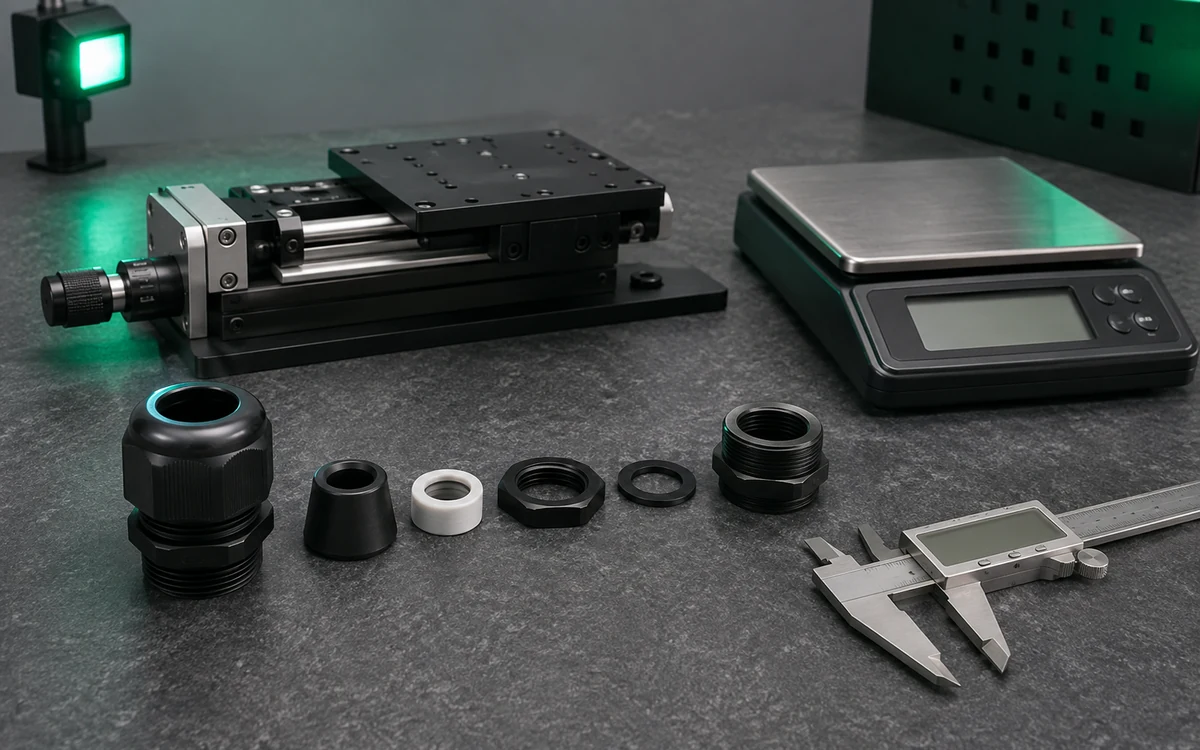
<img alt="無品牌標示的完整電纜密封接頭零件，位於小型移動滑台治具及質量特性量測工具旁。" src="/images/blog/how-cable-gland-material-density-impacts-weight-and-inertia-in-moving-applications/gland-mass-properties-setup.webp" srcset="/images/blog/how-cable-gland-material-density-impacts-weight-and-inertia-in-moving-applications/gland-mass-properties-setup-600.webp 600w, /images/blog/how-cable-gland-material-density-impacts-weight-and-inertia-in-moving-applications/gland-mass-properties-setup.webp 1200w" sizes="(max-width: 700px) 100vw, 1200px" width="1200" height="750" loading="lazy" decoding="async">
<p><em>接頭組件放在小型移動滑台旁，並配有用來比較完整安裝質量的量具。</em></p>
<h2 id="locate-the-gland-before-calculating-dynamic-effect">在計算動態影響前先定位接頭</h2>
<p><strong>接頭固定不動，不會只因電纜移動就成為該軸上的移動質量。</strong> 機櫃接頭可能留在固定結構上，而電纜承載裝置在旁移動。安裝在滑台、旋轉臂、末端執行器箱、門板、主軸附件或移動平台上的接頭，則會隨該組件移動。</p>
<p>計算影響之前，我會先將每個引入口放入正確的軸系或自由體模型，也就是標示所評估物體及其負荷的圖。</p>
<p>請參考 <a href="/zh-hant/blog/how-do-you-choose-the-right-cable-glands-for-robotic-and-automated-systems/">機器人與自動化系統電纜引入指南</a>，以區分穩定的外殼引入口與反覆彎曲的佈線路徑。對移動設備，可參考 <a href="/zh-hant/blog/how-do-you-select-the-right-cable-glands-for-mobile-and-heavy-machinery-applications/">移動電纜支撐方法</a>，協助辨識由移動組件承載的外殼、固定支撐、電纜接觸區及外部負荷路徑。只有在釐清幾何後，才應將接頭質量納入有效載荷或慣性計算。</p>
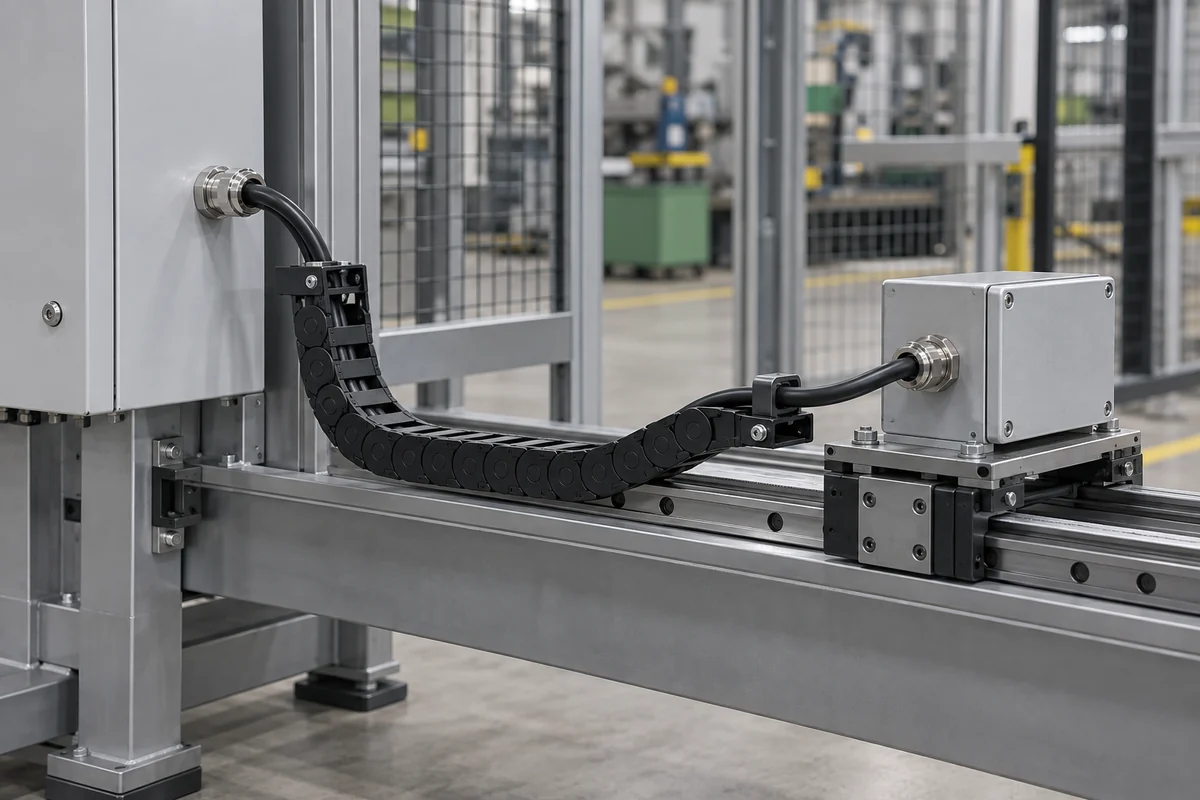
<img alt="固定機櫃上的電纜密封接頭與滑台外殼接頭，位於電纜承載裝置及獨立支撐夾旁。" src="/images/blog/how-cable-gland-material-density-impacts-weight-and-inertia-in-moving-applications/fixed-and-carriage-gland-installation.webp" srcset="/images/blog/how-cable-gland-material-density-impacts-weight-and-inertia-in-moving-applications/fixed-and-carriage-gland-installation-600.webp 600w, /images/blog/how-cable-gland-material-density-impacts-weight-and-inertia-in-moving-applications/fixed-and-carriage-gland-installation.webp 1200w" sizes="(max-width: 700px) 100vw, 1200px" width="1200" height="800" loading="lazy" decoding="async">
<p><em>直線滑台處於停止狀態，固定機櫃引入口與安裝在滑台載台外殼上的接頭之間設有電纜拖鏈與獨立支撐。</em></p>
<p>我會標出所有必要的機械位置。遠端機器人連桿上的接頭，可能會改變它與某個關節的距離，但相對於另一個關節的位置幾乎不變。門板與滑台引入口可能同時涉及平移與旋轉。工具更換、電纜佈線及配件也可能改變質心。應採用實際安裝位置，不要以方便取得的面板尺寸代替。</p>
<figure class="blog-chart" style="container-type: inline-size;">
<svg xmlns="http://www.w3.org/2000/svg" viewBox="0 0 480 1188" role="img" aria-labelledby="mass-motion-title mass-motion-desc" style="font-family:var(--font-body); width: 100% !important; max-width: 100% !important; height: auto !important;" id="cg-typography-785abb179fedbd53">
<style>
#cg-typography-785abb179fedbd53 { --svg-body-screen: 17px; }
@media (max-width: 760px) { #cg-typography-785abb179fedbd53 { --svg-body-screen: 16px; } }
</style>
<title id="mass-motion-title">固定、平移與旋轉接頭的位置</title>
<desc id="mass-motion-desc">狹長的垂直示意圖對比三種位置：固定機櫃上的接頭、由平移滑台承載的接頭，以及接近旋轉連桿末端的接頭。移動情況須採用完整已安裝組件質量；旋轉時還須考慮與各軸的距離。</desc>
<defs><marker id="mass-motion-arrow" markerWidth="9" markerHeight="9" refX="7" refY="4.5" orient="auto"><path d="M0 0L9 4.5L0 9Z" fill="var(--color-primary)"/></marker></defs>
<text x="240" y="52" text-anchor="middle" fill="var(--color-carbon)" font-size="29" font-weight="700" style="font-size: calc(22px * 480px / 100cqw) !important;">接頭安裝在哪裡？</text>
<rect x="20" y="104" width="440" height="280" rx="15" fill="var(--surface-card)" stroke="var(--color-cloud)" stroke-width="2"/>
<text x="42" y="151" fill="var(--color-carbon)" font-size="27" font-weight="700" style="font-size: calc(18px * 480px / 100cqw) !important;">1 · 固定機櫃</text>
<rect x="48" y="185" width="138" height="102" rx="7" fill="var(--color-ash)" stroke="var(--color-carbon)" stroke-width="3"/>
<path d="M186 236h34" stroke="var(--color-carbon)" stroke-width="16" stroke-linecap="round"/>
<rect x="175" y="211" width="34" height="50" rx="6" fill="var(--surface-card)" stroke="var(--color-primary)" stroke-width="4"/>
<path d="M221 236c41 0 48 35 89 35s58-35 112-35" fill="none" stroke="var(--color-primary)" stroke-width="5" stroke-dasharray="12 9"/>
<text x="42" y="333" fill="var(--color-graphite)" font-size="22" style="font-size: calc(var(--svg-body-screen) * 480px / 100cqw) !important;">接頭留在固定結構上。</text>
<text x="42" y="363" fill="var(--color-graphite)" font-size="22" style="font-size: calc(var(--svg-body-screen) * 480px / 100cqw) !important;">計算該軸時不納入其質量。</text>
<rect x="20" y="408" width="440" height="342" rx="15" fill="var(--surface-card)" stroke="var(--color-cloud)" stroke-width="2"/>
<text x="42" y="455" fill="var(--color-carbon)" font-size="27" font-weight="700" style="font-size: calc(18px * 480px / 100cqw) !important;">2 · 平移滑台</text>
<path d="M99 496h193" stroke="var(--color-primary)" stroke-width="5" marker-end="url(#mass-motion-arrow)"/>
<path d="M48 609h384" stroke="var(--color-carbon)" stroke-width="8" stroke-linecap="round"/>
<rect x="130" y="524" width="171" height="78" rx="9" fill="var(--color-ash)" stroke="var(--color-carbon)" stroke-width="3"/>
<rect x="286" y="539" width="34" height="48" rx="6" fill="var(--surface-card)" stroke="var(--color-primary)" stroke-width="4"/>
<path d="M320 563h80" stroke="var(--color-carbon)" stroke-width="15" stroke-linecap="round"/>
<text x="42" y="658" fill="var(--color-graphite)" font-size="22" style="font-size: calc(var(--svg-body-screen) * 480px / 100cqw) !important;">接頭隨滑台移動。</text>
<text x="42" y="689" fill="var(--color-graphite)" font-size="22" style="font-size: calc(var(--svg-body-screen) * 480px / 100cqw) !important;">採用完整已安裝組件質量。</text>
<text x="42" y="720" fill="var(--color-graphite)" font-size="22" style="font-size: calc(var(--svg-body-screen) * 480px / 100cqw) !important;">亦須將其加速度納入模型。</text>
<rect x="20" y="774" width="440" height="386" rx="15" fill="var(--surface-card)" stroke="var(--color-cloud)" stroke-width="2"/>
<text x="42" y="821" fill="var(--color-carbon)" font-size="27" font-weight="700" style="font-size: calc(18px * 480px / 100cqw) !important;">3 · 旋轉連桿</text>
<circle cx="104" cy="971" r="30" fill="var(--color-ash)" stroke="var(--color-carbon)" stroke-width="4"/>
<path d="M104 971L326 878" stroke="var(--color-carbon)" stroke-width="24" stroke-linecap="round"/>
<rect x="307" y="849" width="45" height="59" rx="7" fill="var(--surface-card)" stroke="var(--color-primary)" stroke-width="4"/>
<circle cx="329" cy="878" r="7" fill="var(--color-primary)"/>
<path d="M55 1009c-10-34-4-62 17-84" fill="none" stroke="var(--color-primary)" stroke-width="4" marker-end="url(#mass-motion-arrow)"/>
<text x="42" y="1041" fill="var(--color-graphite)" font-size="22" style="font-size: calc(var(--svg-body-screen) * 480px / 100cqw) !important;">採用完整已安裝組件質量。</text>
<text x="42" y="1073" fill="var(--color-graphite)" font-size="22" style="font-size: calc(var(--svg-body-screen) * 480px / 100cqw) !important;">與各軸的距離也很重要。</text>
<text x="42" y="1105" fill="var(--color-graphite)" font-size="22" style="font-size: calc(var(--svg-body-screen) * 480px / 100cqw) !important;">檢查機械設備的每個位置。</text>
</svg>
<figcaption>固定接頭不納入移動軸的質量模型；滑台上的接頭在平移時會增加完整已安裝組件質量；旋轉連桿上的接頭則依其質量分布及與各軸的距離產生相應影響。</figcaption>
</figure>
<h2 id="translation-and-rotation-use-different-mass-properties">平移與旋轉使用不同的質量特性</h2>
<p><strong>平移慣性</strong> 可用加速度方向上的質量表示。NASA 的 <a href="https://science.nasa.gov/learn/basics-of-space-flight/chapter3-2/">牛頓第二定律說明</a>說明力、質量與加速度之間的關係。運動曲線不變時，接頭質量變化造成的理想力增量為 <span class="article-math article-math-inline" data-latex="\Delta F = \Delta m\,a"><span class="katex"><math xmlns="http://www.w3.org/1998/Math/MathML"><semantics><mrow><mi mathvariant="normal">Δ</mi><mi>F</mi><mo>=</mo><mi mathvariant="normal">Δ</mi><mi>m</mi><mtext> </mtext><mi>a</mi></mrow><annotation encoding="application/x-tex">\Delta F = \Delta m\,a</annotation></semantics></math></span></span>。這並非致動器總推力；摩擦、重力、電纜拖曳、製程負荷、傳動損失及其他移動零件仍須納入。</p>
<p><strong>轉動慣量</strong> 是物體對指定軸角加速度的抵抗程度，由質量分布決定。NASA 的 <a href="https://www.nasa.gov/wp-content/uploads/2021/11/stemonstration_moment_of_inertia_classroom_connection-508.pdf">轉動慣量教學說明</a>說明質量相同的物體為何會有不同的轉動慣量。</p>
<p>對於相較於軸距尺寸很小的緊湊接頭，可使用點質量近似式 <span class="article-math article-math-inline" data-latex="\Delta I_{\mathrm{axis}} \approx \Delta m\,r^2"><span class="katex"><math xmlns="http://www.w3.org/1998/Math/MathML"><semantics><mrow><mi mathvariant="normal">Δ</mi><msub><mi>I</mi><mrow><mi mathvariant="normal">a</mi><mi mathvariant="normal">x</mi><mi mathvariant="normal">i</mi><mi mathvariant="normal">s</mi></mrow></msub><mo>≈</mo><mi mathvariant="normal">Δ</mi><mi>m</mi><mtext> </mtext><msup><mi>r</mi><mn>2</mn></msup></mrow><annotation encoding="application/x-tex">\Delta I_{\mathrm{axis}} \approx \Delta m\,r^2</annotation></semantics></math></span></span>。距離應取軸線至組裝件質心的距離。我會先檢查該幾何，再使用此近似。靠近軸線的大幅減重，對慣量可能影響很小；較小的減重若遠離軸線，則可能有影響。</p>
<p>當接頭尺寸不可忽略、方向會改變，或不同軸看到的幾何不同時，點質量公式便不適用。應採用 CAD 質量特性或多體動力學模型，納入接頭質心的局部慣量及相對軸線的偏移。同一接頭可能對某一軸的移動質量有貢獻，對另一軸則影響轉動慣量。</p>
<table>
<thead>
<tr>
<th>運動情況</th>
<th>接頭的主要輸入</th>
<th>關鍵幾何因素</th>
<th>解讀限制</th>
</tr>
</thead>
<tbody>
<tr>
<td>固定式外殼引入口</td>
<td>不計入移動軸</td>
<td>確認其確實留在固定結構上</td>
<td>附近的電纜移動，不會使接頭成為移動質量</td>
</tr>
<tr>
<td>平移滑台</td>
<td>完整已安裝組件質量</td>
<td>滑台方向與加速度</td>
<td>僅憑質量變化無法得出致動器總推力</td>
</tr>
<tr>
<td>旋轉連桿或轉台</td>
<td>組裝件質量特性</td>
<td>質心與各軸的距離及質量分布</td>
<td>點質量估算可能不足</td>
</tr>
<tr>
<td>門板或鉸接式外殼</td>
<td>質量與位置變化</td>
<td>所有狀態下的鉸鏈或關節運動路徑</td>
<td>單一姿態無法代表完整運動</td>
</tr>
<tr>
<td>多軸末端執行器</td>
<td>質量、質心與方向</td>
<td>每個受影響軸的座標轉換</td>
<td>同一接頭對不同軸的貢獻不同</td>
</tr>
</tbody>
</table>
<h2 id="density-does-not-predict-machine-performance-by-itself">密度本身無法預測機械性能</h2>
<p><strong>降低接頭質量只會改變模型輸入，不保證機械設備的結果。</strong> 運動週期可能受行程、加加速度（加速度變化率）、調校、製程停留、承載裝置限制或致動器功率限制。能耗也取決於驅動效率、再生制動、保持負荷、摩擦及工作週期。</p>
<p>定位性能取決於剛性、背隙、控制頻寬、電纜作用力、感測器及振動模態。我會在機械模型中評估這些因素，而不會僅憑材料密度推斷。</p>
<p>不要直接把材料密度比當成產品質量比。除非幾何形狀不變，也不要把產品質量比直接套用為慣性比。最後，若沒有完整機械模型及具代表性的量測資料，也不要把慣性比換算成速度、能耗、精度、產能或使用壽命百分比。這三項界限可避免在籠統的「輕量接頭」比較中產生大部分虛假的精確性。</p>
<p>變更前後，我會報告接頭占移動質量或軸慣量的比例。若比例很小，替換可能沒有實際效益。若比例顯著，應依機械製造商認可的分析及測試方法，更新運動、負荷、制動、結構、電纜作用力及控制器假設。</p>
<h2 id="a-lighter-gland-must-still-perform-as-a-cable-gland">較輕的接頭仍須具備電纜密封接頭的功能</h2>
<p><strong>動態效益無法彌補電纜引入不匹配。</strong> <a href="https://webstore.iec.ch/en/publication/7034">IEC 62444:2010</a> 涵蓋供應狀態下的完整電纜密封接頭。替換時，應評估聲明或測試所涵蓋的本體、密封件、蓋帽、螺紋、配件、電纜及組裝方式。</p>
<p>僅憑材料本體密度，無法判定固定能力、耐衝擊性、螺紋強度、密封或導通性；也不能判定溫度限制、耐腐蝕與耐化學性，或長期尺寸穩定性。我會分別檢查這些必要功能。</p>
<p>分別檢查面向電纜與面向外殼的介面。請參閱 <a href="/zh-hant/blog/how-do-cable-glands-balance-strain-relief-and-sealing-for-maximum-protection/">密封與應力釋放指南</a>，了解壓縮電纜護套與抵抗電纜位移是不同功能。減輕接頭本體也可能改變密封支撐、電纜接觸幾何、螺紋咬合，或傳遞至較薄移動面板的負荷路徑。應依據確切圖面、說明及完整產品結果，不要假設相似外部尺寸就能維持這些功能。</p>
<p>若引入口承擔保護等電位連接或屏蔽端接功能，應分別確認確切的導電路徑。聚合物本體不能只因能配合孔洞與電纜直徑，就視為可取代導電接頭。同樣地，金屬接頭也不會自動適用於屏蔽或保護電路。仍須確認接觸零件、準備方式、外殼連接、故障或頻率界限，以及完整系統驗證。</p>
<p><a href="https://webstore.iec.ch/en/publication/2452">IEC 60529</a> 將外殼提供的防護等級分類。因此，IP 代碼適用於該測試條件下所代表的外殼及引入口配置。兩筆型錄項目即使有相同 IP 標示，也不能證明其固定能力、質量、耐衝擊性或動態適用性相同；若電纜、接頭、墊圈、安裝壁面、方向或組裝方法改變，也不能據此認定已安裝外殼仍維持原測試結果。</p>
<h2 id="use-a-bounded-comparison-sequence">依界定範圍進行比較</h2>
<p><strong>有效的比較從機械限制開始，並以已安裝的替代方案收尾。</strong> 定位接頭後，我會依以下步驟比較，而不是先做籠統的聚合物對金屬排名。</p>
<ol>
<li><strong>定位引入口。</strong> 找出移動本體、受影響軸、機械位置、電纜路徑、支撐點，以及接頭是固定還是由移動組件承載。</li>
<li><strong>識別已安裝的零件。</strong>列出接頭尺寸與結構、電纜、鎖緊螺帽、墊圈、轉接頭、電氣配件、護罩及安裝配置。</li>
<li><strong>建立完整的質量特性資料。</strong>盡可能量測組裝件的質量。否則，應分別計算各種材料的體積，並採用密度來源與狀態，納入公差、嵌件及排除項目。</li>
<li><strong>更新機械模型。</strong> 平移運動須更新移動質量；旋轉運動須更新每個受影響軸的質心與慣量。點質量估算不足時，採用 CAD 或多體動力學資料。</li>
<li><strong>評估影響。</strong> 依機械製造商認可的方法重新計算有效載荷餘裕、力或扭矩需求、制動、結構、運動曲線及電纜負荷。不要用密度比代替這些結果。</li>
<li><strong>確認電纜引入功能要求。</strong> 針對確切替代方案，確認密封、固定、安裝、環境、衝擊、溫度、化學暴露及任何電氣路徑。</li>
<li><strong>必要時測試具代表性的系統。</strong>使用預定的電纜路徑、支撐、外殼、配件、運動狀態、工作週期與驗收準則。測試結果僅適用於其代表的尺寸、材料及安裝配置。</li>
</ol>
<p>這個流程也能看出何時不值得再優化密度。固定接頭不會納入軸的質量模型。靠近旋轉軸的接頭可能只產生很小的慣量。若配件維持不變且質量較大，實際減重可能低於預期。電纜、承載裝置、連接器、工具或有效載荷也可能主導移動系統的質量。上述情況下，計算可協助將注意力轉向真正限制系統的組件。</p>
<h2 id="conclusion">結論</h2>
<p>電纜密封接頭材料密度對移動應用的影響有一條明確關係鏈：密度與淨材料體積決定零件質量，完整已安裝配置決定承載質量，而接頭位置及質量分布決定其對平移或旋轉的影響。固定式引入口不會改變該軸的移動質量。由移動組件承載的接頭可能產生影響，尤其是遠離旋轉軸時；但只有完整機械模型才能顯示此變化是否顯著。</p>
<p>我建議儘可能量測組裝件質量，並標出所有受影響的軸。應將這項結果與運動週期、能耗、精度、振動及壽命聲明分開。接著，針對電纜配合、環境、機械與安裝功能，以及任何電氣功能，確認較輕的替代方案仍符合要求。</p>
<h2 id="frequently-asked-questions">常見問題</h2>
<h3 id="does-a-lower-density-gland-material-always-produce-a-lighter-cable-gland">較低密度的接頭材料一定會讓電纜密封接頭更輕嗎？</h3>
<p>不一定。完整組件質量還取決於幾何形狀、壁厚、接頭尺寸、密封件、嵌件、鎖緊螺帽、轉接頭及其他配件。應比較確切的已安裝配置或量測具代表性的組件，不要把密度比套用到兩種不同設計。</p>
<h3 id="should-a-stationary-cabinet-gland-be-included-in-robot-axis-inertia">機櫃上的固定接頭需要納入機器人軸的慣量計算嗎？</h3>
<p>若接頭留在固定結構上，且不屬於該軸的移動本體，就不需要。但移動電纜、承載裝置、連接器及支撐仍可能影響軸負荷，因此應在正確的機械模型中標示各組件。</p>
<h3 id="how-should-a-gland-on-a-rotating-arm-be-represented">旋轉臂上的接頭應如何表示？</h3>
<p>使用其完整已安裝組件質量、質心位置、方向，以及與每個受影響軸的距離。對遠離軸線的小型接頭，可用點質量估算進行初步篩查；若幾何形狀或多軸影響重要，則宜使用 CAD 質量特性或多體模型。</p>
<h3 id="will-a-lighter-cable-gland-automatically-reduce-cycle-time-or-energy-use">較輕的電纜密封接頭會自動縮短週期時間或降低能耗嗎？</h3>
<p>不會。它會改變移動質量或慣量，但機械設備結果也取決於運動曲線、有效載荷、致動器與驅動限制、能量回生、摩擦、電纜作用力、控制器設定、剛性、製程停留及安全限制。應重新計算並測試完整系統。</p>
<h3 id="can-two-glands-with-the-same-ip-code-be-treated-as-dynamically-interchangeable">兩種電纜密封接頭的 IP 代碼相同，就能視為動態互換嗎？</h3>
<p>不能。IP 代碼說明受測及具代表性配置的外殼防護能力，並不能證明質量、慣量、固定能力、耐衝擊性、電氣功能、電纜相容性、安裝強度或移動工況適用性相同。</p>
<h3 id="sources-and-technical-references">資料來源與技術參考</h3>
<ul>
<li><a href="https://www.nist.gov/pml/special-publication-811/nist-guide-si-chapter-8">NIST《國際單位制指南》第 8 章</a>, 查閱日期：2026-09-07。</li>
<li><a href="https://science.nasa.gov/learn/basics-of-space-flight/chapter3-2/">NASA Science《第 3 章：重力與力學》</a>, 查閱日期：2026-09-07。</li>
<li><a href="https://www.nasa.gov/wp-content/uploads/2021/11/stemonstration_moment_of_inertia_classroom_connection-508.pdf">NASA《轉動慣量教學連結》</a>, 查閱日期：2026-09-07。</li>
<li><a href="https://webstore.iec.ch/en/publication/7034">IEC 62444:2010《電氣裝置用電纜密封接頭》—IEC</a>, 查閱日期：2026-09-07。</li>
<li><a href="https://webstore.iec.ch/en/publication/2452">IEC 60529《外殼提供的防護等級》—IEC</a>, 查閱日期：2026-09-07。</li>
</ul>