# 電纜密封接頭安裝板配置：接頭與工具放得下嗎？

> Source: https://chinacableglands.com/zh-hant/blog/gland-plate-circular-layout-open-area/
> Language: zh-Hant
> Publisher: 倍拓電纜接頭
> Author: Henry Xu
> Published: 2026-10-22
> Updated: 2026-10-28

依弦距、五金件與工具包絡、邊緣餘量及開孔面積計算電纜密封接頭安裝板配置，並附六孔與十二孔的完整範例。

<p><strong>圓形電纜密封接頭安裝板配置時，我會用相鄰孔中心之間的直線弦長檢查淨空。</strong>沿節圓測量的弧長較長，可能高估可用空間。我會分別檢查開孔、已安裝五金件及工具，再依明確界定的安裝板邊界計算移除面積。</p>
<p>完整範例從六孔安裝板開始，並比較兩種十二孔配置。範例說明為何孔位雖然容得下，接頭仍可能互相碰撞；也說明較大的節圓雖可排除碰撞，卻可能使孔位距邊緣太近。請依所選元件及外殼圖面取得實際開孔、五金件與安裝尺寸。</p>
<blockquote>
<p><strong>重點整理</strong></p>
<ul>
<li>相鄰引入口中心的直線距離，請使用弦距。</li>
<li>分別檢查開孔、五金件及移動工具的包絡。</li>
<li>將安裝板邊界、墊片區、固定件與位置公差納入檢查。</li>
<li>輸入計算器時，請區分半徑與直徑。</li>
<li>用面積計算描述材料移除量，再確認安裝板與外殼設計。</li>
</ul>
</blockquote>
<h2 id="define-the-gland-plate-layout">定義電纜密封接頭安裝板配置</h2>
<p>我會先確認安裝板邊界、基準，以及保留給其他功能的區域。周邊墊片、固定螺栓、折邊法蘭或內部導軌，都可能使名義上開放的區域無法使用。<a href="/zh-hant/blog/a-guide-to-electrical-enclosure-cable-entry-plates-gland-plates/">電纜密封接頭安裝板設計指南</a>涵蓋這些介面；本文的計算則聚焦於其尺寸。</p>
<p><strong>淨空包絡</strong>是元件所占的空間，或工具移動時所需的空間。我會將圖面分成三個不同圖層：</p>
<table>
<thead>
<tr>
<th>圖面層級</th>
<th>需取得的尺寸</th>
<th>我用來檢查的項目</th>
</tr>
</thead>
<tbody>
<tr>
<td>開孔</td>
<td>孔徑、公差、位置，以及螺紋或防轉特徵（如有）</td>
<td>孔間距與安裝板剩餘材料</td>
</tr>
<tr>
<td>安裝後的元件</td>
<td>本體、端蓋、墊圈、鎖緊螺帽及內部突出部分</td>
<td>干涉情況與密封表面的完整支承</td>
</tr>
<tr>
<td>組裝與維修空間</td>
<td>工具頭部、接近方向、移動空間及拆卸路徑</td>
<td>安裝後是否仍可接近</td>
</tr>
</tbody>
</table>
<p>我會依所選電纜密封接頭圖面確認孔徑、公差，以及螺紋或防轉特徵。<a href="/zh-hant/blog/what-does-m20-cable-gland-actually-mean-a-spec-breakdown/">入口螺紋規格指南</a>說明公稱螺紋標示所涵蓋的尺寸。即使公稱入口標示相同，攻牙螺紋與間隙孔仍需要不同規格。</p>
<p>假設範例使用直徑 200 mm 的圓形安裝板、六個直徑 22 mm 的圓孔，以及直徑 120 mm 的節圓。每個已安裝引入口的最大圓形平面包絡尺寸為 35 mm。這些設定值可用來比較配置；製作生產圖時，請採用實際五金件的尺寸。</p>
<h2 id="place-equal-entries-on-a-pitch-circle">在節圓上配置等間距引入口</h2>
<p><strong>節圓</strong>是通過各引入口中心的圓。令其半徑為 <span class="article-math article-math-inline" data-latex="R"><span class="katex"><math xmlns="http://www.w3.org/1998/Math/MathML"><semantics><mrow><mi>R</mi></mrow><annotation encoding="application/x-tex">R</annotation></semantics></math></span></span>、圓心為 <span class="article-math article-math-inline" data-latex="(x_0,y_0)"><span class="katex"><math xmlns="http://www.w3.org/1998/Math/MathML"><semantics><mrow><mo stretchy="false">(</mo><msub><mi>x</mi><mn>0</mn></msub><mo separator="true">,</mo><msub><mi>y</mi><mn>0</mn></msub><mo stretchy="false">)</mo></mrow><annotation encoding="application/x-tex">(x_0,y_0)</annotation></semantics></math></span></span>，引入口數量為整數 <span class="article-math article-math-inline" data-latex="n"><span class="katex"><math xmlns="http://www.w3.org/1998/Math/MathML"><semantics><mrow><mi>n</mi></mrow><annotation encoding="application/x-tex">n</annotation></semantics></math></span></span>，且 <span class="article-math article-math-inline" data-latex="n\geq2"><span class="katex"><math xmlns="http://www.w3.org/1998/Math/MathML"><semantics><mrow><mi>n</mi><mo>≥</mo><mn>2</mn></mrow><annotation encoding="application/x-tex">n\geq2</annotation></semantics></math></span></span>。等距配置可得：</p>
<div class="article-math article-math-display" data-latex="\Delta\alpha=\frac{360^\circ}{n}"><span class="katex"><math xmlns="http://www.w3.org/1998/Math/MathML" display="block"><semantics><mrow><mi mathvariant="normal">Δ</mi><mi>α</mi><mo>=</mo><mfrac><msup><mn>360</mn><mo>∘</mo></msup><mi>n</mi></mfrac></mrow><annotation encoding="application/x-tex">\Delta\alpha=\frac{360^\circ}{n}</annotation></semantics></math></span></div>
<p>從已定義的圖面軸線選定起始角 <span class="article-math article-math-inline" data-latex="\alpha_0"><span class="katex"><math xmlns="http://www.w3.org/1998/Math/MathML"><semantics><mrow><msub><mi>α</mi><mn>0</mn></msub></mrow><annotation encoding="application/x-tex">\alpha_0</annotation></semantics></math></span></span>。對引入口索引 <span class="article-math article-math-inline" data-latex="k=0,1,\ldots,n-1"><span class="katex"><math xmlns="http://www.w3.org/1998/Math/MathML"><semantics><mrow><mi>k</mi><mo>=</mo><mn>0</mn><mo separator="true">,</mo><mn>1</mn><mo separator="true">,</mo><mo>…</mo><mo separator="true">,</mo><mi>n</mi><mo>−</mo><mn>1</mn></mrow><annotation encoding="application/x-tex">k=0,1,\ldots,n-1</annotation></semantics></math></span></span>：</p>
<div class="article-math article-math-display" data-latex="\alpha_k=\alpha_0+k\Delta\alpha"><span class="katex"><math xmlns="http://www.w3.org/1998/Math/MathML" display="block"><semantics><mrow><msub><mi>α</mi><mi>k</mi></msub><mo>=</mo><msub><mi>α</mi><mn>0</mn></msub><mo>+</mo><mi>k</mi><mi mathvariant="normal">Δ</mi><mi>α</mi></mrow><annotation encoding="application/x-tex">\alpha_k=\alpha_0+k\Delta\alpha</annotation></semantics></math></span></div>
<div class="article-math article-math-display" data-latex="x_k=x_0+R\cos\alpha_k,\qquad y_k=y_0+R\sin\alpha_k"><span class="katex"><math xmlns="http://www.w3.org/1998/Math/MathML" display="block"><semantics><mrow><msub><mi>x</mi><mi>k</mi></msub><mo>=</mo><msub><mi>x</mi><mn>0</mn></msub><mo>+</mo><mi>R</mi><mi>cos</mi><mo>⁡</mo><msub><mi>α</mi><mi>k</mi></msub><mo separator="true">,</mo><mspace width="2em"/><msub><mi>y</mi><mi>k</mi></msub><mo>=</mo><msub><mi>y</mi><mn>0</mn></msub><mo>+</mo><mi>R</mi><mi>sin</mi><mo>⁡</mo><msub><mi>α</mi><mi>k</mi></msub></mrow><annotation encoding="application/x-tex">x_k=x_0+R\cos\alpha_k,\qquad y_k=y_0+R\sin\alpha_k</annotation></semantics></math></span></div>
<p>這裡的角度以度數表示，逆時針為正，圖面的正 y 軸朝上。這遵循<a href="https://openstax.org/books/precalculus-2e/pages/5-2-unit-circle-sine-and-cosine-functions">正弦與餘弦的座標關係</a>。我會在圖面上記錄軸向慣例，讓匯入 CAD 的資料採用相同方向。</p>
<p>六孔範例的半徑為 60 mm，角節距為 60°。起始角為 0° 時，各孔中心相對於安裝板中心的座標依序為 (60, 0)、(30, 51.96)、(−30, 51.96)、(−60, 0)、(−30, −51.96) 及 (30, −51.96)，單位皆為毫米。</p>
<p>我會依轉入 CAD 的配置座標及節圓標示進行檢查。範例中前兩個中心的水平差為 30 mm，垂直差約為 51.96 mm；兩者直線距離約為 60 mm，與弦長計算相符。若結果不同，應檢查匯入單位、輸入的是半徑還是直徑，以及角度慣例。我會在計算時保留完整精度，只將顯示座標四捨五入；製造則依圖面公差控制。接著，我會確認起始角與固定螺栓、法蘭及電纜接近路徑的位置關係。旋轉整個孔位圖樣會改變這些關係，但相鄰弦距不變。在矩形安裝板上，旋轉也可能改變最近的邊緣餘量。這些檢查可在孔位核准前找出不同類型的錯誤。</p>
<p><a class="article-tool-card article-tool-card-link" href="/zh-hant/resource-center/tools/circular-entry-pattern-calculator/" aria-label="圓形引入口排列計算器"><span class="article-tool-card-index">工具</span><span class="article-tool-card-kicker">外殼配置</span><strong class="article-tool-card-title">圓形引入口排列計算器</strong><span class="article-tool-card-copy">請輸入節圓半徑，而非直徑：本例使用 60 mm 與 6 個引入口。將計算所得的弦長與實際元件及工具包絡面比較。</span><span class="article-tool-card-formula">θ = 360° / n</span><span class="article-tool-card-inputs" aria-label="計算器輸入項目"><em>排列半徑</em><em>入口數量</em></span><span class="article-tool-card-action">開啟計算器 <span aria-hidden="true">-&gt;</span></span></a></p><h2 id="compare-chord-spacing-with-arc-spacing">比較弦長間距與圓弧間距</h2>
<p><strong>弦</strong>是圓上兩點之間的線段。中心距弦 <span class="article-math article-math-inline" data-latex="c"><span class="katex"><math xmlns="http://www.w3.org/1998/Math/MathML"><semantics><mrow><mi>c</mi></mrow><annotation encoding="application/x-tex">c</annotation></semantics></math></span></span> 連接相鄰孔中心。弧距 <span class="article-math article-math-inline" data-latex="s"><span class="katex"><math xmlns="http://www.w3.org/1998/Math/MathML"><semantics><mrow><mi>s</mi></mrow><annotation encoding="application/x-tex">s</annotation></semantics></math></span></span> 則是沿節圓測量同一對中心之間的距離：</p>
<div class="article-math article-math-display" data-latex="c=2R\sin\left(\frac{\pi}{n}\right),\qquad s=\frac{2\pi R}{n}"><span class="katex"><math xmlns="http://www.w3.org/1998/Math/MathML" display="block"><semantics><mrow><mi>c</mi><mo>=</mo><mn>2</mn><mi>R</mi><mi>sin</mi><mo>⁡</mo><mrow><mo fence="true">(</mo><mfrac><mi>π</mi><mi>n</mi></mfrac><mo fence="true">)</mo></mrow><mo separator="true">,</mo><mspace width="2em"/><mi>s</mi><mo>=</mo><mfrac><mrow><mn>2</mn><mi>π</mi><mi>R</mi></mrow><mi>n</mi></mfrac></mrow><annotation encoding="application/x-tex">c=2R\sin\left(\frac{\pi}{n}\right),\qquad s=\frac{2\pi R}{n}</annotation></semantics></math></span></div>
<p>以下表示式使用弧度。將兩條半徑形成的三角形對半分割，可得弦長表示式。由<a href="https://openstax.org/books/precalculus-2e/pages/5-1-angles">弧長關係</a>可得沿圓周的距離；將整圈等分後，即為所述弧距。<a href="https://dlmf.nist.gov/4.21">餘弦雙角公式</a>可利用兩個中心座標，檢查下列等值關係：<span class="article-math article-math-inline" data-latex="c^2=2R^2[1-\cos(2\pi/n)]"><span class="katex"><math xmlns="http://www.w3.org/1998/Math/MathML"><semantics><mrow><msup><mi>c</mi><mn>2</mn></msup><mo>=</mo><mn>2</mn><msup><mi>R</mi><mn>2</mn></msup><mo stretchy="false">[</mo><mn>1</mn><mo>−</mo><mi>cos</mi><mo>⁡</mo><mo stretchy="false">(</mo><mn>2</mn><mi>π</mi><mi mathvariant="normal">/</mi><mi>n</mi><mo stretchy="false">)</mo><mo stretchy="false">]</mo></mrow><annotation encoding="application/x-tex">c^2=2R^2[1-\cos(2\pi/n)]</annotation></semantics></math></span></span>.</p>
<p>當 <span class="article-math article-math-inline" data-latex="R=60\,\mathrm{mm}"><span class="katex"><math xmlns="http://www.w3.org/1998/Math/MathML"><semantics><mrow><mi>R</mi><mo>=</mo><mn>60</mn><mtext> </mtext><mrow><mi mathvariant="normal">m</mi><mi mathvariant="normal">m</mi></mrow></mrow><annotation encoding="application/x-tex">R=60\,\mathrm{mm}</annotation></semantics></math></span></span> 且 <span class="article-math article-math-inline" data-latex="n=6"><span class="katex"><math xmlns="http://www.w3.org/1998/Math/MathML"><semantics><mrow><mi>n</mi><mo>=</mo><mn>6</mn></mrow><annotation encoding="application/x-tex">n=6</annotation></semantics></math></span></span> 時，弦長為 60.00 mm，圓弧長約為 62.83 mm。若以圓弧節距代替弦長節距，中心距就會高估 2.83 mm。</p>
<figure class="blog-chart">
<svg xmlns="http://www.w3.org/2000/svg" viewBox="0 0 520 635" role="img" aria-labelledby="plate-circle-title plate-circle-desc" style="font-family:var(--font-body)">
<title id="plate-circle-title">圓形電纜密封接頭安裝板上的弦長與圓弧間距</title>
<desc id="plate-circle-desc">六個直徑 22 毫米的孔位於直徑 120 毫米的節圓上，並位於直徑 200 毫米的圓形安裝板內。一條綠色直線弦與一段深色曲線圓弧連接同一對相鄰孔中心；兩者長度分別為 60.00 與 62.83 毫米。</desc>
<text x="260" y="43" text-anchor="middle" fill="var(--color-carbon)" font-size="30" font-weight="700">同一排列，兩種距離</text>
<text x="260" y="82" text-anchor="middle" fill="var(--color-graphite)" font-size="22">相鄰中心相隔 60°</text>
<text x="260" y="116" text-anchor="middle" fill="var(--color-graphite)" font-size="22">200 mm 安裝板</text>
<circle cx="260" cy="300" r="175" fill="var(--surface-card)" stroke="var(--color-graphite)" stroke-width="2.5"/>
<circle cx="260" cy="300" r="105" fill="none" stroke="var(--color-graphite)" stroke-width="2" stroke-dasharray="5 7"/>
<circle cx="365" cy="300" r="19.25" fill="var(--color-ash)" stroke="var(--color-carbon)" stroke-width="2"/>
<circle cx="312.5" cy="209.0673" r="19.25" fill="var(--color-ash)" stroke="var(--color-carbon)" stroke-width="2"/>
<circle cx="207.5" cy="209.0673" r="19.25" fill="var(--color-ash)" stroke="var(--color-carbon)" stroke-width="2"/>
<circle cx="155" cy="300" r="19.25" fill="var(--color-ash)" stroke="var(--color-carbon)" stroke-width="2"/>
<circle cx="207.5" cy="390.9327" r="19.25" fill="var(--color-ash)" stroke="var(--color-carbon)" stroke-width="2"/>
<circle cx="312.5" cy="390.9327" r="19.25" fill="var(--color-ash)" stroke="var(--color-carbon)" stroke-width="2"/>
<path d="M365 300A105 105 0 0 0 312.5 209.0673" fill="none" stroke="var(--color-carbon)" stroke-width="4" stroke-dasharray="6 5"/>
<path d="M365 300L312.5 209.0673" fill="none" stroke="var(--color-primary)" stroke-width="4"/>
<circle cx="365" cy="300" r="4" fill="var(--color-primary)"/>
<circle cx="312.5" cy="209.0673" r="4" fill="var(--color-primary)"/>
<text x="250" y="290" text-anchor="middle" fill="var(--color-carbon)" font-size="22">節圓</text>
<text x="250" y="321" text-anchor="middle" fill="var(--color-carbon)" font-size="26" font-weight="700">120 mm</text>
<text x="260" y="510" text-anchor="middle" fill="var(--color-graphite)" font-size="22">六個 22 mm 開孔</text>
<path d="M55 553H110" fill="none" stroke="var(--color-primary)" stroke-width="4"/>
<text x="132" y="560" fill="var(--color-carbon)" font-size="22">弦長：60.00 mm</text>
<path d="M55 598Q82.5 575 110 598" fill="none" stroke="var(--color-carbon)" stroke-width="4" stroke-dasharray="6 5"/>
<text x="132" y="605" fill="var(--color-carbon)" font-size="22">圓弧長：62.83 mm</text>
</svg>
<figcaption>直線弦長量得圓形包絡面檢查所使用的中心距；曲線圓弧則沿著節圓連接相同的兩個中心。</figcaption>
</figure>
<p>對直徑 <span class="article-math article-math-inline" data-latex="D_e"><span class="katex"><math xmlns="http://www.w3.org/1998/Math/MathML"><semantics><mrow><msub><mi>D</mi><mi>e</mi></msub></mrow><annotation encoding="application/x-tex">D_e</annotation></semantics></math></span></span> 相同的圓形包絡面，其名義邊緣間隙為 <span class="article-math article-math-inline" data-latex="g=c-D_e"><span class="katex"><math xmlns="http://www.w3.org/1998/Math/MathML"><semantics><mrow><mi>g</mi><mo>=</mo><mi>c</mi><mo>−</mo><msub><mi>D</mi><mi>e</mi></msub></mrow><annotation encoding="application/x-tex">g=c-D_e</annotation></semantics></math></span></span>。六個直徑 22 mm 的孔，因此孔邊間隙為 38 mm。較大的 35 mm 安裝後包絡面之間則只剩 25 mm。</p>
<p>引入口數增加時，這項差異更為重要。同一節圓上配置十二個引入口，弦長約為 31.06 mm。直徑 22 mm 的孔仍有 9.06 mm 的正間隙，但 35 mm 的包絡會重疊 3.94 mm。由於安裝後的包絡已經重疊，我會先調整配置，再決定鎖緊順序。</p>
<p>若相鄰圓形包絡面的直徑不同，應從中心距減去兩者直徑總和的一半。六角形及其他形狀則須依其實際方向檢查，或採用保守的外接圓。僅有對邊寬度不足以包住六角形的角部。</p>
<h2 id="check-edge-margins-and-access-separately">分別檢查邊緣餘量與作業空間</h2>
<p>對中心位於圓形安裝板上的圓形排列，孔邊到安裝板邊緣的最短名義徑向餘量為：</p>
<div class="article-math article-math-display" data-latex="m_h=R_p-R-\frac{D_h}{2}"><span class="katex"><math xmlns="http://www.w3.org/1998/Math/MathML" display="block"><semantics><mrow><msub><mi>m</mi><mi>h</mi></msub><mo>=</mo><msub><mi>R</mi><mi>p</mi></msub><mo>−</mo><mi>R</mi><mo>−</mo><mfrac><msub><mi>D</mi><mi>h</mi></msub><mn>2</mn></mfrac></mrow><annotation encoding="application/x-tex">m_h=R_p-R-\frac{D_h}{2}</annotation></semantics></math></span></div>
<p><span class="article-math article-math-inline" data-latex="R_p"><span class="katex"><math xmlns="http://www.w3.org/1998/Math/MathML"><semantics><mrow><msub><mi>R</mi><mi>p</mi></msub></mrow><annotation encoding="application/x-tex">R_p</annotation></semantics></math></span></span> 是安裝板半徑，<span class="article-math article-math-inline" data-latex="D_h"><span class="katex"><math xmlns="http://www.w3.org/1998/Math/MathML"><semantics><mrow><msub><mi>D</mi><mi>h</mi></msub></mrow><annotation encoding="application/x-tex">D_h</annotation></semantics></math></span></span> 是孔徑。本例得到 <span class="article-math article-math-inline" data-latex="m_h=100-60-11=29\,\mathrm{mm}"><span class="katex"><math xmlns="http://www.w3.org/1998/Math/MathML"><semantics><mrow><msub><mi>m</mi><mi>h</mi></msub><mo>=</mo><mn>100</mn><mo>−</mo><mn>60</mn><mo>−</mo><mn>11</mn><mo>=</mo><mn>29</mn><mtext> </mtext><mrow><mi mathvariant="normal">m</mi><mi mathvariant="normal">m</mi></mrow></mrow><annotation encoding="application/x-tex">m_h=100-60-11=29\,\mathrm{mm}</annotation></semantics></math></span></span>。若以直徑 35 mm 的包絡面取代孔徑，該包絡面到安裝板邊緣的距離為 22.5 mm。</p>
<p>接著，我會疊合周邊墊片區、固定件，以及墊圈實際接觸面積。這樣可以看出還剩多少邊緣餘量可支撐引入口密封件。即使安裝板邊緣尺寸清楚，也仍可能與墊片或安裝特徵衝突。</p>
<p>在矩形安裝板上，先計算每個中心到各直線邊界的距離，再扣除相關包絡半徑。我也會檢查最近的內部障礙物。這些距離依實際外形計算，不使用圓形安裝板的表示式。</p>
<p>名義間隙也要納入公差。例如，若相鄰中心各自最多可朝對方移動 0.5 mm，原本 25 mm 的五金件間隙，在考慮其他包絡面不確定性之前，就可能減至 24 mm。指定的位置公差須依圖面標註慣例解讀；直徑形式的位置公差帶數值，不會自動等同於徑向位移。</p>
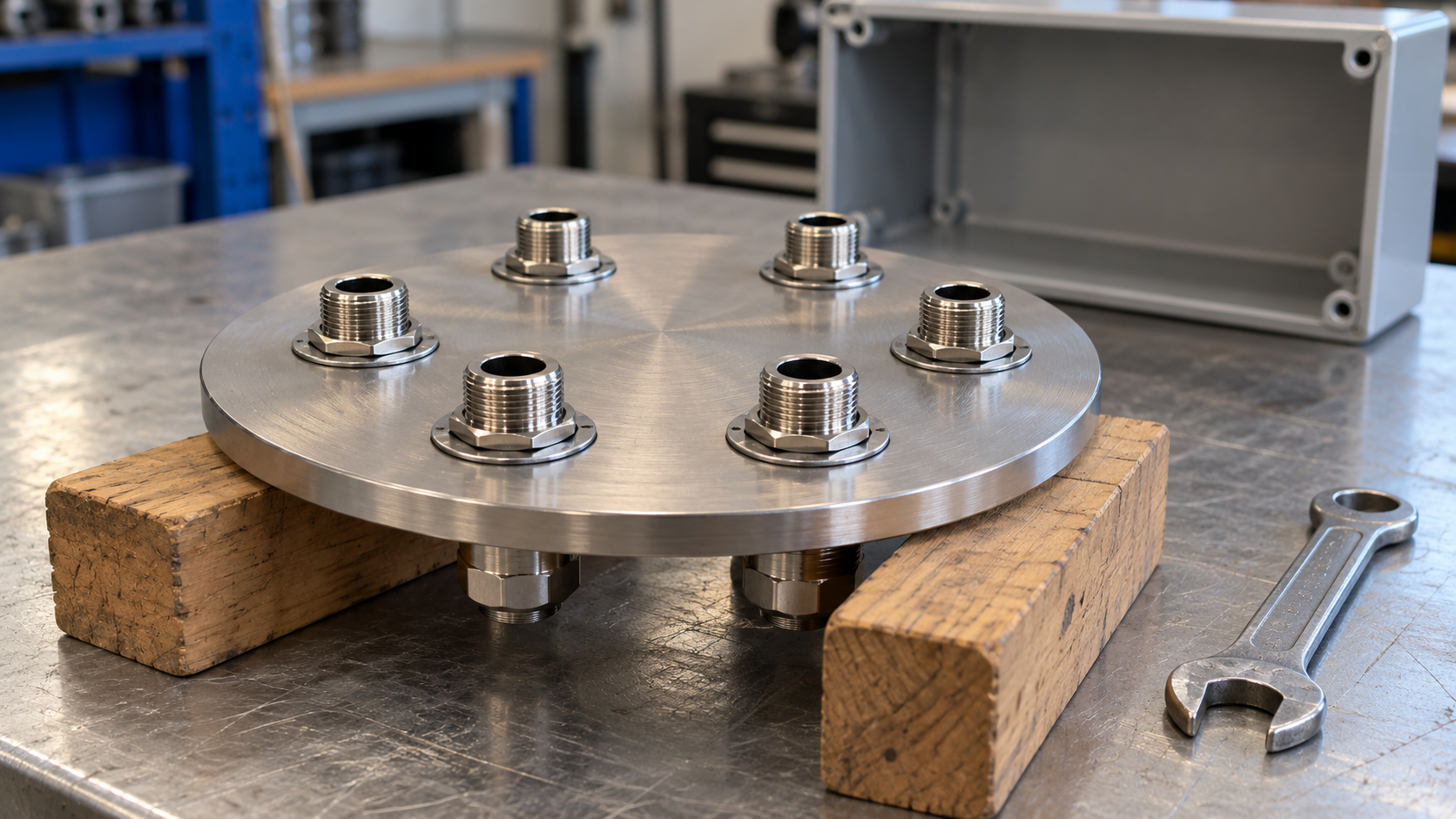
<p>工具所需空間是一個會移動的包絡。我會檢查工具頭、接近方向及工作行程，並涵蓋安裝板的兩側。除了轉動螺帽，也要預留固定接頭本體以防止其轉動的空間。<a href="/zh-hant/blog/whats-the-perfect-torque-value-for-cable-glands-and-how-tight-is-too-tight/">電纜密封接頭鎖緊指南</a>說明轉動及反向固定的位置；配置時必須同時容納兩種工具。<a href="/zh-hant/blog/how-to-customize-junction-boxes-like-a-pro-the-complete-guide-to-cutouts-holes-and-terminal-installation/">接線盒開孔指南</a>則將配置連結到後續的加工與組裝檢查。</p>
<figure>
<img alt="圓形電纜密封接頭安裝板的背面架在工作台上方，可見六根分開的螺紋柄、鎖緊螺帽與墊圈，旁邊放著扳手" src="/images/blog/gland-plate-circular-layout-open-area/gland-plate-circular-layout-open-area-scene-01.png" width="1672" height="941" loading="lazy" decoding="async">
<figcaption>鎖緊螺帽與墊圈占用各引入口周圍空間；安裝板邊緣餘量及周圍間隙則提供組裝所需的作業空間。</figcaption>
</figure>
<h2 id="calculate-open-area-on-a-declared-basis">在指定基準下計算開孔面積</h2>
<p><strong>開孔面積百分比</strong>是移除面積除以指定的安裝板面積，再乘以 100。若圓形開孔彼此不重疊且完全位於安裝板內，我會將各開孔面積相加：</p>
<div class="article-math article-math-display" data-latex="A_o=\sum_{i=1}^{n}\frac{\pi D_i^2}{4},\qquad \phi=\frac{A_o}{A_p}\times100\%"><span class="katex"><math xmlns="http://www.w3.org/1998/Math/MathML" display="block"><semantics><mrow><msub><mi>A</mi><mi>o</mi></msub><mo>=</mo><munderover><mo>∑</mo><mrow><mi>i</mi><mo>=</mo><mn>1</mn></mrow><mi>n</mi></munderover><mfrac><mrow><mi>π</mi><msubsup><mi>D</mi><mi>i</mi><mn>2</mn></msubsup></mrow><mn>4</mn></mfrac><mo separator="true">,</mo><mspace width="2em"/><mi>ϕ</mi><mo>=</mo><mfrac><msub><mi>A</mi><mi>o</mi></msub><msub><mi>A</mi><mi>p</mi></msub></mfrac><mo>×</mo><mn>100</mn><mi mathvariant="normal">%</mi></mrow><annotation encoding="application/x-tex">A_o=\sum_{i=1}^{n}\frac{\pi D_i^2}{4},\qquad \phi=\frac{A_o}{A_p}\times100\%</annotation></semantics></math></span></div>
<p><span class="article-math article-math-inline" data-latex="A_o"><span class="katex"><math xmlns="http://www.w3.org/1998/Math/MathML"><semantics><mrow><msub><mi>A</mi><mi>o</mi></msub></mrow><annotation encoding="application/x-tex">A_o</annotation></semantics></math></span></span> 是已移除的開孔面積，<span class="article-math article-math-inline" data-latex="A_p"><span class="katex"><math xmlns="http://www.w3.org/1998/Math/MathML"><semantics><mrow><msub><mi>A</mi><mi>p</mi></msub></mrow><annotation encoding="application/x-tex">A_p</annotation></semantics></math></span></span> 是指定的參考安裝板面積。各面積使用一致的平方單位。若每個開孔直徑相同，總和可寫成 <span class="article-math article-math-inline" data-latex="n\pi D_h^2/4"><span class="katex"><math xmlns="http://www.w3.org/1998/Math/MathML"><semantics><mrow><mi>n</mi><mi>π</mi><msubsup><mi>D</mi><mi>h</mi><mn>2</mn></msubsup><mi mathvariant="normal">/</mi><mn>4</mn></mrow><annotation encoding="application/x-tex">n\pi D_h^2/4</annotation></semantics></math></span></span>。</p>
<p>六個直徑 22 mm 的孔共移除約 2,280.80 mm²。百分比會隨分母而改變：</p>
<table>
<thead>
<tr>
<th>指定的安裝板邊界</th>
<th>總面積</th>
<th>六孔開孔面積率</th>
</tr>
</thead>
<tbody>
<tr>
<td>圓形安裝板，直徑 200 mm</td>
<td>31,415.93 mm²</td>
<td>7.26%</td>
</tr>
<tr>
<td>方形安裝板，200 × 200 mm</td>
<td>40,000 mm²</td>
<td>5.70%</td>
</tr>
</tbody>
</table>
<p>兩列的移除面積相同。我會在百分比旁註明安裝板邊界，讓讀者看出兩個數值為何不同。</p>
<p>若六個孔中有兩個由 22 mm 擴大至 28 mm，圓形安裝板的結果會變成 8.76%。這是四個較小圓孔與兩個較大圓孔的面積總和；由於直徑需平方，先平均直徑會算錯面積。</p>
<p>請說明總面積是否包含固定孔、連接器開孔及其他移除特徵。狹槽或不規則開孔應依其實際輪廓面積計算。形狀互相重疊時，須計算移除區域的聯集，不能重複計入重疊部分。若邊緣有缺口，只計入安裝板邊界內被移除的部分。</p>
<p>以可用面積為基準的百分比也可能有用，但必須明確繪出並命名該面積。這與總安裝板開孔面積率是不同指標。以總面積計算的 7.26%，不能直接與以較小可用區域為基準的競品配置相比。</p>
<h2 id="compare-layout-changes-before-cutting-the-plate">切割安裝板前比較配置變更</h2>
<p>同一塊 200 mm 安裝板，在孔數與節圓不同時，淨空結果可能大不相同。本比較固定使用直徑 22 mm 的孔與 35 mm 的五金件包絡。</p>
<table>
<thead>
<tr>
<th>假設配置</th>
<th style="text-align: right">節圓半徑</th>
<th style="text-align: right">弦距</th>
<th style="text-align: right">五金件間的邊緣間隙</th>
<th style="text-align: right">五金件至安裝板邊緣餘量</th>
<th style="text-align: right">總開孔面積率</th>
</tr>
</thead>
<tbody>
<tr>
<td>六個引入口</td>
<td style="text-align: right">60 mm</td>
<td style="text-align: right">60.00 mm</td>
<td style="text-align: right">25.00 mm</td>
<td style="text-align: right">22.50 mm</td>
<td style="text-align: right">7.26%</td>
</tr>
<tr>
<td>十二個引入口，節圓相同</td>
<td style="text-align: right">60 mm</td>
<td style="text-align: right">31.06 mm</td>
<td style="text-align: right">−3.94 mm</td>
<td style="text-align: right">22.50 mm</td>
<td style="text-align: right">14.52%</td>
</tr>
<tr>
<td>十二個引入口，節圓較大</td>
<td style="text-align: right">77.28 mm</td>
<td style="text-align: right">40.00 mm</td>
<td style="text-align: right">5.00 mm</td>
<td style="text-align: right">5.22 mm</td>
<td style="text-align: right">14.52%</td>
</tr>
</tbody>
</table>
<p>最後一列假設目標五金件間隙為 5 mm。所需弦長因此是 35 + 5 = 40 mm。重排弦長方程式後可得 <span class="article-math article-math-inline" data-latex="R=40/[2\sin(\pi/12)]\approx77.274\,\mathrm{mm}"><span class="katex"><math xmlns="http://www.w3.org/1998/Math/MathML"><semantics><mrow><mi>R</mi><mo>=</mo><mn>40</mn><mi mathvariant="normal">/</mi><mo stretchy="false">[</mo><mn>2</mn><mi>sin</mi><mo>⁡</mo><mo stretchy="false">(</mo><mi>π</mi><mi mathvariant="normal">/</mi><mn>12</mn><mo stretchy="false">)</mo><mo stretchy="false">]</mo><mo>≈</mo><mn>77.274</mn><mtext> </mtext><mrow><mi mathvariant="normal">m</mi><mi mathvariant="normal">m</mi></mrow></mrow><annotation encoding="application/x-tex">R=40/[2\sin(\pi/12)]\approx77.274\,\mathrm{mm}</annotation></semantics></math></span></span>，本例向上取整為 77.28 mm。5 mm 間隙只是示範性的設計目標；實際淨空需求取決於工具及組裝作業。</p>
<p>我會一起閱讀最後兩列。將十二個孔向外移，可避開圓形五金件包絡，但總移除面積不變。外側五金件餘量降至 5.22 mm，因此接下來要檢查墊片、邊緣支撐及固定件配置。只有當這些細節仍能容納時，較大的節圓才有用。如果墊圈或工具跨入保留區，我會比較較大的安裝板、較少的引入口或不同配置。旋轉孔位圖樣可能讓引入口避開固定螺栓，但相鄰弦距不變。調整組裝順序有助工具進入，卻無法解決中間那列的靜態重疊。因此，我會在規劃鎖緊順序前，先疊合已安裝五金件的包絡。</p>
<h2 id="verify-the-selected-plate-and-enclosure-design">確認所選安裝板與外殼設計</h2>
<p>配置可行後，我會檢視安裝板剩餘材料及其載荷傳遞路徑。相同的移除面積可以形成密集孔群、直線孔列，或分散的圖樣。請檢查開孔之間狹窄的連接料、安裝板材質與厚度、固定件，以及已安裝電纜帶來的負荷。面積比例是實用的圖面特性；結構審查則須使用這些尺寸與負荷。</p>
<p><a href="https://webstore.iec.ch/en/publication/67906">IEC 62208:2023</a> 涵蓋開關設備與控制設備裝入前，空外殼的特性及試驗。<a href="https://webstore.iec.ch/en/publication/2452">IEC 60529</a> 將外殼提供的防護程度分類。我會依適用的外殼要求及製造商的修改指示，規劃對完成組件進行驗證。</p>
<p>現在，工作表已提供標出位置、間隙、排除區域及移除面積的孔位圖樣。請將其連同確切的引入口、密封件、材料厚度與固定細節，一併納入安裝板及外殼審查。記錄已接受的修訂版，確保加工後的安裝板與現場安裝使用相同尺寸。</p>
<h2 id="conclusion">結論</h2>
<p>我開始在安裝板上以圓形排列配置電纜密封接頭時，會先確定節圓、起始角及實際元件尺寸。檢查相鄰圓形包絡時使用弦距，並區分孔位淨空、五金件空間與移動工具所需空間。邊緣餘量取決於實際安裝板邊界、排除區域及公差。</p>
<p>六孔與十二孔的比較顯示了取捨：引入口越多，弦距淨空越小；將引入口向外移，邊緣餘量也會減少。我會依計算尺寸選擇可行圖樣、確認工具可達性，再使用所選五金件驗證安裝板與外殼。</p>
<h2 id="faq-about-circular-gland-plate-layouts">圓形電纜密封接頭安裝板配置常見問題</h2>
<h3 id="should-i-use-arc-spacing-or-chord-spacing-between-holes">孔位間應使用圓弧間距還是弦長間距？</h3>
<p>相鄰圓孔或圓形元件包絡面之間的中心距淨空，請使用直線弦長。沿著節圓量取的圓弧間距較長。只有在製圖工作確實需要該圓弧路徑上的距離，而非直線間隔時，我才使用圓弧長。</p>
<h3 id="does-a-120-mm-pitch-circle-mean-a-120-mm-calculator-radius">120 mm 的節圓是否代表計算器半徑也是 120 mm？</h3>
<p>不是。如果 120 mm 是節圓直徑，半徑就是 60 mm。圓形引入口排列計算器接受的是半徑。若在該欄位輸入直徑，計算出的弦長與圓弧長都會加倍；但在引入口數量相同時，角節距不變。</p>
<h3 id="can-a-positive-hole-gap-prove-that-two-glands-fit">孔間有正間隙，能否證明兩個電纜密封接頭都裝得下？</h3>
<p>不能。接頭本體、墊圈、鎖緊螺帽、端蓋或工具所需空間可能大於開孔。請比較完整安裝包絡面及其方向，並納入公差與工具移動空間。我也會檢查安裝板另一面及電纜接近路徑，因為外側視野看似通暢，內側仍可能有障礙物。</p>
<h3 id="what-open-area-percentage-is-acceptable-for-a-gland-plate">電纜密封接頭安裝板可接受的開孔面積率是多少？</h3>
<p>這項計算沒有通用的可接受百分比。結果表示開孔移除面積相對於指定安裝板面積的比例；它不能證明剛度、強度、密封能力或外殼符合性。是否可接受，取決於實際材料、厚度、孔位、負荷、安裝方式及適用的外殼要求。</p>
<h3 id="sources-and-technical-references">來源與技術參考資料</h3>
<ul>
<li><a href="https://dlmf.nist.gov/4.21">NIST Digital Library of Mathematical Functions — 三角恆等式</a>，查閱日期 2026-10-28。</li>
<li><a href="https://openstax.org/books/precalculus-2e/pages/5-1-angles">OpenStax，微積分預備課程 2e — 角度、弧長與圓面積</a>，查閱日期 2026-10-28。</li>
<li><a href="https://openstax.org/books/precalculus-2e/pages/5-2-unit-circle-sine-and-cosine-functions">OpenStax，微積分預備課程 2e — 單位圓、正弦與餘弦</a>，查閱日期 2026-10-28。</li>
<li><a href="https://webstore.iec.ch/en/publication/67906">IEC 62208:2023 — 低壓開關設備與控制設備組合用空外殼</a>，查閱日期 2026-10-28。</li>
<li><a href="https://webstore.iec.ch/en/publication/2452">IEC 60529 — 外殼提供的防護等級</a>，查閱日期 2026-10-28。</li>
</ul>
