# 電鍍厚度：計算平均值並檢查表面

> Source: https://chinacableglands.com/zh-hant/blog/electroplating-thickness-charge-efficiency/
> Language: zh-Hant
> Publisher: 倍拓電纜接頭
> Author: Henry Xu
> Published: 2026-10-22
> Updated: 2026-10-23

根據電量、電流效率、密度及鍍覆面積估算電鍍平均厚度，再區分此結果與電纜密封接頭表面的局部厚度。

<p><strong>只要反應、電流效率、密度及鍍覆面積都已界定，電鍍電量便可用來估算沉積金屬質量及等效平均鍍層厚度。</strong>這項計算有助於說明製程輸入如何影響估算值，但無法判定電纜密封接頭螺紋牙底的最小厚度、凹陷處鍍層是否連續，或成品組件的耐蝕性能。</p>
<p>實用的計算順序是先求電量，再求沉積質量，最後以體積除以面積。理解這些步驟後，計算所得的平均值與局部量測便是互補的量，而非互相矛盾的答案。</p>
<h2 id="define-the-reaction-and-the-surface-receiving-the-deposit">界定反應與接收沉積的表面</h2>
<p>先確認被沉積的金屬及其電化學反應。由鎳(II)離子沉積鎳時，每個鎳原子涉及兩個電子。<a href="https://pineresearch.com/support-article/exploring-faradays-law-using-inexpensive-screen-printed-electrodes/">Pine Research 的鎳電沉積實驗</a>說明了該反應、法拉第定律的質量關係，以及競爭反應對電流效率的影響。</p>
<p>也須明確界定電氣邊界。供應給多個零件掛架的電流，不會自動等同於流經單一電纜密封接頭的電流。外露導電治具或其他組件也可能形成沉積。計算整個連接負載的質量時，需要使用相應的鍍覆面積；計算單一零件時，則須有理據將電量分配至該零件。</p>
<figure class="blog-scene">
<img src="/images/blog/electroplating-thickness-charge-efficiency/electroplating-thickness-charge-efficiency-scene-01.png" alt="製程槽附近的金屬掛架上，四個帶螺紋的金屬電纜密封接頭本體分別懸掛在金屬線鉤上" width="1672" height="941" loading="lazy" decoding="async" />
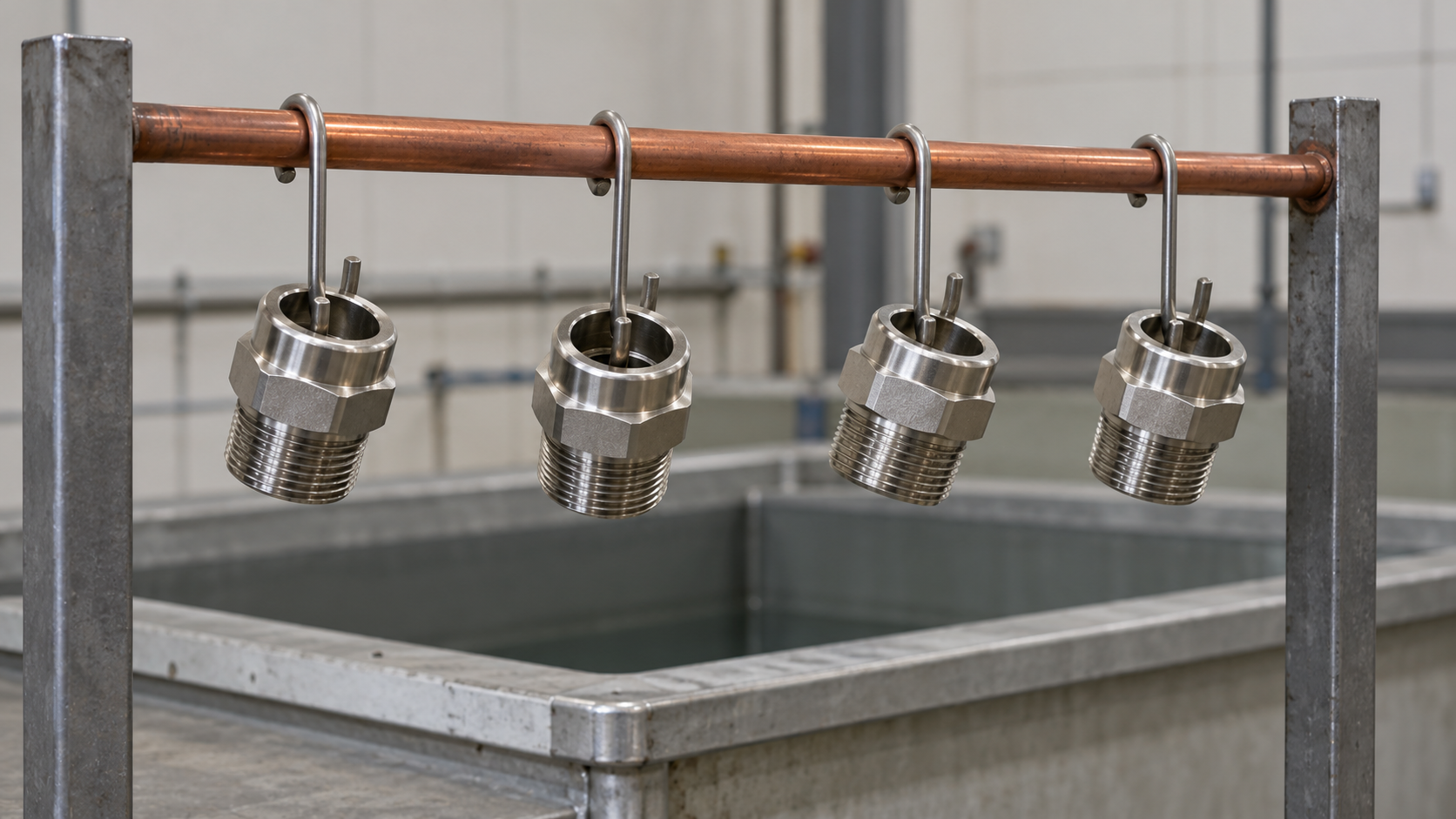
<figcaption>螺紋本體分開懸掛於掛架上，外螺紋與肩部除接觸點外皆外露。</figcaption>
</figure>
<p>鍍覆面積是模型中實際外露的表面，不是照片中零件的輪廓，也不是其外接矩形面積。若螺紋、肩部、孔腔及凹槽外露於鍍液，便會貢獻表面積。遮蔽區域與接觸位置都須明確處理。</p>
<p>對外形複雜的電纜密封接頭，我會依據受控的幾何資料與鍍覆配置建立面積估算，並記錄其不確定性。即使電流與時間記錄準確，未經文件記錄的面積仍可能主導厚度誤差。</p>
<h2 id="convert-current-and-time-into-charge">將電流與時間換算為電量</h2>
<p>若固定電流 <span class="article-math article-math-inline" data-latex="I"><span class="katex"><math xmlns="http://www.w3.org/1998/Math/MathML"><semantics><mrow><mi>I</mi></mrow><annotation encoding="application/x-tex">I</annotation></semantics></math></span></span> 以安培表示，持續時間 <span class="article-math article-math-inline" data-latex="t"><span class="katex"><math xmlns="http://www.w3.org/1998/Math/MathML"><semantics><mrow><mi>t</mi></mrow><annotation encoding="application/x-tex">t</annotation></semantics></math></span></span> 以秒表示：</p>
<div class="article-math article-math-display" data-latex="Q=It"><span class="katex"><math xmlns="http://www.w3.org/1998/Math/MathML" display="block"><semantics><mrow><mi>Q</mi><mo>=</mo><mi>I</mi><mi>t</mi></mrow><annotation encoding="application/x-tex">Q=It</annotation></semantics></math></span></div>
<p>電量 <span class="article-math article-math-inline" data-latex="Q"><span class="katex"><math xmlns="http://www.w3.org/1998/Math/MathML"><semantics><mrow><mi>Q</mi></mrow><annotation encoding="application/x-tex">Q</annotation></semantics></math></span></span> 的單位是庫侖。30 分鐘等於 1,800 秒，因此固定電流 2 A 會產生 <strong>3,600 C</strong>。若紀錄單位是安培小時，應乘以 3,600 換算為庫侖。</p>
<p>電流變動時，應使用積分所得的電量：</p>
<div class="article-math article-math-display" data-latex="Q=\int I(t)\,dt"><span class="katex"><math xmlns="http://www.w3.org/1998/Math/MathML" display="block"><semantics><mrow><mi>Q</mi><mo>=</mo><mo>∫</mo><mi>I</mi><mo stretchy="false">(</mo><mi>t</mi><mo stretchy="false">)</mo><mtext> </mtext><mi>d</mi><mi>t</mi></mrow><annotation encoding="application/x-tex">Q=\int I(t)\,dt</annotation></semantics></math></span></div>
<p>若電流會隨負載爬升、暫停或改變，我會優先採用適用的電量紀錄，而非電源供應器的名義設定值。只有在所述平均電流代表相關時間區間及電氣邊界時，才有參考價值。電流不等於電壓：將電壓設定值乘以時間，無法得到電鍍電量。</p>
<p>脈衝反向或混合反應製程，需要另行處理沉積與溶解。單向正電流的簡化模型不能直接延伸至這些製程，再把所有電流絕對值相加。</p>
<h2 id="calculate-deposited-mass-using-a-justified-efficiency">使用有依據的電流效率計算沉積質量</h2>
<p>對於簡化的單一金屬陰極模型：</p>
<div class="article-math article-math-display" data-latex="m=\frac{QM\eta}{nF}"><span class="katex"><math xmlns="http://www.w3.org/1998/Math/MathML" display="block"><semantics><mrow><mi>m</mi><mo>=</mo><mfrac><mrow><mi>Q</mi><mi>M</mi><mi>η</mi></mrow><mrow><mi>n</mi><mi>F</mi></mrow></mfrac></mrow><annotation encoding="application/x-tex">m=\frac{QM\eta}{nF}</annotation></semantics></math></span></div>
<p>此處 <span class="article-math article-math-inline" data-latex="m"><span class="katex"><math xmlns="http://www.w3.org/1998/Math/MathML"><semantics><mrow><mi>m</mi></mrow><annotation encoding="application/x-tex">m</annotation></semantics></math></span></span> 表示以克為單位的沉積質量，<span class="article-math article-math-inline" data-latex="M"><span class="katex"><math xmlns="http://www.w3.org/1998/Math/MathML"><semantics><mrow><mi>M</mi></mrow><annotation encoding="application/x-tex">M</annotation></semantics></math></span></span> 是金屬的莫耳質量（g/mol），<span class="article-math article-math-inline" data-latex="n"><span class="katex"><math xmlns="http://www.w3.org/1998/Math/MathML"><semantics><mrow><mi>n</mi></mrow><annotation encoding="application/x-tex">n</annotation></semantics></math></span></span> 是每個沉積原子所需的電子數，<span class="article-math article-math-inline" data-latex="\eta"><span class="katex"><math xmlns="http://www.w3.org/1998/Math/MathML"><semantics><mrow><mi>η</mi></mrow><annotation encoding="application/x-tex">\eta</annotation></semantics></math></span></span> 是以分數表示的電流效率。<a href="https://physics.nist.gov/cuu/Constants/Table/allascii.txt">NIST CODATA 基本常數表</a>所列法拉第常數 <span class="article-math article-math-inline" data-latex="F"><span class="katex"><math xmlns="http://www.w3.org/1998/Math/MathML"><semantics><mrow><mi>F</mi></mrow><annotation encoding="application/x-tex">F</annotation></semantics></math></span></span> 約為 96,485.33212 C/mol。</p>
<p>在此模型中，電流效率表示產生目標金屬沉積的電量比例。其他陰極反應也可能消耗電量。請使用有依據且適用於指定鍍浴、操作條件及負載的數值；手冊範例或高效率電源供應器都不能證明實際沉積效率。</p>
<p>以以下數值進行假設性的鎳電鍍計算：</p>
<table>
<thead>
<tr>
<th>輸入項目</th>
<th style="text-align: right">範例數值</th>
<th>依據</th>
</tr>
</thead>
<tbody>
<tr>
<td>供給模型中工件的電量</td>
<td style="text-align: right">3,600 C</td>
<td>2 A，持續 30 分鐘</td>
</tr>
<tr>
<td>莫耳質量</td>
<td style="text-align: right">58.69 g/mol</td>
<td>四捨五入後的鎳輸入值</td>
</tr>
<tr>
<td>電子數</td>
<td style="text-align: right">2</td>
<td>鎳(II)還原</td>
</tr>
<tr>
<td>電流效率</td>
<td style="text-align: right">95%</td>
<td>本例假設的製程輸入值</td>
</tr>
<tr>
<td>沉積物密度</td>
<td style="text-align: right">8.90 g/cm³</td>
<td>本次計算假設的密度</td>
</tr>
<tr>
<td>外露鍍覆面積</td>
<td style="text-align: right">100 cm²</td>
<td>模型假設面積</td>
</tr>
</tbody>
</table>
<p>計算所得的沉積質量<strong>約 1.040 g</strong>。95% 是明確列出的範例假設，並非對任何 Bepto 生產鍍浴的宣稱。若電流效率在製程期間變動，應以按電量加權的產率代表，或將製程分成適當的時間區間評估。</p>
<p>若量測方法能控制其他質量變化，量測前後的質量可協助核對整體沉積量估算，但仍無法定位局部薄鍍區。清潔造成的質量損失、殘留液體或未計入的沉積，都會使未受控的重量差失去判斷價值。</p>
<h2 id="convert-deposited-mass-into-an-average-thickness">將沉積質量換算為平均厚度</h2>
<p>若密度 <span class="article-math article-math-inline" data-latex="\rho"><span class="katex"><math xmlns="http://www.w3.org/1998/Math/MathML"><semantics><mrow><mi>ρ</mi></mrow><annotation encoding="application/x-tex">\rho</annotation></semantics></math></span></span> 以 g/cm³ 表示、外露面積 <span class="article-math article-math-inline" data-latex="A"><span class="katex"><math xmlns="http://www.w3.org/1998/Math/MathML"><semantics><mrow><mi>A</mi></mrow><annotation encoding="application/x-tex">A</annotation></semantics></math></span></span> 以 cm² 表示，等效平均厚度的單位為微米：</p>
<div class="article-math article-math-display" data-latex="\bar{h}=\frac{m}{\rho A}\times10^4"><span class="katex"><math xmlns="http://www.w3.org/1998/Math/MathML" display="block"><semantics><mrow><mover accent="true"><mi>h</mi><mo>ˉ</mo></mover><mo>=</mo><mfrac><mi>m</mi><mrow><mi>ρ</mi><mi>A</mi></mrow></mfrac><mo>×</mo><msup><mn>10</mn><mn>4</mn></msup></mrow><annotation encoding="application/x-tex">\bar{h}=\frac{m}{\rho A}\times10^4</annotation></semantics></math></span></div>
<p>此換算係數將公分換算為微米。本例以 1.040 g 除以 8.90 g/cm³ 與 100 cm²，得到 <strong>約 11.69 µm</strong>。這是假設沉積體積均勻分布於模型表面積所得的厚度，並採用薄鍍層近似。</p>
<p><a class="article-tool-card article-tool-card-link" href="/zh-hant/resource-center/tools/electroplating-thickness-calculator/" aria-label="電鍍沉積厚度 計算器"><span class="article-tool-card-index">工具</span><span class="article-tool-card-kicker">熱與材料變化</span><strong class="article-tool-card-title">電鍍沉積厚度</strong><span class="article-tool-card-copy">選擇輸入電流與時間，或輸入實測電量；接著填入沉積金屬的莫耳質量、電子數、有依據的電流效率、沉積物密度及實際鍍覆面積。輸出為等效平均厚度。</span><span class="article-tool-card-formula">Q = It; m = QMη/(zF); δ = m/(ρA)</span><span class="article-tool-card-inputs" aria-label="計算器輸入項目"><em>已知電荷量</em><em>恆定電鍍電流</em><em>電鍍時間</em><em>實測總電荷</em></span><span class="article-tool-card-action">開啟計算器 <span aria-hidden="true">-&gt;</span></span></a></p><p>可將結果與其輸入值一併檢查。若沉積質量與密度固定而面積加倍，計算出的平均厚度就會減半。若在手寫公式中將效率輸入為 95 而非 0.95，結果會放大 100 倍；計算器的效率欄位使用百分比。請先核對欄位單位，不要將公式中的分數值直接複製到該欄位。</p>
<p>此計算不會把材料分配到個別表面。平均厚度較大時，凹槽仍可能覆蓋不足。計算結果也無法證明鍍層成分、孔隙率、附著力或任何指定的最小厚度。</p>
<h2 id="distinguish-coverage-from-thickness-distribution">區分覆蓋情況與厚度分布</h2>
<p><strong>覆蓋能力關乎電鍍系統能否在整個表面（包括難以鍍覆的區域）形成鍍層；均鍍能力則關乎位於不同位置的表面之間，鍍層厚度分布是否均勻。</strong>美國國家標準局的原始研究 <a href="https://nvlpubs.nist.gov/nistpubs/jres/4/jresv4n1p27_a2b.pdf">《鉻電鍍的均鍍能力》</a>說明了此差異，尤其是相關定義與覆蓋能力的討論。該研究所列的鉻鍍浴數值不是鎳製程設定值。</p>
<p>對電纜密封接頭而言，外露邊緣與凹入的螺紋表面，在電場與鍍液流動幾何中所處的位置不同。因此，掛架配置、陽極位置、遮蔽及表面可接近性都可能影響結果。先確認難以鍍覆的表面是否有連續鍍層，再確認局部厚度是否符合規定。這是兩個不同問題。</p>
<p>考慮另一個假設例子：兩個面積相同的區域，厚度分別為 2 µm 與 10 µm，其面積加權平均為 6 µm。若兩區都均勻覆上 6 µm 鍍層，沉積體積相同，但最小厚度會大不相同。這只是算術示例，並非實測的電纜密封接頭鍍層分布。</p>
<figure class="blog-chart">
<svg xmlns="http://www.w3.org/2000/svg" viewBox="0 0 520 570" role="img" aria-labelledby="plating-mean-title plating-mean-desc" style="font-family:var(--font-body)">
<title id="plating-mean-title">平均值無法顯示最薄區域</title>
<desc id="plating-mean-desc">兩個假設的等面積區域厚度分別為 2 與 10 微米，其面積加權平均為 6 微米。長條表示局部厚度，旁邊另有平均值標示。</desc>
<text x="36" y="48" font-size="32" font-weight="700" fill="var(--color-carbon)"><tspan x="36">平均值相同，</tspan><tspan x="36" dy="39">局部厚度不同</tspan></text>
<text x="36" y="135" font-size="22" fill="var(--color-graphite)">兩個表面積相同的區域</text>
<path d="M70 395H450" stroke="var(--color-carbon)" stroke-width="2"/>
<rect x="95" y="355" width="110" height="40" fill="var(--color-primary)"/>
<rect x="315" y="195" width="110" height="200" fill="var(--color-primary)"/>
<text x="150" y="336" text-anchor="middle" font-size="26" font-weight="700" fill="var(--color-carbon)">2 µm</text>
<text x="370" y="176" text-anchor="middle" font-size="26" font-weight="700" fill="var(--color-carbon)">10 µm</text>
<text x="150" y="437" text-anchor="middle" font-size="22" fill="var(--color-carbon)">區域 A</text>
<text x="370" y="437" text-anchor="middle" font-size="22" fill="var(--color-carbon)">區域 B</text>
<text x="260" y="494" text-anchor="middle" font-size="26" font-weight="700" fill="var(--color-carbon)">面積加權平均：6 µm</text>
<text x="260" y="535" text-anchor="middle" font-size="22" fill="var(--color-graphite)">較薄區域仍只有 2 µm。</text>
</svg>
<figcaption>兩個等面積區域的局部厚度及其面積加權平均值。</figcaption>
</figure>
<h2 id="match-local-measurements-to-the-finished-surfaces">讓局部量測對應成品表面</h2>
<p>選擇量測位置前，先在圖面標出重要表面：可接近的平面、肩部、密封座及相關螺紋區域。在容易量測的平面讀取的數值，應清楚標示為該平面的量測結果。</p>
<p><a href="https://www.sis.se/en/produkter/manufacturing-engineering/surface-treatment-and-coating/metallic-coatings/sseniso3497/">ISO 3497 的公開適用範圍</a>說明，X 射線方法基本上測定單位面積鍍層質量；密度則可用來換算線性厚度。對外形小而彎曲的電纜密封接頭，量測配置也須配合所選位置、量測光點與鍍層系統。單一局部讀值不會自動代表整個零件。</p>
<p>製備截面可檢查切面位置的特定鍍層，而表面方法可能取樣於另一區域。只有確認量測位置與方法假設後，才能比較結果。<a href="https://www.sis.se/en/produkter/manufacturing-engineering/surface-treatment-and-coating/metallic-coatings/sseniso21772004/">ISO 2177:2003</a>說明以受控陽極溶解導電鍍層進行庫侖法厚度量測。這是量測程序，與依據電鍍電流紀錄估算生產沉積量不同。</p>
<p><a href="/zh-hant/blog/how-does-plating-thickness-affect-the-corrosion-resistance-of-brass-cable-glands/">電纜密封接頭局部鍍層厚度與耐蝕指南</a>進一步說明量測與驗收。請將附著力、覆蓋情況、局部厚度及腐蝕暴露分別評估。鍍覆後也要依功能尺寸檢查成品螺紋與密封面；單純的厚度算術估算不能核准配合或使用壽命。</p>
<h2 id="conclusion">結論</h2>
<p>電量與電流效率可估算模型中工件接收多少金屬；再以沉積體積除以已界定的鍍覆面積，即可得到平均厚度。只有配合指定反應、電流效率、面積與密度來解讀，本例的 11.69 µm 才有意義。任何一項輸入改變，都會改變這個數值的含義。</p>
<p>對於成品電纜密封接頭，應將製程估算延伸為依位置規劃的量測方案。覆蓋情況與厚度分布說明了為何看似合理的平均值仍可能伴隨局部偏薄或未覆蓋區域，也說明當圖面規定最小值時，仍須有局部證據。</p>
<h2 id="faq">常見問題</h2>
<h3 id="does-twice-the-plating-time-always-give-twice-the-thickness">電鍍時間加倍，鍍層厚度也一定加倍嗎？</h3>
<p>若電流、電流效率、密度與鍍覆面積都不變，簡化模型預測平均厚度會加倍。實際製程條件可能在電鍍期間改變，零件各處的鍍層分布也可能不同。若要將此比例關係套用至特定電纜密封接頭表面，我會先參考電量紀錄及相關製程資料。</p>
<h3 id="can-i-use-the-total-rack-current-for-one-gland">可以把整個掛架的總電流用於單一電纜密封接頭嗎？</h3>
<p>只有在有理據將該電量分配至該接頭時才可以。其他零件或外露的導電治具也可能通過電流並形成沉積。電氣邊界應與計算中使用的面積一致。以整個掛架的總電量除以單一接頭面積，通常會描述錯誤的物理模型。</p>
<h3 id="what-is-the-difference-between-covering-power-and-throwing-power">覆蓋能力與均鍍能力有何不同？</h3>
<p>覆蓋能力關乎電鍍系統能否在整個表面（包括難以鍍覆的區域）形成鍍層；均鍍能力則關乎位於不同位置的表面之間，鍍層厚度分布是否均勻。表面可能已被鍍覆，但厚度仍低於要求。我會分別評估覆蓋情況與局部厚度，不把其中任何一個詞當成概括性的鍍層品質評分。</p>
<h3 id="does-a-calculated-average-establish-the-minimum-plating-thickness">計算出的平均值能證明電鍍最小厚度嗎？</h3>
<p>不能。相同的沉積體積可能均勻分布，也可能集中於某些區域，其他區域仍然偏薄。等效平均值不包含位置資訊。請針對重要表面制定適當的量測計畫，並將各處的量測結果與圖面或鍍層規格所列的驗收條件比較。</p>
<h3 id="sources-and-technical-references">來源與技術參考資料</h3>
<ul>
<li><a href="https://pineresearch.com/support-article/exploring-faradays-law-using-inexpensive-screen-printed-electrodes/">Pine Research —《以低成本網版印刷電極探索法拉第定律》</a>，查閱日期 2026-10-22。</li>
<li><a href="https://physics.nist.gov/cuu/Constants/Table/allascii.txt">NIST — 2022 CODATA 基本物理常數完整列表</a>，查閱日期 2026-10-22。</li>
<li><a href="https://nvlpubs.nist.gov/nistpubs/jres/4/jresv4n1p27_a2b.pdf">美國國家標準局 —《鉻電鍍的均鍍能力》，RP131</a>，查閱日期 2026-10-22。</li>
<li><a href="https://www.sis.se/en/produkter/manufacturing-engineering/surface-treatment-and-coating/metallic-coatings/sseniso3497/">SIS — SS-EN ISO 3497：X 射線鍍層厚度測量方法</a>，查閱日期 2026-10-22。</li>
<li><a href="https://www.sis.se/en/produkter/manufacturing-engineering/surface-treatment-and-coating/metallic-coatings/sseniso21772004/">SIS — SS-EN ISO 2177:2004 (ISO 2177:2003)：以陽極溶解進行庫侖法鍍層厚度測量</a>，查閱日期 2026-10-23。</li>
</ul>
