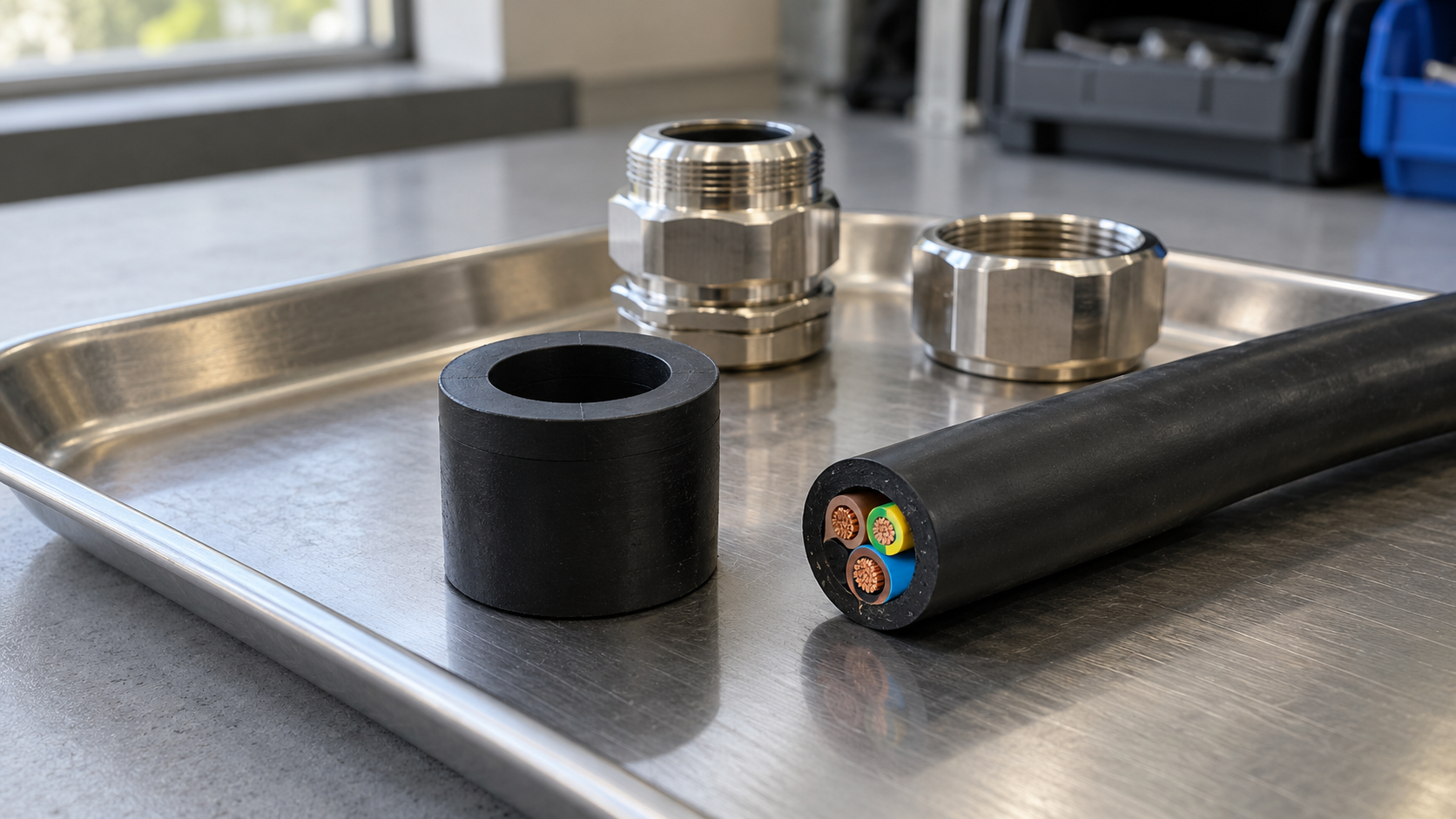
# 電纜密封件壓縮：為什麼只看直徑還不夠

> Source: https://chinacableglands.com/zh-hant/blog/cable-seal-geometry-contact-pressure/
> Language: zh-Hant
> Publisher: 倍拓電纜接頭
> Author: Victor Huang
> Published: 2026-10-22
> Updated: 2026-10-28

計算電纜密封件的壓縮幾何、公差範圍與平均接觸壓力，並透過範例區分重疊量、開口縮減量與載荷。

<p><strong>電纜密封件的壓縮先從幾何著手，但接觸壓力還取決於載荷、材料響應及組裝後嵌件的形狀。</strong>電纜與開口的比較描述初始配合狀況；指定的縮減量則描述開口如何變化。平均接觸壓力代表法向載荷分散在指定接觸面積上的結果。應採用能回答設計問題的量值。</p>
<p>我會先為每項輸入標示自由、已組裝、受載或恢復狀態。這個簡單區分能避免將在未受夾緊套管上量得的尺寸，與螺帽鎖緊後的尺寸混為一談。以下範例使用假設的尺寸與載荷示範計算；選型或安裝時，請依所選接頭的電纜範圍與組裝說明操作。</p>
<blockquote>
<p><strong>重點摘要</strong></p>
<ul>
<li>每項電纜與密封件尺寸都要註明量測狀態及公差。</li>
<li>報告重疊率或縮減率時，應註明分母。</li>
<li>除了名目配合尺寸，也要評估允許的最小與最大尺寸。</li>
<li>以法向載荷及承受該載荷的面積計算平均接觸壓力。</li>
<li>完成上述幾何比較後，應檢查組裝後密封件的局部接觸情況及必要功能。</li>
</ul>
</blockquote>
<h2 id="identify-the-dimensions-behind-cable-seal-compression">確認電纜密封件壓縮涉及的尺寸</h2>
<p><strong>自由開口</strong>是嵌件在指定組裝變形前的內孔。其直徑適用於配合比較；受載尺寸則代表後續狀態。請將狀態標在數值旁，以區分不同階段量得的尺寸。</p>
<table>
<thead>
<tr>
<th>量值</th>
<th>應記錄的狀態</th>
<th>可用來確認的項目</th>
</tr>
</thead>
<tbody>
<tr>
<td>電纜外徑</td>
<td>護套狀況、量測位置與公差</td>
<td>與嵌件接觸的表面</td>
</tr>
<tr>
<td>自由開口</td>
<td>組裝變形前的鬆置嵌件</td>
<td>初始電纜與開口間的重疊或間隙</td>
</tr>
<tr>
<td>組裝後開口</td>
<td>依指定方式完成閉合，並依指定條件裝入或不裝電纜</td>
<td>因此產生的幾何變化</td>
</tr>
<tr>
<td>接觸面積</td>
<td>規定載荷下的選定介面</td>
<td>承受法向力的表面</td>
</tr>
<tr>
<td>回復後尺寸</td>
<td>依指定恢復條件處理後的未受載狀態</td>
<td>暴露後殘留的變形</td>
</tr>
</tbody>
</table>
<p>橢圓形電纜應保留短軸與長軸尺寸。平均值可能掩蓋一側間隙過大、另一側干涉嚴重的情況。開縫嵌件或異形孔也需要能描述實際接觸面的尺寸。我會使量測方式對應密封件實際接觸的部位，再參考<a href="/zh-hant/blog/a-deep-dive-into-the-sealing-ring-designs-conical-profiled-and-slit/">密封環設計指南</a>，了解嵌件如何閉合。</p>
<figure>
<img alt="檢查盤中放著未組裝的黑色密封套與切斷的圓形電纜樣品，旁邊是分開的金屬電纜密封接頭零件" src="/images/blog/cable-seal-geometry-contact-pressure/cable-seal-geometry-contact-pressure-scene-01.png" width="1672" height="941" loading="lazy" decoding="async">
<figcaption>未組裝的密封套與電纜樣品，呈現組裝前的開口及外被表面。</figcaption>
</figure>
<h2 id="calculate-diameter-overlap-with-a-named-reference">以明確基準計算直徑差重疊量</h2>
<p><strong>直徑差重疊量</strong>是電纜直徑減去自由開口直徑。令 <span class="article-math article-math-inline" data-latex="D_c"><span class="katex"><math xmlns="http://www.w3.org/1998/Math/MathML"><semantics><mrow><msub><mi>D</mi><mi>c</mi></msub></mrow><annotation encoding="application/x-tex">D_c</annotation></semantics></math></span></span> 為電纜外徑，<span class="article-math article-math-inline" data-latex="D_o"><span class="katex"><math xmlns="http://www.w3.org/1998/Math/MathML"><semantics><mrow><msub><mi>D</mi><mi>o</mi></msub></mrow><annotation encoding="application/x-tex">D_o</annotation></semantics></math></span></span> 為自由開口直徑。對於圓形且同心的輪廓，名目徑向重疊量為此差值的一半：</p>
<div class="article-math article-math-display" data-latex="\Delta D=D_c-D_o,\qquad \delta_r=\frac{D_c-D_o}{2}"><span class="katex"><math xmlns="http://www.w3.org/1998/Math/MathML" display="block"><semantics><mrow><mi mathvariant="normal">Δ</mi><mi>D</mi><mo>=</mo><msub><mi>D</mi><mi>c</mi></msub><mo>−</mo><msub><mi>D</mi><mi>o</mi></msub><mo separator="true">,</mo><mspace width="2em"/><msub><mi>δ</mi><mi>r</mi></msub><mo>=</mo><mfrac><mrow><msub><mi>D</mi><mi>c</mi></msub><mo>−</mo><msub><mi>D</mi><mi>o</mi></msub></mrow><mn>2</mn></mfrac></mrow><annotation encoding="application/x-tex">\Delta D=D_c-D_o,\qquad \delta_r=\frac{D_c-D_o}{2}</annotation></semantics></math></span></div>
<p>以電纜直徑為基準表示重疊率，可得：</p>
<div class="article-math article-math-display" data-latex="C_D=\frac{D_c-D_o}{D_c}\times100\%"><span class="katex"><math xmlns="http://www.w3.org/1998/Math/MathML" display="block"><semantics><mrow><msub><mi>C</mi><mi>D</mi></msub><mo>=</mo><mfrac><mrow><msub><mi>D</mi><mi>c</mi></msub><mo>−</mo><msub><mi>D</mi><mi>o</mi></msub></mrow><msub><mi>D</mi><mi>c</mi></msub></mfrac><mo>×</mo><mn>100</mn><mi mathvariant="normal">%</mi></mrow><annotation encoding="application/x-tex">C_D=\frac{D_c-D_o}{D_c}\times100\%</annotation></semantics></math></span></div>
<h3 id="worked-example-a-1200-mm-cable-and-1140-mm-opening">計算範例：12.00 mm 電纜與 11.40 mm 開口</h3>
<p>假設兩個尺寸描述的是處於指定自由狀態的圓形特徵。其直徑差重疊量為 12.00 − 11.40 = 0.60 mm，名目徑向重疊量為 0.30 mm。將 0.60 mm 除以 12.00 mm 電纜直徑，得到<strong>以電纜為基準的重疊率為 5.00%</strong>。</p>
<p>若改以 11.40 mm 開口為分母，結果為 5.26%。尺寸沒有變，改變的是計算基準。我會將分母標在百分比旁，方便圖面與計算表採用同一基準比較。</p>
<figure class="blog-chart">
<svg xmlns="http://www.w3.org/2000/svg" viewBox="0 0 520 560" role="img" aria-labelledby="seal-overlap-title seal-overlap-desc" style="font-family:var(--font-body)">
<title id="seal-overlap-title">比較電纜外徑與自由開口直徑</title>
<desc id="seal-overlap-desc">綠色實線電纜輪廓與略小的虛線自由開口輪廓重疊。兩個同心圓用來比較組裝前各自的自由尺寸，並呈現其直徑差。</desc>
<text x="260" y="46" text-anchor="middle" fill="var(--color-carbon)" font-size="30" font-weight="700">比較自由狀態尺寸</text>
<text x="260" y="82" text-anchor="middle" fill="var(--color-graphite)" font-size="22">兩個輪廓，共用一條參考軸</text>
<circle cx="260" cy="280" r="120" fill="none" stroke="var(--color-primary)" stroke-width="5"/>
<circle cx="260" cy="280" r="114" fill="none" stroke="var(--color-carbon)" stroke-width="3" stroke-dasharray="8 6"/>
<line x1="140" y1="280" x2="380" y2="280" stroke="var(--color-graphite)" stroke-width="2"/>
<circle cx="260" cy="280" r="4" fill="var(--color-carbon)"/>
<line x1="76" y1="444" x2="120" y2="444" stroke="var(--color-primary)" stroke-width="5"/>
<text x="138" y="452" fill="var(--color-carbon)" font-size="22">電纜外徑：12.00 mm</text>
<line x1="76" y1="486" x2="120" y2="486" stroke="var(--color-carbon)" stroke-width="3" stroke-dasharray="8 6"/>
<text x="138" y="494" fill="var(--color-carbon)" font-size="22">自由開口直徑：11.40 mm</text>
<text x="260" y="538" text-anchor="middle" fill="var(--color-graphite)" font-size="22">直徑差：0.60 mm</text>
</svg>
<figcaption>重疊顯示的電纜與自由開口輪廓，標出重疊量計算使用的兩個直徑。</figcaption>
</figure>
<p>這些輪廓疊加呈現兩項自由狀態量測。組裝時，嵌件會依其形狀、材料響應與可用空間而變形；電纜也可能依其形狀、材料響應與可用空間而變形。請用輪廓重疊狀態描述初始幾何，再於完整設計中評估這些變形。</p>
<p><a class="article-tool-card article-tool-card-link" href="/zh-hant/resource-center/tools/seal-compression-percentage-calculator/" aria-label="電纜密封壓縮率計算器"><span class="article-tool-card-index">工具</span><span class="article-tool-card-kicker">電纜尺寸</span><strong class="article-tool-card-title">電纜密封壓縮率計算器</strong><span class="article-tool-card-copy">以相同單位輸入電纜 OD 與密封件自由開口直徑。百分比以電纜 OD 為分母；名目值與公差端點的輸入值應分開比較。</span><span class="article-tool-card-formula">c = (Dc − Ds) / Dc × 100%</span><span class="article-tool-card-inputs" aria-label="計算器輸入項目"><em>電纜外徑</em><em>密封件開口直徑</em></span><span class="article-tool-card-action">開啟計算器 <span aria-hidden="true">-&gt;</span></span></a></p><p>負值表示自由狀態下存在間隙。請檢查接頭如何閉合嵌件，以及電纜是否位於其宣告範圍內。正值表示組裝前已有干涉；應依實際密封件設計評估插入、護套受力與閉合情況。<a href="/zh-hant/blog/the-ultimate-guide-to-cable-gland-sizing-how-to-match-glands-to-cable-diameters/">電纜密封接頭尺寸選型指南</a>說明如何將完整電纜直徑區間與該範圍比較。</p>
<h2 id="carry-tolerances-through-the-overlap-calculation">將公差納入重疊量計算</h2>
<p>名目尺寸只代表一種組合。最小電纜搭配最大開口時，重疊量最小；最大電纜搭配最小開口時，重疊量最大。採用相同的圓形尺寸定義時：</p>
<div class="article-math article-math-display" data-latex="\Delta D_{\min}=D_{c,\min}-D_{o,\max},\qquad
\Delta D_{\max}=D_{c,\max}-D_{o,\min}"><span class="katex"><math xmlns="http://www.w3.org/1998/Math/MathML" display="block"><semantics><mrow><mi mathvariant="normal">Δ</mi><msub><mi>D</mi><mi>min</mi><mo>⁡</mo></msub><mo>=</mo><msub><mi>D</mi><mrow><mi>c</mi><mo separator="true">,</mo><mi>min</mi><mo>⁡</mo></mrow></msub><mo>−</mo><msub><mi>D</mi><mrow><mi>o</mi><mo separator="true">,</mo><mi>max</mi><mo>⁡</mo></mrow></msub><mo separator="true">,</mo><mspace width="2em"/><mi mathvariant="normal">Δ</mi><msub><mi>D</mi><mi>max</mi><mo>⁡</mo></msub><mo>=</mo><msub><mi>D</mi><mrow><mi>c</mi><mo separator="true">,</mo><mi>max</mi><mo>⁡</mo></mrow></msub><mo>−</mo><msub><mi>D</mi><mrow><mi>o</mi><mo separator="true">,</mo><mi>min</mi><mo>⁡</mo></mrow></msub></mrow><annotation encoding="application/x-tex">\Delta D_{\min}=D_{c,\min}-D_{o,\max},\qquad
\Delta D_{\max}=D_{c,\max}-D_{o,\min}</annotation></semantics></math></span></div>
<h3 id="worked-example-the-same-nominal-fit-with-tolerances">計算範例：相同名義配合並納入公差</h3>
<p>假設電纜為 12.00 ± 0.10 mm，自由開口為 11.40 ± 0.15 mm。這些公差僅供說明，並非建議的製造限值。</p>
<table>
<thead>
<tr>
<th>尺寸組合</th>
<th>直徑差重疊量</th>
<th>徑向重疊量</th>
<th>以電纜為基準的百分比</th>
</tr>
</thead>
<tbody>
<tr>
<td>最小電纜、最大開口：11.90 與 11.55 mm</td>
<td>0.35 mm</td>
<td>0.175 mm</td>
<td>2.94%</td>
</tr>
<tr>
<td>名目值：12.00 與 11.40 mm</td>
<td>0.60 mm</td>
<td>0.300 mm</td>
<td>5.00%</td>
</tr>
<tr>
<td>最大電纜、最小開口：12.10 與 11.25 mm</td>
<td>0.85 mm</td>
<td>0.425 mm</td>
<td>7.02%</td>
</tr>
</tbody>
</table>
<p>因此，此範例中的名目 5% 代表約 2.94–7.02% 的可能範圍。我會依設計允許的配合與變形檢查兩端數值。這是尺寸的最壞情況範圍，沒有為任一極端值指定發生機率。若溫度、膨潤或護套狀況改變，則需要該狀態下的尺寸。</p>
<h2 id="compare-circular-areas-using-the-squared-diameter-ratio">依直徑平方比比較圓形面積</h2>
<p><strong>面積比</strong>是比較截面尺寸的量值。對於圓形電纜與開口輪廓，面積與直徑平方成正比：</p>
<div class="article-math article-math-display" data-latex="Q_A=\frac{A_c}{A_o}=\left(\frac{D_c}{D_o}\right)^2"><span class="katex"><math xmlns="http://www.w3.org/1998/Math/MathML" display="block"><semantics><mrow><msub><mi>Q</mi><mi>A</mi></msub><mo>=</mo><mfrac><msub><mi>A</mi><mi>c</mi></msub><msub><mi>A</mi><mi>o</mi></msub></mfrac><mo>=</mo><msup><mrow><mo fence="true">(</mo><mfrac><msub><mi>D</mi><mi>c</mi></msub><msub><mi>D</mi><mi>o</mi></msub></mfrac><mo fence="true">)</mo></mrow><mn>2</mn></msup></mrow><annotation encoding="application/x-tex">Q_A=\frac{A_c}{A_o}=\left(\frac{D_c}{D_o}\right)^2</annotation></semantics></math></span></div>
<p>將名目值 12.00 mm 與 11.40 mm 代入，可得 1.108，也就是約 110.8%。電纜的圓形橫截面面積約比自由開口面積大 10.8%。這是開口面積的比較；材料應變則取決於材料自身尺寸的變化。</p>
<p>評估密封材料時，也要考量外側邊界、長度及可移動空間。兩個內孔相同的嵌件，壁厚與閉合機構仍可能不同。這些差異會影響變形，以及電纜表面承受的載荷。孔洞面積、材料面積及受載接觸面積應分開處理。</p>
<h2 id="calculate-a-specified-opening-reduction">計算指定的開口縮減率</h2>
<p><strong>開口縮減率</strong>比較同一開口在指定變化前後的尺寸。若設計指示指定初始直徑的分數縮減量為 <span class="article-math article-math-inline" data-latex="r"><span class="katex"><math xmlns="http://www.w3.org/1998/Math/MathML"><semantics><mrow><mi>r</mi></mrow><annotation encoding="application/x-tex">r</annotation></semantics></math></span></span>，則：</p>
<div class="article-math article-math-display" data-latex="D_f=D_o(1-r),\qquad \frac{A_f}{A_o}=(1-r)^2"><span class="katex"><math xmlns="http://www.w3.org/1998/Math/MathML" display="block"><semantics><mrow><msub><mi>D</mi><mi>f</mi></msub><mo>=</mo><msub><mi>D</mi><mi>o</mi></msub><mo stretchy="false">(</mo><mn>1</mn><mo>−</mo><mi>r</mi><mo stretchy="false">)</mo><mo separator="true">,</mo><mspace width="2em"/><mfrac><msub><mi>A</mi><mi>f</mi></msub><msub><mi>A</mi><mi>o</mi></msub></mfrac><mo>=</mo><mo stretchy="false">(</mo><mn>1</mn><mo>−</mo><mi>r</mi><msup><mo stretchy="false">)</mo><mn>2</mn></msup></mrow><annotation encoding="application/x-tex">D_f=D_o(1-r),\qquad \frac{A_f}{A_o}=(1-r)^2</annotation></semantics></math></span></div>
<h3 id="worked-example-a-specified-5-diameter-reduction">計算範例：指定直徑縮減 5%</h3>
<p>縮減 5% 時，使用 <span class="article-math article-math-inline" data-latex="r=0.05"><span class="katex"><math xmlns="http://www.w3.org/1998/Math/MathML"><semantics><mrow><mi>r</mi><mo>=</mo><mn>0.05</mn></mrow><annotation encoding="application/x-tex">r=0.05</annotation></semantics></math></span></span>。若圓形開口的起始直徑為 10.00 mm，則變為 9.50 mm。面積會從 78.54 mm² 變為 70.88 mm²，<strong>面積縮減率為 9.75%</strong>。由於面積取決於直徑平方，直徑百分比與面積百分比並不相同。</p>
<p>此處的 5% 是明確指定的設計假設。請依相關圖面、量測或經驗證的變形模型，取得閉合位置或開口變化後的尺寸。螺帽扭矩會透過螺紋摩擦與接頭閉合機構傳遞，因此應按規定扭矩組裝產品，並使用適當的尺寸資料進行此計算。</p>
<p>若內孔中有電纜，幾何計算也要納入其尺寸與變形。計算空孔縮減量描述的是空孔狀態；放入電纜後，受載介面可能呈現不同形狀。</p>
<h2 id="calculate-mean-pressure-from-normal-load-and-contact-area">以法向載荷及接觸面積計算平均壓力</h2>
<p><strong>平均接觸壓力</strong>是法向載荷分布在其對應接觸面積上的結果。若載荷 <span class="article-math article-math-inline" data-latex="F_N"><span class="katex"><math xmlns="http://www.w3.org/1998/Math/MathML"><semantics><mrow><msub><mi>F</mi><mi>N</mi></msub></mrow><annotation encoding="application/x-tex">F_N</annotation></semantics></math></span></span> 與面積 <span class="article-math article-math-inline" data-latex="A_{\mathrm{contact}}"><span class="katex"><math xmlns="http://www.w3.org/1998/Math/MathML"><semantics><mrow><msub><mi>A</mi><mrow><mi mathvariant="normal">c</mi><mi mathvariant="normal">o</mi><mi mathvariant="normal">n</mi><mi mathvariant="normal">t</mi><mi mathvariant="normal">a</mi><mi mathvariant="normal">c</mi><mi mathvariant="normal">t</mi></mrow></msub></mrow><annotation encoding="application/x-tex">A_{\mathrm{contact}}</annotation></semantics></math></span></span> 已各自獨立確認：</p>
<div class="article-math article-math-display" data-latex="\bar p=\frac{F_N}{A_{\mathrm{contact}}}"><span class="katex"><math xmlns="http://www.w3.org/1998/Math/MathML" display="block"><semantics><mrow><mover accent="true"><mi>p</mi><mo>ˉ</mo></mover><mo>=</mo><mfrac><msub><mi>F</mi><mi>N</mi></msub><msub><mi>A</mi><mrow><mi mathvariant="normal">c</mi><mi mathvariant="normal">o</mi><mi mathvariant="normal">n</mi><mi mathvariant="normal">t</mi><mi mathvariant="normal">a</mi><mi mathvariant="normal">c</mi><mi mathvariant="normal">t</mi></mrow></msub></mfrac></mrow><annotation encoding="application/x-tex">\bar p=\frac{F_N}{A_{\mathrm{contact}}}</annotation></semantics></math></span></div>
<p>假設法向載荷為 600 N、接觸面積為 300 mm²，則壓力為 2 N/mm²，相當於 <strong>2 MPa</strong>。<a href="https://www.nist.gov/pml/special-publication-811/nist-guide-si-chapter-4-two-classes-si-units-and-si-prefixes">NIST SI 單位表</a>將帕斯卡定義為 N/m²。1 平方毫米等於百萬分之一平方公尺，因此 1 N/mm² 等於 1 MPa。</p>
<p>使用載荷前，我會檢查其方向與表面定義。圓柱形電纜周圍的 <span class="article-math article-math-inline" data-latex="F_N"><span class="katex"><math xmlns="http://www.w3.org/1998/Math/MathML"><semantics><mrow><msub><mi>F</mi><mi>N</mi></msub></mrow><annotation encoding="application/x-tex">F_N</annotation></semantics></math></span></span>，是選定面積上各處法向力大小的總和。相反方向的徑向力在向量上可能互相抵消，但電纜兩側仍都承受壓力。除非有適用的載荷傳遞模型建立關係，否則應將軸向螺帽力與周向接觸載荷分開處理。</p>
<p>若明確假設為完整圓柱帶，表觀面積等於圓周長乘以軸向接觸長度：<span class="article-math article-math-inline" data-latex="A_{\mathrm{band}}=\pi D L"><span class="katex"><math xmlns="http://www.w3.org/1998/Math/MathML"><semantics><mrow><msub><mi>A</mi><mrow><mi mathvariant="normal">b</mi><mi mathvariant="normal">a</mi><mi mathvariant="normal">n</mi><mi mathvariant="normal">d</mi></mrow></msub><mo>=</mo><mi>π</mi><mi>D</mi><mi>L</mi></mrow><annotation encoding="application/x-tex">A_{\mathrm{band}}=\pi D L</annotation></semantics></math></span></span>。應採用指定受載狀態下的直徑與長度。相除前，須確認載荷也對應同一圓柱帶。投影圓盤面積、環形端面與圓柱帶代表不同表面。</p>
<p>平均值可能掩蓋局部高壓區與接觸不足區。評估洩漏路徑時，應追蹤電纜周圍及沿密封帶的接觸情況。<a href="/zh-hant/blog/how-do-cable-gland-sealing-mechanisms-work-at-the-microscopic-level/">微觀密封指南</a>說明表面接觸與這些相連的洩漏路徑之間的關係。</p>
<h2 id="choose-the-percentage-that-matches-the-physical-change">選擇符合實際變化的百分比</h2>
<p>「壓縮」一詞可能指不同量測。我會先比較各項定義，再比較數值，以免把有用的幾何結果誤當成材料測試結果。</p>
<table>
<thead>
<tr>
<th>量值</th>
<th>基準與意義</th>
</tr>
</thead>
<tbody>
<tr>
<td>以電纜為基準的重疊率</td>
<td>電纜 OD 減去自由開口直徑，再除以電纜 OD</td>
</tr>
<tr>
<td>開口縮減量</td>
<td>同一開口相對於其原始尺寸的變化</td>
</tr>
<tr>
<td>O 型環壓縮量</td>
<td>相對於原始橫截面的截面高度縮減量</td>
</tr>
<tr>
<td>墊片壓縮</td>
<td>在指定閉合或載荷下的厚度縮減量</td>
</tr>
<tr>
<td>壓縮永久變形</td>
<td>指定壓縮與恢復後的殘餘變形</td>
</tr>
<tr>
<td>平均接觸壓力</td>
<td>法向載荷除以承載該載荷的表面面積</td>
</tr>
</tbody>
</table>
<p><strong>壓縮永久變形</strong>描述指定測試與恢復後殘留的變形；壓縮量則描述安裝幾何中的強制變形。<a href="https://store.astm.org/d0395-18r25.html">ASTM D395-18(2025)</a> 涵蓋指定力或撓度條件下的橡膠壓縮永久變形測試方法。報告永久變形值時，應一併註明測試方法與恢復條件。若嵌件持續受載期間發生變化，請參考<a href="/zh-hant/blog/why-is-cold-flow-critical-in-cable-gland-seals-and-how-can-you-prevent-it/">密封件冷流指南</a>所述的持續載荷行為。</p>
<p>實務上，先計算預定的幾何量，再評估受載後的接觸情況，最後測試已組裝引入口所需功能。<a href="https://webstore.iec.ch/en/publication/7034">IEC 62444:2010</a> 涵蓋完整接頭的結構與性能。計算結果應對應所選接頭、密封件與電纜，並依產品安裝及性能要求驗收。</p>
<h2 id="conclusion">結論</h2>
<p>只要清楚標示每項輸入的狀態與基準，電纜密封件壓縮計算就能提供實用資訊。重疊量比較電纜與自由開口；公差端點則顯示名目配合周圍的尺寸範圍。開口縮減率與面積比描述不同的幾何變化，因此應清楚標示各自的分母。</p>
<p>若問題在於壓力，我會使用法向載荷及與其相符的接觸面積。接著檢查電纜周圍的接觸情況，以及組裝後的引入口必須維持哪些功能。這可將計算表與實際密封件連結，同時區分重疊量、壓縮量、壓縮永久變形與壓力。</p>
<h2 id="faqs-about-cable-seal-calculations">電纜密封計算常見問題</h2>
<h3 id="is-a-5-diameter-overlap-the-same-as-5-seal-compression">5% 的直徑重疊量等於 5% 的密封壓縮率嗎？</h3>
<p>以電纜為基準的重疊率，是電纜與開口直徑之差除以電纜 OD。O 型環壓縮量與墊片壓縮則描述材料橫截面或厚度的變化。比較百分比前，先確認其基準尺寸與受載狀態。</p>
<h3 id="does-a-negative-overlap-mean-the-gland-cannot-seal">負的重疊量是否代表電纜密封接頭無法密封？</h3>
<p>負值表示未受力開口大於電纜。若接頭在組裝時會閉合嵌件，請評估其閉合行程與宣告的電纜範圍。組裝後，再評估受載幾何與密封功能。</p>
<h3 id="can-tightening-torque-be-converted-directly-to-contact-pressure">能否直接將鎖緊扭矩換算為接觸壓力？</h3>
<p>從鎖緊扭矩換算載荷，需要建立螺紋摩擦、幾何與閉合機構的模型。平均接觸壓力則以所得法向載荷及其對應接觸面積計算。我會採用有獨立依據的載荷資料或針對所選組件驗證過的模型，並依產品安裝說明執行鎖緊。</p>
<h3 id="why-is-a-5-opening-diameter-reduction-a-larger-area-reduction">為什麼開口直徑減少 5% 會造成更大的面積縮減？</h3>
<p>圓形面積與直徑平方成正比。直徑縮減至原值的 95%，面積會保留原值的 90.25%，也就是縮減 9.75%。這個結果描述的是開口幾何；密封材料的變形也取決於其外側邊界、長度及可移動空間。</p>
<h3 id="sources-and-technical-references">來源與技術參考資料</h3>
<ul>
<li><a href="https://www.nist.gov/pml/special-publication-811/nist-guide-si-chapter-4-two-classes-si-units-and-si-prefixes">NIST —《SI 指南》第 4 章：SI 單位的兩類與 SI 前綴</a>，查閱日期：2026-10-28。</li>
<li><a href="https://store.astm.org/d0395-18r25.html">ASTM D395-18(2025) — 橡膠特性標準測試方法－壓縮永久變形</a>，查閱日期：2026-10-28。</li>
<li><a href="https://webstore.iec.ch/en/publication/7034">IEC 62444:2010 — 電氣裝置用電纜密封接頭</a>，查閱日期：2026-10-28。</li>
</ul>
