# 電纜密封接頭出貨：計算毛重與 CBM

> Source: https://chinacableglands.com/zh-hant/blog/cable-gland-shipment-weight-volume/
> Language: zh-Hant
> Publisher: 倍拓電纜接頭
> Author: Chuck Liu
> Published: 2026-10-22
> Updated: 2026-10-23

根據範例訂單及明確的包裝假設，計算電纜密封接頭的紙箱數、淨重與毛重、貨件體積及計費重量。

<p><strong>從完成包裝的產品向外規劃電纜密封接頭貨件：數量決定紙箱數，產品與包裝決定毛重，最終貨運單位則決定測量體積。</strong>套用承運商的計費規則之前，應分別完成這些計算。產品質量本身無法預測運費帳單；個別紙箱體積總和也可能不同於棧板的外部貨運外廓。</p>
<p>以下是假設訂單，並列明包裝及報價輸入值。你可以用自己的核准包裝表替換各項輸入。本例不含現行運費率，也未採用通用材積換算係數。</p>
<h2 id="freeze-the-sku-and-packing-schedule">確認 SKU 與包裝表</h2>
<p>包裝表應從確切的供應單位開始。接頭本體、完整電纜密封接頭組件，以及附有鎖緊螺母與密封墊圈的接頭，質量及每箱包裝數量可能不同。單件質量記錄必須符合採購單實際包含的供應內容。</p>
<table>
<thead>
<tr>
<th>範例 SKU</th>
<th style="text-align: right">訂購單位數</th>
<th style="text-align: right">每箱單位數</th>
<th style="text-align: right">每個供應單位的產品質量</th>
<th>紙箱外部尺寸</th>
</tr>
</thead>
<tbody>
<tr>
<td>A</td>
<td style="text-align: right">1,250</td>
<td style="text-align: right">100</td>
<td style="text-align: right">0.085 kg</td>
<td>40 × 30 × 25 cm</td>
</tr>
<tr>
<td>B</td>
<td style="text-align: right">420</td>
<td style="text-align: right">60</td>
<td style="text-align: right">0.140 kg</td>
<td>50 × 35 × 30 cm</td>
</tr>
</tbody>
</table>
<p>在本例中，不同 SKU 不可混裝於同一紙箱；即使紙箱未裝滿，仍按一般紙箱的外部尺寸計算。這些是包裝假設，不是電纜密封接頭本身的特性。若允許混裝，應逐箱列出實際內容物，而不是先分別將各 SKU 數量換算成整箱數，再事後混裝。</p>
<p>在包裝表中保留批次識別、附件數量及任何允許的數量差異。也要記錄單件質量的取得方式：受控圖面估算、供應商聲明，或秤量定義明確的供應組件。最終包裝貨件秤重之前，初步估算仍只是估算。</p>
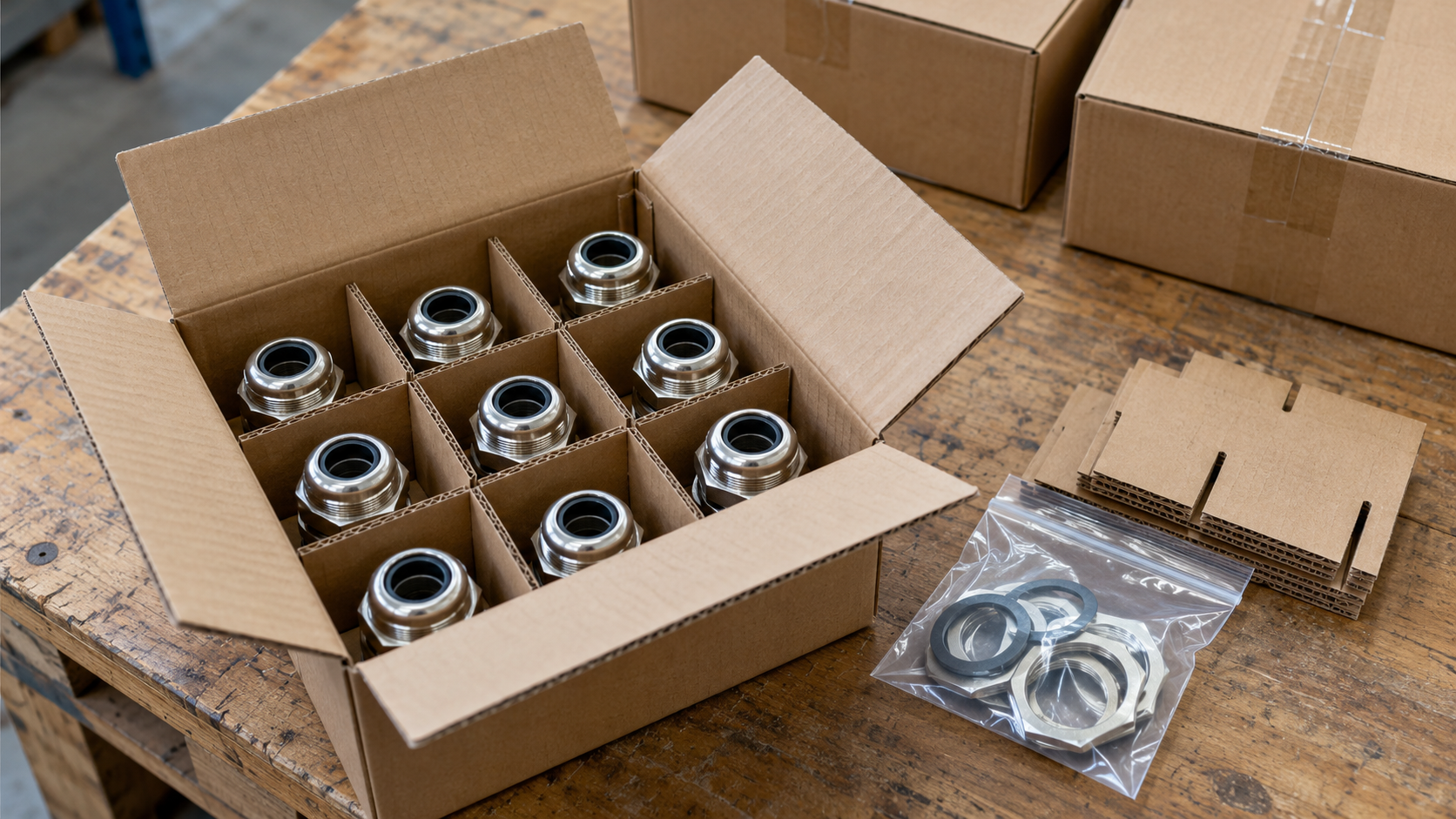
<figure class="blog-scene">
<img src="/images/blog/cable-gland-shipment-weight-volume/cable-gland-shipment-weight-volume-scene-01.png" alt="打開的紙箱內以獨立紙格放置金屬電纜密封接頭，旁邊有一袋墊圈及鎖緊螺母" width="1672" height="941" loading="lazy" decoding="async" />
<figcaption>隔板將電纜密封接頭分隔放置；紙箱旁可看到附件袋及未安裝的內襯。</figcaption>
</figure>
<h2 id="calculate-full-cartons-and-the-final-partial-carton">計算整箱數與最後一箱的剩餘數量</h2>
<p>若訂單數量為 <span class="article-math article-math-inline" data-latex="Q"><span class="katex"><math xmlns="http://www.w3.org/1998/Math/MathML"><semantics><mrow><mi>Q</mi></mrow><annotation encoding="application/x-tex">Q</annotation></semantics></math></span></span>，每箱裝箱數 <span class="article-math article-math-inline" data-latex="p"><span class="katex"><math xmlns="http://www.w3.org/1998/Math/MathML"><semantics><mrow><mi>p</mi></mrow><annotation encoding="application/x-tex">p</annotation></semantics></math></span></span> 為正整數，則紙箱總數為：</p>
<div class="article-math article-math-display" data-latex="N=\left\lceil\frac{Q}{p}\right\rceil"><span class="katex"><math xmlns="http://www.w3.org/1998/Math/MathML" display="block"><semantics><mrow><mi>N</mi><mo>=</mo><mrow><mo fence="true">⌈</mo><mfrac><mi>Q</mi><mi>p</mi></mfrac><mo fence="true">⌉</mo></mrow></mrow><annotation encoding="application/x-tex">N=\left\lceil\frac{Q}{p}\right\rceil</annotation></semantics></math></span></div>
<p>整箱數為 <span class="article-math article-math-inline" data-latex="\lfloor Q/p\rfloor"><span class="katex"><math xmlns="http://www.w3.org/1998/Math/MathML"><semantics><mrow><mo stretchy="false">⌊</mo><mi>Q</mi><mi mathvariant="normal">/</mi><mi>p</mi><mo stretchy="false">⌋</mo></mrow><annotation encoding="application/x-tex">\lfloor Q/p\rfloor</annotation></semantics></math></span></span>，餘數為 <span class="article-math article-math-inline" data-latex="Q-p\lfloor Q/p\rfloor"><span class="katex"><math xmlns="http://www.w3.org/1998/Math/MathML"><semantics><mrow><mi>Q</mi><mo>−</mo><mi>p</mi><mo stretchy="false">⌊</mo><mi>Q</mi><mi mathvariant="normal">/</mi><mi>p</mi><mo stretchy="false">⌋</mo></mrow><annotation encoding="application/x-tex">Q-p\lfloor Q/p\rfloor</annotation></semantics></math></span></span>。餘數為零表示不需增加一個部分裝滿的紙箱；這不代表最後一個滿箱是空的。訂購數量為零時，紙箱數也為零。</p>
<p>SKU A 需要 12 箱裝滿，另有 1 箱裝 50 件：共 <strong>13 箱</strong>。SKU B 需要 7 箱裝滿，共 <strong>7 箱</strong>。因此貨件共 <strong>20 箱，包含 1,670 個供應單位</strong>。</p>
<p>我們可以用紙箱內容物交叉核對訂單：12 × 100 + 50 = 1,250，且 7 × 60 = 420。這能抓出常見的試算表錯誤：使用向上取整後的箱數回推訂購數量，結果意外多出 50 個 SKU A。</p>
<p>如果剩餘數量改用較小且已核准的箱子，應另列一種紙箱類型，並記錄其皮重與尺寸。僅將原紙箱標示為「半滿」，不能減少貨運體積。</p>
<h2 id="add-packaging-once-to-obtain-gross-mass">只將包裝質量加算一次，求得毛重</h2>
<p>產品淨質量是各 SKU 數量乘以其定義單件質量後的總和：</p>
<div class="article-math article-math-display" data-latex="m_{\mathrm{net}}=\sum_i Q_i m_i"><span class="katex"><math xmlns="http://www.w3.org/1998/Math/MathML" display="block"><semantics><mrow><msub><mi>m</mi><mrow><mi mathvariant="normal">n</mi><mi mathvariant="normal">e</mi><mi mathvariant="normal">t</mi></mrow></msub><mo>=</mo><munder><mo>∑</mo><mi>i</mi></munder><msub><mi>Q</mi><mi>i</mi></msub><msub><mi>m</mi><mi>i</mi></msub></mrow><annotation encoding="application/x-tex">m_{\mathrm{net}}=\sum_i Q_i m_i</annotation></semantics></math></span></div>
<p>此例中，SKU A 為 106.25 kg，SKU B 為 58.80 kg，合計<strong>產品淨質量 165.05 kg</strong>。請統一使用公斤。若來源記錄採用其他質量或長度單位，可參考 <a href="https://www.nist.gov/pml/special-publication-811/nist-guide-si-appendix-b-conversion-factors/nist-guide-si-appendix-b9">NIST SI 單位換算表</a>。</p>
<p>範例包裝項目應分列，且各列不可重複計算：</p>
<table>
<thead>
<tr>
<th>質量項目</th>
<th>計算式</th>
<th style="text-align: right">增加的質量</th>
</tr>
</thead>
<tbody>
<tr>
<td>A 紙箱（空箱）</td>
<td>13 × 0.60 kg</td>
<td style="text-align: right">7.80 kg</td>
</tr>
<tr>
<td>B 紙箱（空箱）</td>
<td>7 × 0.80 kg</td>
<td style="text-align: right">5.60 kg</td>
</tr>
<tr>
<td>袋子、隔板及其他內部包裝</td>
<td>本訂單記錄的總質量</td>
<td style="text-align: right">2.50 kg</td>
</tr>
<tr>
<td>一個棧板</td>
<td>記錄的皮重</td>
<td style="text-align: right">20.00 kg</td>
</tr>
<tr>
<td>包膜、束帶及護角</td>
<td>記錄的總質量</td>
<td style="text-align: right">1.20 kg</td>
</tr>
<tr>
<td><strong>包裝總質量</strong></td>
<td>五列合計</td>
<td style="text-align: right"><strong>37.10 kg</strong></td>
</tr>
</tbody>
</table>
<p>因此貨件毛重為 <strong>165.05 + 37.10 = 202.15 kg</strong>。這些都是虛構的範例輸入，不是型錄質量或實際量測的貨件結果。</p>
<p>明確界定測量範圍。如果已包裝紙箱的重量包含袋子與隔板，就不要再把這些材料加算一次。如果整個裝載棧板已作為一個單位秤重，該讀數已包含棧板及包膜。請保留計算明細以便核對；若與最終磅秤讀數有重大差異，應查明原因。</p>
<h2 id="calculate-cbm-from-the-shipping-units-external-dimensions">依貨運單位外部尺寸計算 CBM</h2>
<p>CBM 代表立方公尺。計算長方體包裝時，先將外部長、寬、高全部換算為公尺，再相乘。若尺寸以公分表示：</p>
<div class="article-math article-math-display" data-latex="V_{\mathrm{cartons}}=\sum_j\frac{N_j L_j W_j H_j}{10^6}"><span class="katex"><math xmlns="http://www.w3.org/1998/Math/MathML" display="block"><semantics><mrow><msub><mi>V</mi><mrow><mi mathvariant="normal">c</mi><mi mathvariant="normal">a</mi><mi mathvariant="normal">r</mi><mi mathvariant="normal">t</mi><mi mathvariant="normal">o</mi><mi mathvariant="normal">n</mi><mi mathvariant="normal">s</mi></mrow></msub><mo>=</mo><munder><mo>∑</mo><mi>j</mi></munder><mfrac><mrow><msub><mi>N</mi><mi>j</mi></msub><msub><mi>L</mi><mi>j</mi></msub><msub><mi>W</mi><mi>j</mi></msub><msub><mi>H</mi><mi>j</mi></msub></mrow><msup><mn>10</mn><mn>6</mn></msup></mfrac></mrow><annotation encoding="application/x-tex">V_{\mathrm{cartons}}=\sum_j\frac{N_j L_j W_j H_j}{10^6}</annotation></semantics></math></span></div>
<p>範例中，A 紙箱體積為 13 × 0.40 × 0.30 × 0.25 = <strong>0.3900 m³</strong>。B 紙箱體積為 7 × 0.50 × 0.35 × 0.30 = <strong>0.3675 m³</strong>。紙箱外部體積合計為 <strong>0.7575 m³</strong>。</p>
<p>此總和代表個別紙箱的體積。如果訂單以一個棧板貨運單位交運，應詢問承運商對該處理單位採用的測量規則。假設包含棧板與防護材料在內，最終測得的外部尺寸為 <strong>1.20 × 1.00 × 1.10 m</strong>。棧板外廓體積為 <strong>1.3200 m³</strong>，其中包含堆疊內的空隙及棧板高度；紙箱體積總和並未包含這些部分。</p>
<p>假設的外廓尺寸是出貨規劃輸入值；紙箱排列、堆疊強度與固定方式仍須另外核准。不要只因理想體積能取得較低報價，就用它取代實測外廓。請依服務規定的方法量測突出物及鼓脹的包裝。</p>
<figure class="blog-chart">
<svg xmlns="http://www.w3.org/2000/svg" viewBox="0 0 520 750" role="img" aria-labelledby="shipment-basis-title shipment-basis-desc" style="font-family:var(--font-body)">
<title id="shipment-basis-title">從完成包裝的訂單到計費重量</title>
<desc id="shipment-basis-desc">完成包裝的訂單決定貨件毛重及外部貨運外廓。承運商依報價所列的基準，使用其計費規則比較這些測量值。</desc>
<defs>
<marker id="shipment-basis-arrow" markerWidth="8" markerHeight="8" refX="7" refY="4" orient="auto"><path d="M0 0L8 4L0 8Z" fill="var(--color-primary)"/></marker>
</defs>
<text x="36" y="50" font-size="32" font-weight="700" fill="var(--color-carbon)">測量貨運單位</text>
<rect x="36" y="85" width="448" height="140" rx="12" fill="var(--surface-card)" stroke="var(--color-cloud)" stroke-width="2"/>
<text x="58" y="125" font-size="26" font-weight="700" fill="var(--color-carbon)">1. 完成包裝的訂單</text>
<text x="58" y="165" font-size="22" fill="var(--color-graphite)"><tspan x="58">產品、紙箱及防護材料</tspan><tspan x="58" dy="31">連同棧板，各計一次</tspan></text>
<path d="M260 235V273" stroke="var(--color-primary)" stroke-width="3" marker-end="url(#shipment-basis-arrow)"/>
<rect x="36" y="288" width="448" height="180" rx="12" fill="var(--surface-card)" stroke="var(--color-primary)" stroke-width="2"/>
<text x="58" y="329" font-size="26" font-weight="700" fill="var(--color-carbon)">2. 兩項測量值</text>
<text x="58" y="371" font-size="22" fill="var(--color-graphite)"><tspan x="58">整個貨載的毛重</tspan><tspan x="58" dy="36">每個可受理貨運單位的</tspan><tspan x="58" dy="31">外部尺寸</tspan></text>
<path d="M260 478V516" stroke="var(--color-primary)" stroke-width="3" marker-end="url(#shipment-basis-arrow)"/>
<rect x="36" y="531" width="448" height="172" rx="12" fill="var(--surface-card)" stroke="var(--color-cloud)" stroke-width="2"/>
<text x="58" y="573" font-size="26" font-weight="700" fill="var(--color-carbon)">3. 報價計費規則</text>
<text x="58" y="615" font-size="22" fill="var(--color-graphite)"><tspan x="58">將該服務的換算係數、</tspan><tspan x="58" dy="31">比較基準及數值修約規則</tspan><tspan x="58" dy="31">套用於相同的貨運單位</tspan></text>
</svg>
<figcaption>最終完成包裝的貨運單位，提供貨運報價所需的質量與材積輸入值。</figcaption>
</figure>
<h2 id="apply-the-carriers-factor-and-rounding-rule">套用承運商的換算係數及數值修約規則</h2>
<p><a href="https://www.dhl.com/gb-en/home/global-forwarding/freight-forwarding-education-center/calculating-chargeable-weights.html">DHL 計費重量指南</a>區分包含包裝及棧板的貨件毛重與材積重量。指南也說明材積係數可能因運輸方式及承運商而異。實際報價會載明適用規則；另一種服務使用的除數可能採用不同基準。</p>
<p>若某項服務依實際質量與體積乘以係數 <span class="article-math article-math-inline" data-latex="k"><span class="katex"><math xmlns="http://www.w3.org/1998/Math/MathML"><semantics><mrow><mi>k</mi></mrow><annotation encoding="application/x-tex">k</annotation></semantics></math></span></span>（kg/m³）兩者中較大者計費：</p>
<div class="article-math article-math-display" data-latex="m_{\mathrm{vol}}=Vk,\qquad m_{\mathrm{charge}}=\max(m_{\mathrm{gross}},m_{\mathrm{vol}})"><span class="katex"><math xmlns="http://www.w3.org/1998/Math/MathML" display="block"><semantics><mrow><msub><mi>m</mi><mrow><mi mathvariant="normal">v</mi><mi mathvariant="normal">o</mi><mi mathvariant="normal">l</mi></mrow></msub><mo>=</mo><mi>V</mi><mi>k</mi><mo separator="true">,</mo><mspace width="2em"/><msub><mi>m</mi><mrow><mi mathvariant="normal">c</mi><mi mathvariant="normal">h</mi><mi mathvariant="normal">a</mi><mi mathvariant="normal">r</mi><mi mathvariant="normal">g</mi><mi mathvariant="normal">e</mi></mrow></msub><mo>=</mo><mi>max</mi><mo>⁡</mo><mo stretchy="false">(</mo><msub><mi>m</mi><mrow><mi mathvariant="normal">g</mi><mi mathvariant="normal">r</mi><mi mathvariant="normal">o</mi><mi mathvariant="normal">s</mi><mi mathvariant="normal">s</mi></mrow></msub><mo separator="true">,</mo><msub><mi>m</mi><mrow><mi mathvariant="normal">v</mi><mi mathvariant="normal">o</mi><mi mathvariant="normal">l</mi></mrow></msub><mo stretchy="false">)</mo></mrow><annotation encoding="application/x-tex">m_{\mathrm{vol}}=Vk,\qquad m_{\mathrm{charge}}=\max(m_{\mathrm{gross}},m_{\mathrm{vol}})</annotation></semantics></math></span></div>
<p>假設本例的虛構報價規定係數為 <strong>200 kg/m³</strong>，並在任何明訂的帳務數值修約前套用於整個棧板。材積重量為 1.32 × 200 = <strong>264 kg</strong>，高於 202.15 kg。因此初步計費質量為 <strong>264 kg</strong>。此係數只是報價範例輸入，不是承運商通用或建議的換算值。</p>
<p><a class="article-tool-card article-tool-card-link" href="/zh-hant/resource-center/tools/chargeable-weight-calculator/" aria-label="貨運計費重量計算器"><span class="article-tool-card-index">工具</span><span class="article-tool-card-kicker">專案規劃</span><strong class="article-tool-card-title">貨運計費重量計算器</strong><span class="article-tool-card-copy">輸入貨件實際毛重（kg）、適用的貨運單位體積（m³），以及實際報價所列的係數（kg/m³）。承運商的數值修約及最低收費規則應另外套用。</span><span class="article-tool-card-formula">mcharge = max(mactual, VCBM × Kcarrier)</span><span class="article-tool-card-inputs" aria-label="計算器輸入項目"><em>實際總質量</em><em>出貨體積</em><em>承運商換算係數</em></span><span class="article-tool-card-action">開啟計算器 <span aria-hidden="true">-&gt;</span></span></a></p><p>計算器會執行上述比較，但不會判斷承運商是否逐件計費、是否在相乘前先依其規則修約尺寸、是否設定最低收費，或是否加收不可堆疊及超尺寸費用。若按個別包裹比較，應先逐件計算再加總；全部加總後才取較大值，可能得到不同結果。貨櫃報價也可能採用完全不同的計費基準。</p>
<h2 id="reconcile-the-packing-list-and-quotation">核對裝箱單與報價</h2>
<p>預訂前，請將工作表與實際完成包裝的訂單核對：SKU 總數、20 個紙箱的識別資料、淨質量定義、磅秤量得的毛重、棧板數及最終外部尺寸。附件或包裝方式的任何變更都可能影響多個欄位。</p>
<p>記錄指定的運輸服務、路線、報價日期、測量及數值修約規則、幣別、最低收費與包含的費用。<a href="https://www.sis.se/en/produkter/standardization/graphical-symbols/other/iso7802015/">ISO 780:2015</a> 的搬運標誌用於傳達包裝處理指示；這些標誌不能證明紙箱強度或運費率。</p>
<p>比較報價時，應使用相同的交貨範圍及包裝假設。<a href="/zh-hant/blog/cw-cable-gland-price-comparison-china-vs-india/">電纜密封接頭報價比較指南</a>說明運費及所含附件如何納入整體採購比較。我會先釐清無法解釋的質量或體積差異，再將兩份運費總額視為可直接比較。</p>
<h2 id="conclusion">結論</h2>
<p>可靠的貨運工作表會將數量、質量及體積計算追溯至同一份完成包裝的訂單。在本例中，1,670 個供應單位裝成 20 箱；產品淨質量加上包裝後所得的貨件毛重，與紙箱體積或棧板外廓體積是不同量值。清楚區分這些量值，報價輸入才能重現。</p>
<p>下一步是以核准的包裝表取代範例假設，再依承運商書面計費規則核對最終測量貨載。當紙箱尺寸、附件包或運輸服務變更時，這樣仍能維持計算的實用性。</p>
<h2 id="faq">常見問題</h2>
<h3 id="does-a-partial-carton-count-as-a-full-carton-for-volume">部分裝滿的紙箱在計算體積時算作一整箱嗎？</h3>
<p>請使用紙箱實際外部尺寸。一般紙箱即使裝入較少的電纜密封接頭，仍占用原有外廓體積。如果使用較小且已核准的紙箱，應將其記為另一種紙箱類型。除非計算目標明確是內部空間利用率，否則我絕不會按一般紙箱的裝載百分比縮減其體積。</p>
<h3 id="is-gross-shipment-mass-the-same-as-chargeable-weight">貨件毛重等同於計費重量嗎？</h3>
<p>不等同。毛重描述實際包裝完成的貨件質量。計費重量則是依特定運輸服務規則計算的計費量，可能採用材積重量。我會分開記錄磅秤量得的毛重與承運商計算值，並一併記錄適用係數、測量基準、數值修約規則及最低收費條件。</p>
<h3 id="can-i-use-one-unit-mass-for-all-cable-gland-sizes">所有尺寸的電纜密封接頭都能使用同一個單件質量嗎？</h3>
<p>只有在該數值確實代表所計入的每個供應單位時才可以；不同尺寸或附件包不能想當然地視為相同。請依各 SKU 自身有文件記載的單件質量分別計算，再加總。如果只有估算值，請明確標示，並在出貨前以最終包裝秤重核對。</p>
<h3 id="why-can-pallet-cbm-exceed-the-sum-of-carton-cbm">為什麼棧板 CBM 會大於紙箱 CBM 的總和？</h3>
<p>棧板的外部貨運外廓包括棧板底座、防護材料、紙箱間的空隙，以及測量外部尺寸內未被貨物占用的空間。個別紙箱體積總和不含這些部分。我會使用報價要求的貨運單位測量值；若兩個數值用途不同，也會加上明確標籤分別保留。</p>
<h3 id="sources-and-technical-references">來源與技術參考資料</h3>
<ul>
<li><a href="https://www.dhl.com/gb-en/home/global-forwarding/freight-forwarding-education-center/calculating-chargeable-weights.html">DHL —《空運、海運、公路及鐵路計費重量計算指南》</a>，查閱日期：2026-10-22。</li>
<li><a href="https://www.nist.gov/pml/special-publication-811/nist-guide-si-appendix-b-conversion-factors/nist-guide-si-appendix-b9">NIST —《SI 指南》附錄 B.9：依量值分類的換算係數</a>，查閱日期：2026-10-22。</li>
<li><a href="https://www.sis.se/en/produkter/standardization/graphical-symbols/other/iso7802015/">SIS — ISO 780:2015：配送包裝搬運與儲存標誌</a>，查閱日期：2026-10-23。</li>
</ul>
