# 電纜密封接頭棧板：在限制內可裝多少箱？

> Source: https://chinacableglands.com/zh-hant/blog/cable-gland-pallet-layout/
> Language: zh-Hant
> Publisher: 倍拓電纜接頭
> Author: Chuck Liu
> Published: 2026-10-22
> Updated: 2026-10-23

比較兩種紙箱方向、計算棧板層數並核對滿載與部分裝載棧板，同時分開處理高度、載荷及堆疊限制。

<p><strong>棧板配置計算可回答在指定占地範圍與高度內可放入多少紙箱；但出貨仍須採用合適的棧板、紙箱與固定方式。</strong>先使用紙箱的實際外部尺寸及棧板可用面尺寸，比較兩種簡單方向，再依實際高度與載荷條件限制堆疊層數。</p>
<p>電纜密封接頭訂單中的小紙箱，可能裝有相當重的金屬產品。整齊排得下的配置，可能先碰到重量或紙箱抗壓上限，而非運輸高度上限。下方範例會分別呈現這些檢查，不把幾何計算結果當成裝箱核准。</p>
<h2 id="define-the-usable-deck-and-permitted-carton-orientation">界定棧板可用面與允許的紙箱方向</h2>
<p>記錄棧板長、寬，紙箱外部長、寬、高，以及紙箱是否可在底面上旋轉。在棧板上將箱子旋轉 90 度，與把箱子側放不同。除非包裝說明允許其他方向，否則應保持已核准的直立面朝上。</p>
<p>使用封閉且裝滿後的紙箱尺寸。若一般鼓脹、封口及尺寸變動會影響裝入情況，請將其納入。紙箱內部尺寸代表可容納空間，不應用來計算外部裝箱占地範圍。</p>
<p>此例假設棧板可用面為 <strong>1,200 × 1,000 mm</strong>，且紙箱均為 <strong>450 × 300 × 250 mm</strong>，允許兩種直立的底面方向。假設不超出棧板邊緣，初始計算也不留紙箱間隙。這些是明確列出的計算輸入，並非所有電纜密封接頭出貨通用的棧板或紙箱規格。</p>
<p><a href="https://www.fedex.com/en-us/shipping/freight/resources/packing-guide/pallets.html">FedEx 的棧板裝運指南</a>建議貨品不得超出棧板邊緣，並應選用強度足以承載貨物的棧板。開始計算列數前，實際可用尺寸須依適用的承運商與倉庫要求確定。</p>
<h2 id="compare-the-two-complete-rectangular-grids">比較兩種完整的矩形排列</h2>
<p>令棧板可用面的長、寬分別為 <span class="article-math article-math-inline" data-latex="L_p"><span class="katex"><math xmlns="http://www.w3.org/1998/Math/MathML"><semantics><mrow><msub><mi>L</mi><mi>p</mi></msub></mrow><annotation encoding="application/x-tex">L_p</annotation></semantics></math></span></span> 與 <span class="article-math article-math-inline" data-latex="W_p"><span class="katex"><math xmlns="http://www.w3.org/1998/Math/MathML"><semantics><mrow><msub><mi>W</mi><mi>p</mi></msub></mrow><annotation encoding="application/x-tex">W_p</annotation></semantics></math></span></span>，紙箱底面的長、寬分別為 <span class="article-math article-math-inline" data-latex="L_c"><span class="katex"><math xmlns="http://www.w3.org/1998/Math/MathML"><semantics><mrow><msub><mi>L</mi><mi>c</mi></msub></mrow><annotation encoding="application/x-tex">L_c</annotation></semantics></math></span></span> 與 <span class="article-math article-math-inline" data-latex="W_c"><span class="katex"><math xmlns="http://www.w3.org/1998/Math/MathML"><semantics><mrow><msub><mi>W</mi><mi>c</mi></msub></mrow><annotation encoding="application/x-tex">W_c</annotation></semantics></math></span></span>，且所有尺寸使用相同單位。若紙箱以均勻列排列且不留間隙：</p>
<div class="article-math article-math-display" data-latex="N_A=\left\lfloor\frac{L_p}{L_c}\right\rfloor\left\lfloor\frac{W_p}{W_c}\right\rfloor,\qquad
N_B=\left\lfloor\frac{L_p}{W_c}\right\rfloor\left\lfloor\frac{W_p}{L_c}\right\rfloor"><span class="katex"><math xmlns="http://www.w3.org/1998/Math/MathML" display="block"><semantics><mrow><msub><mi>N</mi><mi>A</mi></msub><mo>=</mo><mrow><mo fence="true">⌊</mo><mfrac><msub><mi>L</mi><mi>p</mi></msub><msub><mi>L</mi><mi>c</mi></msub></mfrac><mo fence="true">⌋</mo></mrow><mrow><mo fence="true">⌊</mo><mfrac><msub><mi>W</mi><mi>p</mi></msub><msub><mi>W</mi><mi>c</mi></msub></mfrac><mo fence="true">⌋</mo></mrow><mo separator="true">,</mo><mspace width="2em"/><msub><mi>N</mi><mi>B</mi></msub><mo>=</mo><mrow><mo fence="true">⌊</mo><mfrac><msub><mi>L</mi><mi>p</mi></msub><msub><mi>W</mi><mi>c</mi></msub></mfrac><mo fence="true">⌋</mo></mrow><mrow><mo fence="true">⌊</mo><mfrac><msub><mi>W</mi><mi>p</mi></msub><msub><mi>L</mi><mi>c</mi></msub></mfrac><mo fence="true">⌋</mo></mrow></mrow><annotation encoding="application/x-tex">N_A=\left\lfloor\frac{L_p}{L_c}\right\rfloor\left\lfloor\frac{W_p}{W_c}\right\rfloor,\qquad
N_B=\left\lfloor\frac{L_p}{W_c}\right\rfloor\left\lfloor\frac{W_p}{L_c}\right\rfloor</annotation></semantics></math></span></div>
<p>第一種排列每層可放 2 × 3 = <strong>6 箱</strong>。將每個紙箱在底面上旋轉後，每層可放 4 × 2 = <strong>8 箱</strong>。在比較這兩種候選排列時，我們可以將每層八箱的方案列入後續評估。</p>
<p><a class="article-tool-card article-tool-card-link" href="/zh-hant/resource-center/tools/pallet-layer-capacity-calculator/" aria-label="棧板每層裝箱量計算器"><span class="article-tool-card-index">工具</span><span class="article-tool-card-kicker">專案規劃</span><strong class="article-tool-card-title">棧板每層裝箱量計算器</strong><span class="article-tool-card-copy">請輸入棧板可用長度、寬度，以及紙箱底面的外部尺寸，並使用相同單位。結果比較兩種直立且方向一致的矩形排列；它不會最佳化混合方向，也不會核准紙箱堆疊強度。</span><span class="article-tool-card-formula">Nlayer = max(⌊Lp/Lc⌋⌊Wp/Wc⌋, ⌊Lp/Wc⌋⌊Wp/Lc⌋)</span><span class="article-tool-card-inputs" aria-label="計算器輸入項目"><em>棧板可用長度</em><em>棧板可用寬度</em><em>紙箱長度</em><em>紙箱寬度</em></span><span class="article-tool-card-action">開啟計算器 <span aria-hidden="true">-&gt;</span></span></a></p><p>此工具不會搜尋所有可能的排列。混合方向、交錯排列、間隙及不規則貨載都可能改變結果。若將這兩種排列中數量較高者稱為全域最佳解，就超出了本計算能支持的結論。若值得評估混合排列，可使用裝箱配置工具或進行實際試排。</p>
<p>圖示呈現本例所用的精確幾何關係，並標出未使用的帶狀區域，方便查看名義上剩餘的空間。實際設計固定方式時，也必須將這些空間納入考量。</p>
<figure class="blog-chart">
<svg xmlns="http://www.w3.org/2000/svg" viewBox="0 0 520 1060" role="img" aria-labelledby="pallet-grid-title pallet-grid-desc" style="font-family:var(--font-body)">
<title id="pallet-grid-title">同一棧板面上的兩種直立紙箱排列</title>
<desc id="pallet-grid-desc">可用尺寸為 1200 × 1000 毫米的棧板面，以一種一致方向放置六個 450 × 300 毫米紙箱，或將每箱旋轉 90 度後放置八箱。圖中保留可見的棧板空帶。</desc>
<text x="36" y="48" font-size="32" font-weight="700" fill="var(--color-carbon)">比較兩種方向</text>
<text x="36" y="90" font-size="22" fill="var(--color-graphite)">棧板可用面：1,200 × 1,000 mm</text>
<text x="36" y="132" font-size="26" font-weight="700" fill="var(--color-carbon)">A · 2 欄 × 3 列 = 6</text>
<rect x="60" y="158" width="400" height="333.333" fill="var(--color-ash)" stroke="var(--color-carbon)" stroke-width="2"/>
<g fill="var(--surface-card)" stroke="var(--color-primary)" stroke-width="2">
<rect x="60" y="158" width="150" height="100"/><rect x="210" y="158" width="150" height="100"/>
<rect x="60" y="258" width="150" height="100"/><rect x="210" y="258" width="150" height="100"/>
<rect x="60" y="358" width="150" height="100"/><rect x="210" y="358" width="150" height="100"/>
</g>
<text x="135" y="201" text-anchor="middle" font-size="22" fill="var(--color-carbon)"><tspan x="135">450 × 300</tspan><tspan x="135" dy="28">mm</tspan></text>
<text x="36" y="535" font-size="22" fill="var(--color-graphite)">每個外框矩形代表一個紙箱。</text>
<text x="36" y="591" font-size="26" font-weight="700" fill="var(--color-carbon)">B · 4 欄 × 2 列 = 8</text>
<rect x="60" y="617" width="400" height="333.333" fill="var(--color-ash)" stroke="var(--color-carbon)" stroke-width="2"/>
<g fill="var(--surface-card)" stroke="var(--color-primary)" stroke-width="2">
<rect x="60" y="617" width="100" height="150"/><rect x="160" y="617" width="100" height="150"/><rect x="260" y="617" width="100" height="150"/><rect x="360" y="617" width="100" height="150"/>
<rect x="60" y="767" width="100" height="150"/><rect x="160" y="767" width="100" height="150"/><rect x="260" y="767" width="100" height="150"/><rect x="360" y="767" width="100" height="150"/>
</g>
<text x="110" y="675" text-anchor="middle" font-size="22" fill="var(--color-carbon)"><tspan x="110">300</tspan><tspan x="110" dy="28">× 450</tspan><tspan x="110" dy="28">mm</tspan></text>
<text x="36" y="997" font-size="22" fill="var(--color-graphite)"><tspan x="36">兩種排列都保持紙箱直立。</tspan><tspan x="36" dy="31">陰影帶為未使用的棧板面積。</tspan></text>
</svg>
<figcaption>兩種一致方向的紙箱排列都使用 1,200 × 1,000 mm 棧板面，紙箱底面均為 450 × 300 mm。</figcaption>
</figure>
<h2 id="recheck-clearances-before-accepting-the-count">確認淨空後再採用計算數量</h2>
<p>旋轉後的範例在棧板一個方向上剛好用滿 1,200 mm：每箱寬 300 mm，共四箱。因此該方向沒有留給尺寸增大或箱間間隙的餘量。我會將此結果標記為對實測紙箱寬度敏感，而不假設名義尺寸的一列必定放得下。</p>
<p>若裝滿後的紙箱寬度變成 302 mm，四箱便需要 1,208 mm。八箱排列因此不再符合前述不得超出棧板邊緣的條件。請重新輸入實際尺寸，不要為了維持先前數量而擠壓紙箱或省略保護材料。</p>
<p>若相鄰紙箱之間要求間隙 <span class="article-math article-math-inline" data-latex="g"><span class="katex"><math xmlns="http://www.w3.org/1998/Math/MathML"><semantics><mrow><mi>g</mi></mrow><annotation encoding="application/x-tex">g</annotation></semantics></math></span></span>，一列 <span class="article-math article-math-inline" data-latex="n"><span class="katex"><math xmlns="http://www.w3.org/1998/Math/MathML"><semantics><mrow><mi>n</mi></mrow><annotation encoding="application/x-tex">n</annotation></semantics></math></span></span> 個寬度為 <span class="article-math article-math-inline" data-latex="c"><span class="katex"><math xmlns="http://www.w3.org/1998/Math/MathML"><semantics><mrow><mi>c</mi></mrow><annotation encoding="application/x-tex">c</annotation></semantics></math></span></span> 的紙箱會占用 <span class="article-math article-math-inline" data-latex="nc+(n-1)g"><span class="katex"><math xmlns="http://www.w3.org/1998/Math/MathML"><semantics><mrow><mi>n</mi><mi>c</mi><mo>+</mo><mo stretchy="false">(</mo><mi>n</mi><mo>−</mo><mn>1</mn><mo stretchy="false">)</mo><mi>g</mi></mrow><annotation encoding="application/x-tex">nc+(n-1)g</annotation></semantics></math></span></span>。邊緣餘量須另行預留。簡易計算器不會納入這些間隙，因此最終圖面必須明確標示，或採用有理據的配置方式並相應縮減可用尺寸。</p>
<p>除了外形是否放得下，也要檢查棧板面開口與紙箱支承。紙箱即使位於棧板周界內，也可能沒有獲得良好支承。實用的計算結果應能以指定的裝滿紙箱及保護材料實際重現。</p>
<h2 id="limit-layers-by-height-mass-and-carton-performance">依高度、重量與紙箱性能限制層數</h2>
<p>若貨件總高度上限為 <span class="article-math article-math-inline" data-latex="H_{max}"><span class="katex"><math xmlns="http://www.w3.org/1998/Math/MathML"><semantics><mrow><msub><mi>H</mi><mrow><mi>m</mi><mi>a</mi><mi>x</mi></mrow></msub></mrow><annotation encoding="application/x-tex">H_{max}</annotation></semantics></math></span></span>，棧板高度為 <span class="article-math article-math-inline" data-latex="H_p"><span class="katex"><math xmlns="http://www.w3.org/1998/Math/MathML"><semantics><mrow><msub><mi>H</mi><mi>p</mi></msub></mrow><annotation encoding="application/x-tex">H_p</annotation></semantics></math></span></span>，額外高度預留總量為 <span class="article-math article-math-inline" data-latex="H_a"><span class="katex"><math xmlns="http://www.w3.org/1998/Math/MathML"><semantics><mrow><msub><mi>H</mi><mi>a</mi></msub></mrow><annotation encoding="application/x-tex">H_a</annotation></semantics></math></span></span>，紙箱高度為 <span class="article-math article-math-inline" data-latex="H_c"><span class="katex"><math xmlns="http://www.w3.org/1998/Math/MathML"><semantics><mrow><msub><mi>H</mi><mi>c</mi></msub></mrow><annotation encoding="application/x-tex">H_c</annotation></semantics></math></span></span>，則初步高度上限為：</p>
<div class="article-math article-math-display" data-latex="n_h=\left\lfloor\frac{H_{\max}-H_p-H_a}{H_c}\right\rfloor"><span class="katex"><math xmlns="http://www.w3.org/1998/Math/MathML" display="block"><semantics><mrow><msub><mi>n</mi><mi>h</mi></msub><mo>=</mo><mrow><mo fence="true">⌊</mo><mfrac><mrow><msub><mi>H</mi><mi>max</mi><mo>⁡</mo></msub><mo>−</mo><msub><mi>H</mi><mi>p</mi></msub><mo>−</mo><msub><mi>H</mi><mi>a</mi></msub></mrow><msub><mi>H</mi><mi>c</mi></msub></mfrac><mo fence="true">⌋</mo></mrow></mrow><annotation encoding="application/x-tex">n_h=\left\lfloor\frac{H_{\max}-H_p-H_a}{H_c}\right\rfloor</annotation></semantics></math></span></div>
<p>預留量須包含實際頂部保護材料及任何層間材料。若其厚度會隨層數改變，應使用依層數變化的總厚度求解，而非固定值。可用高度小於或等於零時，無法容納任何一層。</p>
<p>若總高度上限為 1,400 mm、棧板高 150 mm、總預留高度為 50 mm，且紙箱高 250 mm，計算結果為 <strong>四層</strong>。在相同預留條件下，五層需 1,450 mm，會超過上限。</p>
<p>每層八箱、共四層時，總數為 <strong>32 箱</strong>。假設每個裝滿的紙箱毛重為 12 kg、棧板重 25 kg，其他固定材料重 5 kg，則滿載棧板總重為 <strong>414 kg</strong>，其中 <strong>棧板以上的重量為 389 kg</strong>。請將對應重量與各項上限比較：棧板載重額定值與搬運單元毛重上限的計算邊界可能不同。</p>
<p>僅有高度與重量，仍不足以確定紙箱堆疊層數上限。應索取能代表裝滿紙箱的包裝資料，涵蓋載荷持續時間、環境與堆疊方式。若核准的包裝方式只允許三層，即使幾何計算可放四層，也應採用三層。FedEx 區分直列堆疊與交錯堆疊；排列方式會影響支承與載荷穩定性。選擇方式應符合貨物內容與包裝設計，而不是只為了外觀整齊。</p>
<h2 id="reconcile-full-pallets-and-the-final-partial-pallet">核對滿載棧板與最後一個部分裝載棧板</h2>
<p>當實際包裝配置允許每個棧板裝 32 箱時，75 箱訂單需要：</p>
<ul>
<li>兩個滿載棧板，合計裝載 64 箱。</li>
<li>一個部分裝載棧板，裝載剩餘的 11 箱。</li>
<li>本批貨件共三個棧板，實裝 75 箱，而非理論容量 96 箱。</li>
</ul>
<p>請在工作表中分欄記錄棧板容量與實際裝載數量。每層箱數乘以層數與棧板數，只有在每個棧板都如假設般裝滿所有層時，才代表總容量。</p>
<p>部分裝載棧板需要自己的分層配置、固定方式、外部尺寸及毛重。不能直接照搬滿載棧板圖面的前 11 個位置，就假設 11 箱會自然形成穩定堆疊。依核准的包裝方式，將剩餘紙箱重新分散，或改用較小且合適的底座，可能更妥當。任何變更後都應重新檢查搬運空間與承運商接受條件。</p>
<h2 id="confirm-the-finished-handling-unit">確認完成後的搬運單元</h2>
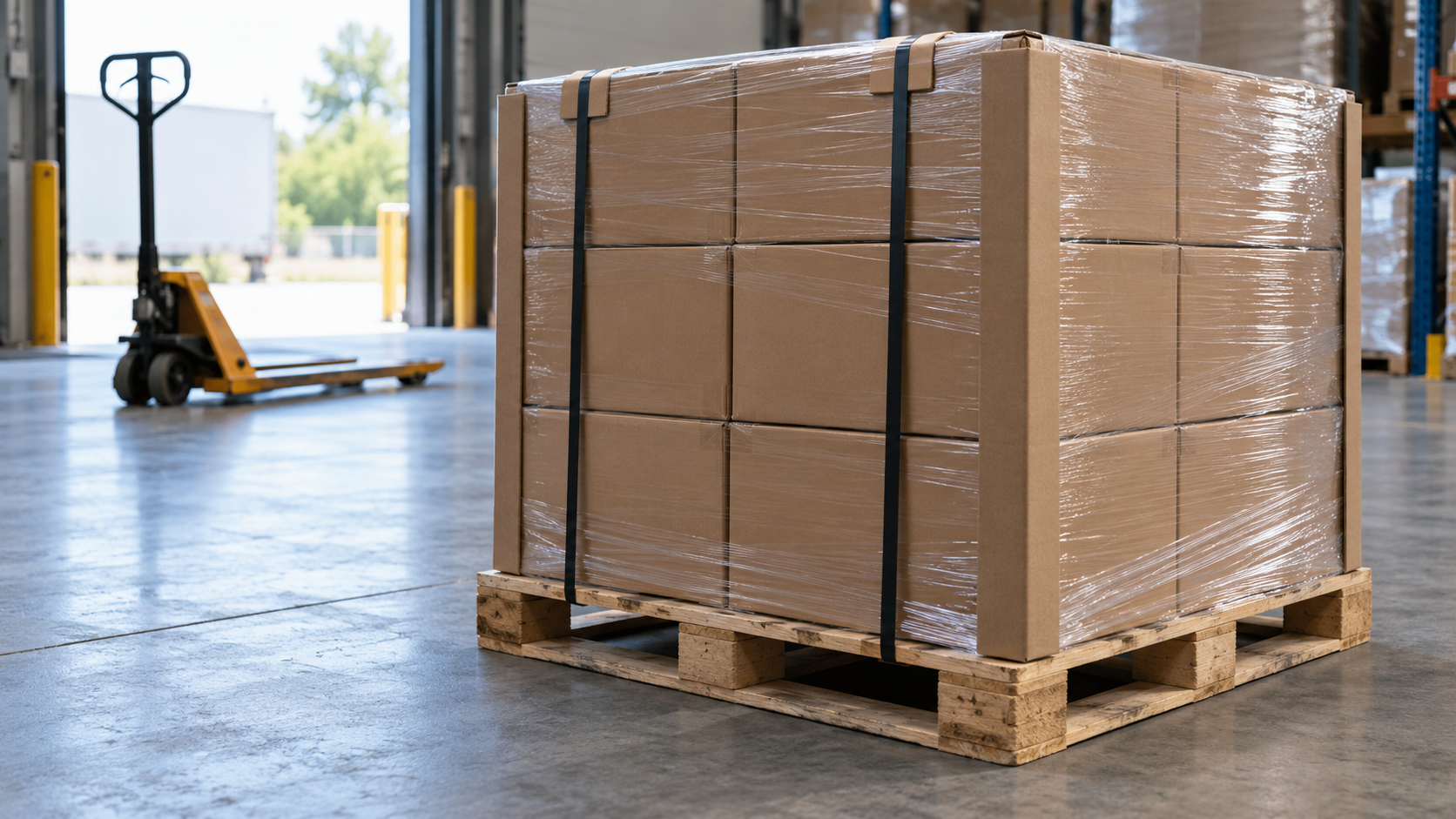
<p>配置圖核准出貨前，請核對實際貨載與圖面：紙箱數量及識別、方向、支承、占用面積、高度、毛重、固定方式及標籤可見度。包膜後記錄最終尺寸，因為承運時申報的就是這些尺寸。</p>
<figure class="blog-scene">
<img src="/images/blog/cable-gland-pallet-layout/cable-gland-pallet-layout-scene-01.png" alt="出貨區內，一疊包膜紙箱放在木棧板範圍內，配有護角與兩條束帶" width="1672" height="941" loading="lazy" decoding="async" />
<figcaption>此搬運單元將堆疊紙箱、邊緣保護、包膜及束帶都置於木棧板占地範圍內。</figcaption>
</figure>
<p><a href="https://www.sis.se/en/produkter/standardization/graphical-symbols/other/iso7802015/">ISO 780:2015</a> 涵蓋配送包裝上的圖形搬運標示。請遵循相關標示的方向與堆疊說明；有標示圖示並不能補足缺少的載重額定值。</p>
<p>貨運報價應說明實際搬運單元，包括任何堆疊限制。若要進行更廣泛的商務比較，<a href="/zh-hant/blog/cw-cable-gland-price-comparison-china-vs-india/">CW 電纜密封接頭報價指南</a>說明了包裝與交貨條件一致的重要性。只有在雙方供應商說明相同包裝基準後，我才會比較運輸報價。</p>
<h2 id="conclusion">結論</h2>
<p>棧板幾何配置可找出可行的候選排列；實際條件可能再降低其容量。本例中，旋轉紙箱使每層計算數由六箱增加為八箱。高度、支承、重量與核准的堆疊條件，才決定這些八箱排列能否成為可用的出貨配置。</p>
<p>請在紀錄中明確列出最後一個部分裝載棧板。可重複執行的裝箱計畫，須說明實際裝載的紙箱、其量測包絡面與選定的固定方式；不能只列出矩形排列的最大容量。</p>
<h2 id="faq">常見問題</h2>
<h3 id="does-the-calculator-find-the-maximum-possible-cartons-per-layer">計算器會找出每層可裝箱數的最大可能值嗎？</h3>
<p>計算器會比較兩種完整的矩形排列，其中一種將每個紙箱都旋轉 90 度。它不會搜尋混合方向或不規則的裝箱排列。我會將兩個候選方案中數量較高者視為較佳方案；只有在潛在改善值得增加裝箱複雜度時，才會另行評估其他排列。</p>
<h3 id="can-i-reduce-carton-height-by-putting-boxes-on-their-side">把紙箱側放，能否降低堆疊高度？</h3>
<p>只有在已核准的包裝與搬運說明允許該方向時才可以。紙箱以底面旋轉仍會保持直立；側放則會改變承載面與產品方向。在採用側放後較短的尺寸作為堆疊高度前，我會先取得適用於該放置方向的包裝配置。</p>
<h3 id="why-can-a-nominally-exact-four-carton-row-fail-to-fit">為什麼名義尺寸剛好能排四箱的一列，實際上卻可能放不下？</h3>
<p>名義尺寸可能未計入裝滿紙箱後的鼓脹、封口、保護材料、尺寸變動或必要間隙。四個名義寬度 300 mm 的紙箱剛好可排進 1,200 mm，但四箱若各為 302 mm，便需要 1,208 mm。請使用實際外部尺寸與必要餘量，勿將名義尺寸剛好相符視為必然有淨空。</p>
<h3 id="does-a-pallets-load-rating-establish-the-carton-stacking-limit">棧板載重額定值能決定紙箱的堆疊層數上限嗎？</h3>
<p>不能。棧板支承載荷，而底層紙箱也必須承受適用的堆疊方式與條件。紙箱抗壓能力、載荷持續時間、環境、產品支承及固定方式仍須分別考量。我會依據相關包裝資料，以及高度與搬運單元重量上限，選定允許的層數。</p>
<h3 id="sources-and-technical-references">來源與技術參考資料</h3>
<ul>
<li><a href="https://www.fedex.com/en-us/shipping/freight/resources/packing-guide/pallets.html">FedEx — 棧板裝運指南</a>，查閱日期 2026-10-22。</li>
<li><a href="https://www.sis.se/en/produkter/standardization/graphical-symbols/other/iso7802015/">SIS — ISO 780:2015：配送包裝的搬運與儲存圖形符號</a>，查閱日期 2026-10-23。</li>
</ul>
