# 壓降洩漏測試：區分氣體洩漏與冷卻效應

> Source: https://chinacableglands.com/zh-hant/blog/cable-entry-leak-rate-pressure-decay/
> Language: zh-Hant
> Publisher: 倍拓電纜接頭
> Author: Victor Huang
> Published: 2026-10-22
> Updated: 2026-10-28

依壓降計算電纜引入處洩漏率，納入溫度與參考條件，並以相符的試驗限值解讀結果。

<p><strong>若要將壓力衰減換算為電纜引入口洩漏率，請以有效氣體容積乘上壓降，再除以測量時間，接著套用報告所用的壓力與溫度。</strong>我會先區分氣體流失、冷卻、容積變化及治具洩漏。控制這些影響後，所得結果便代表受測組件在該測試條件下的平均氣體流失率。</p>
<p>以下範例將「在 0.500 L 容積內，壓力在 60 秒內下降 0.2 kPa」換算為指定參考條件下的 1.0 mL/min。第二個計算則說明，僅冷卻 0.3°C 為何也可能造成類似的壓降。</p>
<blockquote>
<p><strong>重點摘要</strong></p>
<ul>
<li>將連接的治具及管路納入有效氣體容積。</li>
<li>確認測量期間氣體溫度穩定。</li>
<li>區分壓力衰減、壓力－體積流率與參考狀態體積流量。</li>
<li>報告結果時，同時列出氣體種類、測試條件及參考條件。</li>
<li>依照相符的測量量，套用該組件的允收限值及判定規則。</li>
</ul>
</blockquote>
<h2 id="define-the-gas-volume-and-pressure-boundary">定義氣體容積與壓力邊界</h2>
<p><strong>洩漏率</strong>是流體在指定條件下，單位時間內穿越明確界線的量。我會先界定連通氣體空間的邊界。完整接線盒測試會納入盒蓋接合處及所有連接引入口。僅隔離單一接頭的治具，測量的組件範圍較小。<a href="/zh-hant/resource-center/cable-entry-glossary/#leak-rate">洩漏率術語表</a>說明此測量量及其報告條件。</p>
<p>先確認氣體種類、壓差方向，以及試驗涵蓋的介面。若測試整個外殼，蓋板墊片及其他引入口也可能影響結果。<a href="/zh-hant/blog/how-do-you-ensure-proper-seal-integrity-in-junction-box-installations/">接線盒密封完整性指南</a>說明如何辨識這些邊界。</p>
<figure class="blog-scene">
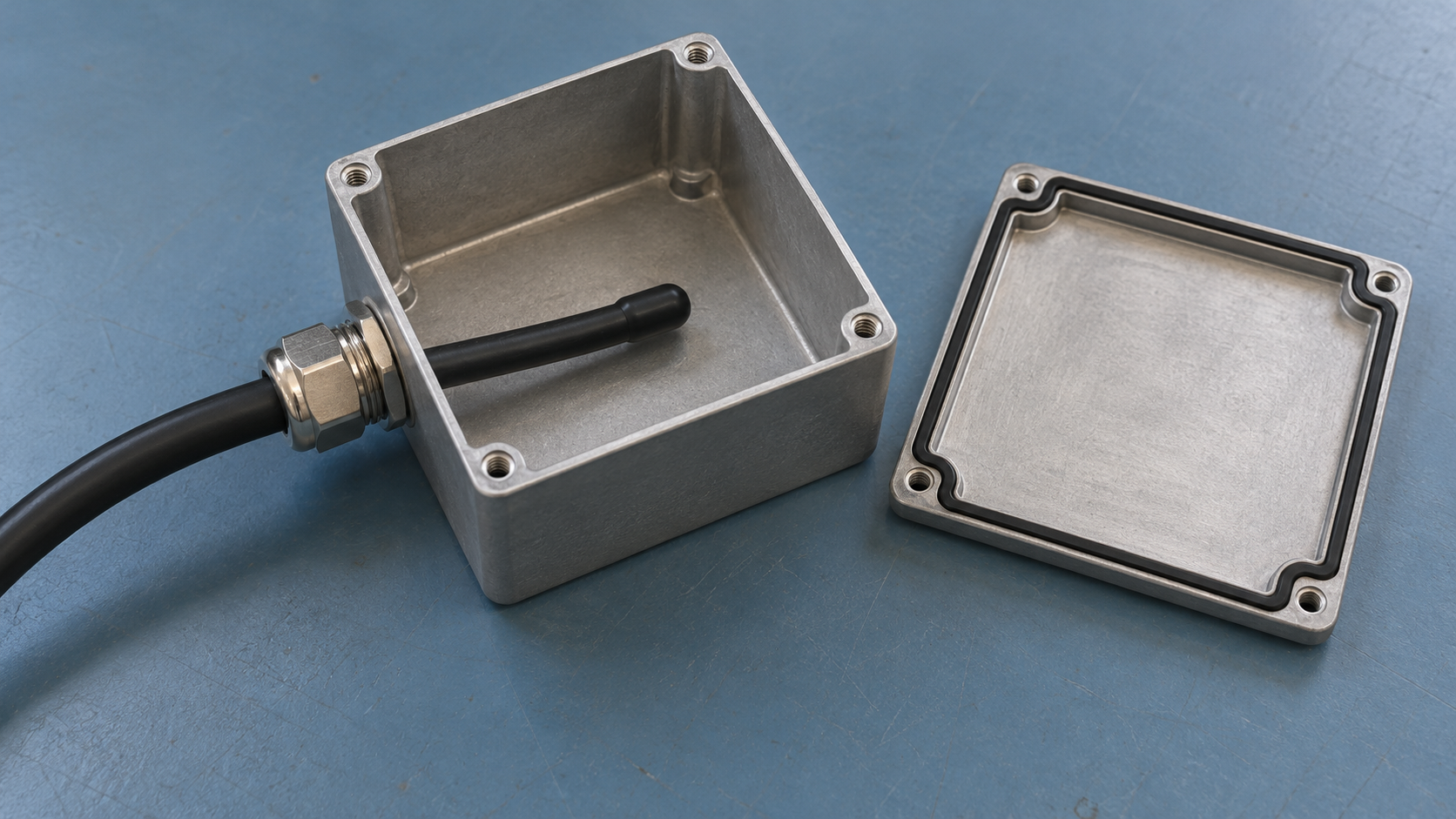
<img alt="打開的金屬接線盒，內腔清晰可見，並有電纜引入口及拆下且帶有墊片的盒蓋" src="/images/blog/cable-entry-leak-rate-pressure-decay/cable-entry-leak-rate-pressure-decay-scene-01.png" width="1672" height="941" loading="lazy" decoding="async" />
<figcaption>打開的外殼可露出內腔、電纜引入口及盒蓋墊片，便於檢查。</figcaption>
</figure>
<p><strong>有效氣體容積</strong>是壓力測量所代表的連通氣體空間，包括隔離邊界內的試件空腔、治具及管路。固體零件會排擠氣體，連接管路則會增加容積。請依試驗設備所指定的方法建立此容積；若測量方法要求，則使用經校正的等效容積。<a href="https://www.cosmo-k.co.jp/en/leak-test/leak-calibration/">Cosmo Instruments 的洩漏率校正說明</a>指出，為何需要使用等效內部容積，才能將壓力反應換算成洩漏率單位。</p>
<p>容積誤差會直接帶入這項換算。若實際有效容積是 0.5 L，卻輸入 0.4 L，在記錄到相同壓降時，計算所得洩漏率會低估 20%。因此，正確確定容積應先於換算。</p>
<h2 id="how-much-pressure-decay-can-cooling-produce">冷卻會造成多大的壓力衰減？</h2>
<p>換算壓降前，我會先將壓力曲線與氣體溫度紀錄比對。即使氣體量保持不變，冷卻仍會使壓力下降。<a href="https://www1.grc.nasa.gov/beginners-guide-to-aeronautics/equation-of-state/">NASA 的理想氣體方程式</a>說明絕對壓力、容積、氣體量及絕對溫度之間的關係。對於固定容積中固定量的氣體，壓力會隨開爾文溫度成比例變化。</p>
<p>以下另舉一個無洩漏示例。氣體起始壓力為 200 kPa 絕對壓力，溫度為 20°C，亦即 293.15 K。計算使用開爾文溫標；<a href="https://www.nist.gov/pml/special-publication-811/nist-guide-si-appendix-b-conversion-factors/nist-guide-si-appendix-b8">NIST 的溫度換算</a>會在攝氏溫度上加 273.15。若容積維持不變而氣體僅冷卻 0.3°C，預測壓降為：</p>
<div class="article-math article-math-display" data-latex="\Delta p_{\mathrm{cooling}}=200\times\frac{0.3}{293.15}\approx0.205\ \mathrm{kPa}"><span class="katex"><math xmlns="http://www.w3.org/1998/Math/MathML" display="block"><semantics><mrow><mi mathvariant="normal">Δ</mi><msub><mi>p</mi><mrow><mi mathvariant="normal">c</mi><mi mathvariant="normal">o</mi><mi mathvariant="normal">o</mi><mi mathvariant="normal">l</mi><mi mathvariant="normal">i</mi><mi mathvariant="normal">n</mi><mi mathvariant="normal">g</mi></mrow></msub><mo>=</mo><mn>200</mn><mo>×</mo><mfrac><mn>0.3</mn><mn>293.15</mn></mfrac><mo>≈</mo><mn>0.205</mn><mtext> </mtext><mrow><mi mathvariant="normal">k</mi><mi mathvariant="normal">P</mi><mi mathvariant="normal">a</mi></mrow></mrow><annotation encoding="application/x-tex">\Delta p_{\mathrm{cooling}}=200\times\frac{0.3}{293.15}\approx0.205\ \mathrm{kPa}</annotation></semantics></math></span></div>
<p>這個壓降略大於下方洩漏示例所用的 0.2 kPa。若將全部壓降解讀為氣體逸出，就會得到錯誤的洩漏結果。</p>
<p>例如，假設在這些起始條件下，假設的測量預算規定冷卻造成的表觀壓力損失最多為 0.02 kPa。固定容積氣體關係式計算得出，允許的溫度變化為 293.15 × 0.02 ÷ 200 = 0.029315 K，約 0.029°C。我會用這類計算，比較所需的熱控制程度與試驗設備經證實的能力。實際分配值應透過測量不確定度預算訂定；此處的 0.02 kPa 僅供說明。</p>
<p>下方兩個假設案例的起始條件相同。一個假設氣體在溫度穩定時流失；另一個則保持氣體量不變，並讓氣體冷卻。</p>
<figure class="blog-chart">
<svg xmlns="http://www.w3.org/2000/svg" viewBox="0 0 520 1040" role="img" aria-labelledby="cable-entry-leak-rate-pressure-decay-comparison-title cable-entry-leak-rate-pressure-decay-comparison-desc" style="font-family:var(--font-body)">
<title id="cable-entry-leak-rate-pressure-decay-comparison-title">相似的壓力下降，成因不同</title>
<desc id="cable-entry-leak-rate-pressure-decay-comparison-desc">兩個假設的理想氣體示例都從固定 0.500 L 容積、200 kPa 絕對壓力及 20°C 開始。溫度穩定且背景損失受控時，60 秒內下降 0.200 kPa，換算為以 100 kPa 絕對壓力及 20°C 為參考條件的 1.0 mL/min。僅冷卻至 19.7°C（由 20.0°C 下降）即使沒有氣體流失，也會造成約 0.205 kPa 壓降。將量測衰減歸因於電纜引入處洩漏前，必須先確認溫度、有效容積與背景壓力損失。</desc>
<defs>
<marker id="cable-entry-leak-rate-pressure-decay-comparison-arrow" markerWidth="8" markerHeight="8" refX="7" refY="4" orient="auto">
<path d="M0 0L8 4L0 8Z" fill="var(--color-primary)"/>
</marker>
</defs>
<text x="28" y="44" fill="var(--color-carbon)" font-size="32" font-weight="700">相似的壓力下降，</text>
<text x="28" y="84" fill="var(--color-carbon)" font-size="32" font-weight="700">成因不同</text>
<text x="28" y="131" fill="var(--color-graphite)" font-size="22">兩者均從 200 kPa 絕對壓力開始。</text>
<text x="28" y="165" fill="var(--color-graphite)" font-size="22">20°C；固定 0.500 L 氣體容積。</text>
<path d="M28 195H492" fill="none" stroke="var(--color-cloud)" stroke-width="2"/>
<text x="28" y="235" fill="var(--color-carbon)" font-size="26" font-weight="700">1. 氣體流失</text>
<text x="28" y="270" fill="var(--color-graphite)" font-size="22">溫度保持不變。</text>
<text x="28" y="316" fill="var(--color-carbon)" font-size="22">氣體逸出</text>
<text x="28" y="350" fill="var(--color-graphite)" font-size="22">於 20.0°C</text>
<path d="M236 326H272" fill="none" stroke="var(--color-primary)" stroke-width="2" marker-end="url(#cable-entry-leak-rate-pressure-decay-comparison-arrow)"/>
<text x="300" y="316" fill="var(--color-carbon)" font-size="22">壓降</text>
<text x="300" y="350" fill="var(--color-carbon)" font-size="22" font-weight="700">0.200 kPa</text>
<text x="300" y="384" fill="var(--color-graphite)" font-size="22">歷時 60 s</text>
<text x="28" y="429" fill="var(--color-carbon)" font-size="26" font-weight="700">參考狀態流量：1.0 mL/min</text>
<text x="28" y="465" fill="var(--color-graphite)" font-size="22">參考條件為 100 kPa 絕對壓力與 20°C。</text>
<text x="28" y="499" fill="var(--color-graphite)" font-size="22">背景損失已受控。</text>
<path d="M28 530H492" fill="none" stroke="var(--color-cloud)" stroke-width="2"/>
<text x="28" y="570" fill="var(--color-carbon)" font-size="26" font-weight="700">2. 僅冷卻</text>
<text x="28" y="605" fill="var(--color-graphite)" font-size="22">氣體量保持不變。</text>
<text x="28" y="650" fill="var(--color-carbon)" font-size="22">20.0°C</text>
<text x="28" y="684" fill="var(--color-graphite)" font-size="22">降至 19.7°C</text>
<path d="M236 663H272" fill="none" stroke="var(--color-primary)" stroke-width="2" marker-end="url(#cable-entry-leak-rate-pressure-decay-comparison-arrow)"/>
<text x="300" y="650" fill="var(--color-carbon)" font-size="22">壓降</text>
<text x="300" y="684" fill="var(--color-graphite)" font-size="22">約</text>
<text x="300" y="718" fill="var(--color-carbon)" font-size="22" font-weight="700">0.205 kPa</text>
<text x="28" y="760" fill="var(--color-carbon)" font-size="26" font-weight="700">僅冷卻也可能造成</text>
<text x="28" y="794" fill="var(--color-carbon)" font-size="26" font-weight="700">相似的量測壓降。</text>
<path d="M28 828H492" fill="none" stroke="var(--color-cloud)" stroke-width="2"/>
<text x="28" y="868" fill="var(--color-carbon)" font-size="26" font-weight="700">先查明原因</text>
<text x="28" y="902" fill="var(--color-carbon)" font-size="26" font-weight="700">再進行換算</text>
<text x="28" y="942" fill="var(--color-graphite)" font-size="22">確認溫度與有效容積</text>
<text x="28" y="976" fill="var(--color-graphite)" font-size="22">及背景壓力損失，再</text>
<text x="28" y="1010" fill="var(--color-graphite)" font-size="22">將壓力衰減歸因於電纜引入處洩漏。</text>
</svg>
<figcaption>比較氣體流失與冷卻所造成的壓降。</figcaption>
</figure>
<p>充氣後，氣體與試件的溫度可能不同。我會在程序的穩定條件達成後開始檢測區間，並使用適合該試驗設備的溫度測量方式。僅測室溫可能無法發現試件內部仍在變化。可變形的外殼或治具也可能在充氣後膨脹，使氣體容積增加、壓力降低。當測得的壓降很小時，這些效應尤其重要。</p>
<p><a href="https://standards.nasa.gov/sites/default/files/standards/NASA/A/0/2023-02-22-NASA-STD-7012A-Approved.pdf">NASA-STD-7012A 第 5.5 節</a>的 NASA 硬體壓力衰減方法，將內部與大氣壓力、溫度、試件容積及治具容積納入考量。這些變數可作為有用的測量參考。對電纜引入口，應使用針對實際組件及試驗設備所訂定的穩定條件、測試壓力及允收限值。</p>
<h2 id="calculate-reference-leak-rate-step-by-step">逐步計算參考狀態洩漏率</h2>
<p>我會先計算壓力－體積流率，再將其換算為明確參考條件下的體積流量。以下模型假設有效容積及氣體溫度固定，將壓力損失視為理想氣體流失。測試程序應控制治具洩漏及其他背景效應。只有在穩定區間符合這些假設時，才使用此公式。</p>
<h3 id="record-the-inputs">記錄輸入值</h3>
<p>下列假設的空氣測試數值描述一段穩定測量區間，可用來逐步說明單位及計算方式；實際測試壓力及區間應依組件的測試程序選定：</p>
<table>
<thead>
<tr>
<th>項目</th>
<th>符號</th>
<th>假設值</th>
</tr>
</thead>
<tbody>
<tr>
<td>有效連通氣體容積</td>
<td><span class="article-math article-math-inline" data-latex="V"><span class="katex"><math xmlns="http://www.w3.org/1998/Math/MathML"><semantics><mrow><mi>V</mi></mrow><annotation encoding="application/x-tex">V</annotation></semantics></math></span></span></td>
<td>0.500 L</td>
</tr>
<tr>
<td>起始絕對壓力</td>
<td><span class="article-math article-math-inline" data-latex="p_1"><span class="katex"><math xmlns="http://www.w3.org/1998/Math/MathML"><semantics><mrow><msub><mi>p</mi><mn>1</mn></msub></mrow><annotation encoding="application/x-tex">p_1</annotation></semantics></math></span></span></td>
<td>200.0 kPa 絕對壓力</td>
</tr>
<tr>
<td>結束絕對壓力</td>
<td><span class="article-math article-math-inline" data-latex="p_2"><span class="katex"><math xmlns="http://www.w3.org/1998/Math/MathML"><semantics><mrow><msub><mi>p</mi><mn>2</mn></msub></mrow><annotation encoding="application/x-tex">p_2</annotation></semantics></math></span></span></td>
<td>199.8 kPa 絕對壓力</td>
</tr>
<tr>
<td>檢測區間</td>
<td><span class="article-math article-math-inline" data-latex="\Delta t_s"><span class="katex"><math xmlns="http://www.w3.org/1998/Math/MathML"><semantics><mrow><mi mathvariant="normal">Δ</mi><msub><mi>t</mi><mi>s</mi></msub></mrow><annotation encoding="application/x-tex">\Delta t_s</annotation></semantics></math></span></span></td>
<td>60 s</td>
</tr>
<tr>
<td>試驗氣體恆定溫度</td>
<td><span class="article-math article-math-inline" data-latex="T_{\mathrm{gas}}"><span class="katex"><math xmlns="http://www.w3.org/1998/Math/MathML"><semantics><mrow><msub><mi>T</mi><mrow><mi mathvariant="normal">g</mi><mi mathvariant="normal">a</mi><mi mathvariant="normal">s</mi></mrow></msub></mrow><annotation encoding="application/x-tex">T_{\mathrm{gas}}</annotation></semantics></math></span></span></td>
<td>20°C = 293.15 K</td>
</tr>
<tr>
<td>參考絕對壓力</td>
<td><span class="article-math article-math-inline" data-latex="p_{\mathrm{ref}}"><span class="katex"><math xmlns="http://www.w3.org/1998/Math/MathML"><semantics><mrow><msub><mi>p</mi><mrow><mi mathvariant="normal">r</mi><mi mathvariant="normal">e</mi><mi mathvariant="normal">f</mi></mrow></msub></mrow><annotation encoding="application/x-tex">p_{\mathrm{ref}}</annotation></semantics></math></span></span></td>
<td>100 kPa 絕對壓力</td>
</tr>
<tr>
<td>參考溫度</td>
<td><span class="article-math article-math-inline" data-latex="T_{\mathrm{ref}}"><span class="katex"><math xmlns="http://www.w3.org/1998/Math/MathML"><semantics><mrow><msub><mi>T</mi><mrow><mi mathvariant="normal">r</mi><mi mathvariant="normal">e</mi><mi mathvariant="normal">f</mi></mrow></msub></mrow><annotation encoding="application/x-tex">T_{\mathrm{ref}}</annotation></semantics></math></span></span></td>
<td>20°C = 293.15 K</td>
</tr>
</tbody>
</table>
<p>量得的壓力損失為 <span class="article-math article-math-inline" data-latex="\Delta p=p_1-p_2"><span class="katex"><math xmlns="http://www.w3.org/1998/Math/MathML"><semantics><mrow><mi mathvariant="normal">Δ</mi><mi>p</mi><mo>=</mo><msub><mi>p</mi><mn>1</mn></msub><mo>−</mo><msub><mi>p</mi><mn>2</mn></msub></mrow><annotation encoding="application/x-tex">\Delta p=p_1-p_2</annotation></semantics></math></span></span>，結果是 0.2 kPa。100 kPa 的參考壓力用來定義報告時採用的容積；它不是試驗壓力，也不是密封兩側的壓差。請另行記錄外部壓力，以說明試驗中的壓差。</p>
<h3 id="calculate-pressure-volume-throughput">計算壓力－體積流率</h3>
<p><strong>壓力－體積流率</strong>是單位時間內損失的壓力－體積量；此處以測試氣體溫度表示。容積與溫度固定時，其平均值為：</p>
<div class="article-math article-math-display" data-latex="q_{pV}=\frac{V\,\Delta p}{\Delta t_s}"><span class="katex"><math xmlns="http://www.w3.org/1998/Math/MathML" display="block"><semantics><mrow><msub><mi>q</mi><mrow><mi>p</mi><mi>V</mi></mrow></msub><mo>=</mo><mfrac><mrow><mi>V</mi><mtext> </mtext><mi mathvariant="normal">Δ</mi><mi>p</mi></mrow><mrow><mi mathvariant="normal">Δ</mi><msub><mi>t</mi><mi>s</mi></msub></mrow></mfrac></mrow><annotation encoding="application/x-tex">q_{pV}=\frac{V\,\Delta p}{\Delta t_s}</annotation></semantics></math></span></div>
<p>以公升和千帕表示時，數值換算很直接：1 kPa·L 等於 1 Pa·m³。這是因為 1 kPa = 1,000 Pa，且 1 L = 0.001 m³；<a href="https://www.nist.gov/pml/special-publication-811/nist-guide-si-appendix-b-conversion-factors/nist-guide-si-appendix-b8">NIST 的 SI 換算表</a>也列有公升的換算方式。</p>
<div class="article-math article-math-display" data-latex="q_{pV}=\frac{0.500\times0.2}{60}\approx0.00167\ \mathrm{Pa\cdot m^3/s}"><span class="katex"><math xmlns="http://www.w3.org/1998/Math/MathML" display="block"><semantics><mrow><msub><mi>q</mi><mrow><mi>p</mi><mi>V</mi></mrow></msub><mo>=</mo><mfrac><mrow><mn>0.500</mn><mo>×</mo><mn>0.2</mn></mrow><mn>60</mn></mfrac><mo>≈</mo><mn>0.00167</mn><mtext> </mtext><mrow><mi mathvariant="normal">P</mi><mi mathvariant="normal">a</mi><mo>⋅</mo><msup><mi mathvariant="normal">m</mi><mn>3</mn></msup><mi mathvariant="normal">/</mi><mi mathvariant="normal">s</mi></mrow></mrow><annotation encoding="application/x-tex">q_{pV}=\frac{0.500\times0.2}{60}\approx0.00167\ \mathrm{Pa\cdot m^3/s}</annotation></semantics></math></span></div>
<p>此量需一併標示氣體溫度。它表示單位時間內壓力與容積的乘積，不是以 L/min 表示的體積流量。</p>
<h3 id="convert-to-a-reference-volume-flow">換算為參考狀態體積流量</h3>
<p><strong>參考狀態體積流量</strong>是單位時間內損失的氣體量，以指定壓力及溫度下所占的體積表示。套用理想氣體關係式可得：</p>
<div class="article-math article-math-display" data-latex="Q_{\mathrm{ref}}=\frac{V\,\Delta p}{p_{\mathrm{ref}}}\frac{T_{\mathrm{ref}}}{T_{\mathrm{gas}}}\frac{60}{\Delta t_s}"><span class="katex"><math xmlns="http://www.w3.org/1998/Math/MathML" display="block"><semantics><mrow><msub><mi>Q</mi><mrow><mi mathvariant="normal">r</mi><mi mathvariant="normal">e</mi><mi mathvariant="normal">f</mi></mrow></msub><mo>=</mo><mfrac><mrow><mi>V</mi><mtext> </mtext><mi mathvariant="normal">Δ</mi><mi>p</mi></mrow><msub><mi>p</mi><mrow><mi mathvariant="normal">r</mi><mi mathvariant="normal">e</mi><mi mathvariant="normal">f</mi></mrow></msub></mfrac><mfrac><msub><mi>T</mi><mrow><mi mathvariant="normal">r</mi><mi mathvariant="normal">e</mi><mi mathvariant="normal">f</mi></mrow></msub><msub><mi>T</mi><mrow><mi mathvariant="normal">g</mi><mi mathvariant="normal">a</mi><mi mathvariant="normal">s</mi></mrow></msub></mfrac><mfrac><mn>60</mn><mrow><mi mathvariant="normal">Δ</mi><msub><mi>t</mi><mi>s</mi></msub></mrow></mfrac></mrow><annotation encoding="application/x-tex">Q_{\mathrm{ref}}=\frac{V\,\Delta p}{p_{\mathrm{ref}}}\frac{T_{\mathrm{ref}}}{T_{\mathrm{gas}}}\frac{60}{\Delta t_s}</annotation></semantics></math></span></div>
<p>此公式的容積使用 L，兩個壓力值均使用 kPa，溫度使用 K，時間區間使用秒。乘數 60 會將輸出換算為 L/min。即使儀器或計算器要求輸入 °C，溫度比仍須使用絕對溫度。</p>
<p>代入上述示例：</p>
<div class="article-math article-math-display" data-latex="Q_{\mathrm{ref}}=\frac{0.500\times0.2}{100}\times\frac{293.15}{293.15}\times\frac{60}{60}=0.001\ \mathrm{L/min}"><span class="katex"><math xmlns="http://www.w3.org/1998/Math/MathML" display="block"><semantics><mrow><msub><mi>Q</mi><mrow><mi mathvariant="normal">r</mi><mi mathvariant="normal">e</mi><mi mathvariant="normal">f</mi></mrow></msub><mo>=</mo><mfrac><mrow><mn>0.500</mn><mo>×</mo><mn>0.2</mn></mrow><mn>100</mn></mfrac><mo>×</mo><mfrac><mn>293.15</mn><mn>293.15</mn></mfrac><mo>×</mo><mfrac><mn>60</mn><mn>60</mn></mfrac><mo>=</mo><mn>0.001</mn><mtext> </mtext><mrow><mi mathvariant="normal">L</mi><mi mathvariant="normal">/</mi><mi mathvariant="normal">m</mi><mi mathvariant="normal">i</mi><mi mathvariant="normal">n</mi></mrow></mrow><annotation encoding="application/x-tex">Q_{\mathrm{ref}}=\frac{0.500\times0.2}{100}\times\frac{293.15}{293.15}\times\frac{60}{60}=0.001\ \mathrm{L/min}</annotation></semantics></math></span></div>
<p>我報告的結果為<strong>在 100 kPa 絕對壓力與 20°C 參考條件下，空氣洩漏率為 1.0 mL/min</strong>，平均值取自 60 秒的測量區間。測試開始時，氣體壓力為 200.0 kPa 絕對壓力，溫度為 20°C。也請將外部壓力一併記錄，因為它決定氣體穿越邊界的壓差。測量不確定度及適用限值則是完成允收判定所需的資訊。</p>
<p><a class="article-tool-card article-tool-card-link" href="/zh-hant/resource-center/tools/pressure-decay-leak-rate-calculator/" aria-label="壓降漏率 計算器"><span class="article-tool-card-index">工具</span><span class="article-tool-card-kicker">壓力與環境</span><strong class="article-tool-card-title">壓降漏率</strong><span class="article-tool-card-copy">若要重現此例，請輸入 0.5 L、200 與 199.8 kPa 絕對壓力、60 s；試驗溫度與參考溫度都輸入 20°C，參考壓力輸入 100 kPa 絕對壓力。請使用穩定後的資料與有效連通容積。</span><span class="article-tool-card-formula">Qref = VΔp/pref × Tref/Tgas × 60/Δts</span><span class="article-tool-card-inputs" aria-label="計算器輸入項目"><em>有效試驗容積</em><em>起始絕對壓力</em><em>結束絕對壓力</em><em>檢測區間</em></span><span class="article-tool-card-action">開啟計算器 <span aria-hidden="true">-&gt;</span></span></a></p><p>此工具也會回傳 0.2 kPa/min 的平均壓降速率。這個數值描述壓力曲線；1.0 mL/min 則表示依選定參考條件換算的等效氣體體積流失量。</p>
<h2 id="keep-the-quantity-unit-and-reference-conditions-together">一併標示物理量、單位與參考條件</h2>
<p>比較兩個洩漏率數值時，應將物理量、單位及參考條件並列。只有在描述相同物理量且條件相符時，這些數字才可比較。</p>
<table>
<thead>
<tr>
<th>報告的物理量</th>
<th>單位示例</th>
<th>必須一併提供的資訊</th>
</tr>
</thead>
<tbody>
<tr>
<td>壓降速率</td>
<td>kPa/min</td>
<td>有效容積、氣體溫度、壓力條件及時間區間</td>
</tr>
<tr>
<td>參考狀態體積流量</td>
<td>mL/min 或 L/min</td>
<td>參考絕對壓力與溫度、氣體種類及試驗條件</td>
</tr>
<tr>
<td>壓力－體積流率</td>
<td>Pa·m³/s</td>
<td>流率所採用的溫度、氣體種類及試驗條件</td>
</tr>
<tr>
<td>質量流率</td>
<td>kg/s</td>
<td>氣體種類與試驗條件；若由體積流量換算，還須提供氣體專用的換算方式</td>
</tr>
</tbody>
</table>
<p>以相同的示例氣體流失量為例，僅將報告參考壓力從 100 kPa 改為 101.325 kPa，20°C 下的結果便約為 0.987 mL/min。試件沒有任何改善；改變的是等效報告體積。</p>
<p>凡是標示為「標準」或「正常」狀態體積流量的數值，我都會在旁邊註明參考壓力及溫度。<a href="https://nvlpubs.nist.gov/nistpubs/Legacy/SP/nistspecialpublication250-38.pdf">NIST 洩漏率校正服務附錄 A</a> 說明不同的氣體流量測量量，以及標準狀態所使用的多種溫度。變更報告參考條件會重新縮放特定氣體流失量所對應的體積。改變密封件兩側的實際壓差，可能改變氣體流失量本身；這需要進行相應測試，或採用已驗證的流量模型。</p>
<p>計算器的起始與結束輸入值，以及參考壓力，都要使用絕對壓力。只有在大氣壓參考值未變時，兩個表壓讀值之差才會等於相應的絕對壓力差。檢查前述熱效應時，絕對壓力也很重要。</p>
<h2 id="how-do-i-separate-joint-leakage-from-other-effects">如何區分接合處洩漏與其他效應？</h2>
<p>壓力衰減測量的是連通氣體空間的淨反應。我會綜合時間曲線、溫度紀錄及治具控制結果，找出最適合的下一項檢查。</p>
<p>電纜密封處、面板密封處或治具若有連通間隙，氣體就可能逸出。滲透作用是氣體穿過完整材料；<a href="https://tsapps.nist.gov/publication/get_pdf.cfm?pub_id=920805">NIST 的滲透標準漏孔研究</a>區分了氣體經實際通道流動與在材料屏障中擴散。NIST 洩漏率校正服務也指出，放氣會影響壓力量測。依氣體質量平衡，材料吸收氣體會降低壓力，而氣體釋放至量測空間則可能部分掩蓋向外的流失。<a href="/zh-hant/blog/the-permeability-of-gland-seals-to-gases-and-vapors-a-technical-analysis/">電纜密封接頭密封件的氣體與蒸氣滲透指南</a>進一步說明這些材料與介面差異。</p>
<p>以下觀察到的變化型態有助於引導調查。每種型態都提示一項檢查；搭配的控制測試或溫度測量則可判斷該解釋是否成立。</p>
<table>
<thead>
<tr>
<th>觀察到的變化型態</th>
<th>應檢查的影響來源</th>
<th>有助於採取的下一步</th>
</tr>
</thead>
<tbody>
<tr>
<td>充氣後壓力下降最快，接著斜率變小</td>
<td>氣體冷卻，或治具／試件逐漸穩定</td>
<td>比對溫度曲線，並依程序的穩定條件重測</td>
</tr>
<tr>
<td>封閉測試端的治具也呈現類似下降曲線</td>
<td>治具密封件、閥件、管路或儀器背景效應</td>
<td>查明並處理治具反應後，再將其歸因於電纜引入口。</td>
</tr>
<tr>
<td>溫度及容積穩定後，壓力仍持續下降</td>
<td>氣體從接合處逸出，或材料發生滲透</td>
<td>使用指定的定位或控制測試區分不同路徑</td>
</tr>
<tr>
<td>壓力上升，或預期的壓降變小</td>
<td>氣體升溫，或有氣體釋放至測量空間</td>
<td>比對溫度及調理履歷，再檢查背景反應</td>
</tr>
</tbody>
</table>
<p>程序要求背景修正時，我會使用實測且可重現的控制結果。封閉測試端的治具反應若有變化，可在更換任何電纜密封件前先找出試驗設備問題。如果測量中仍混合了多條路徑，請將結果歸屬於該完整受測邊界。如此既可用來比較組件，又能保留總氣體流失與特定接合處洩漏之間的區別。</p>
<h2 id="compare-the-result-with-a-matching-acceptance-limit">以相符的驗收限值比較結果</h2>
<p>判讀計算出的 1.0 mL/min 時，應在相同測試條件下，與適用於該組件的限值一併比較。比較項目須使用相同氣體、壓力方向、測試壓力、溫度、調理方式及報告參考條件。我也會檢查測試方法及納入的介面。完整外殼的測試結果會包含單一引入口治具可能排除的洩漏路徑，因此限值及邊界必須對應同一組件。</p>
<p><strong>判定規則</strong>是判斷是否符合限值時，用來考量測量不確定度的約定方法。<a href="https://ilac.org/?ddownload=122722">ILAC-G8:09/2019</a> 說明這項關係及允收界限的用法。請套用該項工作所指定的規則，並在測量前確認所需的選擇方式。這能讓接近界限的結果獲得一致判讀。</p>
<p>請一併記錄以下資訊，使計算結果可追溯：</p>
<ul>
<li>試件及納入測試的介面、氣體種類、壓力方向，以及兩側壓力。</li>
<li>有效容積及其確定方式、溫度記錄、穩定判準與檢測區間。</li>
<li>量得的壓力、計算出的物理量與單位、參考條件，以及相關背景檢查。</li>
<li>方法的檢測能力、量測不確定度、適用限值、議定的決策規則及最終判定。</li>
</ul>
<p>若顯示為零，請檢查方法的解析度及已建立的檢測能力。低於該能力的氣體流失可能無法判定；抵銷性的背景效應也可能使表觀衰減變小。請依程序的報告規則，列出可解析的結果或適用的檢測界限。</p>
<p><a href="https://webstore.iec.ch/en/publication/2452">IEC 60529</a> 依適用測試對外殼侵入防護進行分類。應依各自的測試方法，分別記錄氣體洩漏結果及 IP 防護評估。若已針對該組件驗證其與所需性能的關聯，生產用氣體洩漏測試可支援檢查。</p>
<h2 id="conclusion">結論</h2>
<p>我會先界定連通容積，並檢查溫度、容積穩定性及治具背景效應，再將壓力衰減曲線換算為洩漏率。接著計算氣體流失量，並註明參考條件。範例結果為在 100 kPa 絕對壓力與 20°C 下的 1.0 mL/min；另一個冷卻案例則說明為何判讀時必須考量溫度。</p>
<p>將結果與組件限值比較時，應使用相同邊界、氣體、壓力條件及報告基準。套用約定的不確定度判定規則，並將結果連同受測配置記錄下來，以利日後檢查或故障排查。</p>
<h2 id="faq">常見問題</h2>
<h3 id="can-a-pressure-decay-result-prove-an-ip-rating">壓降測試結果能證明 IP 防護等級嗎？</h3>
<p>IP 防護等級須透過適用的侵入防護測試建立。壓力衰減測量的是其自身測試條件下的氣體行為。若已針對該組件驗證相關性，壓力衰減可支援生產檢查；但 mL/min 數值並無通用方式可換算為 IP 代碼。</p>
<h3 id="can-i-enter-gauge-pressure-into-the-calculator">計算器可以輸入表壓嗎？</h3>
<p>依計算器要求，輸入起始與結束的絕對壓力。依適用的大氣壓力將表壓換算為絕對壓力。只要大氣壓參考值不變，兩個表壓讀值之差就會等於相應的絕對壓力差。參考壓力及熱效應計算所用的壓力也必須是絕對壓力。</p>
<h3 id="does-a-zero-result-mean-the-cable-entry-is-gas-tight">結果為零是否代表電纜引入處完全不漏氣？</h3>
<p>零值顯示可能代表變化低於方法的解析度或檢測能力。溫度或背景效應也可能抵銷部分氣體損失。我會連同測試條件一併報告可解析的結果或檢測界限，再套用指定限值及判定規則。</p>
<h3 id="why-must-the-test-volume-include-connected-tubing">為什麼試驗容積必須包括連接管路？</h3>
<p>壓力讀值代表隔離邊界內所有互相連通的氣體空間。連接管路及治具空腔會影響特定壓降所對應的氣體量。請依方法要求使用有效容積或經校正的等效容積，並納入這些連通空間。</p>
<h3 id="sources-and-technical-references">來源與技術參考資料</h3>
<ul>
<li><a href="https://www.cosmo-k.co.jp/en/leak-test/leak-calibration/">Cosmo Instruments — 洩漏率校正</a>，查閱日期：2026-10-28。</li>
<li><a href="https://www1.grc.nasa.gov/beginners-guide-to-aeronautics/equation-of-state/">NASA Glenn Research Center — 狀態方程式</a>，查閱日期：2026-10-28。</li>
<li><a href="https://standards.nasa.gov/sites/default/files/standards/NASA/A/0/2023-02-22-NASA-STD-7012A-Approved.pdf">NASA — NASA-STD-7012A，《洩漏測試要求》，2023 年，第 5.5 節</a>，查閱日期：2026-10-28。</li>
<li><a href="https://www.nist.gov/pml/special-publication-811/nist-guide-si-appendix-b-conversion-factors/nist-guide-si-appendix-b8">NIST — SI 指南，附錄 B.8：依字母排列的單位換算因數</a>，查閱日期：2026-10-28。</li>
<li><a href="https://nvlpubs.nist.gov/nistpubs/Legacy/SP/nistspecialpublication250-38.pdf">NIST — SP 250-38，NIST 洩漏率校正服務，1992 年</a>，查閱日期：2026-10-28。</li>
<li><a href="https://tsapps.nist.gov/publication/get_pdf.cfm?pub_id=920805">NIST — 商用氦氣滲透標準漏孔：其特性與可靠性，1996 年</a>，查閱日期：2026-10-28。</li>
<li><a href="https://ilac.org/?ddownload=122722">ILAC — G8:09/2019，《決策規則與符合性聲明指南》</a>，查閱日期：2026-10-28。</li>
<li><a href="https://webstore.iec.ch/en/publication/2452">IEC — IEC 60529:1989+AMD1:1999+AMD2:2013 CSV，外殼提供的防護程度（IP 代碼）</a>，查閱日期：2026-10-28。</li>
</ul>
