# ケーブルグランドの出荷：総質量とCBMの計算

> Source: https://chinacableglands.com/ja/blog/cable-gland-shipment-weight-volume/
> Language: ja
> Publisher: ベプトケーブルグランド
> Author: Chuck Liu
> Published: 2026-10-22
> Updated: 2026-10-23

具体的な注文例と明示した梱包前提に基づき、ケーブルグランドのカートン数、正味・総質量、出荷容積、運賃計算対象重量を計算します。

<p><strong>梱包済み製品を起点に外側へ順にたどり、ケーブルグランドの出荷を計画します。数量からカートン数を決め、製品と梱包材から総質量を求め、最終的な出荷単位の実測容積を算出します。</strong>これらは運送会社の課金ルールを適用する前に、個別に計算してください。製品自体の質量だけでは運賃請求額は予測できず、カートン単体の容積合計はパレット全体の外側出荷包絡から求めた容積と異なることがあります。</p>
<p>以下は、梱包条件と見積もり条件を明示した仮想注文の例です。各入力を、自社で承認済みの梱包表に置き換えてください。現在の運賃や普遍的な容積換算係数を示すものではありません。</p>
<h2 id="freeze-the-sku-and-packing-schedule">SKUと梱包表を確定する</h2>
<p>梱包表は、供給単位を正確に定義するところから始めます。グランド本体、グランド一式、ロックナットとシールワッシャーを含むグランドでは、質量と梱包数量が異なる場合があります。単位質量の記録を、発注書に実際に含まれる供給単位と照合してください。</p>
<table>
<thead>
<tr>
<th>SKU例</th>
<th style="text-align: right">注文数量</th>
<th style="text-align: right">1カートン当たりの数量</th>
<th style="text-align: right">供給単位当たりの製品質量</th>
<th>カートン外寸</th>
</tr>
</thead>
<tbody>
<tr>
<td>A</td>
<td style="text-align: right">1,250</td>
<td style="text-align: right">100</td>
<td style="text-align: right">0.085 kg</td>
<td>40 × 30 × 25 cm</td>
</tr>
<tr>
<td>B</td>
<td style="text-align: right">420</td>
<td style="text-align: right">60</td>
<td style="text-align: right">0.140 kg</td>
<td>50 × 35 × 30 cm</td>
</tr>
</tbody>
</table>
<p>この例ではSKUを同じカートンに混載できず、数量が一部だけのカートンも通常の外寸を保つものとします。これらは梱包上の前提であり、ケーブルグランド自体の特性ではありません。混載を認める場合は、SKUごとの合計を別々に丸めてから混ぜるのではなく、各カートンの実際の内容を記載してください。</p>
<p>ロット識別情報、付属品の数量、許容される数量差があれば梱包表に記録します。単位質量の根拠も記録してください。管理された図面からの推定、供給者の申告、または定義した供給組立品の計量などが該当します。予備的な推定値は、出荷梱包後に計量するまでは推定値です。</p>
<figure class="blog-scene">
<img src="/images/blog/cable-gland-shipment-weight-volume/cable-gland-shipment-weight-volume-scene-01.png" alt="個別の段ボール仕切りに入った金属製ケーブルグランドの開梱カートンと、金属ワッシャーおよびロックナットの袋" width="1672" height="941" loading="lazy" decoding="async" />
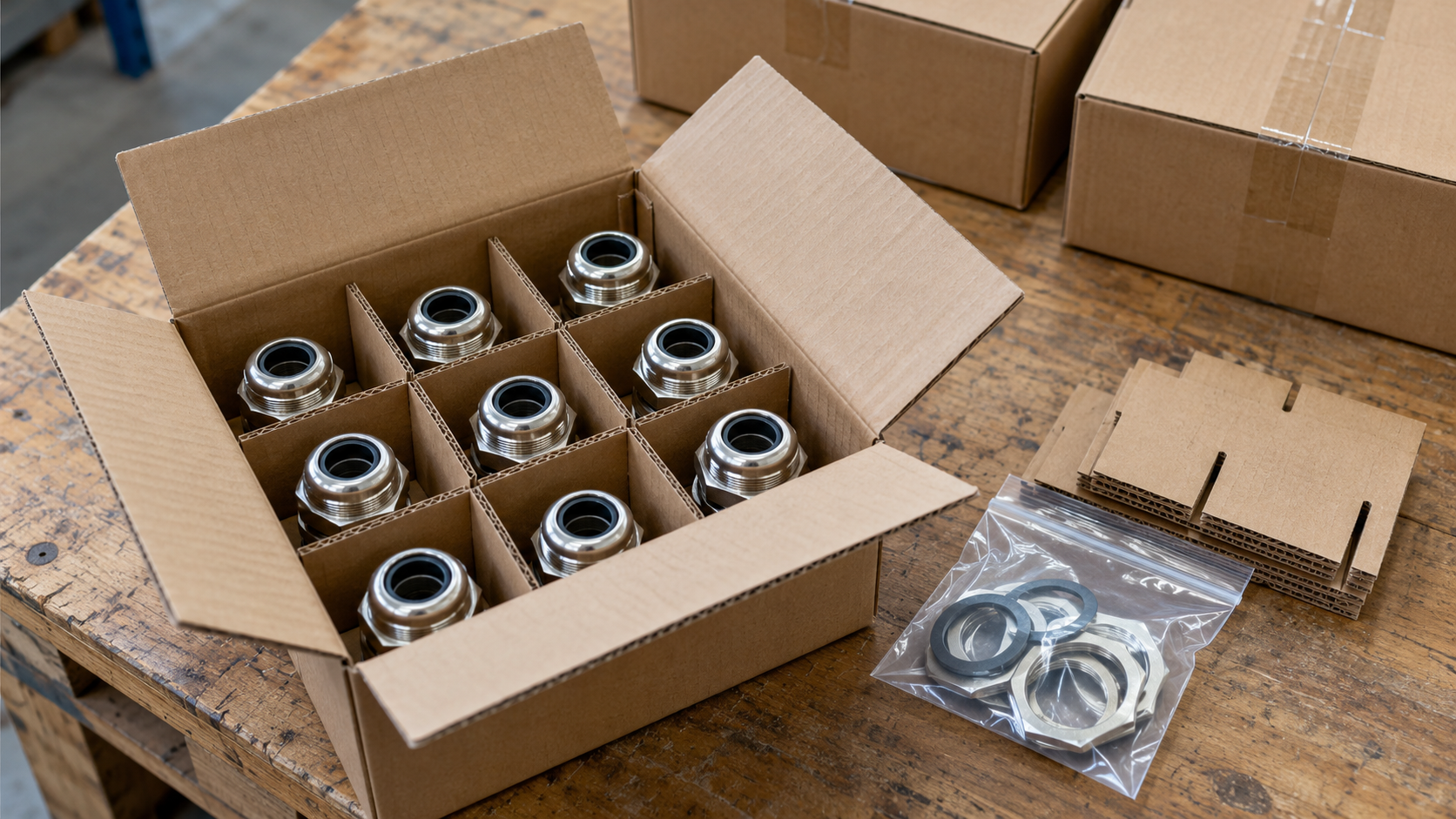
<figcaption>仕切りがケーブルグランドを分け、外箱の脇には付属品の袋と、ばらのインサート部品が見えています。</figcaption>
</figure>
<h2 id="calculate-full-cartons-and-the-final-partial-carton">満載カートン数と最後の部分カートンを計算する</h2>
<p>注文数量 <span class="article-math article-math-inline" data-latex="Q"><span class="katex"><math xmlns="http://www.w3.org/1998/Math/MathML"><semantics><mrow><mi>Q</mi></mrow><annotation encoding="application/x-tex">Q</annotation></semantics></math></span></span> と、正の整数である梱包単位数 <span class="article-math article-math-inline" data-latex="p"><span class="katex"><math xmlns="http://www.w3.org/1998/Math/MathML"><semantics><mrow><mi>p</mi></mrow><annotation encoding="application/x-tex">p</annotation></semantics></math></span></span> に対する合計カートン数は次のとおりです：</p>
<div class="article-math article-math-display" data-latex="N=\left\lceil\frac{Q}{p}\right\rceil"><span class="katex"><math xmlns="http://www.w3.org/1998/Math/MathML" display="block"><semantics><mrow><mi>N</mi><mo>=</mo><mrow><mo fence="true">⌈</mo><mfrac><mi>Q</mi><mi>p</mi></mfrac><mo fence="true">⌉</mo></mrow></mrow><annotation encoding="application/x-tex">N=\left\lceil\frac{Q}{p}\right\rceil</annotation></semantics></math></span></div>
<p>満載カートン数は <span class="article-math article-math-inline" data-latex="\lfloor Q/p\rfloor"><span class="katex"><math xmlns="http://www.w3.org/1998/Math/MathML"><semantics><mrow><mo stretchy="false">⌊</mo><mi>Q</mi><mi mathvariant="normal">/</mi><mi>p</mi><mo stretchy="false">⌋</mo></mrow><annotation encoding="application/x-tex">\lfloor Q/p\rfloor</annotation></semantics></math></span></span> で、余りは <span class="article-math article-math-inline" data-latex="Q-p\lfloor Q/p\rfloor"><span class="katex"><math xmlns="http://www.w3.org/1998/Math/MathML"><semantics><mrow><mi>Q</mi><mo>−</mo><mi>p</mi><mo stretchy="false">⌊</mo><mi>Q</mi><mi mathvariant="normal">/</mi><mi>p</mi><mo stretchy="false">⌋</mo></mrow><annotation encoding="application/x-tex">Q-p\lfloor Q/p\rfloor</annotation></semantics></math></span></span> です。余りがゼロなら追加の部分カートンはありません。最後の満載カートンが空という意味ではありません。注文数量がゼロならカートン数もゼロです。</p>
<p>SKU Aは満載カートン12個と、50個を入れたカートン1個が必要で、合計<strong>13カートン</strong>です。SKU Bは満載カートンが7個必要で、合計<strong>7カートン</strong>です。したがって出荷は合計<strong>20カートン、供給単位1,670個</strong>です。</p>
<p>カートンの内容から注文数を照合できます。12 × 100 + 50 = 1,250、7 × 60 = 420です。これにより、丸めたカートン数から注文数量を逆算し、SKU Aを誤って50個多く計上するという、よくある表計算のミスを見つけられます。</p>
<p>余りに承認済みの小型箱を使う場合は、風袋質量と寸法を個別に記録した別のカートン種別行を作成してください。元の箱を「半分充填」と表示するだけで運賃容積を減らすことはできません。</p>
<h2 id="add-packaging-once-to-obtain-gross-mass">梱包材を一度だけ加えて総質量を求める</h2>
<p>正味製品質量は、SKUごとの数量に定義済みの単位質量を掛け、その結果を合計したものです：</p>
<div class="article-math article-math-display" data-latex="m_{\mathrm{net}}=\sum_i Q_i m_i"><span class="katex"><math xmlns="http://www.w3.org/1998/Math/MathML" display="block"><semantics><mrow><msub><mi>m</mi><mrow><mi mathvariant="normal">n</mi><mi mathvariant="normal">e</mi><mi mathvariant="normal">t</mi></mrow></msub><mo>=</mo><munder><mo>∑</mo><mi>i</mi></munder><msub><mi>Q</mi><mi>i</mi></msub><msub><mi>m</mi><mi>i</mi></msub></mrow><annotation encoding="application/x-tex">m_{\mathrm{net}}=\sum_i Q_i m_i</annotation></semantics></math></span></div>
<p>ここではSKU Aが106.25 kg、SKU Bが58.80 kgとなり、<strong>正味製品質量165.05 kg</strong>です。kg単位を一貫して使用します。原記録に異なる質量単位や長さ単位が使われている場合は、<a href="https://www.nist.gov/pml/special-publication-811/nist-guide-si-appendix-b-conversion-factors/nist-guide-si-appendix-b9">NIST SI単位換算表</a>で換算できます。</p>
<p>この例の梱包材は、重複しない別々の行に分けます：</p>
<table>
<thead>
<tr>
<th>質量項目</th>
<th>計算</th>
<th style="text-align: right">加算質量</th>
</tr>
</thead>
<tbody>
<tr>
<td>空のAカートン</td>
<td>13 × 0.60 kg</td>
<td style="text-align: right">7.80 kg</td>
</tr>
<tr>
<td>空のBカートン</td>
<td>7 × 0.80 kg</td>
<td style="text-align: right">5.60 kg</td>
</tr>
<tr>
<td>袋、仕切り、その他の内装梱包材</td>
<td>この注文で記録した合計</td>
<td style="text-align: right">2.50 kg</td>
</tr>
<tr>
<td>パレット1枚</td>
<td>記録された風袋質量</td>
<td style="text-align: right">20.00 kg</td>
</tr>
<tr>
<td>包装フィルム、ストラップ、角当て材</td>
<td>記録した合計</td>
<td style="text-align: right">1.20 kg</td>
</tr>
<tr>
<td><strong>梱包材合計</strong></td>
<td>上記5行の合計</td>
<td style="text-align: right"><strong>37.10 kg</strong></td>
</tr>
</tbody>
</table>
<p>したがって出荷総質量は<strong>165.05 + 37.10 = 202.15 kg</strong>です。これらは仮定した例の入力値であり、カタログ上の質量や実測した出荷結果ではありません。</p>
<p>測定の境界を明確にしてください。梱包済みカートンの質量に袋や仕切りがすでに含まれる場合、それらを二重に加算しないでください。積載済みパレットを一体として計量した場合、その測定値にはパレットと包装材も含まれます。計算した内訳は照合用に残し、最終的な台ばかりの値と大きく異なる場合は原因を調べてください。</p>
<h2 id="calculate-cbm-from-the-shipping-units-external-dimensions">出荷単位の外寸からCBMを計算する</h2>
<p>CBMは立方メートルを意味します。直方体の梱包では、外寸の長さ、幅、高さをすべてメートルに換算してから掛け合わせます。寸法がセンチメートルの場合：</p>
<div class="article-math article-math-display" data-latex="V_{\mathrm{cartons}}=\sum_j\frac{N_j L_j W_j H_j}{10^6}"><span class="katex"><math xmlns="http://www.w3.org/1998/Math/MathML" display="block"><semantics><mrow><msub><mi>V</mi><mrow><mi mathvariant="normal">c</mi><mi mathvariant="normal">a</mi><mi mathvariant="normal">r</mi><mi mathvariant="normal">t</mi><mi mathvariant="normal">o</mi><mi mathvariant="normal">n</mi><mi mathvariant="normal">s</mi></mrow></msub><mo>=</mo><munder><mo>∑</mo><mi>j</mi></munder><mfrac><mrow><msub><mi>N</mi><mi>j</mi></msub><msub><mi>L</mi><mi>j</mi></msub><msub><mi>W</mi><mi>j</mi></msub><msub><mi>H</mi><mi>j</mi></msub></mrow><msup><mn>10</mn><mn>6</mn></msup></mfrac></mrow><annotation encoding="application/x-tex">V_{\mathrm{cartons}}=\sum_j\frac{N_j L_j W_j H_j}{10^6}</annotation></semantics></math></span></div>
<p>例のAカートンの容積は13 × 0.40 × 0.30 × 0.25 = <strong>0.3900 m³</strong>です。Bカートンは7 × 0.50 × 0.35 × 0.30 = <strong>0.3675 m³</strong>です。個々のカートンの外部容積を合計すると<strong>0.7575 m³</strong>です。</p>
<p>この合計は個々のカートンを表します。注文をパレット1台として引き渡す場合は、その荷扱い単位に対する運送業者の測定ルールを確認してください。パレットと保護材を含む最終的な外寸が<strong>1.20 × 1.00 × 1.10 m</strong>だとします。パレット外形の容積は<strong>1.3200 m³</strong>です。カートン容積の合計には含まれない、積み重ねた内部の空間とパレット高さも含まれます。</p>
<p>仮定したパレット外寸は出荷計画用の入力値です。カートンの配置、積み重ね強度、固定方法には別途承認が必要です。見積額が下がるという理由だけで、実測した外寸を理想的な容積に置き換えないでください。突き出しや膨らんだ梱包材は、サービスで指定された方法に従って測定します。</p>
<figure class="blog-chart">
<svg xmlns="http://www.w3.org/2000/svg" viewBox="0 0 520 750" role="img" aria-labelledby="shipment-basis-title shipment-basis-desc" style="font-family:var(--font-body)">
<title id="shipment-basis-title">梱包済み注文から運賃計算対象重量まで</title>
<desc id="shipment-basis-desc">梱包済み注文から総質量と外部出荷寸法が決まる。運送業者の見積もりルールは、指定された基準に従ってそれらの測定値を比較する。</desc>
<defs>
<marker id="shipment-basis-arrow" markerWidth="8" markerHeight="8" refX="7" refY="4" orient="auto"><path d="M0 0L8 4L0 8Z" fill="var(--color-primary)"/></marker>
</defs>
<text x="36" y="50" font-size="32" font-weight="700" fill="var(--color-carbon)">出荷単位を測定する</text>
<rect x="36" y="85" width="448" height="140" rx="12" fill="var(--surface-card)" stroke="var(--color-cloud)" stroke-width="2"/>
<text x="58" y="125" font-size="26" font-weight="700" fill="var(--color-carbon)">1. 梱包済み注文</text>
<text x="58" y="165" font-size="22" fill="var(--color-graphite)"><tspan x="58">製品、カートン、保護材</tspan><tspan x="58" dy="31">およびパレットを各1回計上</tspan></text>
<path d="M260 235V273" stroke="var(--color-primary)" stroke-width="3" marker-end="url(#shipment-basis-arrow)"/>
<rect x="36" y="288" width="448" height="180" rx="12" fill="var(--surface-card)" stroke="var(--color-primary)" stroke-width="2"/>
<text x="58" y="329" font-size="26" font-weight="700" fill="var(--color-carbon)">2. 2つの測定値</text>
<text x="58" y="371" font-size="22" fill="var(--color-graphite)"><tspan x="58">積荷全体の総質量</tspan><tspan x="58" dy="36">受け入れられる各出荷単位の</tspan><tspan x="58" dy="31">外部寸法</tspan></text>
<path d="M260 478V516" stroke="var(--color-primary)" stroke-width="3" marker-end="url(#shipment-basis-arrow)"/>
<rect x="36" y="531" width="448" height="172" rx="12" fill="var(--surface-card)" stroke="var(--color-cloud)" stroke-width="2"/>
<text x="58" y="573" font-size="26" font-weight="700" fill="var(--color-carbon)">3. 見積もりの課金ルール</text>
<text x="58" y="615" font-size="22" fill="var(--color-graphite)"><tspan x="58">サービスの係数を適用し、</tspan><tspan x="58" dy="31">同じ出荷単位の比較基準と</tspan><tspan x="58" dy="31">端数処理を用いる</tspan></text>
</svg>
<figcaption>最終的な梱包単位から、運賃見積もりに使う質量と寸法の両方が得られます。</figcaption>
</figure>
<h2 id="apply-the-carriers-factor-and-rounding-rule">運送業者の係数と端数処理ルールを適用する</h2>
<p><a href="https://www.dhl.com/gb-en/home/global-forwarding/freight-forwarding-education-center/calculating-chargeable-weights.html">DHLの運賃計算対象重量ガイド</a>では、梱包材とパレットを含む出荷総質量と容積重量を区別しています。輸送方式や運送業者によって容積換算比率が異なる場合があることも説明しています。適用するルールは実際の見積書で確認してください。他サービスの除数は基準が異なる場合があります。</p>
<p>実質量と、容積に係数 <span class="article-math article-math-inline" data-latex="k"><span class="katex"><math xmlns="http://www.w3.org/1998/Math/MathML"><semantics><mrow><mi>k</mi></mrow><annotation encoding="application/x-tex">k</annotation></semantics></math></span></span>（kg/m³）を掛けた値のうち、大きい方に課金するサービスの場合：</p>
<div class="article-math article-math-display" data-latex="m_{\mathrm{vol}}=Vk,\qquad m_{\mathrm{charge}}=\max(m_{\mathrm{gross}},m_{\mathrm{vol}})"><span class="katex"><math xmlns="http://www.w3.org/1998/Math/MathML" display="block"><semantics><mrow><msub><mi>m</mi><mrow><mi mathvariant="normal">v</mi><mi mathvariant="normal">o</mi><mi mathvariant="normal">l</mi></mrow></msub><mo>=</mo><mi>V</mi><mi>k</mi><mo separator="true">,</mo><mspace width="2em"/><msub><mi>m</mi><mrow><mi mathvariant="normal">c</mi><mi mathvariant="normal">h</mi><mi mathvariant="normal">a</mi><mi mathvariant="normal">r</mi><mi mathvariant="normal">g</mi><mi mathvariant="normal">e</mi></mrow></msub><mo>=</mo><mi>max</mi><mo>⁡</mo><mo stretchy="false">(</mo><msub><mi>m</mi><mrow><mi mathvariant="normal">g</mi><mi mathvariant="normal">r</mi><mi mathvariant="normal">o</mi><mi mathvariant="normal">s</mi><mi mathvariant="normal">s</mi></mrow></msub><mo separator="true">,</mo><msub><mi>m</mi><mrow><mi mathvariant="normal">v</mi><mi mathvariant="normal">o</mi><mi mathvariant="normal">l</mi></mrow></msub><mo stretchy="false">)</mo></mrow><annotation encoding="application/x-tex">m_{\mathrm{vol}}=Vk,\qquad m_{\mathrm{charge}}=\max(m_{\mathrm{gross}},m_{\mathrm{vol}})</annotation></semantics></math></span></div>
<p>この例の仮想見積もりでは、請求上の端数処理を行う前にパレット全体へ適用する係数を<strong>200 kg/m³</strong>とします。容積重量は1.32 × 200 = <strong>264 kg</strong>で、202.15 kgを上回ります。したがって暫定の運賃計算対象質量は<strong>264 kg</strong>です。この係数は見積もり例の入力値であり、運送業者に推奨される普遍的な換算係数ではありません。</p>
<p><a class="article-tool-card article-tool-card-link" href="/ja/resource-center/tools/chargeable-weight-calculator/" aria-label="運賃計算対象重量計算ツール"><span class="article-tool-card-index">ツール</span><span class="article-tool-card-kicker">プロジェクト計画</span><strong class="article-tool-card-title">運賃計算対象重量計算ツール</strong><span class="article-tool-card-copy">梱包済み貨物の総質量（kg）、適用する出荷単位の容積（m³）、実際の見積もりに記載された係数（kg/m³）を入力してください。運送業者の端数処理と最低課金ルールは別途適用します。</span><span class="article-tool-card-formula">mcharge = max(mactual, VCBM × Kcarrier)</span><span class="article-tool-card-inputs" aria-label="計算ツールの入力項目"><em>実際の総質量</em><em>出荷容積</em><em>運送業者の換算係数</em></span><span class="article-tool-card-action">計算ツールを開く <span aria-hidden="true">-&gt;</span></span></a></p><p>この計算ツールは上記の比較を行います。運送業者が小口貨物ごとに課金するか、掛け算の前に寸法を丸めるか、最低料金を設けるか、積み重ね不可や規格外寸法の追加料金を加えるかは判定しません。小口貨物ごとの比較なら、各貨物を先に計算してから合計してください。合計後に最大値だけを選ぶと、結果が異なる場合があります。コンテナ単位の見積もりには、さらに別の課金基準が使われることがあります。</p>
<h2 id="reconcile-the-packing-list-and-quotation">梱包明細と見積もりを照合する</h2>
<p>予約前に、計算表を実際の梱包済み注文と照合してください。SKU合計、20個のカートン識別情報、正味質量の定義、台ばかりでの総質量、パレット数、最終外寸を確認します。付属品や梱包方法を変更すると、複数の項目に影響する場合があります。</p>
<p>指定の輸送サービス、経路、見積日、測定および端数処理ルール、通貨、最低料金、料金に含まれる項目を記録してください。<a href="https://www.sis.se/en/produkter/standardization/graphical-symbols/other/iso7802015/">ISO 780:2015</a>の図記号は包装物の取扱い指示を伝えるもので、カートン強度や運賃を定めるものではありません。</p>
<p>見積もりを比べる際は、同じ引渡し条件と梱包前提を使ってください。<a href="/ja/blog/cw-cable-gland-price-comparison-china-vs-india/">ケーブルグランドの見積もり比較ガイド</a>では、運賃と付属品の扱いを購入全体の比較にどう含めるかを説明しています。質量または容積の差に説明がつかない場合、私はその原因を確認してから、二つの運賃合計を同等として扱います。</p>
<h2 id="conclusion">まとめ</h2>
<p>信頼できる出荷計算表では、数量、質量、容積の計算を同じ梱包済み注文まで追跡できます。この例では、供給単位1,670個が20カートンになります。正味製品質量と梱包材を合計した値は、カートン容積やパレット外形の容積とは別の量です。これらを区別すると、見積もり入力を再現できます。</p>
<p>次に、例の前提を承認済みの梱包表に置き換え、最終的な実測積荷を運送業者の書面による課金ルールと照合してください。そうすれば、カートンサイズ、付属品セット、輸送サービスが変わっても計算を役立てられます。</p>
<h2 id="faq">よくある質問</h2>
<h3 id="does-a-partial-carton-count-as-a-full-carton-for-volume">部分カートンは容積計算で満載カートンとして数えますか？</h3>
<p>実際の外寸を使ってください。ケーブルグランドの数量が少ない通常サイズのカートンでも、外形寸法はそのままです。承認済みの小型カートンを使う場合は、別のカートン種別として記録してください。内部空間の利用率を計算する目的で明示的に行う場合を除き、通常サイズのカートン容積に充填率を掛けて小さく見積もることはしません。</p>
<h3 id="is-gross-shipment-mass-the-same-as-chargeable-weight">出荷総質量と運賃計算対象重量は同じですか？</h3>
<p>いいえ。出荷総質量は梱包済み貨物の実質量です。運賃計算対象重量はサービス固有の課金上の数量であり、実質量ではなく容積重量に基づく場合があります。適用係数、測定基準、端数処理、最低課金条件を含め、台ばかりで得た総質量と運送業者の計算結果を別々の欄に記録します。</p>
<h3 id="can-i-use-one-unit-mass-for-all-cable-gland-sizes">すべてのケーブルグランドサイズに同じ単位質量を使えますか？</h3>
<p>その値が実際に数えている各供給単位を表している場合に限ります。サイズや付属品の組み合わせが異なる製品に同じ値が当てはまるとは限りません。SKUごとに文書化された単位質量を使って計算し、その結果を合計してください。推定値しかない場合は推定であることを明記し、出荷前に梱包後の実測質量と照合します。</p>
<h3 id="why-can-pallet-cbm-exceed-the-sum-of-carton-cbm">パレットのCBMがカートンCBMの合計を上回るのはなぜですか？</h3>
<p>パレットの外部出荷寸法には、パレット台、保護材、カートン間の空間、測定した外形内の未使用空間が含まれます。個々のカートン容積の合計には、これらの要素は含まれません。見積もりで指定された出荷単位に合う測定値を使い、異なる計画用途に使う場合は両方の値を明確に区別して記録します。</p>
<h3 id="sources-and-technical-references">出典と技術資料</h3>
<ul>
<li><a href="https://www.dhl.com/gb-en/home/global-forwarding/freight-forwarding-education-center/calculating-chargeable-weights.html">DHL — 航空・海上・道路・鉄道輸送の運賃計算対象重量</a>、参照日 2026-10-22。</li>
<li><a href="https://www.nist.gov/pml/special-publication-811/nist-guide-si-appendix-b-conversion-factors/nist-guide-si-appendix-b9">NIST — 国際単位系（SI）ガイド、付録B.9：量別換算係数</a>、参照日 2026-10-22。</li>
<li><a href="https://www.sis.se/en/produkter/standardization/graphical-symbols/other/iso7802015/">SIS — ISO 780:2015：流通包装の取扱いおよび保管用図記号</a>、参照日 2026-10-23。</li>
</ul>
