

Introduction
I’ve lost count of how many times procurement managers have asked me: “Samuel, what’s the real difference between V-0 and V-2 nylon cable glands?” It’s a critical question that directly impacts both safety compliance and project budgets.
Here’s the direct answer: UL94 V-0 rated nylon cable glands self-extinguish within 10 seconds and produce no flaming drips, while V-2 glands may burn up to 30 seconds and can create burning particles—making V-0 essential for high-risk environments like data centers, railways, and marine applications.
Last month, I worked with Hassan, a project manager from Dubai who learned this lesson the hard way. His team initially specified V-2 glands for a metro station project to save costs. During the final inspection, the fire safety authority rejected the entire installation because the specification required V-0 materials for all enclosed electrical spaces. The rework cost him three weeks and $18,000 in labor alone.
Let me walk you through everything you need to know about these flammability ratings so you can make the right choice the first time.
Table of Contents
- What Does UL94 Flammability Rating Actually Mean?
- How Do V-0 and V-2 Ratings Differ in Real-World Performance?
- Which Applications Require V-0 vs. V-2 Nylon Cable Glands?
- How to Verify Authentic UL94 Certification on Your Cable Glands?
- FAQ
What Does UL94 Flammability Rating Actually Mean?
UL941 is the globally recognized standard published by Underwriters Laboratories for testing the flammability of plastic materials used in electrical devices and appliances. When you see “UL94 V-0” or “UL94 V-2” stamped on a nylon cable gland, it tells you exactly how that material behaves when exposed to open flame.
The “V” in these ratings stands for “Vertical Burn Test”—the most common testing method for cable management components. During this test, a controlled flame is applied to a vertically mounted specimen twice for 10 seconds each time. What happens after the flame is removed determines the rating.
Key aspects evaluated during UL94 testing:
- Self-extinguishing time: How quickly the material stops burning after flame removal
- Dripping behavior: Whether molten material drips and if those drips are flaming
- Cotton indicator ignition: Whether burning drips can ignite cotton placed below the specimen
- Afterglow duration: How long the material continues to glow after visible flames stop
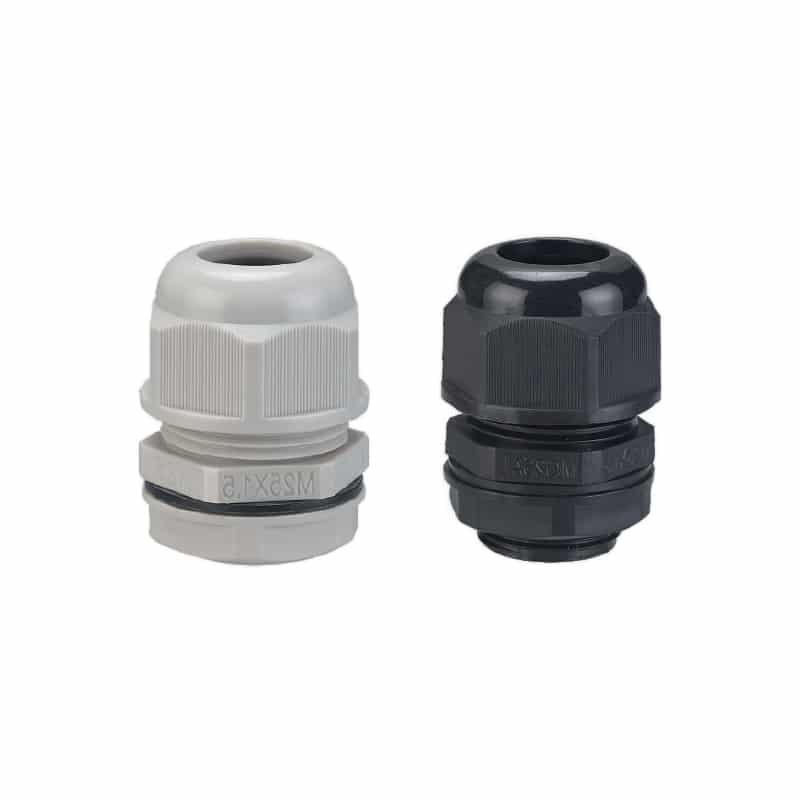
At Bepto, we manufacture nylon cable glands using PA66 (Polyamide 66) material2 that can be formulated to achieve either V-0 or V-2 ratings depending on the flame retardant additives used. The base polymer is the same—it’s the halogen-free or halogenated flame retardant packages that make the difference.
Understanding these ratings isn’t just about checking a compliance box. It’s about knowing whether your installation will contain a fire or contribute to its spread during those critical first minutes when evacuation is happening.

How Do V-0 and V-2 Ratings Differ in Real-World Performance?
The technical specifications tell only part of the story. Let me break down what these ratings actually mean when a fire breaks out in your facility.
| Test Parameter | UL94 V-0 | UL94 V-2 | Safety Impact |
|---|---|---|---|
| Afterflame time (per specimen) | ≤10 seconds | ≤30 seconds | V-0 stops fire spread 3x faster |
| Total afterflame time (5 specimens) | ≤50 seconds | ≤250 seconds | V-0 limits cumulative burn exposure |
| Afterglow time after 2nd flame | ≤30 seconds | ≤60 seconds | V-0 reduces smoldering risk |
| Dripping behavior | No flaming drips allowed | Flaming drips permitted | V-2 can ignite materials below |
| Cotton indicator ignition | Must NOT ignite | Must NOT ignite | Both prevent secondary ignition |
The critical difference: flaming drips. This is where V-2 glands pose real danger in vertical installations. When V-2 nylon melts under fire exposure, those burning droplets can fall onto cable insulation, junction boxes, or other combustible materials below—essentially spreading the fire vertically through your installation.
I remember David, a purchasing manager from a solar farm project in California, who initially questioned why we recommended V-0 glands for their inverter cabinets. “They’re outdoors,” he said, “and V-2 is $0.30 cheaper per unit.” I showed him a video of the UL94 test comparison. When he saw those flaming drips from the V-2 specimen igniting the materials below, he immediately understood. In a solar installation where cables run vertically down from roof-mounted panels, those drips could ignite the entire cable run.
Material composition differences:
- V-0 formulations: Typically use higher concentrations of flame retardant additives (15-30% by weight), often red phosphorus or halogen-free intumescent systems
- V-2 formulations: Lower flame retardant loading (8-15%), which reduces material cost but compromises drip performance
- Color impact: V-0 materials often have a slightly different color tone due to higher additive content—usually a grayer black compared to V-2’s deeper black
The self-extinguishing speed matters enormously in confined spaces. In an electrical cabinet or cable duct, those extra 20 seconds of burning time with V-2 can mean the difference between a contained incident and a spreading fire that damages adjacent equipment.
Which Applications Require V-0 vs. V-2 Nylon Cable Glands?
Choosing the right flammability rating isn’t about picking the “best” option—it’s about matching the rating to your specific risk profile and regulatory requirements.
When V-0 Rating Is Mandatory
High-consequence environments where fire spread must be absolutely minimized:
- Railway and metro systems: Enclosed passenger areas, signal cabinets, and underground installations where evacuation is complex
- Marine vessels: Engine rooms, control panels, and below-deck installations per IACS requirements3
- Data centers: Server racks, raised floor cable management, and overhead cable trays
- Healthcare facilities: Operating rooms, ICU equipment, and life-support system connections
- Aerospace ground equipment: Airport terminal systems and aircraft servicing installations
I recently supplied 5,000 V-0 rated M20 nylon cable glands to a metro project in Singapore. Their specification explicitly stated: “All non-metallic components in electrical systems must meet UL94 V-0 or equivalent IEC 60695-11-10 standard.” There was no room for substitution—V-2 simply wasn’t acceptable regardless of cost savings.
When V-2 Rating Is Sufficient
Standard industrial and commercial applications with adequate fire suppression:
- General manufacturing facilities with sprinkler systems
- Outdoor solar installations with adequate spacing
- HVAC control panels in commercial buildings
- Agricultural and irrigation control systems
- Warehouse lighting and power distribution
Cost consideration: V-2 glands typically cost 15-25% less than V-0 equivalents. For a large project using 10,000 glands, this could mean $3,000-$5,000 in savings. But this only makes sense if your application genuinely doesn’t require V-0 performance.
Geographic and Industry-Specific Requirements
Europe: EN 45545 for railway applications mandates V-0 equivalent performance (HL2 or HL3 hazard levels)
North America: NEC (National Electrical Code) Article 5014 for hazardous locations often requires V-0 for Class I, Division 2 areas
Marine: DNV-GL and Lloyd’s Register specifications typically require V-0 for accommodation and machinery spaces
Middle East: Many GCC countries have adopted stricter fire safety codes post-2017, often mandating V-0 for high-rise buildings above 15 floors

How to Verify Authentic UL94 Certification on Your Cable Glands?
Here’s an uncomfortable truth: I’ve seen counterfeit UL94 certificates circulating in the market. Some suppliers simply print “V-0” on their product labels without any actual testing. This puts your project at serious risk.
Step-by-step verification process:
Request the official UL Yellow Card: This is the authentic certification document issued by UL. It includes the file number (e.g., E123456), material designation, and tested thickness ranges.
Cross-reference the UL file number: Visit the official UL Product iQ database5and search for the manufacturer’s file number. The listing should match the material grade claimed.
Check material thickness specifications: UL94 ratings are thickness-dependent. A material might achieve V-0 at 3.0mm thickness but only V-2 at 1.5mm. Verify that your cable gland’s wall thickness matches the tested range.
Inspect product markings: Legitimate manufacturers mold or print the UL recognition mark directly on the product along with the file number. At Bepto, every V-0 gland has “UL94 V-0” molded into the body.
Three common certification mistakes to avoid:
Mistake #1: Accepting a certificate for “PA66 V-0 material” without verifying it covers the specific compound used in your glands. Different PA66 formulations have different UL files.
Mistake #2: Assuming black nylon automatically means V-0. Color has nothing to do with flammability rating—it’s purely about the flame retardant package.
Mistake #3: Not requesting batch-specific test reports for large orders. Material formulations can change; ask for confirmation that your specific production batch meets the rating.
Red flags that suggest fake certification:
- Supplier cannot provide a UL file number, only a “test report”
- Certificate shows testing by an unknown third-party lab instead of UL
- Price is significantly lower than market rate (genuine V-0 material costs more)
- Supplier hesitates when you ask for a sample to send for independent testing
For critical projects, I always recommend clients send samples to an independent testing lab like TUV or SGS for verification testing. It costs $300-$500 but provides absolute certainty before you commit to a large order.
Conclusion
The bottom line: Choose V-0 when fire containment is critical and human safety is at stake; opt for V-2 when you’re working in standard industrial environments with adequate fire protection systems and lower regulatory requirements.
Don’t let a $0.30 per unit cost difference compromise a multi-million dollar project or, more importantly, put lives at risk. At Bepto, we maintain both V-0 and V-2 nylon cable gland inventory with full UL certification documentation ready for your review.
FAQs About UL94 Flammability Ratings for Cable Glands
Q: Can I use V-2 rated cable glands in a vertical cable run?
A: Not recommended for critical applications. V-2 allows flaming drips that can ignite cables below. Use V-0 for vertical installations where fire spread prevention is essential, especially in enclosed spaces.
Q: Does V-0 rating mean the cable gland is completely fireproof?
A: No. V-0 means self-extinguishing within 10 seconds without flaming drips. It’s not fireproof—it will eventually burn under sustained flame exposure, but significantly slows fire spread compared to V-2.
Q: Are halogen-free V-0 cable glands available?
A: Yes. Modern halogen-free flame retardant systems can achieve V-0 ratings using red phosphorus or intumescent additives. These are preferred for enclosed spaces due to lower smoke toxicity during fire.
Q: How much more expensive are V-0 cable glands compared to V-2?
A: Typically 15-25% higher due to increased flame retardant content. For an M20 nylon gland, expect $0.25-$0.40 more per unit. Volume orders above 5,000 pieces often reduce this premium.
Q: Will V-0 rated nylon glands work in outdoor UV-exposed applications?
A: Yes, if UV-stabilized. UL94 rating addresses flammability only. Request PA66 with both V-0 rating and UV stabilizers for outdoor solar, marine, or agricultural applications to prevent degradation.
-
Learn the full details of the globally recognized UL94 standard for plastic flammability testing. ↩
-
Understand the mechanical and thermal characteristics of PA66, the base material for nylon cable glands. ↩
-
Review the specific International Association of Classification Societies requirements for cable gland materials in marine vessels. ↩
-
Get an overview of the National Electrical Code requirements for electrical equipment in Class I, Division 2 areas. ↩
-
See how to use the official UL database to verify the authenticity of a product’s UL certification and file number. ↩
