

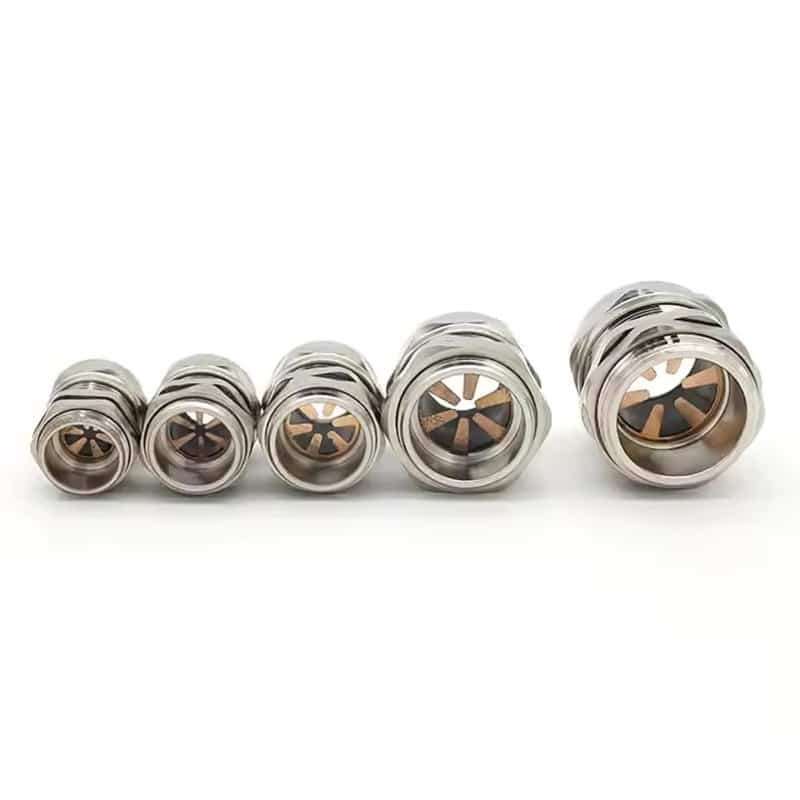
Improper cable gland specification for high-frequency data cables causes signal degradation, electromagnetic interference, impedance mismatches, and network performance issues that can cripple critical communication systems, disrupt industrial automation, compromise data integrity, and create costly downtime in modern facilities where reliable high-speed data transmission is essential for operational efficiency and safety.
Specifying cable glands for high-frequency data cables like Cat 6/7 requires careful consideration of EMC shielding effectiveness, impedance matching, grounding continuity, environmental sealing, and mechanical strain relief to maintain signal integrity, prevent electromagnetic interference, and ensure reliable network performance while meeting industry standards for data transmission quality and environmental protection. Proper specification is critical for maintaining gigabit and 10-gigabit network performance.
Having designed network infrastructure for data centers from Frankfurt’s financial district to Seoul’s technology complexes, I’ve learned that 80% of high-frequency data transmission problems1 stem from improper cable gland selection and installation. Let me share the proven specifications that ensure reliable gigabit performance in demanding industrial environments.
Table of Contents
- What Makes High-Frequency Data Cable Glands Different?
- How Do You Maintain Signal Integrity Through Glands?
- What EMC Requirements Must Be Met for Cat 6/7 Applications?
- How Do You Select the Right Gland Size and Configuration?
- What Installation Best Practices Ensure Optimal Performance?
- FAQs About High-Frequency Data Cable Glands
What Makes High-Frequency Data Cable Glands Different?
High-frequency data cable glands differ from standard glands through specialized EMC shielding, impedance-controlled designs, 360-degree grounding systems, precision-engineered contact surfaces, and materials specifically selected to maintain signal integrity at frequencies up to 600MHz for Cat 6 and 1000MHz for Cat 7 applications while providing environmental protection and mechanical strain relief without compromising data transmission quality.
Understanding these differences is essential for maintaining network performance and preventing costly signal degradation.

EMC Shielding Requirements
360-Degree Shielding: High-frequency data glands must provide continuous electromagnetic shielding around the entire cable circumference to prevent signal leakage and external interference.
Shielding Effectiveness: Specifications typically require minimum 40dB shielding effectiveness across the operating frequency range to meet EMC compliance standards.
Conductive Materials: Specialized conductive gaskets, contact springs, and plated surfaces ensure reliable electrical continuity between cable shield and gland body.
Ground Path Integrity: Low-impedance ground paths are essential for effective EMC performance and signal quality maintenance.
Signal Integrity Considerations
Impedance Control: Gland designs must maintain characteristic impedance2 (typically 100Ω for twisted pair) through the transition zone to prevent reflections and signal distortion.
Frequency Response: Components must maintain performance across the full frequency spectrum without introducing resonances or signal attenuation.
Crosstalk Prevention: Proper shielding and grounding prevent near-end and far-end crosstalk between adjacent cable pairs.
Return Loss Optimization: Gland transitions should minimize return loss to maintain signal power and reduce bit error rates.
Material Specifications
Conductive Elements: High-conductivity materials like silver-plated copper or beryllium copper provide reliable electrical connections.
Dielectric Properties: Insulating materials must have stable dielectric constants and low loss tangents across the operating frequency range.
Corrosion Resistance: Marine-grade materials prevent degradation that could compromise electrical performance over time.
Temperature Stability: Materials must maintain electrical properties across the specified operating temperature range.
Mechanical Design Features
Precision Tolerances: Tight manufacturing tolerances ensure consistent electrical performance and reliable mechanical connections.
Strain Relief Integration: Proper strain relief prevents cable movement that could degrade electrical connections or signal quality.
Vibration Resistance: Designs must maintain electrical continuity under mechanical vibration and thermal cycling.
Cable Compatibility: Glands must accommodate the specific construction and dimensions of high-frequency data cables.
Performance Standards Compliance
| Standard | Frequency Range | Key Requirements | Testing Methods |
|---|---|---|---|
| Cat 6 | Up to 250MHz | Return loss, insertion loss, NEXT | TIA-568-C.2 |
| Cat 6A | Up to 500MHz | Alien crosstalk3, shielding effectiveness | TIA-568-C.2 |
| Cat 7 | Up to 600MHz | Class F performance, EMC compliance | ISO/IEC 11801 |
| Cat 7A | Up to 1000MHz | Class FA requirements, enhanced shielding | ISO/IEC 11801 |
Marcus, a network infrastructure manager at a major automotive plant in Stuttgart, Germany, was experiencing intermittent network failures in their new Industry 4.0 implementation. Standard cable glands were causing signal degradation in their Cat 6A backbone, resulting in packet loss and system timeouts. We provided specialized EMC cable glands with 360-degree shielding and proper impedance matching that eliminated the interference issues and restored full gigabit performance across their 500-meter network runs. 😊
How Do You Maintain Signal Integrity Through Glands?
Maintaining signal integrity through cable glands requires precise impedance matching, continuous shielding, proper grounding techniques, controlled cable geometry, and elimination of discontinuities that could cause reflections, signal loss, or electromagnetic interference, while ensuring environmental sealing and mechanical protection don’t compromise the electrical performance of high-frequency data transmission systems.
Signal integrity is the foundation of reliable high-speed data communication.
Impedance Matching Techniques
Characteristic Impedance Control: Maintain 100Ω ±15Ω impedance through the gland transition to prevent signal reflections and power loss.
Geometry Optimization: Carefully control conductor spacing and dielectric materials to maintain consistent impedance characteristics.
Transition Design: Gradual impedance transitions minimize reflections and maintain signal quality through the gland interface.
Material Selection: Use materials with appropriate dielectric constants to maintain impedance matching requirements.
Shielding Continuity Methods
360-Degree Contact: Ensure complete circumferential contact between cable shield and gland body for effective EMC performance.
Contact Pressure Control: Maintain optimal contact pressure to ensure reliable electrical connection without damaging cable shields.
Multiple Contact Points: Use multiple contact elements to provide redundant shielding connections and improved reliability.
Corrosion Prevention: Apply appropriate surface treatments to prevent corrosion that could degrade shielding effectiveness.

Grounding System Design
Low-Impedance Paths: Provide direct, low-impedance ground paths from cable shield to equipment ground for effective EMC performance.
Ground Loop Prevention: Design grounding systems to prevent ground loops that could introduce noise and interference.
Equipotential Bonding: Ensure all metallic components are at the same electrical potential to prevent circulating currents.
Ground Integrity Testing: Implement testing procedures to verify ground path continuity and impedance.
Cable Geometry Preservation
Pair Twist Maintenance: Preserve twisted pair geometry through the gland to maintain differential signal characteristics.
Bend Radius Control: Maintain minimum bend radius requirements to prevent impedance variations and signal degradation.
Conductor Separation: Maintain proper conductor spacing to preserve characteristic impedance and prevent crosstalk.
Shield Termination: Properly terminate cable shields to maintain shielding effectiveness without creating impedance discontinuities.
Frequency Response Optimization
Bandwidth Preservation: Ensure gland design doesn’t introduce frequency-dependent losses or phase distortions.
Resonance Avoidance: Design glands to avoid resonant frequencies within the operating bandwidth.
Group Delay Control: Minimize group delay variations that could cause signal distortion in high-speed applications.
Harmonic Suppression: Prevent harmonic generation that could interfere with other frequency bands.
Testing and Verification
Network Analysis: Use vector network analyzers4 to verify impedance and frequency response through gland assemblies.
Time Domain Reflectometry: Identify impedance discontinuities and optimize gland designs for minimal reflections.
Bit Error Rate Testing: Verify actual data transmission performance under operating conditions.
EMC Compliance Testing: Confirm electromagnetic compatibility performance meets applicable standards.
What EMC Requirements Must Be Met for Cat 6/7 Applications?
EMC requirements for Cat 6/7 applications include minimum shielding effectiveness of 40-60dB, proper grounding to prevent ground loops, compliance with emission and immunity standards, control of common-mode currents, prevention of alien crosstalk, and maintenance of signal quality under electromagnetic interference conditions while meeting regulatory requirements for industrial and commercial installations.
Meeting EMC requirements is essential for reliable operation in electromagnetically noisy environments.
Shielding Effectiveness Standards
Frequency Range Coverage: Shielding must be effective across the entire operating frequency range, from DC to maximum rated frequency.
Minimum Performance Levels: Typically require 40dB minimum shielding effectiveness for Cat 6 and 60dB for Cat 7 applications.
Testing Methods: Shielding effectiveness must be verified using standardized test methods like IEEE 299 or IEC 61000-5-7.
Environmental Conditions: Performance must be maintained under various temperature, humidity, and mechanical stress conditions.
Emission Control Requirements
Radiated Emissions: Prevent electromagnetic energy from radiating beyond acceptable limits as defined by FCC Part 155 or EN 55032.
Conducted Emissions: Control conducted emissions on power and signal lines to prevent interference with other equipment.
Harmonic Distortion: Minimize harmonic generation that could interfere with other frequency bands or services.
Spurious Emissions: Eliminate unwanted emissions outside the intended frequency bands.
Immunity Performance Standards
Radiated Immunity: Maintain signal integrity when exposed to electromagnetic fields as specified in IEC 61000-4-3.
Conducted Immunity: Resist conducted interference on cables as defined in IEC 61000-4-6.
ESD Protection: Provide electrostatic discharge protection according to IEC 61000-4-2 requirements.
Surge Immunity: Withstand electrical surges as specified in IEC 61000-4-5 without performance degradation.
Grounding and Bonding Requirements
Equipment Grounding: Provide reliable connection to equipment ground for safety and EMC performance.
Shield Grounding: Properly terminate cable shields to maintain shielding effectiveness without creating ground loops.
Bonding Continuity: Ensure continuous bonding between all metallic components for equipotential grounding.
Ground Impedance: Maintain low-impedance ground paths for effective EMC performance.
Common-Mode Current Control
Balanced Transmission: Maintain balanced transmission characteristics to minimize common-mode current generation.
Common-Mode Chokes: Integrate common-mode suppression where necessary to control unwanted currents.
Differential Mode Preservation: Maintain differential signal characteristics while suppressing common-mode interference.
Mode Conversion Prevention: Prevent conversion between differential and common modes that could degrade performance.
Regulatory Compliance Framework
| Region | Standard | Key Requirements | Compliance Method |
|---|---|---|---|
| North America | FCC Part 15 | Emission limits, immunity levels | Third-party testing |
| Europe | EN 55032/35 | EMC directive compliance | CE marking |
| International | IEC 61000 series | Generic EMC standards | Accredited testing |
| Industrial | IEC 61326 | Industrial environment EMC | Application-specific testing |
Hassan, who manages a petrochemical facility in Dubai, UAE, needed to upgrade their control network to support new safety systems. The harsh electromagnetic environment from variable frequency drives and high-power equipment was causing data errors in their existing network. We specified Cat 7 cable glands with enhanced EMC shielding (65dB effectiveness) and implemented proper grounding techniques that eliminated interference issues and achieved 99.99% network availability for their critical safety systems.
How Do You Select the Right Gland Size and Configuration?
Selecting the right gland size and configuration for high-frequency data cables requires careful consideration of cable outer diameter, conductor count, shielding type, environmental sealing requirements, mounting thread specifications, and future expansion needs while ensuring proper fit, optimal electrical performance, and compliance with installation standards for reliable long-term operation.
Proper sizing and configuration are critical for both performance and installation success.
Cable Dimension Analysis
Outer Diameter Measurement: Accurately measure cable outer diameter including jacket, shielding, and any protective coverings.
Tolerance Considerations: Account for manufacturing tolerances and temperature-induced dimensional changes in cable sizing.
Bundle Configurations: Consider single cable versus multi-cable installations and their impact on gland selection.
Future Expansion: Plan for potential cable additions or upgrades that might require larger gland sizes.
Conductor Configuration Factors
Pair Count: Determine the number of twisted pairs and their impact on cable diameter and gland requirements.
Conductor Gauge: Consider conductor size and its effect on cable flexibility and minimum bend radius requirements.
Shielding Type: Account for individual pair shielding, overall shield, or both in gland selection criteria.
Drain Wire Provisions: Ensure glands accommodate drain wires and provide proper termination points.

Environmental Sealing Requirements
IP Rating Specifications: Select glands with appropriate ingress protection ratings for the installation environment.
Temperature Range: Ensure gland materials and seals can operate reliably across the expected temperature range.
Chemical Compatibility: Verify compatibility with cleaning agents, solvents, and other chemicals present in the environment.
UV Resistance: Consider ultraviolet exposure for outdoor installations and select appropriate materials.
Thread and Mounting Specifications
Thread Standards: Choose between metric (M12, M16, M20) and NPT threading based on enclosure specifications.
Thread Length: Ensure adequate thread engagement for secure mounting and environmental sealing.
Panel Thickness: Verify gland thread length is appropriate for the mounting panel thickness.
Locknut Requirements: Determine if locknuts are needed for secure mounting and vibration resistance.
Configuration Options
Single vs. Multiple Entry: Choose between individual glands for each cable or multi-port glands for multiple cables.
Straight vs. Angled: Select entry angle based on cable routing requirements and space constraints.
EMC vs. Standard: Determine if EMC versions are required based on electromagnetic environment and performance needs.
Modular Systems: Consider modular gland systems that allow for future reconfiguration and expansion.
Performance Optimization Factors
Strain Relief Integration: Ensure adequate strain relief for cable protection and connection reliability.
Bend Radius Compliance: Verify gland design maintains minimum bend radius requirements for signal integrity.
Contact Reliability: Select glands with proven contact systems for long-term electrical performance.
Maintenance Access: Consider accessibility for future maintenance, testing, and cable replacement.
Selection Decision Matrix
| Cable Type | Recommended Gland Size | Thread Size | Key Features | Application Notes |
|---|---|---|---|---|
| Cat 6 UTP | 6-8mm cable range | M12 x 1.5 | Basic sealing | Indoor applications |
| Cat 6 STP | 7-9mm cable range | M16 x 1.5 | EMC shielding | Industrial environments |
| Cat 6A STP | 8-10mm cable range | M16 x 1.5 | Enhanced EMC | High-performance networks |
| Cat 7 S/FTP | 9-12mm cable range | M20 x 1.5 | Maximum shielding | Critical applications |
What Installation Best Practices Ensure Optimal Performance?
Installation best practices for high-frequency data cable glands include proper cable preparation, correct grounding techniques, controlled torque application, shield termination procedures, testing verification, and documentation practices that ensure optimal signal integrity, EMC performance, and long-term reliability while meeting industry standards and manufacturer specifications for professional network installations.
Proper installation is as important as correct specification for achieving optimal performance.
Cable Preparation Procedures
Precision Stripping: Strip cable jackets to exact lengths specified by gland manufacturers to ensure proper sealing and electrical contact.
Shield Preparation: Carefully prepare cable shields, avoiding nicks or cuts that could compromise shielding effectiveness.
Conductor Protection: Protect individual conductors during preparation to prevent damage that could affect signal quality.
Cleanliness Standards: Maintain clean work environment and handle cables properly to prevent contamination of contact surfaces.
Grounding and Bonding Techniques
Shield Termination: Properly terminate cable shields using manufacturer-recommended techniques for optimal EMC performance.
Ground Path Verification: Verify low-impedance ground paths using appropriate test equipment before system energization.
Equipotential Bonding: Ensure all metallic components are properly bonded to prevent potential differences and circulating currents.
Ground Loop Prevention: Implement grounding practices that prevent ground loops while maintaining safety and EMC performance.
Assembly and Installation Process
Component Inspection: Inspect all gland components for damage, contamination, or defects before installation.
Proper Sequencing: Follow manufacturer assembly sequences to ensure correct component positioning and optimal performance.
Torque Control: Use calibrated torque tools and follow specifications to prevent over-tightening or under-tightening.
Seal Verification: Verify proper seal positioning and compression to ensure environmental protection.
Testing and Verification Procedures
Continuity Testing: Verify electrical continuity of all connections using appropriate test equipment.
Insulation Testing: Perform insulation resistance testing to verify proper isolation between conductors and ground.
Network Performance Testing: Use network analyzers or cable testers to verify signal integrity and performance parameters.
EMC Compliance Verification: Perform EMC testing where required to verify shielding effectiveness and emission compliance.
Quality Control Measures
Installation Documentation: Document installation details, test results, and component specifications for future reference.
Performance Baselines: Establish baseline performance measurements for future comparison and troubleshooting.
Acceptance Testing: Perform comprehensive acceptance testing to verify all performance requirements are met.
Training Requirements: Ensure installation personnel are properly trained on high-frequency cable gland installation techniques.
Long-Term Maintenance Planning
Inspection Schedules: Establish regular inspection schedules based on environmental conditions and criticality of applications.
Performance Monitoring: Implement monitoring systems to detect performance degradation before failures occur.
Preventive Maintenance: Develop preventive maintenance procedures to maintain optimal performance over the system lifecycle.
Upgrade Planning: Plan for future upgrades and modifications that might affect cable gland requirements.
Conclusion
Specifying cable glands for high-frequency data cables requires careful attention to EMC requirements, signal integrity considerations, proper sizing, and installation best practices. Success depends on understanding the unique requirements of Cat 6/7 applications and selecting glands that maintain performance while providing environmental protection.
The key to successful high-frequency data cable gland specification lies in balancing electrical performance with mechanical and environmental requirements. At Bepto, we provide specialized EMC cable glands designed specifically for high-frequency applications, along with comprehensive technical support to ensure optimal network performance and reliability.
FAQs About High-Frequency Data Cable Glands
Q: What’s the difference between regular cable glands and those for Cat 6/7 cables?
A: High-frequency data cable glands include EMC shielding, impedance control, and 360-degree grounding systems that regular glands lack. They maintain signal integrity at frequencies up to 1000MHz while providing electromagnetic interference protection essential for reliable gigabit network performance.
Q: How do I know if I need EMC cable glands for my Cat 6 installation?
A: EMC cable glands are required when using shielded cables (STP/FTP) or in electromagnetically noisy environments with motors, drives, or RF equipment. If your installation requires EMC compliance or experiences interference issues, EMC glands are essential for proper performance.
Q: Can I use standard cable glands with Cat 7 cables?
A: Standard cable glands should not be used with Cat 7 cables as they cannot maintain the required shielding effectiveness and signal integrity. Cat 7 requires specialized glands with proper EMC shielding and grounding to achieve rated performance up to 1000MHz.
Q: What size cable gland do I need for Cat 6A cables?
A: Cat 6A cables typically require M16 x 1.5 thread glands for 8-10mm cable diameter range. Always verify the specific cable outer diameter and select glands with appropriate size range and EMC shielding for optimal performance.
Q: How do I test if my high-frequency cable glands are working properly?
A: Test using network cable analyzers to verify signal integrity, measure shielding effectiveness with EMC test equipment, check ground continuity with low-resistance ohmmeters, and perform bit error rate testing under actual operating conditions to ensure proper performance.
Review industry analyses on the most common sources of failure in structured cabling systems. ↩
Understand the fundamental concept of characteristic impedance and its importance in preventing signal reflections. ↩
Learn about alien crosstalk, a key performance parameter for 10 Gigabit Ethernet cabling. ↩
Discover the principles of how a Vector Network Analyzer (VNA) measures high-frequency network performance. ↩
Explore the official FCC regulations governing radio frequency emissions from electronic devices. ↩
