


When your submersible pump fails underwater, the culprit is often a poorly chosen cable gland that allowed water ingress. This single component failure can cost thousands in equipment replacement and system downtime. The key to selecting the right cable gland for submersible pumps and fountains lies in understanding IP68 ratings, material compatibility, and pressure resistance requirements. As someone who’s helped countless clients avoid costly underwater failures over the past decade, I’ve seen how the right gland selection can mean the difference between years of reliable operation and frequent maintenance headaches.
Table of Contents
- What Makes Submersible Cable Glands Different?
- How Do You Determine the Right IP Rating?
- Which Materials Work Best Underwater?
- What Size and Thread Specifications Do You Need?
- How Do You Ensure Long-Term Reliability?
- FAQ
What Makes Submersible Cable Glands Different?
Submersible cable glands are specifically engineered with enhanced sealing systems and pressure-resistant designs that standard cable glands simply cannot match.
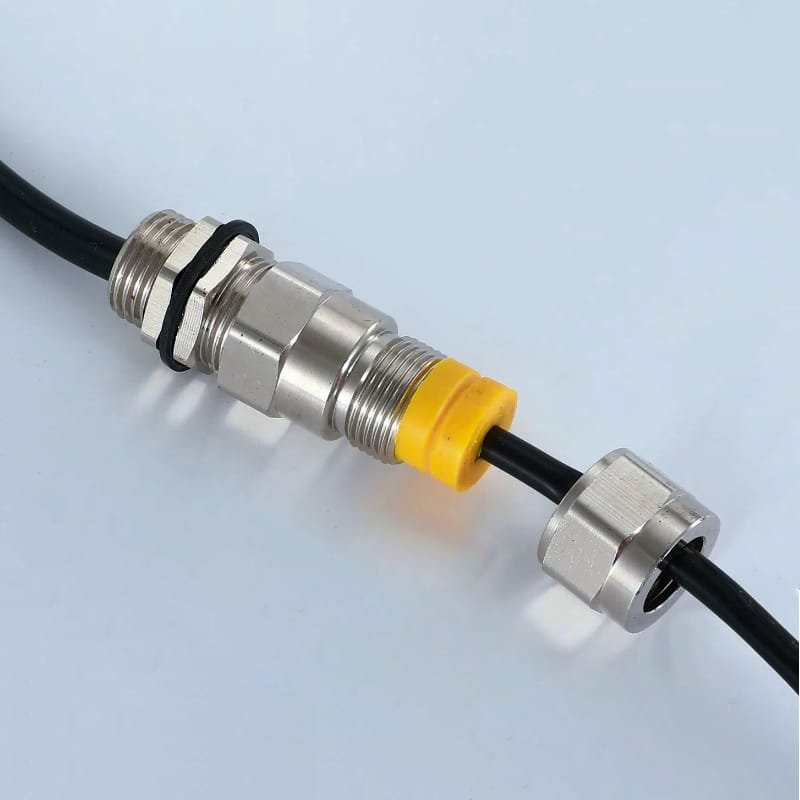
Enhanced Sealing Technology
Unlike surface-mounted applications, submersible environments demand multiple sealing barriers. Our marine-grade cable glands feature dual O-ring systems with EPDM or Viton seals that maintain integrity under continuous water pressure. The compression mechanism creates a 360-degree seal around both the cable jacket and individual conductors.
I remember working with David, a facilities manager at a water treatment plant in Manchester, who was frustrated with frequent pump failures. His maintenance team was replacing pumps every 18 months due to water ingress through inadequate cable glands. After switching to our IP68-rated submersible glands with dual sealing systems, they’ve achieved over 4 years of continuous operation without a single failure.
Pressure Resistance Requirements
Submersible applications face hydrostatic pressure that increases by approximately 1 bar (14.5 PSI) for every 10 meters of depth1. Standard cable glands rated for IP65 or IP67 will fail under this continuous pressure. Our submersible glands are tested to withstand pressures up to 10 bar, suitable for depths up to 100 meters.
Key Differences from Standard Glands:
- Sealing System: Dual O-rings vs. single seal
- Pressure Rating: 10+ bar vs. atmospheric pressure only
- Material Grade: Marine-grade metals and elastomers
- Testing Standards: IP68 continuous immersion vs. IP67 temporary immersion
How Do You Determine the Right IP Rating?
For submersible pumps and fountains, IP68 rating is mandatory, but the specific test conditions vary significantly between manufacturers.
Understanding IP68 Variations
The IP68 standard allows manufacturers to define their own test conditions2, leading to confusion in the market. When we specify IP68 for our submersible glands, we test under these conditions:
- Depth: 10 meters (1 bar pressure)
- Duration: 72 hours continuous immersion
- Temperature: -20°C to +80°C range
Application-Specific Requirements
Fountain Applications:
- Minimum IP68 with 1-meter depth rating
- Chemical resistance for chlorinated water
- UV-resistant materials for outdoor exposure
Deep Well Pumps:
- IP68 with pressure rating matching installation depth
- Temperature resistance up to 60°C
- Corrosion resistance for groundwater minerals
Sewage and Wastewater:
- IP68 with enhanced chemical resistance
- Stainless steel construction preferred
- Easy maintenance access for cleaning
Hassan, who owns a fountain installation company in Dubai, learned this lesson the hard way. His initial installations used standard IP67 glands that failed within months due to the harsh desert environment and continuous water exposure. After upgrading to our IP68-rated marine glands with UV-resistant housings, his maintenance calls dropped by 85%.
Which Materials Work Best Underwater?
Stainless steel 316L and high-grade nylon with glass fiber reinforcement offer the best combination of corrosion resistance and mechanical strength for submersible applications.
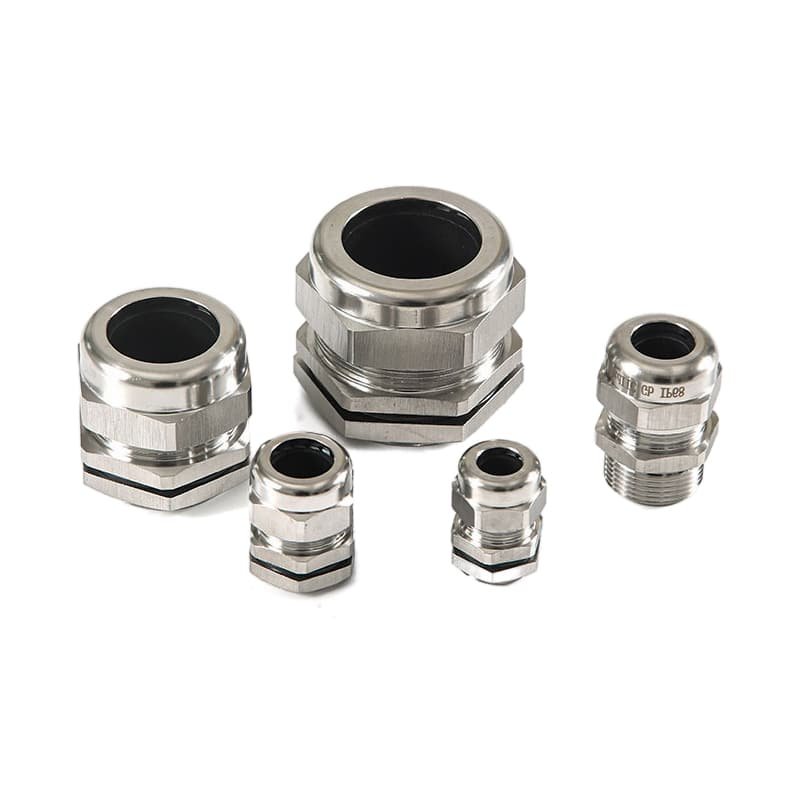
Stainless Steel Options
316L Stainless Steel remains the gold standard for marine environments:
- Superior corrosion resistance in saltwater and chemicals3
- Mechanical strength for high-pressure applications
- Temperature stability from -40°C to +120°C
- Long-term cost effectiveness despite higher initial investment
304 Stainless Steel offers a budget alternative for freshwater applications but shows limited corrosion resistance in chlorinated or saltwater environments.
Advanced Nylon Solutions
Our marine-grade nylon cable glands incorporate several enhancements:
- PA66 with 30% glass fiber: Increased mechanical strength
- UV stabilizers: Prevents degradation in outdoor fountains
- Flame retardant additives: Meets UL94-V2 standards4
- Chemical resistance: Compatible with pool chemicals and industrial fluids
Seal Material Selection
EPDM (Ethylene Propylene Diene Monomer):
- Excellent water resistance and flexibility
- Temperature range: -40°C to +120°C
- Cost-effective for most applications
Viton (FKM):
- Superior chemical resistance
- Higher temperature capability: -20°C to +200°C
- Preferred for industrial wastewater applications
What Size and Thread Specifications Do You Need?
Proper sizing requires matching the cable outer diameter, selecting appropriate thread specifications, and ensuring adequate strain relief for underwater installations.
Cable Diameter Matching
Accurate cable measurement is critical for submersible applications where re-work is expensive and difficult:
| Cable Type | Typical OD Range | Recommended Gland Size |
|---|---|---|
| Submersible Pump 3-core | 12-16mm | M20 or 3/4″ NPT |
| Fountain Control Cable | 8-12mm | M16 or 1/2″ NPT |
| Heavy Duty 4-core | 16-22mm | M25 or 1″ NPT |
Thread Selection Guidelines
Metric Threads (M16, M20, M25):
- Standard in European and Asian markets
- Fine pitch provides better sealing
- Compatible with most European pump manufacturers
NPT Threads (1/2″, 3/4″, 1″):
- Common in North American applications5
- Tapered design enhances sealing
- Requires thread sealant for optimal performance
Strain Relief Considerations
Submersible installations face unique mechanical stresses:
- Wave action in fountain applications
- Thermal cycling causing cable expansion/contraction
- Installation tension during lowering operations
Our submersible glands include extended strain relief boots that distribute stress over a longer cable length, preventing conductor fatigue and seal failure.
How Do You Ensure Long-Term Reliability?
Long-term reliability depends on proper installation techniques, regular inspection schedules, and selecting glands with proven track records in similar applications.
Installation Best Practices
Pre-Installation Preparation:
- Verify cable outer diameter with calipers
- Check thread compatibility and condition
- Inspect sealing surfaces for damage
- Apply appropriate thread sealant for NPT connections
Assembly Sequence:
- Install strain relief boot on cable
- Insert cable through gland body
- Position sealing elements correctly
- Tighten compression nut to specified torque
- Verify seal integrity before submersion
Maintenance and Inspection
Even the best submersible glands require periodic inspection:
Annual Inspection Points:
- Visual check for corrosion or damage
- Seal integrity verification
- Cable strain relief condition
- Thread connection tightness
Replacement Indicators:
- Visible seal deterioration
- Corrosion on metal components
- Cable jacket damage near gland
- Any signs of moisture ingress
Quality Certifications
When selecting submersible cable glands, verify these certifications:
- IP68 rating with specific test conditions
- CE marking for European compliance
- UL listing for North American installations
- Marine certification for saltwater applications
At Bepto, our submersible cable glands carry all major certifications and undergo rigorous testing in our facility. We maintain ISO9001 quality systems and provide detailed test certificates with each shipment.
Conclusion
Selecting the right cable gland for submersible pump and fountain applications requires careful consideration of IP ratings, material compatibility, sizing requirements, and installation conditions. The investment in high-quality submersible glands pays dividends through reduced maintenance costs, extended equipment life, and reliable operation. Remember that in underwater applications, there’s no such thing as “good enough” – the harsh environment will quickly expose any weaknesses in your cable sealing system.
FAQs About Submersible Cable Glands
Q: What’s the difference between IP67 and IP68 cable glands for underwater use?
A: IP67 glands are tested for temporary immersion (30 minutes at 1-meter depth), while IP68 glands are designed for continuous submersion under specified pressure and depth conditions. For submersible pumps, only IP68-rated glands should be used.
Q: How deep can submersible cable glands be installed?
A: Standard submersible glands are typically rated for 10-meter depth (1 bar pressure). For deeper installations, specify glands with higher pressure ratings – our marine-grade units can handle up to 100-meter depths with proper specification.
Q: Can I use regular cable glands with waterproof tape for fountain applications?
A: No, this approach will fail quickly. Waterproof tape degrades under UV exposure and continuous water contact. Proper submersible glands with engineered sealing systems are essential for reliable operation.
Q: What causes most submersible cable gland failures?
A: The most common failure modes are improper sizing (allowing water ingress), wrong material selection (corrosion), and inadequate pressure rating for the installation depth. Always verify specifications match your application requirements.
Q: How often should submersible cable glands be replaced?
A: With proper selection and installation, quality submersible glands can last 5-10 years. However, annual inspection is recommended, with replacement indicated by visible seal deterioration, corrosion, or any signs of moisture ingress.
-
“Fluid statics”,
https://en.wikipedia.org/wiki/Fluid_statics. Explains the physics of hydrostatic pressure increasing with depth. Evidence role: mechanism/general_support; Source type: research. Supports: Hydrostatic pressure increase. ↩ -
“IEC 60529:1989 Degrees of protection provided by enclosures (IP Code)”,
https://webstore.iec.ch/publication/2452. Specifies that IP68 testing conditions are subject to agreement between manufacturer and user. Evidence role: standard; Source type: standard. Supports: IP68 standard variations. ↩ -
“SAE 316L stainless steel”,
https://en.wikipedia.org/wiki/SAE_316L_stainless_steel. Details the material properties and corrosion resistance of marine-grade stainless steel. Evidence role: mechanism; Source type: research. Supports: 316L corrosion resistance. ↩ -
“UL 94”,
https://en.wikipedia.org/wiki/UL_94. Standard for safety of flammability of plastic materials for parts in devices and appliances. Evidence role: standard; Source type: standard. Supports: UL94-V2 flammability standards. ↩ -
“National pipe thread”,
https://en.wikipedia.org/wiki/National_pipe_thread. Describes the U.S. national technical standard for pipe threads. Evidence role: standard; Source type: standard. Supports: NPT thread usage in North America. ↩
