

Introduction
Ever wondered why some cable glands maintain perfect sealing even when cables move or vibrate, while others fail within months? The secret lies in a sophisticated engineering principle called “displacement seal”—a concept that separates premium cable glands from basic ones, yet remains misunderstood by many procurement professionals.
Displacement seal in cable glands refers to a sealing mechanism that maintains consistent compression and contact pressure on the cable sheath regardless of minor cable movement, thermal expansion, or installation tolerances. This is achieved through elastomeric sealing elements designed to deform and adapt while maintaining constant sealing force, ensuring reliable IP ratings1 throughout the product’s lifespan.
I’m Samuel, Sales Director at Bepto Connector, and in my 10+ years in this industry, I’ve witnessed countless sealing failures that could have been prevented with proper understanding of displacement seal technology. Just last quarter, a client from a wind farm project in Denmark contacted us after experiencing water ingress issues with their existing cable glands. The root cause? They didn’t understand how displacement seals work. Let me break down this critical concept that could save your project from costly failures. 💧
Table of Contents
- What Exactly Is a Displacement Seal in Cable Glands?
- How Does Displacement Seal Technology Differ from Traditional Sealing Methods?
- What Are the Key Components That Enable Displacement Sealing?
- Why Is Displacement Seal Critical for Maintaining IP Ratings?
- How Do You Select Cable Glands with Proper Displacement Seal Design?
- Conclusion
- FAQs About Displacement Seal in Cable Glands
What Exactly Is a Displacement Seal in Cable Glands?
Let’s start with the fundamentals, because understanding this concept is crucial for anyone specifying cable glands for critical applications.
A displacement seal is an engineered sealing system where elastomeric2 components compress and deform to fill gaps around the cable, creating a continuous barrier that adapts to cable diameter variations, movements, and environmental changes. Unlike rigid seals that rely on precise dimensional matching, displacement seals accommodate tolerances through controlled material deformation.

The Engineering Principle Behind It
Think of displacement sealing like a tire valve—when you press down, the rubber deforms to create a perfect seal regardless of minor irregularities. In cable glands, this principle operates through:
Controlled Compression: When you tighten the cable gland, the sealing element (typically an O-ring or sealing insert) compresses against the cable sheath. The material “displaces” into available spaces, creating multiple sealing lips and contact zones.
Elastic Memory: High-quality elastomers (like NBR, EPDM, or silicone) maintain their shape memory, continuously applying sealing pressure even as cables shift or temperatures fluctuate.
Multi-Point Contact: Unlike a single-line seal, displacement seals create multiple contact zones along the cable circumference, providing redundancy and superior protection.
Real-World Application
I recently worked with Thomas, an electrical contractor from Hamburg, Germany, who was installing cable glands on a coastal monitoring station. He initially selected basic compression glands to save costs. Within eight months, salt spray and cable vibration from wind caused seal degradation and moisture ingress. When we replaced them with our displacement seal cable glands featuring premium EPDM sealing inserts, the IP68 rating held perfectly even after two years of harsh marine exposure. The lesson? Displacement seal technology isn’t a luxury—it’s essential for demanding environments. 🌊
Key Characteristics of Effective Displacement Seals
- Cable Range Accommodation: Quality displacement seals handle ±10-15% cable diameter variation
- Pressure Distribution: Even compression across 360 degrees of cable circumference
- Temperature Resilience: Maintains sealing from -40°C to +100°C (material dependent)
- Dynamic Sealing: Adapts to cable movement without losing contact pressure
How Does Displacement Seal Technology Differ from Traditional Sealing Methods?
Understanding the differences helps you make informed purchasing decisions and avoid costly mistakes.
Traditional compression seals rely on mechanical force applied directly to the cable, while displacement seals use engineered elastomeric elements that deform to create adaptive, multi-zone sealing barriers. This fundamental difference results in superior performance, longer service life, and greater tolerance for installation variations.
Comparison Matrix
| Feature | Traditional Compression Seal | Displacement Seal Technology |
|---|---|---|
| Sealing Mechanism | Direct mechanical pressure | Elastic material deformation |
| Cable Diameter Tolerance | ±2-5% | ±10-15% |
| Installation Sensitivity | High (requires precise torque) | Moderate (more forgiving) |
| Vibration Resistance | Limited | Excellent |
| Long-term Reliability | Degrades with movement | Maintains integrity |
| IP Rating Consistency | Can degrade over time | Stable throughout lifespan |
| Cost | Lower initial cost | Higher value over lifecycle |
Why Traditional Methods Fall Short
Rigid Dependency: Traditional compression seals require exact cable diameter matching. A cable that’s 0.5mm smaller than specified can result in seal failure—a common issue I see with clients who don’t verify actual cable dimensions before ordering.
Torque Sensitivity: Over-tightening crushes the cable; under-tightening leaves gaps. Displacement seals are far more forgiving because the elastomer compensates for installation variations.
Movement Vulnerability: In applications with vibration (motors, wind turbines, railway systems), traditional seals can loosen or create micro-gaps. Displacement seals maintain contact pressure through elastic recovery.
The Bepto Advantage
At Bepto, our nylon and brass cable glands incorporate advanced displacement seal designs with precisely engineered sealing inserts. We use premium elastomers tested to 10,000+ compression cycles, ensuring your installations maintain IP66, IP67, or IP68 ratings throughout their service life. Our in-house CNC manufacturing allows us to control tolerances to ±0.05mm, critical for optimal displacement seal performance. 🔧
What Are the Key Components That Enable Displacement Sealing?
Let’s dissect a quality cable gland to understand what makes displacement sealing work effectively.
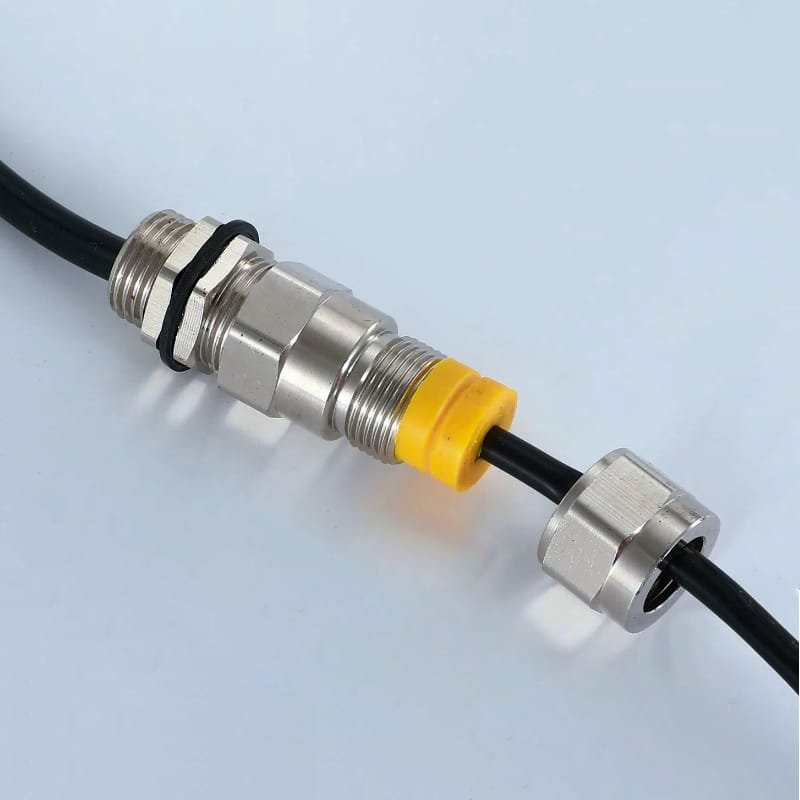
The essential components for displacement sealing include the sealing insert (elastomeric element), compression cone or wedge, gland body with precision bore, and locknut or compression mechanism. Each component must be engineered to work synergistically, with material selection and dimensional tolerances being critical factors.

Component Breakdown
1. Sealing Insert (The Heart of Displacement Seal)
This elastomeric component does the actual sealing work:
- Material Options: NBR (general purpose), EPDM (weather/ozone resistant), Silicone (extreme temperature), Viton (chemical resistant)
- Design Features: Multiple sealing lips, controlled compression zones, shore hardness3 typically 60-80A
- Quality Indicators: Uniform material density, no air bubbles, precise molding
2. Compression Cone/Wedge
Distributes tightening force evenly across the sealing insert:
- Function: Converts axial force (tightening) into radial compression (sealing pressure)
- Material: Typically nylon, brass, or stainless steel matching the gland body
- Critical Angle: Usually 15-30 degrees for optimal force distribution
3. Gland Body with Precision Bore
Provides the structural framework:
- Tolerance Requirements: Inner bore must be machined to ±0.05mm for consistent seal compression
- Thread Quality: Clean, precise threads ensure even compression during installation
- Material Strength: Must resist deformation under tightening torque
4. Locknut and Sealing Washer
Secures the assembly and provides secondary sealing:
- Locknut Function: Maintains compression force, prevents loosening from vibration
- Sealing Washer: Creates environmental seal between gland and enclosure
- Material Compatibility: Must match gland body to prevent galvanic corrosion4
Material Science Matters
I once consulted with Ahmed, a project manager for a petrochemical facility in Abu Dhabi. He was experiencing premature seal failures in high-temperature areas (80-90°C ambient). The issue? His supplier used standard NBR sealing inserts rated only to 70°C. We replaced them with our silicone-based displacement seals rated to 180°C, and the problem disappeared completely. Material selection isn’t just a technical detail—it’s the difference between success and failure. 🔥
Quality Verification Checklist
When evaluating cable glands for displacement seal quality:
- ✓ Request material certifications for sealing elements
- ✓ Verify shore hardness specifications (should be documented)
- ✓ Check for multi-lip or multi-zone seal design
- ✓ Confirm compression cone angle and material
- ✓ Inspect bore finish quality (should be smooth, no tool marks)
- ✓ Test sample units for consistent compression feel
Why Is Displacement Seal Critical for Maintaining IP Ratings?
IP ratings aren’t just marketing numbers—they’re performance guarantees that displacement seal technology makes possible.
Displacement seals are critical for IP ratings because they create redundant sealing barriers that adapt to real-world conditions including cable movement, thermal cycling, pressure differentials, and aging, which static seals cannot accommodate. Without proper displacement seal design, achieving and maintaining IP67 or IP68 ratings over extended periods is virtually impossible.
Understanding IP Rating Requirements
Let’s clarify what these ratings actually mean:
- IP66: Protected against powerful water jets (100L/min at 100kPa)
- IP67: Protected against immersion up to 1 meter for 30 minutes
- IP68: Protected against continuous immersion (depth/duration specified by manufacturer)
The Challenge: These tests are performed on new products under controlled conditions. Real-world installations face:
- Temperature swings causing material expansion/contraction
- UV exposure degrading elastomers (outdoor installations)
- Vibration creating micro-movements
- Chemical exposure affecting seal materials
- Installation variations in tightening torque
How Displacement Seals Maintain IP Ratings
Adaptive Sealing: As cables expand from heat or contract from cold, displacement seals maintain contact pressure through elastic recovery. Traditional rigid seals create gaps under these conditions.
Multiple Sealing Zones: Quality displacement seal designs create 2-3 independent sealing lips. If one zone is compromised, others maintain protection—built-in redundancy.
Pressure Compensation: In IP68 applications (submersion), water pressure actually helps displacement seals by increasing compression. Traditional seals can be forced open by external pressure.
Aging Resilience: Premium elastomers maintain 80%+ of their sealing properties after 10 years, while inferior materials harden and crack within 2-3 years.
Testing Standards and Verification
At Bepto, we test our cable glands to:
- IEC 60529: Standard IP rating test protocol
- Thermal Cycling: -40°C to +100°C for 500 cycles
- Vibration Testing: 10-55Hz for 1000 hours
- Aging Tests: 2000+ hours accelerated aging
Our displacement seal cable glands consistently maintain their rated IP protection throughout these rigorous tests, which is why we confidently offer comprehensive warranties. 📊
Cost of IP Rating Failure
Consider the real costs when seals fail:
- Equipment damage from moisture ingress: $5,000-$50,000+
- Downtime and lost productivity: Variable but often exceeds repair costs
- Safety incidents: Potentially catastrophic in hazardous locations
- Warranty voidance: Many equipment manufacturers require proper IP-rated cable entries
- Regulatory penalties: Especially in food, pharmaceutical, or hazardous industries
How Do You Select Cable Glands with Proper Displacement Seal Design?
Making the right choice requires understanding both your application requirements and product specifications.
Select cable glands with proper displacement seal design by evaluating the sealing insert material compatibility, cable diameter range accommodation, environmental conditions, certification requirements, and manufacturer quality standards. A systematic selection process ensures long-term reliability and cost-effectiveness.

Step-by-Step Selection Process
Step 1: Define Your Environmental Conditions
Document these critical factors:
- Temperature Range: Ambient and cable operating temperatures
- Chemical Exposure: Oils, solvents, cleaning agents, fuels
- Moisture/Submersion: Splash, spray, temporary immersion, or continuous submersion
- UV Exposure: Indoor, outdoor shaded, or direct sunlight
- Vibration Level: Static, moderate, or high-vibration environment
Step 2: Determine Cable Specifications
Measure and document:
- Outer Diameter: Measure actual cable, don’t rely solely on datasheet
- Cable Type: PVC, rubber, PE, PUR, or armored
- Diameter Variation: Account for manufacturing tolerances
- Cable Movement: Static installation or dynamic flexing
Step 3: Match Sealing Material to Environment
| Environment | Recommended Seal Material | Bepto Product Line |
|---|---|---|
| General indoor/outdoor | NBR (Nitrile) | Standard nylon cable glands |
| UV exposure, weathering | EPDM | UV-resistant nylon glands |
| High temperature (>80°C) | Silicone | High-temp brass/SS glands |
| Chemical/oil exposure | Viton (FKM) | Chemical-resistant brass glands |
| Food/pharmaceutical | FDA-compliant silicone | Stainless steel sanitary glands |
Step 4: Verify Certification Requirements
Ensure the cable gland meets:
- IP Rating: Match or exceed your enclosure rating
- ATEX/IECEx5: Required for hazardous locations (Zone 1, 2, 21, 22)
- UL/CSA: North American installations
- Marine Certifications: DNV, ABS, Lloyd’s Register for maritime applications
- Industry-Specific: 3-A Sanitary, EHEDG for food processing
Quality Indicators to Look For
Manufacturer Transparency: Reputable suppliers like Bepto provide:
- Detailed material specifications for sealing elements
- Test reports and certifications
- Installation torque specifications
- Cable diameter range charts
- Cross-sectional drawings showing seal design
Physical Inspection: When evaluating samples:
- Sealing insert should feel uniform, no hard spots or voids
- Compression should be smooth and consistent when tightening
- No visible flash or molding defects on elastomeric parts
- Threads should be clean and precise
- Assembly should feel solid, not loose or rattling
Common Selection Mistakes to Avoid
❌ Choosing based on price alone: A $2 cable gland that fails costs far more than a $5 quality gland that lasts
❌ Ignoring actual cable diameter: Always measure your specific cable, don’t assume nominal sizes
❌ Overlooking temperature ratings: Seal material must handle both ambient and cable operating temperatures
❌ Neglecting chemical compatibility: One incompatible chemical can destroy seals in months
❌ Assuming all IP68 glands are equal: Testing standards and quality vary dramatically between manufacturers
The Bepto Consultation Advantage
We don’t just sell cable glands—we solve sealing challenges. When you contact Bepto:
- Our technical team reviews your specific application requirements
- We recommend optimal products from our comprehensive range
- We provide samples for field testing when needed
- We supply detailed technical documentation and installation guidance
- We offer post-installation support to ensure success
contact me directly for application-specific recommendations. We’ve solved sealing challenges for projects ranging from offshore wind farms to desert solar installations—let us help you get it right the first time. 🎯
Conclusion
Displacement seal technology represents the difference between cable glands that merely connect cables and those that provide reliable, long-term protection in demanding environments. By understanding how displacement seals work—through adaptive elastomeric compression, multi-zone sealing barriers, and engineered material selection—you can make informed decisions that prevent costly failures and ensure consistent IP rating performance throughout your installation’s lifespan.
Whether you’re specifying cable glands for a new project or troubleshooting existing seal failures, remember that quality displacement seal design is non-negotiable for critical applications. At Bepto Connector, we combine advanced displacement seal engineering with rigorous quality control and in-house manufacturing to deliver cable glands that perform reliably year after year. Don’t compromise on sealing integrity—your equipment and reputation depend on it.
FAQs About Displacement Seal in Cable Glands
Q: What is the difference between displacement seal and compression seal in cable glands?
A: Displacement seals use elastomeric elements that deform to fill gaps and adapt to cable variations, while compression seals rely on direct mechanical pressure on the cable. Displacement seals offer superior tolerance accommodation (±10-15% vs ±2-5%), better vibration resistance, and more consistent long-term IP rating performance.
Q: How do I know if a cable gland has proper displacement seal design?
A: Look for multi-lip sealing inserts made from specified elastomers (NBR, EPDM, silicone), documented shore hardness ratings, precision-machined gland bodies, and manufacturer test reports showing IP rating verification. Quality manufacturers like Bepto provide cross-sectional drawings clearly showing the displacement seal mechanism and material specifications.
Q: Can displacement seal cable glands handle cable movement and vibration?
A: Yes, displacement seals excel in dynamic applications because the elastomeric material maintains contact pressure through elastic recovery even as cables move. This makes them ideal for motor connections, wind turbines, railway systems, and other vibration-prone installations where traditional rigid seals would fail.
Q: What sealing material should I choose for outdoor UV exposure?
A: EPDM (ethylene propylene diene monomer) offers the best UV and ozone resistance for outdoor applications. It maintains sealing properties for 5-10+ years under direct sunlight exposure, while standard NBR may degrade within 2-3 years. For extreme UV environments, consider metal cable glands with EPDM sealing inserts.
Q: How tight should I tighten cable glands with displacement seals?
A: Follow manufacturer torque specifications, typically 5-8 Nm for nylon glands and 10-15 Nm for brass/stainless steel. Displacement seals are more forgiving than traditional seals, but proper torque ensures optimal compression and sealing performance. Over-tightening can damage the cable or sealing insert, while under-tightening may not achieve full IP rating protection.
-
View the international standard defining levels of sealing effectiveness against dust and water. ↩
-
Learn about polymer materials with viscoelasticity, crucial for maintaining seal integrity under stress. ↩
-
Understand how rubber hardness is measured to ensure the seal is neither too soft nor too rigid. ↩
-
Read about the electrochemical process that damages metals when dissimilar types are in contact with moisture. ↩
-
Explore the safety standards required for equipment used in explosive atmospheres. ↩
