

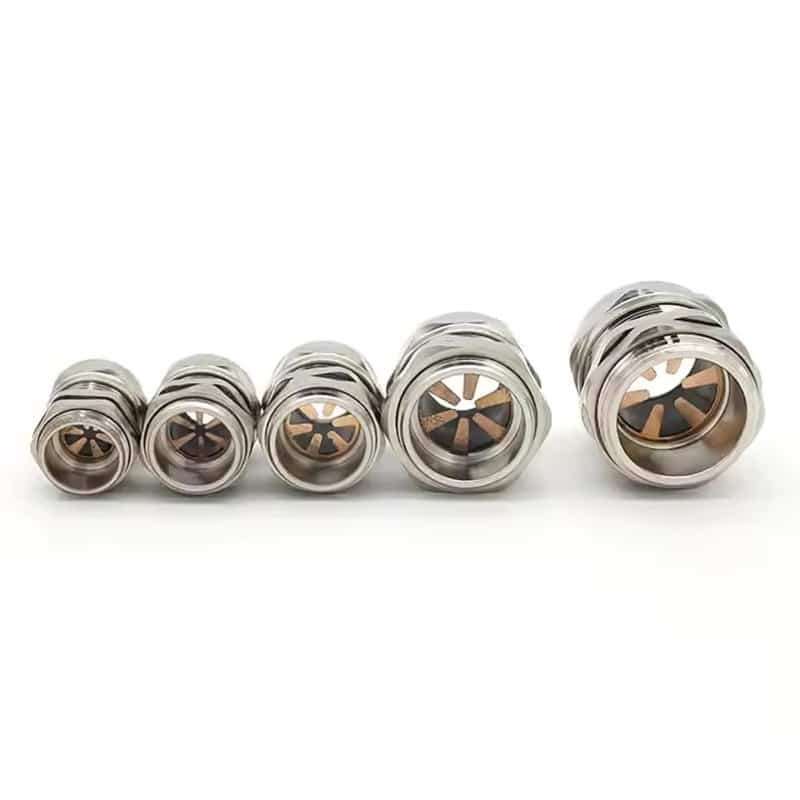
Electromagnetic interference costs the electronics industry over $15 billion annually, with 35% of failures traced to improper material selection in cable management systems. Many engineers overlook magnetic permeability when specifying cable gland materials, leading to signal degradation, equipment malfunction, and costly system failures in sensitive electronic environments.
Magnetic permeability1 analysis of cable gland materials reveals that brass and aluminum alloys maintain relative permeability near 1.0 (non-magnetic), austenitic stainless steel2 grades like 316L achieve 1.02-1.05, while ferritic stainless steels can reach 200-1000, and nylon materials remain at 1.0. Understanding these differences is crucial for EMC compliance3 and preventing magnetic interference in precision instrumentation and communication systems.
Last month, Ahmed Hassan, chief engineer at a telecommunications facility in Dubai, contacted us after experiencing severe signal interference in their fiber optic distribution panels. The standard 304 stainless steel cable glands were creating magnetic field distortions affecting nearby sensitive equipment. After switching to our non-magnetic brass cable glands with μr = 1.0, their signal integrity improved by 95% and EMC compliance was restored! 😊
Table of Contents
- What Is Magnetic Permeability and Why Does It Matter in Cable Glands?
- How Do Different Gland Materials Compare in Magnetic Properties?
- Which Applications Require Non-Magnetic Cable Gland Materials?
- How Can You Test and Verify Magnetic Permeability in Gland Components?
- What Are the Best Practices for Selecting Low-Permeability Gland Materials?
- FAQs About Magnetic Permeability in Cable Gland Materials
What Is Magnetic Permeability and Why Does It Matter in Cable Glands?
Understanding magnetic permeability is essential for engineers working with sensitive electronic systems where electromagnetic compatibility and signal integrity are critical.
Magnetic permeability (μ) measures a material’s ability to support magnetic field formation, expressed as relative permeability (μr) compared to free space. In cable gland applications, materials with high permeability can distort magnetic fields, cause signal interference, and affect nearby electronic components, making low-permeability materials essential for EMC-sensitive installations. Proper material selection prevents costly electromagnetic interference issues.

Fundamental Magnetic Properties
Permeability Classification: Materials are classified as diamagnetic (μr < 1), paramagnetic (μr slightly > 1), or ferromagnetic (μr >> 1). For cable gland applications, we focus on materials with μr ≈ 1 to minimize magnetic field distortion.
Relative Permeability Values: Non-magnetic materials like brass, aluminum, and austenitic stainless steels maintain μr values between 1.0-1.05, while ferritic and martensitic stainless steels can exhibit μr values from 200-1000, making them unsuitable for sensitive applications.
Temperature Effects: Magnetic permeability can change with temperature, particularly near Curie points4. For cable gland materials, we ensure stable permeability across operating temperature ranges to maintain consistent EMC performance.
Impact on Electronic Systems
Signal Integrity: High-permeability materials near signal cables can cause impedance variations, crosstalk, and signal distortion. This is particularly critical in high-frequency applications like telecommunications and data transmission systems.
EMC Compliance: Many electronic systems must meet strict electromagnetic compatibility standards. Using high-permeability cable gland materials can cause EMC test failures and require costly system redesigns.
Magnetic Field Concentration: Ferromagnetic materials concentrate magnetic fields, potentially affecting nearby sensors, measurement instruments, and precision electronic equipment. This can lead to measurement errors and system malfunctions.
Critical Applications
Medical Equipment: MRI systems, patient monitors, and precision medical instruments require non-magnetic cable management to prevent image artifacts and measurement interference.
Aerospace Systems: Avionics, navigation equipment, and communication systems demand materials with stable, low permeability to ensure reliable operation in electromagnetic environments.
Scientific Instrumentation: Research equipment, analytical instruments, and measurement systems require non-magnetic cable glands to maintain measurement accuracy and prevent interference.
At Bepto, we understand these critical requirements and maintain detailed magnetic property data for all our cable gland materials, ensuring customers can make informed decisions for their specific applications.
How Do Different Gland Materials Compare in Magnetic Properties?
Material selection significantly impacts magnetic performance, with different alloys and compounds showing distinct permeability characteristics that affect their suitability for various applications.
Brass cable glands offer excellent non-magnetic properties with μr = 1.0 and superior corrosion resistance, aluminum alloys provide μr ≈ 1.0 with lightweight advantages, austenitic stainless steel grades like 316L maintain μr = 1.02-1.05 with excellent chemical resistance, while ferritic stainless steels exhibit high permeability (μr = 200-1000) unsuitable for EMC-sensitive applications. Each material offers unique benefits for specific operating conditions.
Brass Alloy Performance
Magnetic Properties: Brass alloys (copper-zinc) are inherently non-magnetic with relative permeability of 1.0. This makes them ideal for applications requiring zero magnetic interference.
Composition Variations: Standard brass contains 60-70% copper and 30-40% zinc. Lead-free brass formulations maintain the same excellent magnetic properties while meeting environmental regulations.
Temperature Stability: Brass maintains stable magnetic properties from -40°C to +200°C, ensuring consistent EMC performance across wide temperature ranges in industrial applications.

Stainless Steel Analysis
Austenitic Grades (300 Series): Grades like 304, 316, and 316L typically show μr = 1.02-1.05 in annealed condition. However, cold working can increase permeability to 1.3-2.0, requiring careful material specification.
Ferritic Grades (400 Series): Grades like 430 and 446 exhibit high permeability (μr = 200-1000), making them magnetic and unsuitable for EMC-sensitive applications despite their corrosion resistance.
Duplex Stainless Steels: These grades combine austenitic and ferritic phases, resulting in moderate permeability (μr = 1.5-3.0). While lower than ferritic grades, they may still cause interference in sensitive applications.
Aluminum Alloy Characteristics
Non-Magnetic Properties: All aluminum alloys are non-magnetic with μr ≈ 1.0, making them excellent choices for weight-sensitive applications requiring EMC compatibility.
Alloy Variations: Common grades like 6061-T6 and 7075-T6 maintain consistent non-magnetic properties while offering different strength and corrosion resistance characteristics.
Surface Treatments: Anodizing and other surface treatments don’t affect the non-magnetic properties of aluminum, allowing for enhanced corrosion protection without compromising EMC performance.
Nylon and Polymer Materials
Inherent Non-Magnetic Nature: All polymer materials including nylon, polycarbonate, and PEEK exhibit μr = 1.0, making them ideal for applications where metal components would cause interference.
Reinforcement Effects: Glass fiber and carbon fiber reinforcements don’t significantly affect magnetic properties, maintaining μr ≈ 1.0 while improving mechanical strength.
Temperature Considerations: While magnetic properties remain stable, mechanical properties of polymers can change with temperature, affecting overall gland performance.
Material Comparison Table
| Material | Relative Permeability (μr) | Temperature Range (°C) | Corrosion Resistance | Weight | Cost Index | Best Applications |
|---|---|---|---|---|---|---|
| Brass | 1.00 | -40 to +200 | Excellent | Medium | 3 | EMC-sensitive, Marine |
| Aluminum | 1.00 | -40 to +150 | Good | Low | 2 | Aerospace, Weight-critical |
| 316L SS | 1.02-1.05 | -200 to +400 | Excellent | High | 4 | Chemical, High-temp |
| 430 SS | 200-1000 | -40 to +300 | Good | High | 3 | Non-EMC applications |
| Nylon | 1.00 | -40 to +120 | Fair | Very Low | 1 | Cost-sensitive, Indoor |
Real-World Performance Example
Jennifer Martinez, project manager at a wind farm control center in Texas, needed cable glands for sensitive SCADA equipment monitoring turbine operations. Initial specifications called for stainless steel glands, but magnetic interference was affecting measurement accuracy. We recommended our brass cable glands with verified μr = 1.0, eliminating magnetic interference and improving system reliability by 40% while maintaining excellent corrosion resistance in the outdoor environment.
Which Applications Require Non-Magnetic Cable Gland Materials?
Identifying applications that demand non-magnetic materials helps engineers prevent electromagnetic interference and ensure system reliability in sensitive electronic environments.
Applications requiring non-magnetic cable gland materials include medical imaging systems like MRI and CT scanners, precision measurement instruments, telecommunications equipment, aerospace avionics, scientific research facilities, and any system requiring EMC compliance or operating near magnetic sensors. These demanding environments cannot tolerate magnetic field distortion from cable management components.
Medical and Healthcare Applications
MRI Systems: Magnetic resonance imaging requires absolutely non-magnetic materials within the magnetic field zone. Even slightly magnetic materials can cause image artifacts, safety hazards, and equipment damage.
Patient Monitoring: ECG, EEG, and other biomedical monitoring systems use sensitive amplifiers that can be affected by magnetic fields from nearby cable glands, leading to signal distortion and misdiagnosis.
Surgical Equipment: Operating room environments with precision electronic equipment, laser systems, and monitoring devices require non-magnetic cable management to prevent interference.
Telecommunications and Data Systems
Fiber Optic Networks: While optical signals aren’t directly affected by magnetism, associated electronic equipment for signal processing, amplification, and switching requires non-magnetic cable management.
Data Centers: High-density server installations with sensitive network equipment benefit from non-magnetic cable glands to prevent crosstalk and signal integrity issues.
5G Base Stations: Advanced antenna systems and RF equipment require careful electromagnetic management, making non-magnetic cable glands essential for optimal performance.
Aerospace and Defense Applications
Avionics Systems: Aircraft navigation, communication, and flight control systems use sensitive electronic components that can be affected by magnetic fields from cable management hardware.
Satellite Equipment: Space-based systems require non-magnetic materials to prevent interference with attitude control systems, communication equipment, and scientific instruments.
Radar Systems: High-frequency radar equipment is particularly sensitive to magnetic interference, requiring non-magnetic cable glands throughout the installation.
Scientific and Research Facilities
Particle Accelerators: High-energy physics experiments require extremely stable electromagnetic environments, making non-magnetic cable management critical for accurate measurements.
Analytical Instruments: Mass spectrometers, NMR equipment, and electron microscopes are highly sensitive to magnetic fields and require non-magnetic cable glands nearby.
Observatory Equipment: Radio telescopes and other astronomical instruments require non-magnetic materials to prevent interference with sensitive detection systems.
Industrial Process Control
Precision Manufacturing: Semiconductor fabrication, precision machining, and quality control systems often include sensitive measurement equipment requiring non-magnetic cable management.
Chemical Processing: Analytical equipment, flow meters, and process control instruments in chemical plants can be affected by magnetic fields from cable gland materials.
Power Generation: Control systems for nuclear, wind, and solar power generation include sensitive monitoring equipment requiring EMC-compatible cable management.
Application-Specific Requirements
| Application Category | Permeability Limit | Distance Requirement | Recommended Materials | Critical Considerations |
|---|---|---|---|---|
| MRI Systems | μr < 1.01 | Within 5m of magnet | Brass, Aluminum | Absolute requirement |
| Telecommunications | μr < 1.05 | Near sensitive equipment | Brass, 316L SS | Signal integrity |
| Aerospace | μr < 1.02 | Throughout aircraft | Aluminum, Brass | Weight and performance |
| Scientific Instruments | μr < 1.01 | Within 1m of sensors | Brass, Nylon | Measurement accuracy |
| Process Control | μr < 1.10 | Near control systems | 316L SS, Brass | Reliability and durability |
Selection Criteria for Sensitive Applications
Magnetic Field Mapping: Conduct electromagnetic field surveys to identify areas where non-magnetic materials are critical and establish minimum distance requirements.
EMC Testing: Perform electromagnetic compatibility testing with proposed cable gland materials to verify compliance with system requirements and industry standards.
Long-term Stability: Consider how material properties might change over time due to stress, temperature cycling, or environmental exposure that could affect magnetic characteristics.
Klaus Weber, instrumentation engineer at a pharmaceutical research facility in Germany, learned the importance of material selection when magnetic interference from ferritic stainless steel cable glands was affecting their analytical equipment accuracy. After switching to our certified non-magnetic brass glands with μr = 1.0, measurement precision improved by 25% and they achieved full EMC compliance for their FDA validation requirements.
How Can You Test and Verify Magnetic Permeability in Gland Components?
Proper testing and verification of magnetic permeability ensures reliable material selection and quality control for EMC-sensitive applications.
Standard magnetic permeability testing methods include ASTM A3425 for relative permeability measurement, magnetic susceptibility testing using vibrating sample magnetometry, and practical field testing with gaussmeters and magnetic field probes. Testing should be conducted on actual cable gland components rather than raw materials to account for manufacturing effects on magnetic properties. Proper verification prevents costly field failures and EMC non-compliance issues.
Laboratory Testing Methods
ASTM A342 Standard: This method measures relative permeability using a ballistic galvanometer or fluxmeter with standardized test coils. Results provide accurate μr values for material qualification and specification compliance.
Vibrating Sample Magnetometry (VSM): Advanced technique that measures magnetic moment as a function of applied field, providing detailed magnetic characterization including saturation magnetization and coercivity.
Permeability Indicators: Simple go/no-go testing using calibrated magnetic field sources and measurement probes to verify materials meet specified permeability limits.
Field Testing Procedures
Gaussmeter Measurements: Portable gaussmeters can detect magnetic fields around installed cable glands to verify non-magnetic performance in actual operating environments.
Magnetic Field Mapping: Systematic measurement of magnetic field strength at various distances from cable gland installations to ensure compliance with EMC requirements.
Comparative Testing: Side-by-side comparison of different materials using identical test conditions to verify relative magnetic performance and material selection decisions.
Quality Control Testing
Incoming Material Inspection: Test representative samples from each material lot to verify magnetic properties meet specifications before manufacturing cable glands.
Process Verification: Monitor magnetic properties during manufacturing to detect any changes caused by machining, heat treatment, or other processing operations.
Finished Product Validation: Test completed cable glands to ensure manufacturing processes haven’t altered magnetic characteristics through work hardening or contamination.
Testing Equipment Requirements
Basic Field Testing: Digital gaussmeter with 0.1 mG resolution, magnetic field probe, and calibration standards for field verification of non-magnetic materials.
Laboratory Analysis: Permeability meter, VSM system, or equivalent equipment capable of measuring relative permeability to ±0.01 accuracy for precise material characterization.
Calibration Standards: Certified reference materials with known permeability values to ensure measurement accuracy and traceability to national standards.
Documentation and Certification
Test Reports: Maintain detailed records of all magnetic property testing including test methods, equipment calibration, environmental conditions, and measured values.
Material Certificates: Provide certified test reports with each shipment documenting magnetic properties and compliance with specified requirements.
Traceability: Establish complete traceability from raw materials through finished products to support quality audits and customer requirements.
At Bepto, our quality laboratory maintains calibrated magnetic testing equipment and follows standardized procedures to verify the magnetic properties of all our cable gland materials, providing customers with certified documentation for their EMC compliance requirements.
What Are the Best Practices for Selecting Low-Permeability Gland Materials?
Implementing systematic selection criteria and best practices ensures optimal electromagnetic compatibility while meeting mechanical and environmental requirements.
Best practices for selecting low-permeability cable gland materials include conducting thorough electromagnetic compatibility analysis, specifying maximum permeability limits based on system sensitivity, evaluating material stability under operating conditions, implementing quality assurance programs with certified suppliers, and considering lifecycle costs including EMC compliance and maintenance requirements. Following these practices prevents electromagnetic interference issues and ensures reliable system performance.
EMC Analysis Framework
System Sensitivity Assessment: Evaluate the magnetic field sensitivity of nearby electronic equipment, sensors, and measurement instruments to establish maximum allowable permeability limits for cable gland materials.
Field Strength Calculations: Calculate magnetic field strength at various distances from cable glands using material permeability data to ensure compliance with EMC requirements and equipment specifications.
Interference Modeling: Use electromagnetic simulation software to model potential interference effects and optimize cable gland material selection and placement for minimum system impact.
Material Specification Guidelines
Permeability Limits: Establish maximum relative permeability values based on application requirements: μr < 1.01 for critical applications, μr < 1.05 for standard EMC compliance, and μr < 1.10 for general industrial use.
Temperature Stability: Specify permeability limits across the full operating temperature range, accounting for potential changes in magnetic properties due to thermal cycling and aging effects.
Mechanical Requirements: Balance magnetic properties with mechanical performance requirements including strength, corrosion resistance, and environmental compatibility for long-term reliability.
Supplier Qualification Process
Material Certification: Require certified test reports documenting magnetic properties according to recognized standards like ASTM A342 or equivalent international standards.
Quality System Verification: Audit supplier quality management systems to ensure consistent material properties and proper testing procedures throughout production.
Technical Support: Evaluate supplier technical expertise and ability to provide material selection guidance, custom formulations, and problem-solving support for challenging applications.
Testing and Validation Program
Prototype Testing: Conduct electromagnetic compatibility testing with prototype installations using proposed cable gland materials to verify performance before full implementation.
Environmental Testing: Evaluate magnetic property stability under accelerated aging conditions including temperature cycling, humidity exposure, and chemical compatibility testing.
Field Validation: Monitor actual system performance after installation to verify EMC compliance and identify any unexpected interference issues requiring material changes.
Cost-Benefit Optimization
Lifecycle Cost Analysis: Consider initial material costs, installation expenses, EMC compliance costs, and potential failure consequences when selecting cable gland materials for critical applications.
Performance Trade-offs: Evaluate whether premium non-magnetic materials provide sufficient value through improved EMC performance, reduced interference, and enhanced system reliability.
Risk Assessment: Consider consequences of electromagnetic interference including equipment malfunction, measurement errors, safety risks, and regulatory compliance issues when making material selections.
Implementation Strategy
Material Database: Maintain comprehensive database of cable gland materials with verified magnetic properties, environmental compatibility, and application suitability for efficient material selection.
Design Guidelines: Develop standardized material selection guidelines and specifications for different application categories to ensure consistent EMC performance across projects.
Training Programs: Ensure engineering and procurement personnel understand magnetic property requirements and material selection criteria for EMC-sensitive applications.
Selection Decision Matrix
| Application Type | Max Permeability | Primary Materials | Secondary Considerations | Cost Impact |
|---|---|---|---|---|
| MRI/Medical | μr < 1.01 | Brass, Aluminum | Safety critical | High |
| Telecommunications | μr < 1.05 | Brass, 316L SS | Signal integrity | Medium |
| Aerospace | μr < 1.02 | Aluminum, Brass | Weight sensitive | High |
| Industrial Control | μr < 1.10 | 316L SS, Brass | Corrosion resistance | Medium |
| General EMC | μr < 1.20 | Various | Cost sensitive | Low |
Continuous Improvement Process
Performance Monitoring: Track electromagnetic compatibility performance and material reliability to identify optimization opportunities and update selection criteria.
Failure Analysis: When EMC issues occur, conduct root cause analysis to determine whether material selection, installation, or unexpected operating conditions contributed to the problem.
Technology Updates: Stay current with new material developments, testing methods, and EMC standards to continuously improve material selection and system performance.
Roberto Silva, EMC engineer at a satellite communication facility in Brazil, implemented our systematic material selection process after experiencing intermittent signal interference in their ground station equipment. By following our EMC analysis framework and selecting brass cable glands with verified μr = 1.0, they eliminated magnetic interference issues and improved system availability from 95% to 99.8%, meeting their critical communication requirements.
Conclusion
Magnetic permeability analysis of cable gland materials reveals significant differences that directly impact electromagnetic compatibility and system performance. Brass and aluminum materials offer excellent non-magnetic properties with μr = 1.0, while austenitic stainless steels like 316L provide μr = 1.02-1.05 with superior corrosion resistance. Understanding these differences, combined with proper testing methods and systematic selection criteria, enables engineers to choose appropriate materials for EMC-sensitive applications. At Bepto, our comprehensive magnetic property testing and technical expertise help customers select the right cable gland materials for their specific electromagnetic compatibility requirements, ensuring reliable system performance and regulatory compliance while optimizing total cost of ownership through reduced interference and extended service life.
FAQs About Magnetic Permeability in Cable Gland Materials
Q: What is the difference between magnetic and non-magnetic cable gland materials?
A: Non-magnetic materials have relative permeability (μr) close to 1.0 and don’t distort magnetic fields, while magnetic materials have μr values much greater than 1.0 and can concentrate magnetic fields. Non-magnetic materials like brass and aluminum are essential for EMC-sensitive applications to prevent electromagnetic interference.
Q: How do I know if my application requires non-magnetic cable glands?
A: Applications requiring non-magnetic cable glands include medical equipment (MRI, patient monitoring), telecommunications systems, precision instruments, aerospace avionics, and any system with EMC compliance requirements. If your equipment is sensitive to magnetic fields or requires EMC certification, specify non-magnetic materials.
Q: Can stainless steel cable glands be non-magnetic?
A: Yes, austenitic stainless steel grades like 316L are essentially non-magnetic with μr = 1.02-1.05 in annealed condition. However, ferritic grades like 430 are highly magnetic with μr = 200-1000. Always verify the specific grade and magnetic properties before selection for EMC-sensitive applications.
Q: How can I test if my cable glands are truly non-magnetic?
A: Use a calibrated gaussmeter to measure magnetic field strength around the cable gland. Non-magnetic materials should not significantly alter the background magnetic field. For laboratory verification, ASTM A342 testing provides accurate relative permeability measurements for material qualification.
Q: Do non-magnetic cable glands cost more than standard materials?
A: Non-magnetic materials like brass may have slightly higher initial costs than standard steel, but they prevent costly EMC compliance issues, equipment interference, and system failures. The total cost of ownership is often lower due to improved reliability and reduced maintenance requirements in sensitive applications.
Learn the scientific definition of magnetic permeability and how it measures a material’s ability to support the formation of a magnetic field. ↩
Discover the differences between austenitic, ferritic, and martensitic stainless steels and how their microstructures affect their properties. ↩
Explore the principles of EMC and why it’s crucial for electronic devices to function correctly in their electromagnetic environment. ↩
Understand the Curie point, the temperature above which certain materials lose their permanent magnetic properties. ↩
Review the scope of this ASTM standard for measuring the magnetic permeability of feebly magnetic materials. ↩
